
The most effective approach to bar inventory management is scheduling regular physical counts and reconciling them against your POS's theoretical usage, then automating the repetitive parts of that process, invoice capture, POS syncing, and reporting. This single habit exposes overpours, theft, and vendor billing errors before they eat your margin. Start small: pick one high-value spirit and count it weekly against sales data before rolling out a full program.
TL;DR:
- Focusing on high-value spirits for weekly counts can quickly identify the largest dollar losses due to overpours, theft, or invoice errors.
- Using scale-assisted counting provides the most precise inventory data, but it requires hardware calibration, making app-based methods a practical balance between speed and accuracy.
- Automating POS integration and invoice OCR significantly reduces manual data entry errors, but variance investigations still require human judgment to identify causes.
- Tracking dollar variance and actual versus theoretical usage reveals true leak points, enabling targeted adjustments that improve profitability.
- External consultants are most beneficial when persistent variances indicate systemic problems that internal processes cannot resolve efficiently.
Table of Contents
- Why Bar Inventory Management Matters to Your Bottom Line
- Core Components of an Effective Bar Inventory System
- Manual Counts vs. Automation: What to Delegate to Software
- How to Evaluate Bar Inventory Management Software
- Step-by-Step: Running Your First Accurate Bar Inventory Count
- Metrics That Actually Tell You Something
- A Consultant's View: Where DIY Ends and Outside Help Begins
- Get Hands-On Support With Your Bar Inventory Program
- Sources
Why Bar Inventory Management Matters to Your Bottom Line
Pour cost is the number that decides whether your bar program makes money or just looks busy. Every ounce that leaves the well without ringing up as a sale is pure loss, and most operators only discover how much they're bleeding once they start comparing what their POS says they should have used against what physically left the shelf.
That comparison, actual usage versus theoretical usage, is the whole game. Your POS records sales, not spills, overpours, or the free round a bartender comps a regular. Wisk's operator research makes this distinction clear: treating POS data as if it equals poured volume is the most common and most expensive assumption in bar management. It equals what got rung up, not what got poured.

Pro Tip: Run your first reconciliation on your three highest-cost liquors only. You'll isolate your biggest dollar risks in a single count instead of drowning in 200 SKUs on day one.
Reconciling counts against POS data doesn't just catch theft. It surfaces receiving errors, mispriced invoices, and recipe drift, cases where a bartender's "generous" pour has quietly become the house standard. Operator guides on beverage cost control consistently point to count frequency and disciplined variance analysis as the two levers that separate profitable bar programs from ones that just feel busy. Get the counting rhythm right, and the rest of your cost control strategy has something solid to stand on.
Core Components of an Effective Bar Inventory System
Before you can manage liquor inventory well, you need to decide how you'll count it, and what data you'll track alongside those counts. Three counting methods dominate the industry, each with real tradeoffs.
Visual counts rely on staff eyeballing bottle fill levels and estimating fractions. They're fast and require no equipment, but they're also the least accurate, since a "quarter bottle" estimate varies wildly from person to person. Phone-app scanning speeds up data entry by letting staff scan barcodes and log quantities directly into a mobile inventory system, cutting transcription errors compared to clipboard counts. Bluetooth scale modes weigh bottles and calculate remaining volume automatically, which is the most precise method but requires buying and calibrating scale hardware for every station.
Whichever method you choose, your system needs a few non-negotiable data elements to function:
- Unit of measure conversions so a 1.75 liter bottle, a case of 12, and a 750 milliliter pour all reconcile against the same recipe.
- Par levels for every SKU, set by sales velocity and lead time, not guesswork.
- Storage zone mapping so counts happen in a consistent physical sequence every time.
- Recipe and portion data tying every cocktail on your menu to exact pour sizes.
On the technology side, four integrations do most of the heavy lifting. POS sync pulls sales data automatically so you're not manually re-entering what already rang up. Invoice capture with optical character recognition reads vendor invoices and updates cost data without a manager typing line items by hand. Accounting exports push clean data into your books. A recipe library ties pour sizes to menu items so theoretical usage calculations stay accurate as your menu changes. Liquor-specific platforms also handle FIFO rotation and batch or expiry tracking, which matters more than most owners expect once a wine or specialty spirits program grows past a handful of SKUs.
Manual Counts vs. Automation: What to Delegate to Software
Not every part of inventory tracking deserves the same level of automation. Some tasks save real time when you hand them to software; others still need a human eye.
- Counting method accuracy. Clipboard counts are the slowest and most error-prone, since handwriting and math mistakes compound across dozens of SKUs. App-based counts cut transcription errors substantially by logging data directly. Scale-assisted counts add the most precision but the least speed, since each bottle needs individual weighing.
- Integration gains. POS syncing and automated invoice capture deliver the largest accuracy improvements of any single change you can make, because they eliminate the two points where manual re-entry historically introduces the most errors. Enterprise inventory platforms that combine mobile scanning with these integrations report cutting counting time substantially in large multi-unit programs.
- Where humans still matter. Automation flags a variance. It doesn't tell you why it happened. Investigating whether a $40 shortfall on your top-shelf tequila came from a bartender's heavy pour, a missed invoice line, or an actual theft still requires a manager who knows the shift schedule and the delivery log.
The practical rule: automate data capture and calculation, keep variance investigation and receiving verification in human hands.
How to Evaluate Bar Inventory Management Software
Choosing a bar inventory system doesn't require comparing feature lists line by line. It requires knowing which capabilities actually move the needle for your operation and which are just marketing language.
Start with the essentials that determine whether the tool will actually reduce your workload:
- POS integration that pulls sales data automatically rather than requiring manual export and import.
- Invoice OCR that reads vendor bills and updates costs without manual entry.
- Automatic unit conversions across bottles, cases, and pour sizes.
- Actual-versus-theoretical reporting that surfaces dollar-level variance, not just percentage swings.
Next, weigh operational fit against your team's real working conditions. How long does a full count actually take with this tool in hand? Does it work offline in a basement storage room with no signal? What does onboarding look like for a staff that turns over every six months? A system that requires a training manual to operate will get abandoned by week three.
Finally, look at commercial fit. Pricing models vary between flat monthly fees and per-location tiers, so match the structure to how many properties you're running. Ask whether a free trial exists before you commit, and confirm you can export your own data cleanly if you ever switch platforms. Locking your historical variance data inside one vendor's system is a bad trade for saving a few dollars a month.
Step-by-Step: Running Your First Accurate Bar Inventory Count
Getting your first count right sets the tone for every count after it. Rush the setup and you'll spend weeks chasing phantom variance that was never real, just inconsistent counting.
- Set your zones and par levels before count day. Walk the bar and back stock, assign a fixed counting sequence, and confirm par levels reflect actual sales velocity, not last year's guess.
- Standardize your partial-bottle convention. Decide how your team records a third-full or quarter-full bottle, and make sure every staff member uses the same rule. Inconsistent partial-bottle logic is a common source of reconciliation errors that has nothing to do with actual theft or waste.
- Map every recipe to its pour size so your theoretical usage calculation reflects what's actually on the menu.
- Assign clear roles on count day, one counter, one recorder, and one person cross-checking recent invoices and deliveries against what arrived.
- Run the actual-versus-theoretical report once counts are logged, and rank variances by total dollar impact rather than percentage.
- Investigate your top five dollar variances first, checking invoice accuracy, pour consistency, and shift timing before assuming shrinkage.
Pro Tip: A targeted pilot covering just ten high-value SKUs across one service period usually tells you within a week whether your losses trace back to overpouring or to accounting mistakes, long before you need to count your entire back bar.
Standardizing this sequence across shifts starts with training. Cross-reference your team training programs to make sure new hires learn the same counting conventions as your veteran staff, since one inconsistent counter can quietly distort every reconciliation report that follows.
Metrics That Actually Tell You Something
Tracking inventory data without knowing which numbers matter is busywork dressed up as diligence. Four metrics deserve a permanent spot on your weekly review:
- Dollar variance, the actual cost difference between theoretical and physical counts, ranked above percentage variance every time.
- Pour cost percentage, your beverage cost divided by beverage sales, tracked by category.
- Inventory turnover, how quickly stock moves, which flags slow-moving SKUs tying up cash.
- Time per count, a simple efficiency measure that tells you whether your process is actually getting faster.
On ranking: a five percent variance on a $12 bottle of well vodka matters far less than a two percent variance on a $180 bottle of aged scotch. Enterprise inventory data consistently shows that prioritizing by absolute dollar loss, not percentage, catches the leaks that actually damage your margin. Once you're tracking variance by dollar amount, patterns start to reveal themselves. A spike concentrated on one shift usually points to a specific bartender or a specific rush period. A variance that shows up consistently across every shift more often traces back to invoice pricing errors or a recipe that calls for more product than the menu price accounts for.
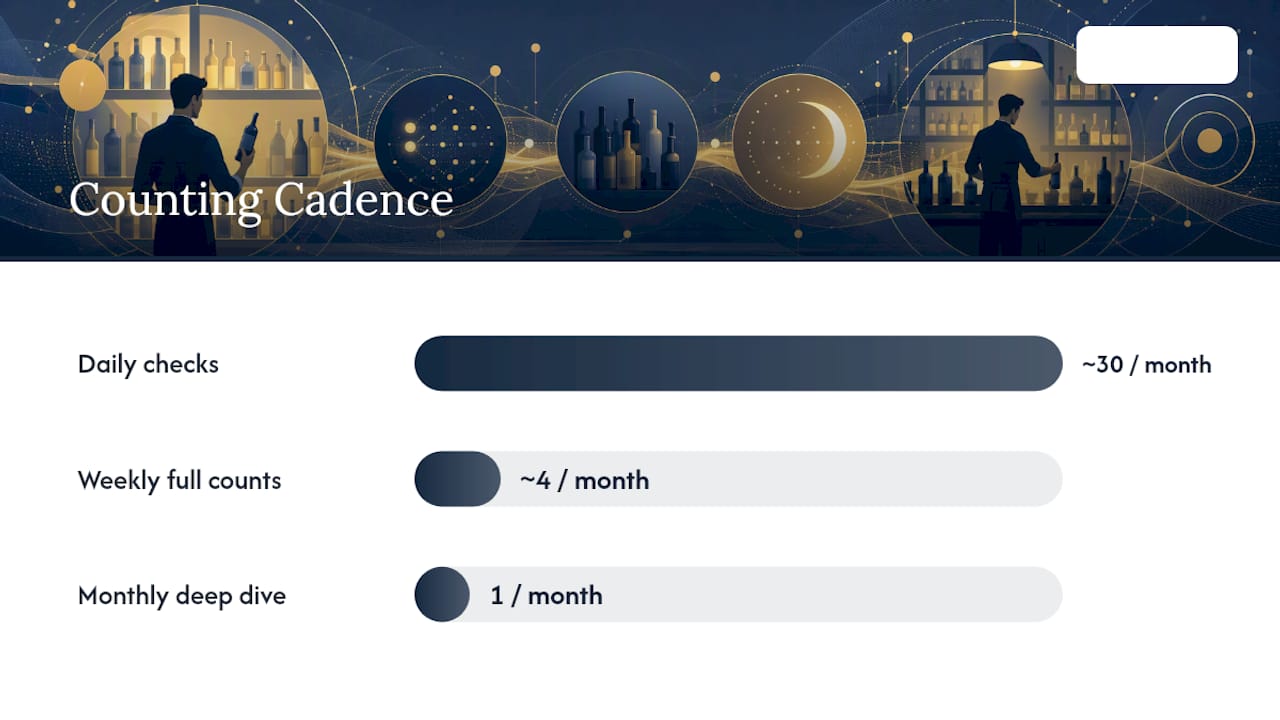
Cadence matters as much as the metrics themselves. Check high-theft-risk items daily, run full counts weekly, and reserve one monthly session for a deep dive into slow-movers, expired stock, and supplier pricing trends.
A Consultant's View: Where DIY Ends and Outside Help Begins
Most bars can run a solid counting cadence on their own once the process is standardized. Where outside hospitality consulting firms typically get called in is when variance has stopped being a mystery and started being a pattern nobody on staff has time to chase down. One recurring case: a bar's dollar variance concentrates on two or three SKUs every single week, but the manager's spreadsheet can't isolate whether it's a pour problem, a receiving problem, or a recipe that's simply undercosted.
Our analytics work, run through our Ingest platform, ranks variance fixes by expected dollar recovery against how hard each fix actually is to implement. That triage matters because owners rarely have the time to fix everything at once, and fixing the wrong thing first burns morale along with margin.
A few signals tell us it's time to bring in outside help rather than keep tweaking internally: variance that persists for months despite process changes, bookkeeping that can't produce clean cost-per-pour numbers, or a multi-location group where each property counts inventory a different way. Any one of those is a sign the fix needs structure your current team doesn't have bandwidth to build.
— Chris
Get Hands-On Support With Your Bar Inventory Program
Standardizing counts and automating your POS and invoice data closes most of the gap between guessing and knowing. But some variance problems run deeper than a process fix, especially in multi-location groups or operations where bookkeeping and counting have never been aligned in the first place.
Some hospitality consulting firms work with hotel, restaurant, and beverage groups to build inventory systems that actually hold up under real shift pressure, not just on a training slide. Our deep analytics and advisory services rank your variance issues by dollar impact and implementation effort, so you know exactly which fix to tackle first. If your program needs faster intervention, our task force engagements put experienced operators on-site to stabilize counting discipline and reporting during a turnaround or opening. Reach out to Wits' End Solutions to talk through where your program stands today.
Sources
For deeper technical detail beyond this playbook, a few resources stand out. Restaurant365's bar inventory guide breaks down count frequency and par-setting for operators building a program from scratch. BarGuard's product resources explain how POS and invoice data combine to isolate loss by shift. BinWise Pro's documentation covers enterprise-scale scanning and recipe libraries for multi-unit groups. And if you're planning service logistics for an event bar, this beverage checklist from Gin de Chimay offers a practical field-tested counting sequence worth adapting.