

Most hospitality owners know their food and beverage program needs to perform. What fewer realize is how much money they're leaving on the table by treating F&B as a service amenity rather than a strategic business engine. The difference between a venue that covers its costs and one that genuinely drives profit often has nothing to do with the quality of the food. It comes down to how leadership thinks about their outlets, measures their performance, and builds a framework that connects every menu decision, staffing choice, and partnership to a defined business goal.
Table of Contents
- Defining food & beverage strategy in hospitality
- Key pillars of an effective F&B strategy
- Overcoming common strategy pitfalls: Standardization vs. local adaptation
- Measuring and maximizing F&B strategy performance
- Why most F&B strategies fail—and how to think differently
- Drive your business with expert F&B strategy
- Frequently asked questions
Key Takeaways
| Point | Details |
|---|---|
| Strategic F&B impacts profit | Treat food and beverage as a strategic business driver, not just a cost center or amenity. |
| Measure what matters | Use RevPAR, RevPOR, and EBITDA to accurately gauge and improve F&B performance. |
| Adapt locally for best results | Balance global brand standards with local innovation using pop-ups, tailored outlets, and delivery. |
| Invest in performance, not vanity | Structure chef, mixologist, and partnership deals around measurable returns instead of publicity. |
Defining food & beverage strategy in hospitality
Food and beverage strategy is not a menu refresh or a seasonal promotion calendar. At its core, a true F&B strategy aligns your menus, service models, pricing structure, and daily operations to the specific financial and guest experience goals your business is working toward. It treats each outlet not as a department to manage but as a business unit to optimize.
One of the most valuable shifts modern operators are making is treating each restaurant, bar, rooftop, or café as a micro-venue with its own guest segment, daypart target, and performance expectations. A lobby bar serving business travelers at breakfast has a fundamentally different job than a rooftop bar activating on weekend evenings. When you treat them identically, you optimize for neither. A strong brand development guide helps clarify how each outlet should be positioned from the start.
The metrics that define success also need to evolve. Covers (the number of guests served) and total F&B revenue are lagging indicators that tell you what happened, not why or what to do next. Industry experts emphasize that operators should measure F&B RevPAR (Food and Beverage Revenue per Available Room), RevPOR (Revenue per Occupied Room), and EBITDA (Earnings Before Interest, Taxes, Depreciation, and Amortization) to get a complete picture of outlet health and strategic impact.
"Treat F&B as a portfolio of micro-venues with specific daypart and guest targets, measuring by F&B RevPAR, RevPOR, and EBITDA, not just covers. Chef partnerships must be performance-based, not vanity projects." — HospitalityNet
Performance-based chef and bartender partnerships are also replacing deals built on celebrity status. A well-known name generates press, but if the menu isn't driving repeat visits and the financials don't improve, the collaboration is a cost, not an asset.
Key pillars of an effective F&B strategy
With a clear definition in hand, the next step is understanding what actually builds a strategy that holds up in day-to-day operations. There are five pillars that consistently define high-performing F&B programs across hotels and restaurants.
Brand alignment. Every decision your F&B program makes, from the ingredients you source to the music playing during dinner service, should reinforce your venue's positioning and the promise you've made to guests. When your rooftop cocktail menu reads like it belongs at a downtown speakeasy but your property brand is coastal leisure, there's a disconnect guests feel even if they can't name it.
Data-driven decisions. Operators who rely on gut feel alone miss meaningful opportunities. Regular use of analytics for F&B allows your team to track which menu items drive the highest margin, which dayparts are underperforming, and how guest spend trends are shifting week to week. This information makes planning faster and more confident.
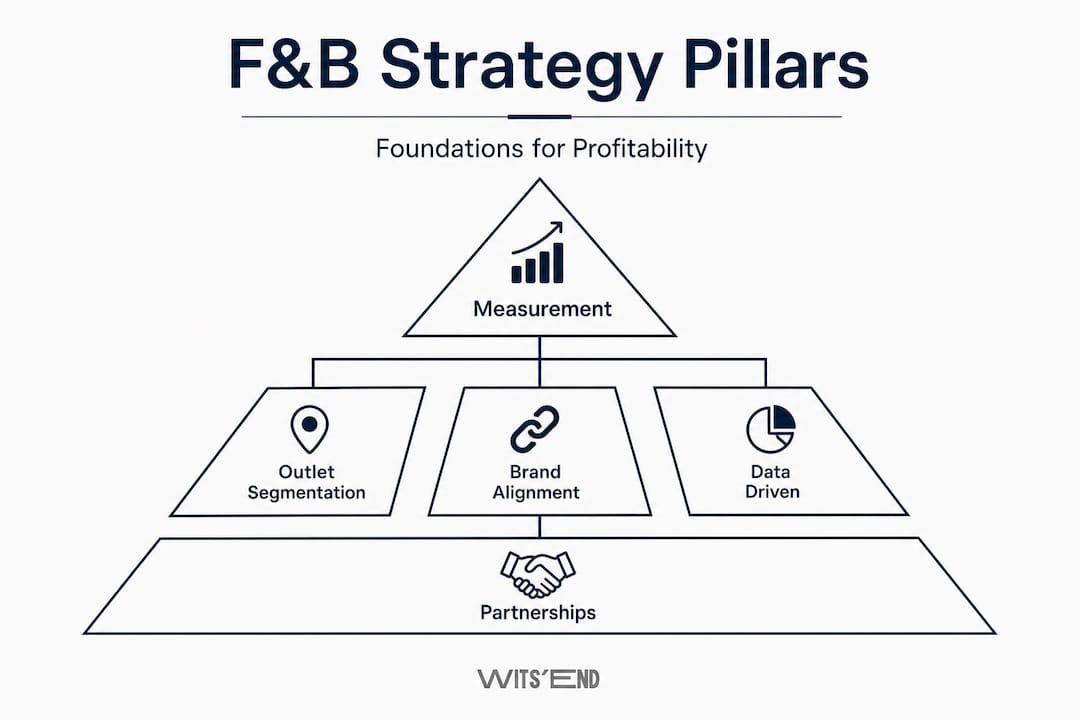
Outlet segmentation. Approaching each bar, restaurant, or dining space as its own business unit forces sharper thinking. What are this outlet's revenue targets? Who is its primary guest? What does success look like on a Tuesday at noon versus a Friday evening? These questions build focus and accountability into the operation.
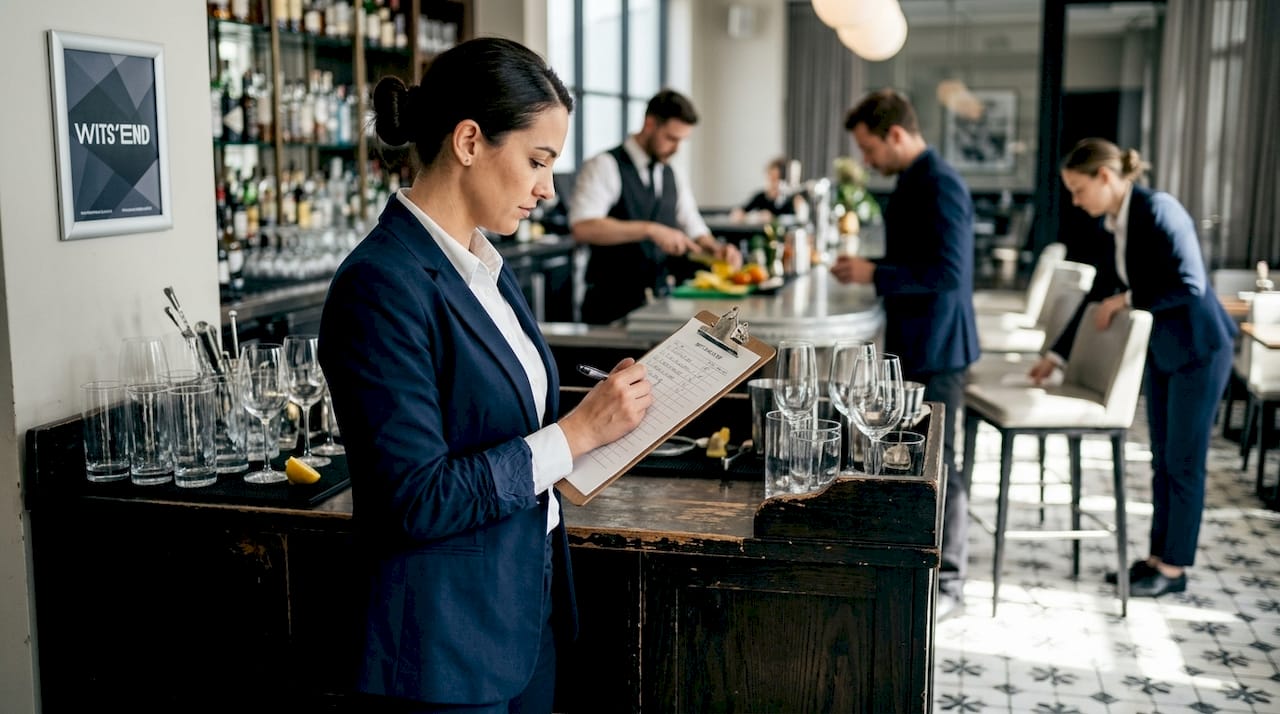
Dynamic measurement. The shift from basic sales figures to F&B RevPAR and RevPOR is not just a metrics upgrade. It changes how your leadership team talks about performance and where they focus their energy. RevPOR in particular ties your F&B results directly to your occupied room base, giving you a clear read on how well you're capturing spend from the guests already in your building.
Performance-driven partnerships. Collaborating with chefs and mixologists should deliver measurable returns. Set clear expectations around margin, guest satisfaction scores, and repeat visit rates before any partnership is formalized. A strong collaborator will welcome the accountability.
| Traditional approach | Strategic approach |
|---|---|
| Measures covers and total revenue | Measures F&B RevPAR, RevPOR, EBITDA |
| One menu fits all outlets | Each outlet has defined guest and daypart goals |
| Chef partnerships based on reputation | Chef partnerships based on performance benchmarks |
| Menu refreshed seasonally | Menu engineered based on margin and sales data |
| F&B treated as guest amenity | F&B treated as a profit-generating portfolio |
Pro Tip: Before your next menu engineering session, pull a full breakdown of your item-level contribution margin, not just sales volume. Your most popular dish and your most profitable dish are rarely the same item. Knowing the difference changes where you focus your upsell training.
Overcoming common strategy pitfalls: Standardization vs. local adaptation
Even operators who have strong strategic foundations run into the same set of execution problems. The most common is the tension between maintaining brand consistency and adapting to what actually works in a specific market.
Global brand standards exist for good reasons. They create consistency, protect brand equity, and simplify training across properties. But when standards become rigid templates that override local market knowledge, they stop serving the business. A brunch concept that performs exceptionally in a neighborhood with high weekend foot traffic may be a drain on labor and food cost in a highway corridor hotel where guests check out before 10 a.m. Forcing the same program into both locations based on brand requirements is a strategy that serves the brand manual more than it serves the P&L.
Smart operators are solving this tension in a few practical ways. First, they're shrinking the number of active outlets to focus resources and talent on the concepts that have proven demand. A hotel running three underperforming restaurants is not offering guests more choice. It's spreading its kitchen team, its purchasing power, and its management attention too thin.
Second, seasonal pop-ups are becoming a powerful tool for testing new concepts without committing to a full rebrand or buildout. A six-week pop-up in an underutilized space gives you real guest data, real revenue, and a low-stakes environment to pressure-test a concept before any significant investment. This is exactly the kind of local adaptation that global templates can't account for. F&B business optimization often starts with identifying which outlets are candidates for this kind of rethinking.
Third, delivery integrations are opening new revenue channels that bypass the limitations of your physical dining room. Whether it's a ghost kitchen concept running out of an existing kitchen or a delivery-only menu built around your highest-margin items, these channels let you generate revenue during off-peak hours without adding front-of-house labor cost.
| Challenge | Rigid approach | Adaptive approach |
|---|---|---|
| Underperforming outlet | Maintain and fund it | Shrink or sunset it |
| New concept testing | Full rebrand commitment | Seasonal pop-up with defined metrics |
| Off-peak revenue | Discount promotions | Delivery integration or ghost kitchen |
| Local market differences | Apply global standard | Adjust product mix within brand guardrails |
Pro Tip: When evaluating whether to keep or close an outlet, run a simple contribution margin analysis over 90 days. If the outlet is not covering its direct costs including food, beverage, and dedicated labor, it's pulling resources from outlets that could grow. Task force services for F&B can help you make that call with confidence and manage the transition.
Measuring and maximizing F&B strategy performance
A strategy without a measurement system is just a plan that fades after the first difficult week of service. Building a consistent, practical process for tracking performance is what separates operators who improve over time from those who keep solving the same problems in new ways.
Start by defining your strategic objectives clearly. Are you focused on increasing guest satisfaction scores in your dining room? Improving overall margin across the F&B portfolio? Growing F&B revenue from non-hotel guests? Each objective points to a different set of metrics and a different set of actions.
Here is a straightforward process for keeping your F&B strategy on track:
- Set specific targets by outlet. Each micro-venue should have its own RevPAR, RevPOR, guest spend per segment, and EBITDA target for the quarter.
- Review weekly, not just monthly. Monthly P&L reviews catch problems after the damage is done. Weekly check-ins on key metrics let your team course-correct in real time.
- Track guest trends with intention. Watch how your guest mix is shifting, which segments are spending more, and where you're losing repeat visits. This data should inform pricing decisions, not just your marketing team.
- Test one variable at a time. If you change your prix fixe price point and your menu simultaneously, you won't know which change drove the result. Discipline in testing makes your data more useful.
- Iterate based on what the numbers show. Expert guidance consistently points to the gap between operators who review metrics and those who act on them. The acting part is where the performance gains live.
Properties that actively measure hospitality analytics at the outlet level, specifically using F&B RevPAR rather than just cover counts, consistently outperform their competitive set in total revenue capture and margin improvement. The metric itself is not magic. It's the behavior it drives, the outlet-level focus, the daypart thinking, and the performance accountability, that produces results.
Statistic: Hospitality operators who shift from cover-count measurement to F&B RevPAR and RevPOR tracking gain a significantly more actionable view of performance, enabling faster and more confident decisions about pricing, labor deployment, and concept investment.
Why most F&B strategies fail—and how to think differently
Here is the honest take from operators who have worked inside this industry at every level. Most F&B strategies fail not because the concept was wrong or the chef wasn't talented. They fail because ownership treats F&B as a fixed asset rather than a living portfolio that requires active management, continuous measurement, and the courage to make hard calls.
The venues that consistently win treat every outlet as a live experiment. They set a hypothesis, run it for a defined period, measure the results, and make a decision based on data rather than pride of ownership or attachment to the original concept. That mindset is rarer than it should be.
The willingness to sunset what isn't working is one of the most undervalued skills in hospitality leadership. Operators who hold onto struggling outlets because of sunk cost or brand attachment are not protecting their investment. They are funding the underperformance of the rest of their portfolio.
Vanity chef partnerships are a specific version of this problem. A celebrated name generates a media cycle. But if the menu isn't connecting with your guest base, if the margins don't hold up, and if your team can't execute the vision consistently after the chef leaves the building, you've bought a press release. Impactful chef collaborations are structured around delivery and accountability from day one. That structure is what makes them last and perform.
Adaptability, measurement, and the confidence to end what isn't working are the real marks of a high-performing F&B operation. The operators we respect most are not the ones with the most ambitious concepts. They're the ones who build systems that keep improving.
Drive your business with expert F&B strategy
If this guide has surfaced questions about where your current F&B program stands, or confirmed that you're ready for a more structured approach, working with experienced operators can accelerate the results significantly.
At Wits' End, we partner with hotel and restaurant owners to build F&B strategies that are grounded in real operations, not just consulting frameworks. From brand strategy services that define how each outlet should position itself, to F&B business optimization that identifies where you're losing margin and what to do about it, to analytics advising that builds the measurement system your team will actually use, we work at every stage of the process. Our team has run these operations themselves. We know what it looks like when a strategy is working and when it's just looking good on paper.
Frequently asked questions
What is the difference between F&B strategy and just creating a menu?
An F&B strategy aligns menus, operations, pricing, and guest targeting to defined business goals, while menu creation is just one component of that larger strategic framework.
Which metrics matter most for F&B strategy performance?
Industry leaders track F&B RevPAR, RevPOR, and EBITDA rather than total sales or guest counts because these metrics connect outlet performance directly to the overall business.
How can brands balance consistent standards with local relevance?
The most effective approach uses frameworks like limiting underperforming outlets, testing seasonal pop-ups, and integrating delivery channels to adapt locally while maintaining core brand guardrails.
Do chef partnerships really impact F&B success?
Yes, but only when they are structured around measurable business outcomes rather than publicity, with clear performance benchmarks established before the collaboration begins.