

Your menu is one of the most powerful business tools you own, yet most operators treat it as an afterthought. A poorly structured menu quietly drains revenue, confuses guests, and creates unnecessary pressure on your kitchen team every single shift. The good news is that a strategic menu creation process can reverse all of that. Menu engineering increases profitability by 10 to 15 percent, which means the decisions you make on paper translate directly to your bottom line. This guide walks you through every stage of that process, from concept alignment to ongoing improvement.
Table of Contents
Key Takeaways
| Point | Details |
|---|---|
| Menu engineering boosts profit | Strategic menu design can increase your profitability by 10–15%. |
| Descriptive labels drive sales | Menu items with appealing and clear descriptions sell up to 28% more. |
| Optimal selection avoids overwhelm | Keeping 5–7 items per category supports both guest satisfaction and kitchen efficiency. |
| Continuous improvement wins | Regular menu updates using guest data keep your offerings competitive and effective. |
Assessing your concept and audience
Once you recognize the financial potential of menu optimization, the first step is to understand your business’s positioning and guest needs. Before you write a single menu item, you need to know exactly what your restaurant or hotel represents and who you are serving. These two things shape every decision that follows, from ingredient sourcing to price points to the tone of your item descriptions.
Start by defining your concept clearly. Are you running a casual neighborhood spot, a boutique hotel dining room, a fast-casual concept, or a fine dining destination? Each of these environments carries a different set of guest expectations. A casual diner expects familiar comfort food at accessible prices. A fine dining guest expects elevated language, thoughtful sourcing details, and a curated selection. If your menu does not match your environment, guests feel the disconnect immediately, even if they cannot name it.
Next, study your target guests with the same rigor you would apply to your financials. What are they ordering most? What are they skipping? Are they families looking for shareable plates, business travelers who want a quick, reliable lunch, or food-forward guests seeking seasonal and locally sourced dishes? Talking to your front-of-house team is one of the fastest ways to gather this intelligence. They hear guest feedback in real time, every service.
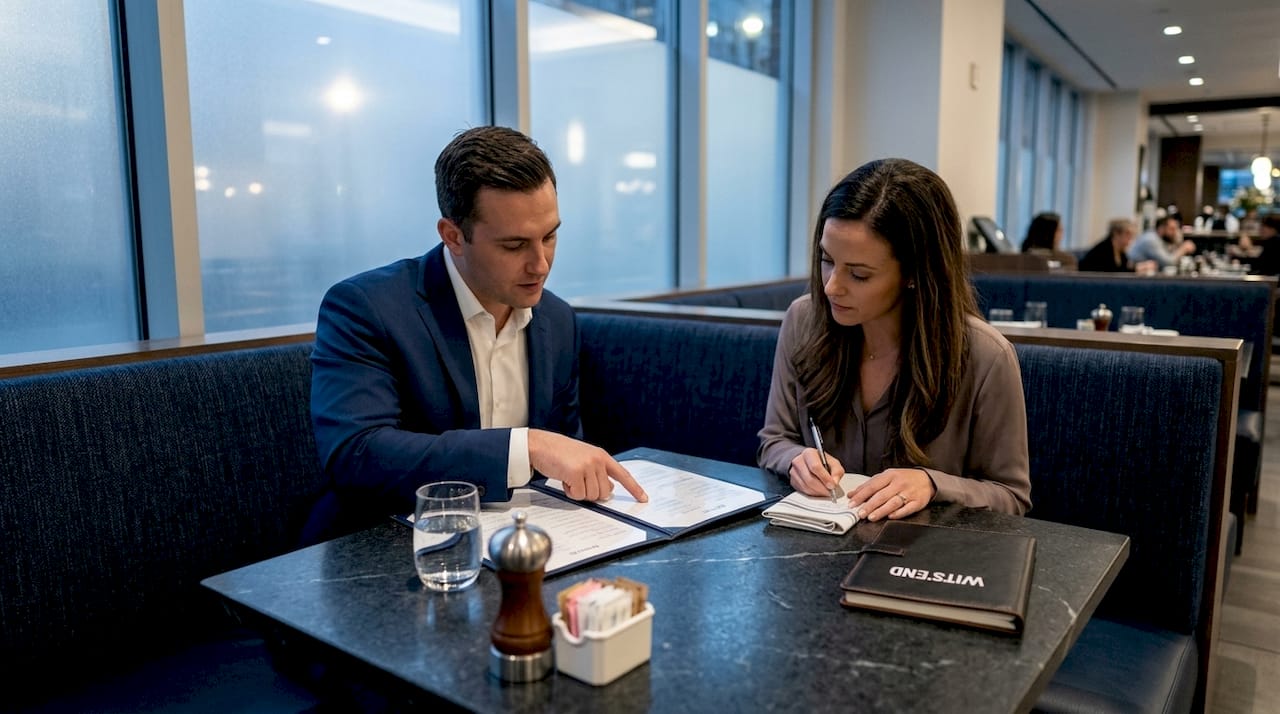
Competitive analysis is equally important. Visit your top three local competitors and study their menus carefully. Look at their pricing, their category structure, their item count, and how they describe their dishes. You are not looking to copy them. You are looking to identify gaps in the market that your menu can fill with confidence.
Your menu must also reflect your brand identity. The language you use, the fonts you choose, and the way you name dishes all communicate who you are. This is where brand design and development becomes a genuine business investment rather than a cosmetic exercise. A well-crafted brand story told through your menu builds guest loyalty before the food even arrives at the table.
One of the most underestimated elements of menu creation is item description. Descriptive labels raise item sales by 27 to 28 percent. Calling a dish “Pan-Seared Atlantic Salmon with Lemon Herb Butter and Roasted Fingerling Potatoes” outperforms “Salmon with Potatoes” every time. Sensory and origin-based language creates appetite and perceived value simultaneously.
Pro Tip: Write your menu descriptions out loud before printing them. If they sound stiff or confusing when spoken, your servers will struggle to sell those items confidently at the table.
Menu planning: Structure, categories, and pricing
Once your concept is clear and you know your customers, it is time to structure a menu that is both guest-friendly and revenue-driven. The organization of your menu directly affects how guests make decisions and how efficiently your kitchen operates.
Most successful menus follow a logical flow: appetizers, soups and salads, mains, sides, desserts, and beverages. Within each of those categories, the number of items you offer matters more than most operators realize. Research consistently shows that 5 to 7 items per category is the sweet spot for guest psychology and operational efficiency. Too few items and guests feel limited. Too many and they experience decision fatigue, which slows table turns and increases kitchen errors.
Here is a practical example of how a well-structured menu section breakdown might look:
| Category | Recommended item count | Notes |
|---|---|---|
| Appetizers | 5 to 7 | Include at least one shareable option |
| Soups and salads | 3 to 5 | Rotate seasonally for freshness |
| Mains | 6 to 8 | Balance proteins, vegetarian, and signature items |
| Sides | 4 to 6 | Keep prep simple for kitchen efficiency |
| Desserts | 4 to 6 | Feature at least one high-margin item |
| Beverages | 6 to 10 | Include non-alcoholic options prominently |
Pricing is where many operators either leave money on the table or price themselves out of the market. Setting prices requires you to know your food cost percentage targets, your local competitive range, and your guest’s perceived value threshold. A common industry benchmark is to keep food cost between 28 and 35 percent of the menu price, though this varies by concept and region.
Use this sequenced checklist when planning your menu layout and pricing:
-
Calculate the actual food cost for every item you plan to include.
-
Research competitor pricing for comparable dishes in your market.
-
Identify your highest-margin items and plan to feature them prominently.
-
Set prices that reflect value, not just cost, because guests pay for experience.
-
Build in flexibility for seasonal ingredient fluctuations so your margins stay stable.
-
Review pricing against your P&L (profit and loss statement) at least quarterly.
Pro Tip: Avoid ending prices in .99 for upscale concepts. Round numbers like $24 or $38 read as more sophisticated and are associated with higher perceived quality in full-service dining environments.
Leveraging business optimization insights can help you model pricing scenarios before you commit to a printed menu. And when your team understands the reasoning behind pricing decisions, they sell with more confidence. That is where training programs for teams become a direct revenue tool.
Menu design and engineering for maximum results
With your menu’s structure in place, proper design and engineering can further amplify both sales and guest satisfaction. Design is not decoration. It is a strategic layer that guides guest attention and influences purchase decisions before a single word is read.
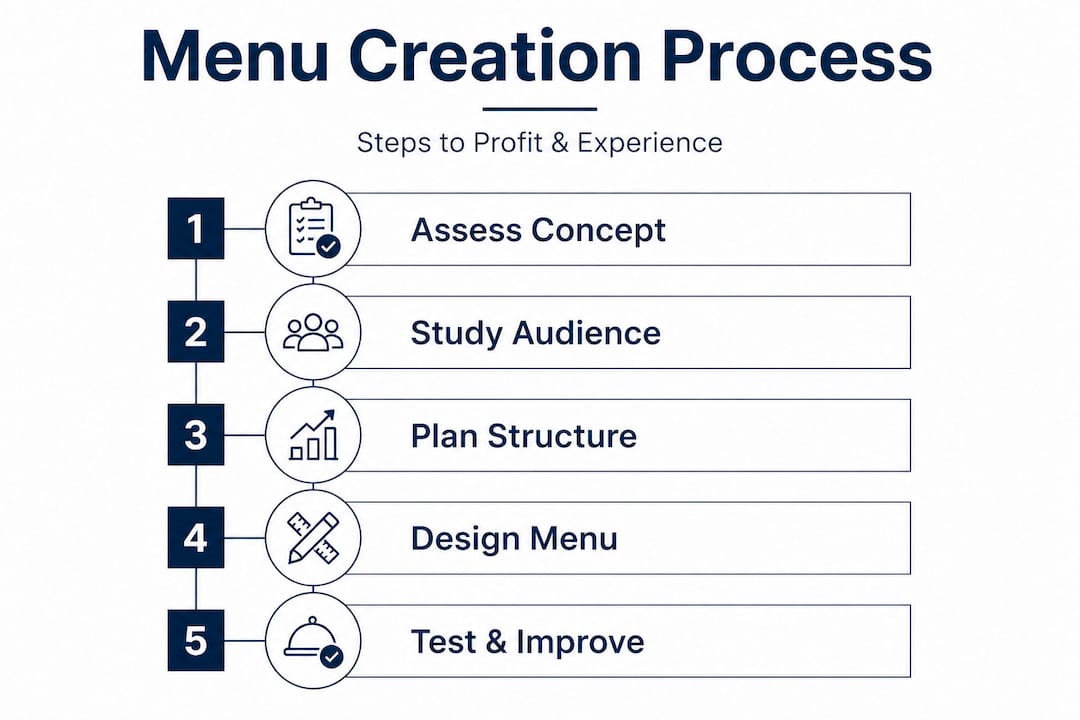
Visual hierarchy refers to the order in which the eye naturally moves across a page. Studies show that guests typically look at the upper right corner of a menu first. Placing your highest-margin items in that zone, or using subtle visual cues like boxes, bold text, or icons, draws attention exactly where you want it. Avoid cluttering the layout. White space is your friend because it creates focus and signals quality.
Menu engineering is the practice of categorizing every item on your menu based on two factors: popularity and profitability. The four categories are:
-
Stars: High popularity, high profit. Protect and promote these items at all costs.
-
Workhorses: High popularity, lower profit. Look for ways to reduce their cost without changing the guest experience.
-
Puzzles: Low popularity, high profit. These need better placement, stronger descriptions, or server promotion.
-
Dogs: Low popularity, low profit. These are candidates for removal in your next revision cycle.
Here is a side-by-side comparison of what happens when you engineer your menu versus leaving it static:
| Factor | Engineered menu | Static menu |
|---|---|---|
| Profitability | Increases 10 to 15 percent | Flat or declining |
| Guest decision speed | Faster, more confident choices | Slower, more confusion |
| Server selling ability | Aligned with high-margin items | Random, inconsistent |
| Menu revision cycle | Scheduled and data-driven | Reactive or never |
| Brand consistency | Reinforced through design | Often inconsistent |
“A menu that is never reviewed is a menu that is slowly working against you. The best operators treat it like a living document, not a finished product.”
The role of photography is worth addressing directly. High-quality photos of two to four signature items can increase sales of those dishes significantly. However, low-quality photos do the opposite. If you cannot invest in professional food photography, descriptive language is a stronger choice than a poor image.
Upsell strategies that work often begin with the menu itself. When premium add-ons, pairings, and upgrades are clearly presented on the page, servers do not have to work as hard to suggest them. The menu does the selling first. Similarly, thinking about increasing guest count and revenue through digital channels means your menu design needs to translate well online, not just in print.
Testing, launches, and ongoing improvement
Once your menu is beautifully designed, ensure real-world results by rolling it out systematically and measuring outcomes. Skipping this stage is one of the most common and costly mistakes operators make. A menu that looks great in a design file may create unexpected kitchen bottlenecks or confuse guests in ways you did not anticipate.
Follow this pre-launch testing checklist before going live:
-
Run every new item through a full kitchen prep trial to confirm timing, plating consistency, and yield.
-
Host a staff tasting so your team can speak to every dish with genuine enthusiasm and accuracy.
-
Gather feedback from a small group of trusted regulars or a soft-launch dinner before full rollout.
-
Confirm that all item costs have been recalculated based on current supplier pricing.
-
Review the printed or digital menu for errors, inconsistencies in formatting, and alignment with your brand voice.
A soft launch, where you introduce the new menu to a limited audience before full public rollout, gives you real-world data without full exposure risk. During this period, track which items are being ordered, which are being returned or modified, and what your servers are saying about guest reactions.
After launch, the KPIs (key performance indicators) you should monitor include:
-
Item-level sales mix: Which dishes are selling and in what proportion?
-
Food cost percentage by item: Are your margins holding where you projected?
-
Table turn time: Has the new menu affected how long guests take to decide and order?
-
Guest satisfaction scores: Are comments about food quality and variety trending positively?
-
Return visit rate: Are guests coming back more frequently since the menu change?
Analytics for menu performance give you the data layer to make these assessments with confidence rather than gut feeling. When you see a puzzle item underperforming, you can test a description change or a placement shift before pulling it entirely. This kind of precision is only possible when you are tracking the right numbers consistently.
Pro Tip: Schedule a formal menu audit every 90 days. Put it on the calendar the same way you would a P&L review. Treat it as a business meeting, not a creative exercise, and bring your sales data, food cost reports, and server feedback to the table.
Menu planning task forces can also help you build a cross-functional team that includes your chef, front-of-house manager, and a financial lead. When the people closest to the guest experience and the numbers are in the same room, menu decisions become sharper and more aligned with real business outcomes.
Why most menu creation efforts fail—and what actually works
With a clear process for improvement in place, it is important to recognize what separates high-performing menus from the rest: mindset and consistency. In our experience working with operators across the country, the menus that underperform share a common trait. They were created once and never seriously revisited.
Most operators put significant energy into the launch of a new menu and then treat it as finished. Six months later, food costs have shifted, guest preferences have evolved, and two of the most popular items are now barely breaking even. But the menu has not changed. That gap between what the menu says and what the business actually needs is where profit quietly disappears.
The most common mistakes we see are predictable once you know what to look for. Too many items create complexity that slows the kitchen and dilutes your identity. A menu with 60 items is not impressive. It is a liability. Unclear brand storytelling means guests cannot connect emotionally with what you are serving, which makes price resistance more likely. And ignoring sales data means you are making decisions based on personal preference rather than what your guests are actually telling you with their orders.
The operators who make meaningful gains are not always the ones who overhaul their menus dramatically. More often, they are the ones who make small, deliberate adjustments on a regular schedule. They remove a dog, rewrite a puzzle’s description, and shift a star to a more prominent position. Over time, those small moves compound into real revenue improvement.
Business optimization for hospitality is not a one-time project. It is a discipline. Your menu is one of the clearest expressions of that discipline, and the operators who treat it that way consistently outperform those who do not.
Upgrade your menu with expert support
If you want to ensure your next menu rollout leads to measurable business improvements, professional support can accelerate your progress significantly.
At Wits’ End, we work with restaurant and hotel operators across the United States to build menus that perform as well as they look. From professional menu design and branding to full business optimization services that align your menu with your P&L, our team brings hands-on experience to every engagement. We have done this work ourselves, which means our recommendations are grounded in operational reality, not theory. If your team needs support executing a new menu confidently, our hospitality training programs build the skills and fluency that turn a great menu into a great guest experience, shift after shift.
Frequently asked questions
How many items should each menu category have?
Ideally, each menu category should feature 5 to 7 items for the best results in sales and operational efficiency. This range reduces guest decision fatigue while keeping kitchen execution manageable.
Why use descriptive labels on menu items?
Descriptive labels raise item sales by 27 to 28 percent because they make dishes more appealing and guide guest choices toward higher perceived value. Strong descriptions also reduce the need for servers to explain every item verbally.
What is menu engineering and why does it matter?
Menu engineering is the strategic arrangement and pricing of items to maximize profit, and when done consistently, it typically raises profitability by 10 to 15 percent. It gives operators a clear framework for deciding what to promote, reposition, or remove.
How often should menus be reviewed or updated?
Menus should be reviewed at least quarterly to adjust for shifts in guest preferences, ingredient costs, and overall business performance. Treating the menu as a living document rather than a finished product is one of the clearest differentiators between high-performing and struggling operations.
What role does pricing strategy play in menu success?
Pricing strategy directly impacts profitability and can guide guests toward higher-margin items when applied with intention. The right price signals value, reinforces your brand positioning, and protects your food cost targets across every service period.