
Rebranding a restaurant is one of the most misunderstood investments an operator can make. Most owners assume it means a new logo, a fresh coat of paint, and updated menus. The reality is far more strategic, and the business case is compelling. Studies show that rebrands can boost revenue by 15 to 30 percent when executed with purpose and discipline. In this article, we'll walk you through why restaurants rebrand, what the process actually involves, what it costs, and how to avoid the mistakes that derail even well-funded efforts.
Table of Contents
- Why restaurants consider rebranding
- What does restaurant rebranding actually involve?
- Budgeting for a restaurant rebrand: What it really costs
- Common pitfalls and expert strategies for a successful rebrand
- A fresh perspective: Why strategy, not just style, makes or breaks a restaurant rebrand
- Partner with experts to ensure your restaurant rebrand succeeds
- Frequently asked questions
Key Takeaways
| Point | Details |
|---|---|
| Rebranding boosts growth | A strategic rebrand can increase revenue by 15-30% and attract new demographics. |
| Process over cosmetics | Successful rebrands require audits, customer insight, and clear goals—not just a new logo. |
| Pilot before rollouts | Testing changes in select locations helps minimize risk and maximize positive outcomes. |
| Budgeting matters | Costs range widely; careful planning helps align investment with business goals. |
| Avoid common pitfalls | Balance innovation with heritage to prevent backlash and maintain loyal customers. |
Why restaurants consider rebranding
Now that you understand the impact, let's get specific about why restaurants choose to rebrand. The decision rarely comes from one single moment. It builds over time, as small signals accumulate into a pattern you can no longer ignore. Sales flatten out despite consistent traffic. Your dining room feels dated against newer competitors. A demographic shift in your neighborhood means your original guest profile no longer fills your seats. These are real, measurable business problems, and rebranding, done right, is a legitimate solution.
The typical brand lifecycle in the restaurant industry lasts 5 to 7 years before it begins to lose relevance. That doesn't mean you overhaul everything on a fixed schedule. It means you pay attention to the signals your market is sending you and respond with intention. Tracking those signals is where analytics for restaurant rebranding becomes genuinely useful, giving you data-backed reasons to act rather than gut feelings.
Common reasons restaurant operators decide to rebrand include:
- Stagnant or declining same-store sales despite stable foot traffic
- A customer base that has shifted in age, income, or lifestyle preferences
- Outdated visual identity that underperforms in digital and social environments
- New competitive entries in the market raising the bar on experience and concept
- A need to attract a new demographic or expand to a new market segment
- Mobile and online ordering expectations that the current brand doesn't support
What drives the biggest results isn't aesthetics alone. It's alignment. When your brand story, your menu, your interior environment, and your digital presence all tell the same story to the right guest, that's when revenue moves. Textile trends in hospitality illustrate this clearly. Modern dining environments that update materials, textures, and design language alongside a brand refresh create a cohesive guest experience that feels intentional rather than patched together.
"Rebranding is not about chasing trends. It's about returning to relevance. The most successful restaurant rebrands are built around the guest's evolving expectations, not the owner's personal preferences."
That perspective matters. The operators who approach rebranding as a guest experience exercise, rather than an ego exercise, are the ones who see lasting revenue gains.

What does restaurant rebranding actually involve?
Understanding the need is one thing. Knowing what the process looks like is another. Here's how rebranding typically unfolds for a restaurant, from first audit to full launch.
A structured rebranding process follows seven key stages:
- Audit your current brand. Review your existing identity, guest perception, competitive positioning, and operational alignment. Understand what guests actually value before you change anything.
- Survey loyal and lapsed customers. Talk to both groups. Loyal guests tell you what to protect. Lapsed guests tell you what pushed them away. Both voices are essential.
- Define mission, vision, values, and target guest profile. This is the strategic foundation. Every visual and operational decision flows from this clarity.
- Execute a visual refresh. Logo, color palette, typography, signage, and menu design should all evolve together, guided by the strategic positioning you've defined.
- Train your team. Brand development strategies don't land at the guest level unless your team understands and can articulate the new identity. Staff fluency in the brand story is non-negotiable.
- Conduct a phased rollout. Start with teasers to generate curiosity, move to a soft launch with select guests, then execute a full promotional push with media, social, and local press support.
- Measure key performance indicators. Track guest acquisition rates, repeat visit frequency, average check, and social engagement. Your business optimization metrics will tell you quickly what's working and what needs adjustment.
Here's a comparison that helps clarify why the approach matters as much as the investment.
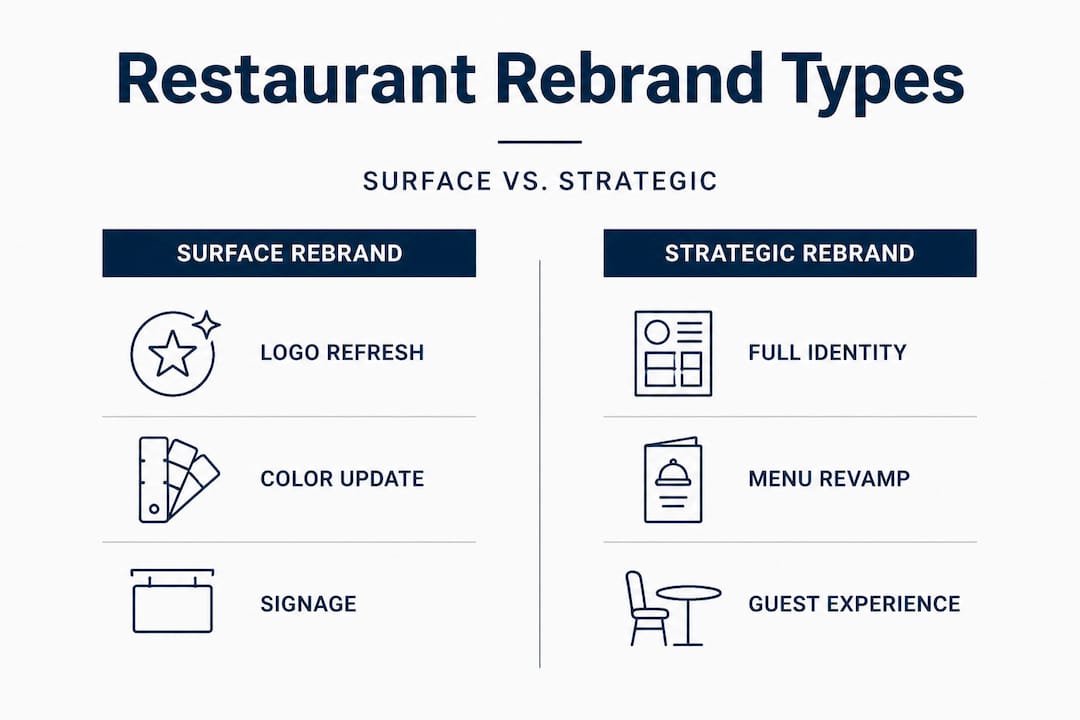
| Factor | Surface rebrand | Strategic rebrand |
|---|---|---|
| Scope | Logo, colors, signage | Identity, operations, positioning |
| Timeline | 4 to 8 weeks | 4 to 12 months |
| Staff involvement | Minimal | Full training program |
| Guest input | None | Surveys and focus groups |
| Measurable outcome | Aesthetic refresh | Revenue and retention gains |
| Risk level | Low short-term, high long-term | Managed with phased rollout |
Pro Tip: Engage your front-of-house and kitchen leadership early in the process. They interact with guests every shift and carry more brand equity than any logo ever will. Their buy-in turns the rebrand into a team movement, not a top-down mandate.
Budgeting for a restaurant rebrand: What it really costs
Before you take the leap, it's vital to understand the financial commitment involved in rebranding. One of the most common mistakes operators make is underestimating scope. They budget for a new logo and a website refresh, then get surprised by the true cost of signage, interior updates, and operational system changes.
Here's a realistic breakdown of cost categories and national ranges based on current market data.
| Cost category | Typical range | Notes |
|---|---|---|
| Logo and brand identity | $10,000 to $250,000 | Depends on agency vs. freelance |
| Signage per location | $50,000 to $750,000 | Exterior, interior, digital displays |
| Interior renovation | $200,000 to $1,000,000+ | Per location, scope-dependent |
| Menu design and print | $5,000 to $30,000 | Design, copy, photography |
| Technology and digital | $10,000 to $100,000 | POS, ordering platforms, website |
| Staff training | $5,000 to $50,000 | Depends on team size and depth |
To put the full picture in context, Cracker Barrel's 2025 rebrand across more than 660 US locations carried an estimated $700 million price tag. That's a scale most independent operators will never reach, but the principle applies at every level. Interior changes, signage replacement, and operational updates add up faster than most owners anticipate.
Before committing to a full rollout, explore common restaurant renovation pitfalls that operators fall into when they move too quickly from concept to construction. Scope creep, contractor delays, and unanticipated structural needs can push budgets significantly beyond projections.
Pro Tip: If you operate multiple locations, pilot the rebrand at a single site first. Run it for 90 days, measure guest response, staff performance, and sales lift before committing to full-scale rollout. This approach protects your capital and gives you real data to refine the concept before it goes wide.
Common pitfalls and expert strategies for a successful rebrand
Investment alone doesn't guarantee success. A thoughtful approach does. Here's how to avoid common missteps and maximize your impact.
The mistakes that derail restaurant rebrands are consistent and preventable. The most damaging ones include:
- Ignoring brand heritage. Removing the elements guests love most in favor of something trend-forward is a fast way to lose loyal customers.
- Overhauling too fast. Changing everything at once overwhelms your team, confuses your guests, and leaves no room to catch mistakes before they become crises.
- Under-communicating with guests. Guests who walk in and find a completely different experience without warning feel disoriented, not excited.
- Skipping testing. Releasing a new identity or menu to the full market before piloting it in a controlled environment is unnecessary risk.
- Letting visuals drive strategy. Choosing a design direction before defining your target guest and value proposition gets the process exactly backward.
The impact of moving too fast is well documented. Cracker Barrel's 2025 rebrand was reversed within a single week after guest backlash over changes to the brand's nostalgic identity and iconic logo. The reversal followed a reported $100 million stock drop and flat sales, a painful and public example of what happens when heritage is underweighted in the rebranding calculus.
"The goal is never to erase who you are. It's to evolve what you do so the right guests find you, recognize you, and come back. Strategy always comes before style." (Restaurant Rebranding Step-by-Step)
Smart operators who boost guest count with rebranding treat the launch communication strategy with the same care as the visual identity. They tell guests what's changing, why it's changing, and what they can still count on. That transparency builds anticipation rather than anxiety.
Integrating digital signage for guest experience is one tactical example of a change that can enhance the brand without threatening it. It modernizes the environment and improves operational communication while preserving the physical space guests are familiar with. Tactical and strategic changes layered together create momentum without rupture.
A fresh perspective: Why strategy, not just style, makes or breaks a restaurant rebrand
You've learned the mechanics. Now here's the tough-love truth that few people in this industry will say out loud.
Most restaurant rebrands fail not because the design was bad, but because the business case was never clearly defined. Owners get excited about a new visual direction, invest in a talented design agency, and launch something that looks great but doesn't move revenue. Why? Because they started with "what should it look like?" instead of "what specific business problem are we solving?"
The operators who win start with the why. Is your revenue plateauing despite stable traffic? That points to an average check or positioning problem, not a logo problem. Are you losing ground to a competitor who opened nearby? That's a differentiation problem. Has your target guest shifted but your brand hasn't followed? That's an audience alignment problem. Each of these diagnoses leads to a different rebranding prescription.
The evidence backs this up clearly. Chili's achieved a 31% sales increase through menu and operational innovation rather than a sweeping visual overhaul. They sharpened their value story, simplified their menu, and leaned into what guests actually wanted. The result was dramatic and measurable, not just aesthetically pleasing.
The operators we work with who see the strongest results from rebranding are the ones who treat it as a business transformation initiative with a creative expression layer, not the other way around. A phased US rollout minimizes financial and operational risk while giving you the data to course-correct before full commitment. Internal testing with your own team, your regular guests, and a select group of target guests before any public launch is not optional. It's the only responsible way to protect what you've built.
Your rebrand needs clear business goals attached to it. Revenue per cover, new guest acquisition rate, repeat visit percentage, digital engagement. If you can't articulate how success gets measured, you're not ready to spend. Full brand development strategies always begin with those metrics, then build the identity and experience to achieve them.
Partner with experts to ensure your restaurant rebrand succeeds
Ready to start or refine your restaurant's rebrand journey? The right partnerships make all the difference.
Rebranding a restaurant is one of the most consequential decisions you'll make as an owner. It touches every corner of your operation, from the way your team communicates to the way guests feel when they walk through your door. Getting it right requires strategy, experience, and the ability to hold both the creative vision and the business outcomes in the same conversation.
At Wits' End, we work alongside restaurant owners across the United States to build brands that hold up over time. Our brand development services are grounded in real operations experience, not just theory. Whether you need strategic guidance, hands-on execution support, or a team to run alongside yours through a full transformation, our restaurant task force solutions are built to flex around what your business actually needs. Wits' End hospitality support is available at every stage, from the first planning conversation to the hundredth night of service after launch.
Frequently asked questions
How often should a restaurant rebrand to stay competitive?
Most restaurants consider a major rebrand every 5 to 7 years to remain market-relevant, but smaller refreshes can happen more frequently in response to market shifts.
Does rebranding always mean changing the restaurant's name?
No. Effective rebrands often preserve the original name and focus instead on visual updates, messaging refinement, or operational improvements that better serve the target guest.
What is the biggest risk of rebranding a restaurant?
The primary risk is alienating loyal guests by removing beloved elements. As Cracker Barrel's reversal demonstrated, testing extensively and communicating changes proactively are essential safeguards.
Can small, independent restaurants afford to rebrand?
Yes, because rebranding costs vary widely and independent operators can phase updates over time, piloting changes at minimal cost before committing to a full rollout.
How can I tell if my restaurant needs a rebrand or just a refresh?
If you're experiencing revenue stagnation or market misalignment, a full rebrand may be warranted. If your brand is healthy but visually dated, a targeted refresh is often enough.