

Most hospitality owners assume F&B optimization means finding ways to spend less. Cut the menu, trim the labor, watch the food cost percentage. That mindset is understandable, but it leaves real money on the table. True F&B optimization is a strategic discipline that aligns your outlets with guest behavior, sharpens your concept, and builds the kind of experience that brings guests back. This guide breaks down what optimization actually looks like in practice, which metrics tell the real story, and how you can apply these principles to drive stronger results across your food and beverage operation.
Table of Contents
- Defining F&B optimization in hospitality
- Key components of successful F&B optimization
- Metrics that matter: measuring F&B performance
- Practical strategies to optimize your F&B operations
- A fresh perspective: value creation is the real goal
- Next steps to elevate your F&B operation
- Frequently asked questions
Key Takeaways
| Point | Details |
|---|---|
| Beyond cost control | F&B optimization is not just about reducing expenses, but maximizing guest value and operational profitability. |
| Metrics matter | Using advanced metrics like RevPAR and EBITDA leads to smarter decisions than relying solely on cover counts. |
| Outlet alignment | Aligning each outlet with guest journeys and dayparts optimizes both satisfaction and profitability. |
| Value-driven design | Designing concepts and layouts around guest needs creates stronger commercial outcomes. |
| Actionable strategies | Practical steps—like labor calibration, guest feedback, and smart upselling—drive real improvements. |
Defining F&B optimization in hospitality
F&B optimization is one of the most misunderstood concepts in the hospitality industry. When operators hear the word "optimization," they default to tightening margins, reducing portion sizes, or cutting staff hours. Those are tactical moves, not strategy. Real optimization starts with a much bigger question: is each of your outlets working as hard as it can for both your guests and your business?
A better framework treats each F&B outlet as a micro-venue with its own P&L, its own guest journey, and its own purpose within the property. A hotel lobby bar at 7 a.m. serves a completely different guest need than that same bar at 10 p.m. Recognizing that difference, and building your concept, staffing, and menu around it, is the foundation of genuine optimization.
"F&B optimization is often handled like portfolio and micro-venue management: align each outlet with guest journeys and dayparts, right-size labor, evaluate using contribution and EBITDA metrics."
Industry thinking has shifted significantly in recent years. Hotel Dive frames F&B optimization as value creation based on concept design and guest experience, not just bottom-line management. That framing matters because it changes what decisions you make and how you measure success.
Key shifts in thinking include:
- Moving from cost-per-cover to contribution and four-wall EBITDA as primary performance measures
- Treating layout and design as revenue levers, not just aesthetic choices
- Aligning labor models to actual demand curves rather than static schedules
- Viewing each daypart as a distinct service product with its own guest promise
- Building concepts around the guests who actually visit, not the guests you hope to attract
When you look at your operation through this lens, you stop asking "how do we spend less?" and start asking "how do we create more value?" That shift in question changes everything that follows.
Key components of successful F&B optimization
With a clear definition in place, the next step is understanding what the actual building blocks of a well-optimized F&B operation look like. There are four core components worth examining closely.
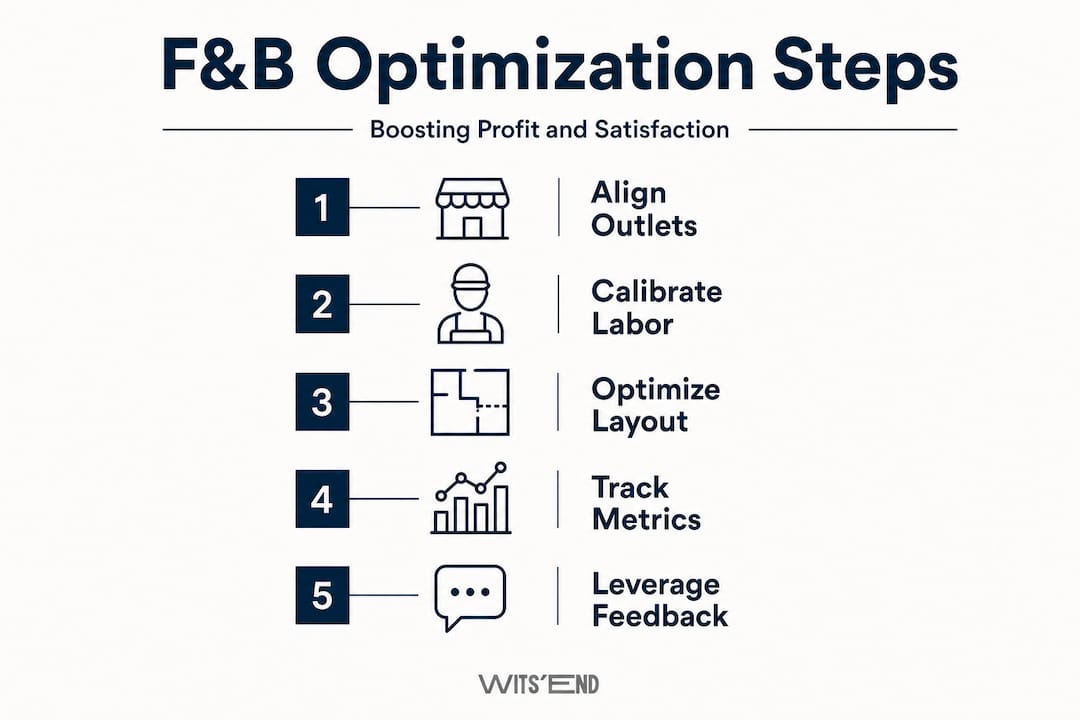
1. Outlet alignment with guest journeys
Every F&B outlet on your property needs a clearly defined role. Your breakfast room serves guests who are preparing for a busy day, often moving quickly, prioritizing familiarity and efficiency. Your rooftop bar serves a guest who has slowed down, wants atmosphere, and is open to spending more. Outlet alignment, staffing intensity, and hard data are vital for optimizing labor and guest experience in a hotel setting.
Misalignment is costly. A restaurant that tries to serve as both a quick-service breakfast spot and a leisurely fine dining room in the same space at the same time usually does neither well. Defining the outlet's purpose by daypart and guest type lets you build a menu, a staffing model, and an ambiance that actually delivers.
2. Labor calibration based on real data
Labor is your single largest controllable expense. But calibrating it correctly does not mean cutting it to the bone. It means scheduling the right number of people with the right skills at the right times. This requires actual demand data: covers by daypart, average check, transaction volume, and table turn time. When you have that data, you can build a staffing model that maintains service quality while managing cost.
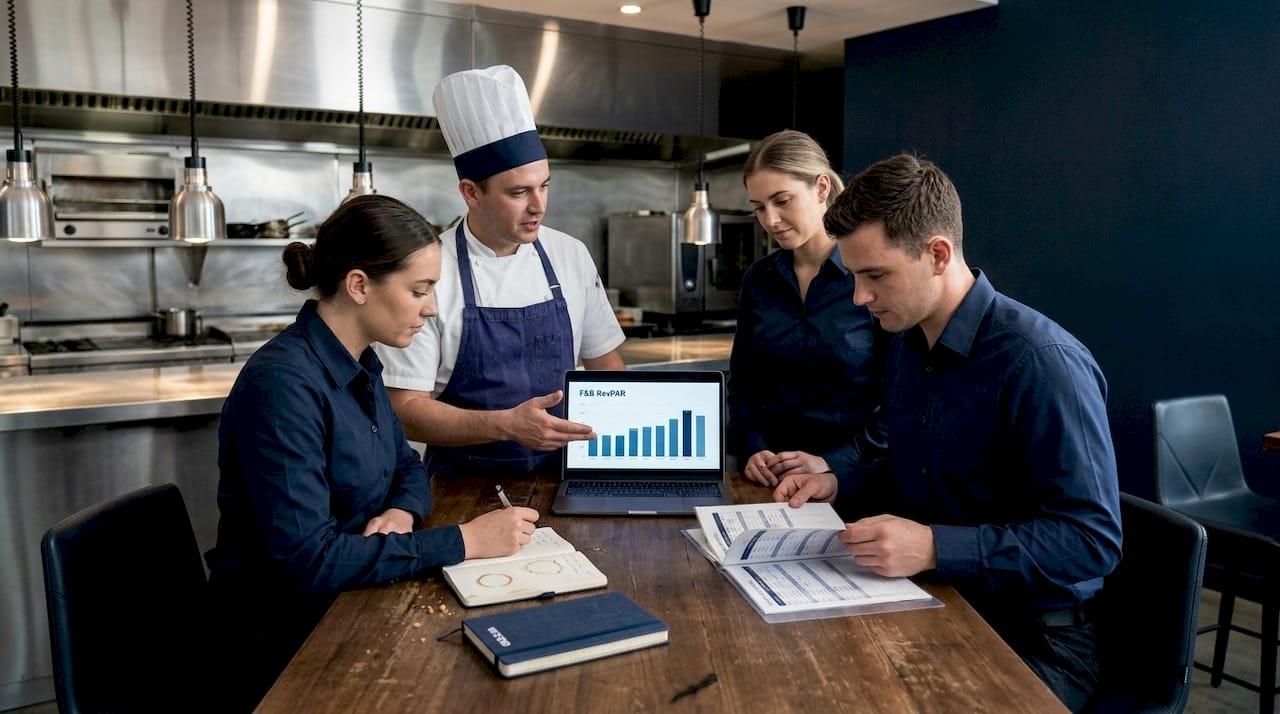
Measuring outlets by F&B RevPAR and four-wall EBITDA enables better operational decisions, including when to invest in additional labor and when to scale back. Most operators schedule based on habit rather than data. That habit is expensive.
3. Concept and layout as revenue drivers
Your physical space either supports or undermines your revenue goals. A bar with poor sight lines from the entrance loses spontaneous walk-in traffic. A dining room with tables spaced too far apart sacrifices covers. A coffee counter hidden around a corner from the lobby does not capture morning hotel guests. These are design and layout problems that directly affect revenue.
Exploring customer experience best practices reveals how small physical adjustments, from lighting levels to furniture height to pathway design, influence guest behavior and spend. Optimization is not just operational. It is physical.
4. Measurement through contribution metrics
Comparison tables help clarify why traditional metrics fall short.
| Metric | What it measures | Limitation |
|---|---|---|
| Cover count | Volume | Ignores check average and margin |
| Food cost % | Cost control | Ignores revenue and labor |
| F&B RevPOR | Revenue per occupied room | Ties performance to hotel occupancy |
| Four-wall EBITDA | True outlet profitability | Most complete view of performance |
Pro Tip: Before your next scheduling cycle, pull transaction data by hour for the past 30 days. Map it against your current staffing model. You will almost certainly find gaps where you are over-staffed in slow periods and under-staffed during peak demand. That one exercise can unlock real savings without sacrificing service quality.
Investing in the right training programs and bringing in experienced support through task force services can accelerate your team's ability to execute across all four of these components.
Metrics that matter: measuring F&B performance
One of the most persistent problems in hotel and restaurant F&B management is measuring performance with the wrong tools. Cover count tells you how many people sat down. It does not tell you whether those guests were profitable, satisfied, or likely to return. Using cover count as your primary success metric is like measuring a road trip by the number of stops rather than the distance covered.
The metrics that give you a genuine picture of F&B health are more specific. Here is what to prioritize:
- F&B RevPAR (Revenue per Available Room): Ties your outlet revenue directly to hotel occupancy. Lets you assess how well you are capturing spend from guests already on property.
- F&B RevPOR (Revenue per Occupied Room): Measures average F&B revenue per guest stay. Useful for identifying upsell opportunities and benchmarking against comp set.
- Four-wall EBITDA: Strips out allocations and overhead to show the actual profitability of a single outlet. This is the number that tells you whether an outlet is worth running.
- Contribution margin: Revenue minus variable costs. Essential for evaluating menu items, dayparts, and outlet formats.
Hotel F&B profitability is best measured by F&B RevPAR, RevPOR, contribution, and four-wall EBITDA. Cover count alone is genuinely misleading. A restaurant running 200 covers a day at an average check of $18 with high labor and food cost may be generating far less value than one running 80 covers at $45 with a tighter operation.
Making decisions based on these advanced metrics requires better data collection. You need a POS system that captures transaction-level detail, reservation data that connects to guest stay information, and labor reporting that breaks down cost by outlet and daypart. Once you have that infrastructure, the insights follow naturally.
Building those reporting habits also opens the door to stronger upsell strategies because you can identify exactly where guests are under-spending relative to their potential. You stop guessing and start executing with precision.
Practical strategies to optimize your F&B operations
Understanding the framework and the metrics is important. But operators need tactics they can act on this week. Here are concrete steps that move the needle.
1. Design concepts for the guests you actually have
Start with your guest mix. Who is staying in your hotel or walking into your restaurant right now? What do they want at breakfast versus dinner? What price points are they comfortable with? Build or adjust your concept around real data, not aspirations. Concept design, layout, and staffing patterns are vital for maximizing both traffic and profitability. A concept that resonates with your actual guest profile outperforms a beautiful concept that attracts no one.
2. Adjust layout and flow to drive revenue
Walk your space as a guest would. Enter from the lobby. Follow the natural path to your seat. Notice what you see first, what feels welcoming, and where the friction points are. Small layout changes, moving a host stand, repositioning a bar, adding visible merchandising for specialty beverages, often deliver faster ROI than any menu overhaul. Reviewing your brand design approach is a smart starting point before any renovation or repositioning work.
3. Build a data-driven staffing model
Stop scheduling based on last week's intuition. Pull 60 to 90 days of transaction data, map it by day and hour, and build a coverage model around actual demand. Train supervisors to read daily demand signals and adjust in real time. This practice alone can reduce labor cost by 2 to 4 percentage points without reducing service quality.
4. Use technology to capture more guest spend
Mobile ordering, digital menus, and app-based loyalty programs give guests more ways to spend and give you more data about their preferences. Platforms like those discussed in our guide on apps for guest count show how technology can drive incremental revenue in a non-intrusive way.
5. Build a feedback loop into daily operations
Guest feedback should reach your team fast enough to act on it during the same service or at minimum the next day. Train your floor team to ask specific questions, not just "was everything okay?" Use POS data alongside comment cards and online reviews to identify patterns. Then fix the patterns, not just the incidents.
Pro Tip: Schedule a monthly 30-minute review of your four-wall EBITDA by outlet. Bring your F&B manager, your chef, and ideally your controller. Look at what moved, what did not, and what operational decision explains the variance. That monthly habit builds accountability and surfaces problems before they compound.
A fresh perspective: value creation is the real goal
Here is what most F&B optimization conversations miss. The goal is not efficiency. Efficiency is a tool. The goal is value, and value has two sides. One side belongs to the guest. The other belongs to you as the owner.
Cost reduction narrows the margin between revenue and expense. Value creation expands both sides simultaneously. It makes guests want to spend more because the experience is genuinely worth it, and it keeps costs aligned because the operation is built intelligently from the start. Those two outcomes compound over time in a way that pure cost cutting never does.
We have seen owners go deep on labor reduction, trim menus down to the point of mediocrity, and squeeze food cost into compliance, only to watch average check fall, review scores decline, and repeat visits disappear. That is not optimization. That is managed decline.
F&B optimization is not just cost cutting. It is value creation dependent on concept and guest experience. The most commercially durable hospitality businesses we have worked with make every F&B decision through that lens. They ask "does this create more value for our guest?" before they ask "does this save us money?" Often the two answers align. But when they conflict, the best operators know which question to answer first.
Investing in venue design and character is one of the highest-return decisions you can make, precisely because it shapes guest perception before a single item is ordered. The room sets the expectation. The service confirms it. The food delivers on it. When all three are aligned around a clear concept, revenue follows naturally.
Next steps to elevate your F&B operation
F&B optimization is not a one-time project. It is an ongoing practice that sharpens your operation, strengthens your guest experience, and builds sustainable profitability over time. The frameworks and tactics in this guide are starting points, and you do not have to work through them alone.
At Wits' End, our business optimization services are built for hospitality owners who want real results, not just recommendations. Whether you need a full operational audit, a targeted review of a single outlet, or support building the right reporting infrastructure, we bring hands-on experience to every engagement. Our brand development services help you sharpen your concept and align your physical environment with your guest promise. And our analytics and advising capabilities give you the data clarity to make better decisions faster. If you are ready to move from insight to action, we are ready to work alongside you.
Frequently asked questions
Is F&B optimization only about reducing costs?
No, F&B optimization focuses on value creation, guest experience, and profitability. Hotel Dive frames it as a strategic discipline built on concept design and guest experience, not just cost reduction.
What metrics are most important for measuring F&B performance?
Key metrics include F&B RevPAR, RevPOR, four-wall EBITDA, and contribution margin. Performance is best measured by these advanced indicators rather than cover count alone.
How can I align my F&B outlets with guest needs?
Analyze guest journeys by daypart, build distinct concepts for each outlet's purpose, and use transaction data to calibrate staffing. Aligning outlets with guest journeys using micro-venue management and labor calibration is a proven starting point.
What role does concept and layout play in F&B optimization?
Concept and layout directly drive guest experience, traffic, and outlet profitability. Concept design and staffing patterns are critical levers for maximizing both guest satisfaction and revenue performance.