

Most restaurant owners assume that tightening up daily operations means cutting labor hours or squeezing food costs. That instinct is understandable. But it's also the reason so many restaurants feel perpetually reactive, constantly putting out fires instead of running clean, predictable shifts. Real operational efficiency comes from something more deliberate: clear workflows, role-specific accountability, smart use of technology, and measuring the outcomes that actually reflect how well your restaurant is performing. This guide walks through each of those layers and gives you a practical framework to put them to work.
Table of Contents
- Understanding the core components of restaurant daily operations
- Designing clear workflows for kitchen and service
- Measuring what actually matters: Beyond cost savings
- Leveraging technology and training for operational visibility
- Putting it all together: A daily operations playbook
- Why small operational tweaks outshine sweeping overhauls
- Take the next step in optimizing your restaurant operations
- Frequently asked questions
Key Takeaways
| Point | Details |
|---|---|
| Optimize workflows | Assign clear roles and sequence tasks to ensure smooth kitchen and service operations. |
| Measure what matters | Track guest satisfaction, service speed, and engagement alongside financial metrics. |
| Embrace tech and training | Leverage real-time tools and focused training to ensure daily tasks are completed and visible. |
| Small improvements add up | Consistently refining each part of your operation creates long-term success more than big overhauls. |
Understanding the core components of restaurant daily operations
Daily operations are not just the hours between open and close. They are a sequence of interdependent systems, each one affecting the next. When you treat your restaurant's daily rhythm as a set of connected processes rather than a loose collection of tasks, everything becomes more manageable.
The four core phases of any restaurant's operational day are pre-opening, service, closing, and post-shift analysis. Pre-opening covers mise en place, equipment checks, staff briefings, and floor setup. Service is the visible part, the execution of hospitality in real time. Closing includes sanitation, reconciliation, restocking, and locking down the building. Post-shift analysis is where most restaurants leave the most value on the table. Reviewing what happened during service, where the bottlenecks appeared, and what guests responded to creates a feedback loop that drives continuous improvement.
The reason strategic operations outperform ad hoc responses is simple: when every team member knows their role and the sequence of tasks they are responsible for, the operation becomes more resilient. A server who knows exactly what needs to happen before the first guest arrives does not wait to be told. A line cook who understands the flow from ticket to plate does not create delays by improvising. Explicit workflow design, including clear roles, task sequencing, and time discipline, is what allows a kitchen to avoid falling behind during continuous service. This is visible in elite kitchens and just as applicable in casual dining.
Building customer loyalty best practices into your daily operations starts here, because guests feel the difference between a team that is organized and one that is improvising.
| Operational phase | Key focus areas | Common failure points |
|---|---|---|
| Pre-opening | Setup, briefings, prep | Skipped communication, incomplete mise en place |
| Service | Execution, hospitality | Unclear roles, poor sequencing |
| Closing | Sanitation, reconciliation | Rushed checklists, missing handoffs |
| Post-shift analysis | Review, feedback | Skipped entirely under time pressure |
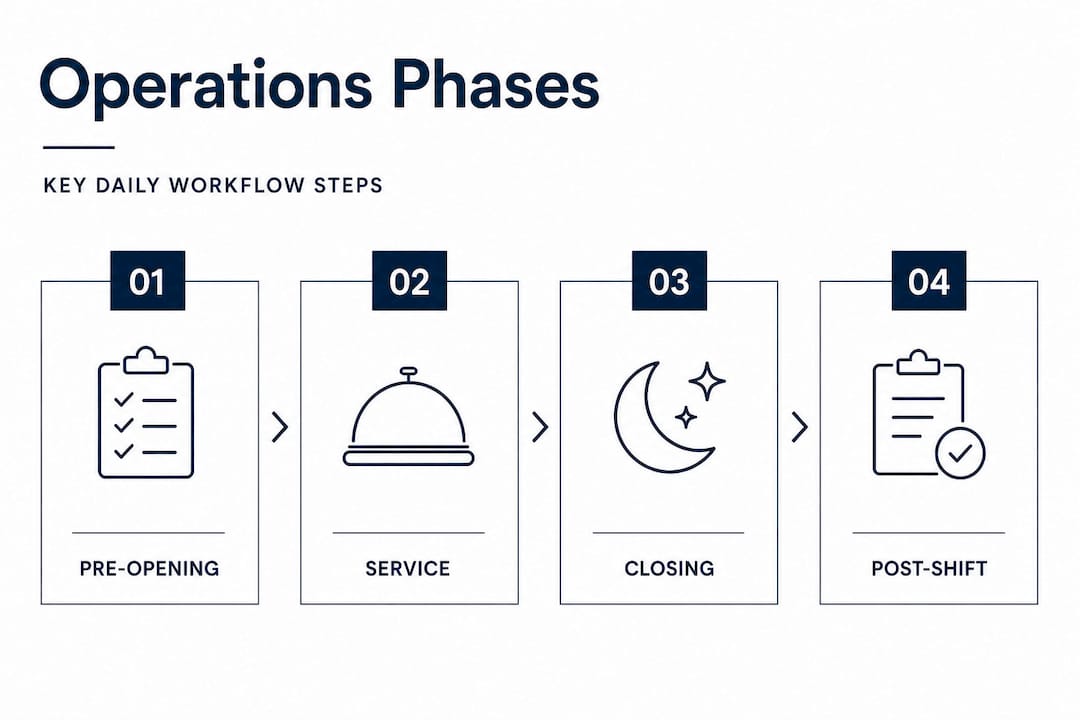
When you map your day this way, gaps become obvious. And obvious gaps are fixable gaps.
Designing clear workflows for kitchen and service
There are two fundamental approaches to how restaurants organize their work: explicit workflows and ad hoc workflows. Ad hoc operations rely on experienced staff to figure things out as they go. This can work on slow nights with a seasoned crew, but it breaks down fast under pressure. Explicit workflows define who does what, in what order, and by when. They are the foundation of consistency.
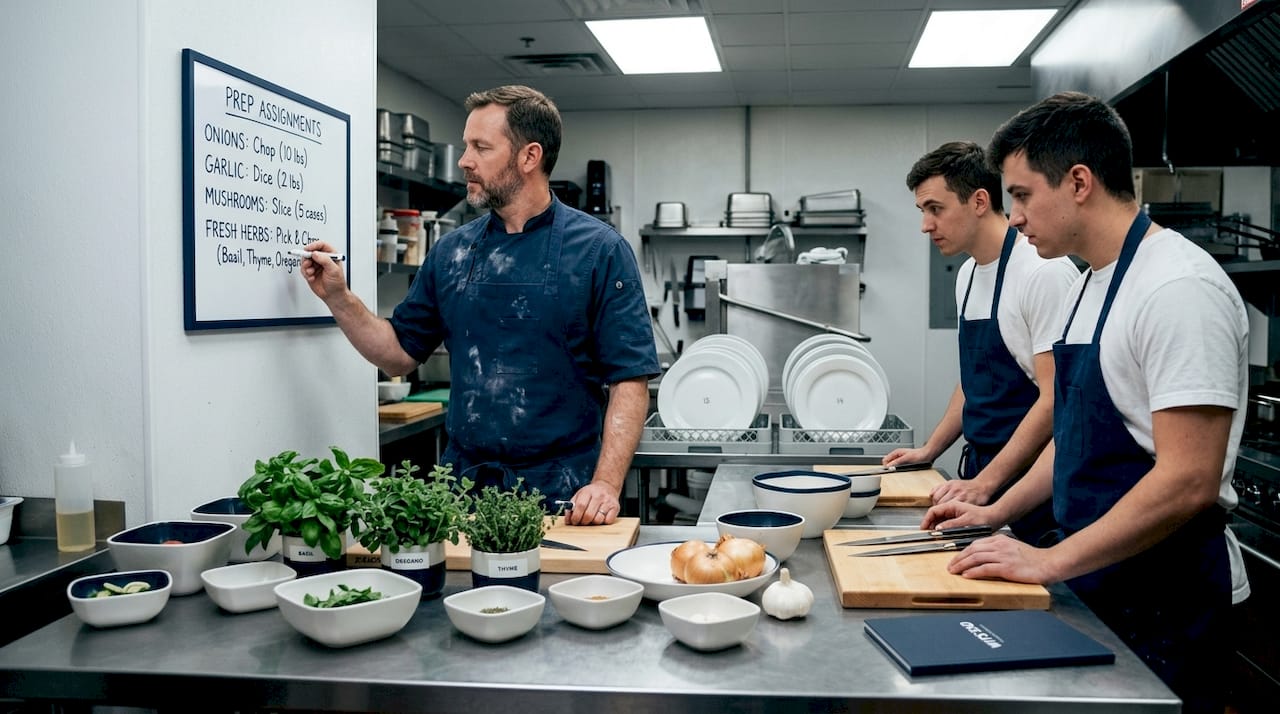
Think about the difference between a Friday night where everyone knows their lane and a Friday night where two people are waiting on the same task. The guest experience reflects the difference, even if the guests cannot name exactly what felt off.
Here is a practical opening-to-closing sequence you can adapt for your operation:
- Opening manager arrives and completes a physical walkthrough, checking equipment, temperatures, and supplies.
- Kitchen team completes mise en place for the first service period, with each station accountable for their own prep sheet.
- Pre-shift meeting covers the day's specials, any 86'd items, reservation notes, and one focused team goal.
- Doors open and hosts confirm the floor plan with the manager on duty.
- Service runs with designated expo or pass management to control ticket timing.
- Mid-service check-in at the two-hour mark for a quick reset on pacing and guest feedback.
- Closing team transitions with a clear handoff protocol, not an assumption that the outgoing team handled everything.
- Closing checklist completed with a manager sign-off before anyone leaves.
- Post-shift debrief takes five minutes and covers what worked, what didn't, and one thing to adjust tomorrow.
Plating pace and explicit sequencing are critical when guests are moving through timed courses, but the principle applies equally to any service environment where timing affects satisfaction.
Pro Tip: Post a simple whiteboard in your kitchen with one task per team member listed before each shift. It takes three minutes and removes the single biggest cause of mid-service confusion: people not knowing what they own.
| Traditional workflow | Modern explicit workflow |
|---|---|
| Tasks assigned verbally, forgotten quickly | Tasks written, visible, and time-stamped |
| Role overlap causes friction | Clear lanes eliminate redundancy |
| Debrief skipped due to fatigue | Short structured review builds habits |
| Improvement depends on memory | Improvement documented and tracked |
Your pre-shift tips and the way you structure your restaurant training programs both feed directly into how effective these workflows become in practice.
Measuring what actually matters: Beyond cost savings
The instinct to measure food cost and labor cost is not wrong. Those numbers matter. But if they are the only numbers you look at daily, you are flying with half your instruments blacked out.
The highest-performing restaurants measure guest experience alongside financial metrics, not instead of them. Managers who only track cost savings miss the fuller operational picture. What you should be measuring every day includes service speed, guest satisfaction scores, staff mood and energy, and early signals of repeat business.
Here is a practical list of daily KPIs worth tracking:
- Table turn time by daypart, not just as a daily average
- Guest satisfaction feedback, whether through comment cards, online reviews, or a quick server observation
- Staff readiness score, a simple manager assessment of whether the team arrived prepared and engaged
- Ticket time from order to table, tracked at the pass or expo station
- Void and comp rate, which signals both service failures and kitchen errors
- Repeat guest count, tracked through reservation history or loyalty program data
Most of these require no expensive software. A well-designed daily log and a five-minute review conversation can surface patterns that your P&L never will.
Pro Tip: Run your daily team huddle around experience, not just sales. Ask one question: "What did a guest tell you yesterday that we should do differently today?" That single habit shifts your team's orientation from transactional to relational.
Strong business optimization starts with knowing what to measure. And your analytics for hospitality toolkit should reflect both the financial and experiential sides of your operation.
Leveraging technology and training for operational visibility
Technology does not fix broken operations. But when your operations have a clear structure, technology makes that structure visible, scalable, and consistent across shifts and locations.
Real-time digital checklists are one of the most practical tools available to restaurant operators today. When team members complete tasks on a shared platform, managers can see progress without walking the floor every ten minutes. More importantly, completion data becomes a training tool. If opening tasks are consistently incomplete by a specific station, that signals a training gap rather than a personnel problem.
The results of thoughtful technology integration are measurable. Task execution linked to training through a shared platform can achieve over 80% checklist completion rates, and one restaurant group using this approach saw 22x user growth as adoption spread through the organization. Those numbers reflect real operational change, not just app downloads.
Here is how to implement a digital daily checklist without overcomplicating it:
- Audit your current manual checklists and identify which tasks are consistently skipped or done inconsistently.
- Choose a platform that your team can access on the devices they already use, reducing friction from the start.
- Build the checklist collaboratively with your managers and key staff so that ownership is built in from day one.
- Run a two-week pilot on one shift or one department before rolling out restaurant-wide.
- Review completion data weekly and use it as a coaching tool, not a disciplinary one.
- Celebrate consistency, not just results. A team that completes 95% of daily tasks reliably is building the foundation for excellent service.
| Technology feature | Operational benefit |
|---|---|
| Real-time task completion tracking | Managers address gaps before they affect service |
| Training content linked to tasks | Staff learn in context, not just in theory |
| Multi-unit visibility dashboard | Operators compare performance across locations |
| Automatic shift handoff notes | Reduces communication gaps between teams |
| Guest feedback integration | Connects service outcomes to operational decisions |
Tools like apps for driving guest count and a strong daily analytics dashboard create operational visibility that keeps your whole team aligned, from the dishwasher to the general manager.
Putting it all together: A daily operations playbook
A playbook is not a rigid rulebook. It is a living document that captures your best thinking about how a shift should run, then makes that thinking accessible to every person on your team, every day.
Your daily operations playbook should include the following elements:
- A written workflow for each phase of the day, with role assignments and time benchmarks
- A daily KPI tracking sheet covering both financial and experiential metrics
- A pre-shift briefing template that takes less than ten minutes
- A digital or paper checklist for opening, service, and closing
- A feedback loop structure, including how observations from the floor get back to management
- A space to capture one improvement idea per shift, no matter how small
To make this real, walk through a sample day. Opening manager arrives, completes the walkthrough, and checks the digital checklist to confirm all pre-opening tasks are assigned. The pre-shift briefing covers the reservation count, one training focus, and any menu updates. Service runs with an expo managing ticket flow. At the two-hour mark, the manager does a quick check on guest satisfaction and staff pacing. Closing team executes their checklist with manager sign-off. A five-minute debrief closes the loop.
Microsystems that link task execution, workflow, and real-time feedback create operations that are resilient to turnover, unexpected rushes, and the hundred small surprises that define restaurant life. The playbook is not about control. It is about giving your team the clarity to perform at their best without depending on you to be everywhere at once.
The playbook also needs to fit your concept. A fast-casual operation has different sequencing than a fine-dining room. Adapt the framework and the language to match your actual environment. Build in ways to boost guest count and upsell strategies into your briefing templates so that revenue goals and hospitality goals travel together.
Why small operational tweaks outshine sweeping overhauls
Here is something we have seen consistently across years of working with restaurants at every stage and scale: operators who chase the single fix almost always struggle. They invest in a new POS system, or redesign the kitchen, or hire an executive chef, and then discover that the underlying operational habits have not changed. The new tool or the new hire arrives into the same broken patterns.
The restaurants that improve most reliably do it differently. They make small, deliberate adjustments to their daily workflows. They ask better questions in pre-shift meetings. They add one KPI to their daily review. They introduce a checklist for one phase of the operation and actually hold the team accountable to it. These are not dramatic moves. But stacked over weeks and months, they create a fundamentally different operation.
The research on restaurant automation supports this view directly. Automation only optimizes what is already effective. When you layer technology onto chaos, you get faster chaos. When you layer technology onto clear workflows and strong training, you get scale.
We also push back on the idea that operational improvement is a project with an end date. The best operators we know treat it as an ongoing practice. They build feedback loops into their daily rhythm so that the operation is always learning. A shift debrief that captures one insight per day generates over 300 improvement cycles per year. That compounds.
The path forward is not about overhauling everything at once. It is about business optimization strategies that stack small, consistent wins into something your guests feel and your P&L reflects.
Take the next step in optimizing your restaurant operations
Running a high-performing restaurant takes more than good instincts. It takes structure, measurement, and a team that knows exactly what is expected of them each shift.
At Wits' End, we help restaurant operators put these systems in place, whether you need hands-on support through our task force services, structured skill-building through our training programs, or data-driven insight through our analytics and advising platform. We have run these operations ourselves, which means every recommendation we make is grounded in what actually works on the floor. If you are ready to move from reactive to intentional, we are ready to help you build that foundation.
Frequently asked questions
What are the essential elements of daily restaurant operations?
Core elements include structured workflows, clear role assignments, daily checklists, continuous measurement, and effective staff communication. Explicit workflow design with clear roles and sequencing is what keeps teams from falling behind during continuous service.
How can I measure success in daily restaurant operations?
Track service speed, guest satisfaction, staff engagement, and repeat business alongside your cost metrics. Measuring only cost savings leaves out the most important signals of how well your operation is actually performing.
What technology helps make restaurant operations more efficient?
Real-time checklist apps, training platforms with task integration, and analytics dashboards give managers visibility into daily performance. Task execution linked to measurable completion rates helps multi-unit operators maintain consistent standards across locations.
How do I start updating our restaurant's daily operations?
Begin by mapping your current workflow for each phase of the day, then assign specific roles to each task and introduce a simple daily checklist. Review the data with your team weekly to identify what to adjust.
Why do some restaurants with automation still deliver poor service?
Automation improves what is already working but cannot fix unclear workflows or undertrained teams on its own. When adopting technology, guest experience outcomes including service speed, staff engagement, and loyalty still need to be measured and actively managed.