
TL;DR:
- Hospitality outsourcing involves delegating operational functions to external specialists to cut costs and enhance service quality. It enables demand-based staffing, reduces fixed overheads, and allows management to focus on strategic initiatives. Carefully selecting and training partners ensures brand consistency, measurable performance, and significant operational efficiencies.
Hospitality outsourcing is defined as the delegation of specific operational functions to specialized external partners to reduce costs, improve service quality, and free internal teams for high-value work. The global hospitality outsourcing market is projected to reach $25 billion in 2026, growing at a CAGR of 10.5%, with some operators cutting operating expenses by up to 70%. Functions ranging from housekeeping and reservations to IT support and revenue management are now routinely handed to dedicated external providers. For hotel and restaurant operators competing on thin margins, this shift from fixed labor overhead to flexible, demand-based staffing models is one of the most consequential structural decisions you can make.
Why choose hospitality outsourcing over in-house operations?
The core case for outsourcing rests on four pillars: cost structure, scalability, service consistency, and leadership focus. Each one compounds the others when executed well.

Cost structure. In-house labor carries fixed costs regardless of occupancy or covers. Recruitment, onboarding, benefits, turnover, and compliance overhead stack up before a single guest interaction occurs. Outsourcing converts that unpredictable burden into a transparent contract rate. Your P&L becomes easier to model, and your cost-per-interaction drops as the partner scales their own team.
Scalability. A 200-room hotel running at 40% occupancy in January does not need the same housekeeping headcount as it does in July at 95%. Outsourced staffing models flex with demand, which means you stop paying for capacity you are not using. The same logic applies to reservations and customer service, where call volume swings sharply by season and day of week.
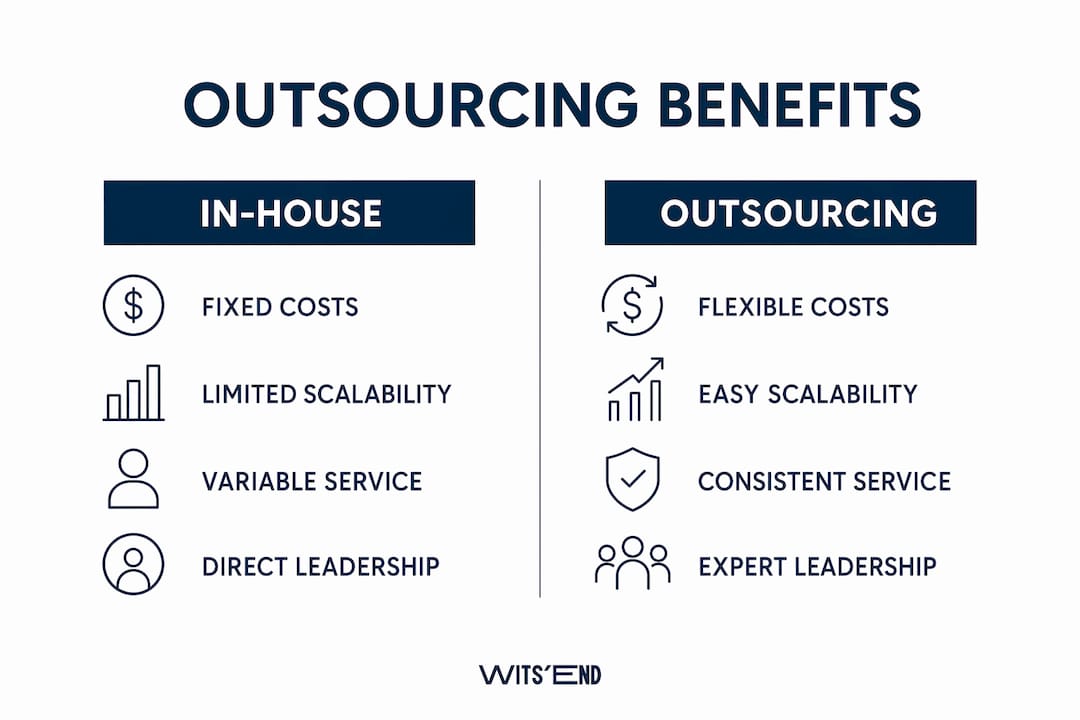
Service consistency. Specialized outsourced teams work within standardized workflows and quality systems. Specialized teams deliver higher reliability and faster response times than overextended in-house staff managing too many responsibilities at once. That consistency shows up directly in guest satisfaction scores and online reviews.
Leadership focus. Outsourcing frees management from operational firefighting, returning cognitive bandwidth to loyalty programs, guest engagement, and brand initiatives. This is the benefit most operators underestimate until they experience it firsthand.
- Reduced recruitment and training cycles for high-turnover roles
- Variable labor costs aligned to actual demand
- Access to specialized expertise in IT, revenue management, and compliance
- Faster ramp-up for new properties or seasonal openings
- Consistent service delivery backed by partner-managed quality controls
Pro Tip: Before signing any outsourcing contract, audit the partner's training program for brand alignment. Ask specifically how they handle service recovery and escalation protocols. A vendor who cannot answer that question in detail is not ready to represent your brand.
Which hospitality functions are most commonly outsourced?
The functions best suited for outsourcing share three characteristics: they are labor-intensive, their cost varies significantly with demand, and they require specialized expertise that is expensive to build in-house. Commonly outsourced functions include housekeeping, IT support, reservations, revenue management, and customer service.
Here is how the in-house versus outsourced model compares across those functions:
| Function | In-house model | Outsourced model |
|---|---|---|
| Housekeeping | Fixed payroll, benefits, and turnover costs | Demand-based scheduling, partner-managed retention |
| Reservations | Dedicated staff with idle time in low season | Scalable agent pools with 24/7 coverage options |
| IT support | Full-time hire or reactive break-fix | Managed service with proactive monitoring |
| Revenue management | Single analyst, limited benchmarking data | Specialist team with cross-portfolio market data |
| Customer service | In-house team capped by headcount | 24/7 guest support with teams as small as 2 to 4 dedicated agents |
Back-office functions like bookkeeping, HR administration, and payroll processing are also strong outsourcing candidates. These roles require precision and compliance knowledge but do not touch the guest directly, making them lower-risk to transition. Operators who outsource back-office work alongside front-line functions often see the largest combined efficiency gains because the administrative drag on property managers disappears at the same time as the operational one.
The key distinction between functions that outsource well and those that do not comes down to how deeply the role is embedded in your brand identity. Revenue management and IT are largely invisible to guests. Housekeeping and customer service are not, which means the training and integration requirements are higher but the upside is also greater when done correctly.
How does outsourcing affect guest experience and brand consistency?
The most common objection to outsourcing is that external teams will not care about your brand the way your own staff does. That concern is legitimate, but it is also solvable. The answer is not to avoid outsourcing guest-facing roles. The answer is to choose partners who treat brand alignment as a core deliverable, not an afterthought.
Brand-aligned training that covers brand voice, guest journey touchpoints, and service recovery protocols is the non-negotiable foundation for any guest-facing outsourced role. Partners who skip this step produce generic interactions that erode the differentiation you have spent years building. Partners who invest in it produce guest interactions that are often more consistent than what an undertrained in-house team delivers.
Digital tools and real-time reporting have changed the transparency equation significantly. Outsourced housekeeping operations now run on data-informed quality controls and reporting dashboards, turning what was once a "black box" function into a measurable business process. You can see room completion rates, inspection scores, and response times in real time rather than waiting for a guest complaint to surface a problem.
"Consistent guest experience requires outsourcing partners deeply embedded in brand culture rather than transactional vendors." — Brand-first hospitality outsourcing
Small dedicated teams also solve the coverage problem without sacrificing personalization. A team of two to four agents trained specifically on your property can maintain 24/7 support coverage while still knowing your room categories, your loyalty program tiers, and your escalation contacts. That is a level of service continuity that most independent hotels cannot sustain with in-house staff alone. For more on building guest experience standards that hold across every touchpoint, the principles apply whether your team is internal or external.
What financial and operational efficiencies does outsourcing unlock?
The financial case for outsourcing goes deeper than the headline labor cost reduction. Outsourcing converts unpredictable labor overhead into transparent contract costs while the partner absorbs benefits, recruitment, and retention expenses. That shift alone simplifies your monthly P&L review and removes a category of cost that most operators struggle to forecast accurately.
Hidden costs are where the real savings accumulate. Consider what in-house turnover actually costs: job postings, manager time spent interviewing, onboarding hours, reduced productivity during the learning curve, and then the cycle repeating. Outsourcing partners manage their own retention, which means those costs disappear from your books entirely.
Pro Tip: When evaluating outsourcing ROI, calculate your current fully-loaded cost per role including benefits, turnover replacement cost, and manager oversight time. Compare that to the all-in contract rate. Most operators find the gap is larger than they expected.
Compliance and liability exposure is another area where outsourcing delivers measurable value. Partners who specialize in hospitality staffing stay current on labor law, safety regulations, and training requirements. That expertise reduces your risk without requiring you to build a compliance function in-house.
- Lower turnover replacement costs transferred to the outsourcing partner
- Reduced liability through partner-managed compliance and safety training
- Predictable monthly contract costs replacing variable payroll fluctuations
- Faster scaling without capital investment in recruitment infrastructure
- Access to automation and workflow tools the partner has already built and tested
The operational advantages of business optimization compound over time. As your outsourcing partner learns your property and refines their workflows, efficiency improves without additional cost on your end.
How to select and implement the right outsourcing partner
Choosing the right partner is where most outsourcing arrangements succeed or fail. The decision criteria go well beyond price. Partnership quality, transparency, and performance monitoring are the factors that differentiate effective outsourcing engagements from costly mistakes.
Follow this process to select and onboard an outsourcing partner effectively:
- Define the scope precisely. Identify which functions you are outsourcing, what performance standards apply, and what the handoff points are between the partner and your in-house team. Ambiguity at this stage creates friction later.
- Evaluate brand alignment capability. Ask every candidate how they train guest-facing staff on brand voice and service recovery. Request examples from comparable properties. A generic answer is a disqualifying answer.
- Assess dedicated versus pooled models. Dedicated teams assigned exclusively to your property deliver better brand consistency than shared agent pools. For guest-facing roles, the dedicated model is almost always worth the premium.
- Negotiate transparency into the contract. Require real-time reporting access, defined KPIs, and regular performance reviews. You should be able to see operational data without asking for it.
- Plan the onboarding in detail. Build a structured ramp-up period with clear milestones. Include your brand standards documentation, escalation protocols, and a shadowing period where the partner team works alongside your in-house staff before going live.
- Retain operational control on standards. Outsourcing execution does not mean outsourcing accountability. Your team sets the standards, monitors performance, and holds the partner to them. The partner delivers the labor and expertise. You own the outcome.
For properties considering task force solutions as a bridge between in-house and fully outsourced models, that hybrid approach can also work well during transitions or high-demand periods.
Key takeaways
Hospitality outsourcing delivers the greatest return when operators treat it as a strategic model for cost control, service quality, and leadership focus rather than a simple headcount reduction.
| Point | Details |
|---|---|
| Cost structure shift | Outsourcing converts fixed labor overhead into transparent, demand-based contract costs. |
| Guest experience is manageable | Brand-aligned training and real-time reporting keep outsourced teams consistent with your standards. |
| Functions suited for outsourcing | Housekeeping, reservations, IT, revenue management, and customer service outsource most effectively. |
| Partner selection is decisive | Transparency, dedicated team models, and performance monitoring separate strong partners from weak ones. |
| Leadership focus is the hidden gain | Freeing management from operational tasks returns time to loyalty, engagement, and revenue growth. |
The case for outsourcing is stronger than most operators realize
I have worked with enough hotel and restaurant operators to know that the word "outsourcing" still triggers a defensive reaction in many of them. The fear is that handing off a function means losing control of it. In practice, the opposite is often true.
When you outsource housekeeping to a partner running digital quality controls and real-time dashboards, you have more visibility into that operation than you did when it was managed informally in-house. When you bring in a dedicated reservations team trained on your brand, you get more consistent call handling than a rotating cast of front desk staff covering phones between check-ins.
The operators I have seen get the most from outsourcing treat it as a precision tool, not a blunt cost-cutting instrument. They outsource specific functions where a specialist can outperform their in-house team, and they hold those partners to clear, measurable standards. They do not outsource their culture or their accountability. They outsource execution in areas where execution is the problem.
The financial case is real. The service quality case is real. But the most underrated benefit is what happens to your leadership team when they stop spending half their week managing operational problems that a good partner could handle. That reclaimed focus is where competitive differentiation actually gets built. Read more on how hospitality consulting can support that shift in strategic focus.
— Chris
How Wits' End Solutions supports your outsourcing strategy
At Wits' End Solutions, we work with hotel and restaurant operators across the United States to build the operational models that make outsourcing work. That includes brand development to define the standards your outsourcing partners must meet, task force services to cover critical operational gaps, and deep analytics to track performance across every function you hand off. We have run these operations ourselves, which means we know what good looks like and what a weak partner contract costs you over time. If you are evaluating outsourcing options or want a second opinion on a current arrangement, talk to our team about where the real opportunities are in your business.
FAQ
What is hospitality outsourcing?
Hospitality outsourcing is the practice of delegating specific operational functions, such as housekeeping, reservations, IT support, or revenue management, to specialized external partners. The goal is to reduce costs, improve service consistency, and free internal teams for higher-value work.
Is hospitality outsourcing worth it for small properties?
Yes. Small properties benefit significantly because outsourcing removes the fixed cost burden of full-time roles that may not be fully utilized. Even a team of two to four dedicated agents can provide 24/7 guest support coverage that a small in-house team cannot sustain.
Which hospitality functions should you outsource first?
Start with labor-intensive, high-turnover functions where specialist expertise adds clear value. Housekeeping, customer service, and IT support are the most common starting points because the cost and quality benefits are measurable and the transition risk is manageable.
How do you maintain brand standards with an outsourced team?
Require brand-specific training that covers your guest journey, service recovery protocols, and communication standards before the partner goes live. Pair that with real-time reporting and regular performance reviews to catch and correct drift early.
What does hospitality management outsourcing cost compared to in-house staffing?
The all-in contract rate for outsourced functions is typically lower than the fully-loaded in-house cost once you account for benefits, recruitment, turnover replacement, and manager oversight time. The exact gap varies by function and market, but operators consistently find the comparison favors outsourcing when all costs are included.