

Hospitality consulting is one of those terms that gets applied to everything from a one-time menu review to a full operational overhaul, and that ambiguity costs operators real money. When you don't know exactly what you're buying, you can't measure whether it worked. This guide cuts through the noise and gives you a clear picture of what hospitality consulting actually covers, the distinct specializations that exist within it, why and when businesses engage consultants, and how to structure an engagement so it produces results you can measure on your P&L.
Table of Contents
- Key takeaways
- What hospitality consulting is
- Why and when to use hospitality consulting
- How a consulting engagement actually works
- The five consulting types in practice
- How to select and engage the right consultant
- My honest take on where consulting goes wrong
- How Witsendsolutions can help
- FAQ
Key takeaways
| Point | Details |
|---|---|
| Hospitality consulting is sector-specific | It requires deep knowledge of hotel and restaurant operations, not just general business advisory skills. |
| Five core specializations exist | Finance, operations, revenue management, strategy, and technology each address distinct business challenges. |
| Timing and triggers matter | Engage consultants during growth phases, operational breakdowns, or financial restructuring for the strongest return. |
| Structure prevents failure | Clear scope, defined milestones, and knowledge transfer are what separate successful engagements from expensive reports. |
| Cultural fit is non-negotiable | The best consultant with the wrong working style will underdeliver. Alignment between teams matters as much as credentials. |
What hospitality consulting is
At its core, hospitality consulting refers to sector-specific advisory services delivered to hotels, restaurants, bars, resorts, food and beverage groups, and hospitality real estate owners. The work is aimed at improving performance, whether that means tightening labor costs, building a new brand concept, fixing a broken guest experience, or preparing a property for investment.
What separates hospitality consulting from general business consulting is the depth of operational knowledge required. Understanding USALI reporting, labor scheduling in a union environment, or how a hotel's RevPAR interacts with its cost structure are not skills that transfer from other industries. A general business consultant can analyze a P&L. A hospitality consultant reads it in the context of a 200-cover Friday service or a 90-room property running at 68% occupancy during shoulder season.
It's also worth separating hospitality consulting from hospitality management. Management means running the operation day to day. Consulting means advising on how to improve it, with a defined beginning and end, even when the engagement includes hands-on support. The distinction matters because it shapes how you measure success and how you structure the relationship.
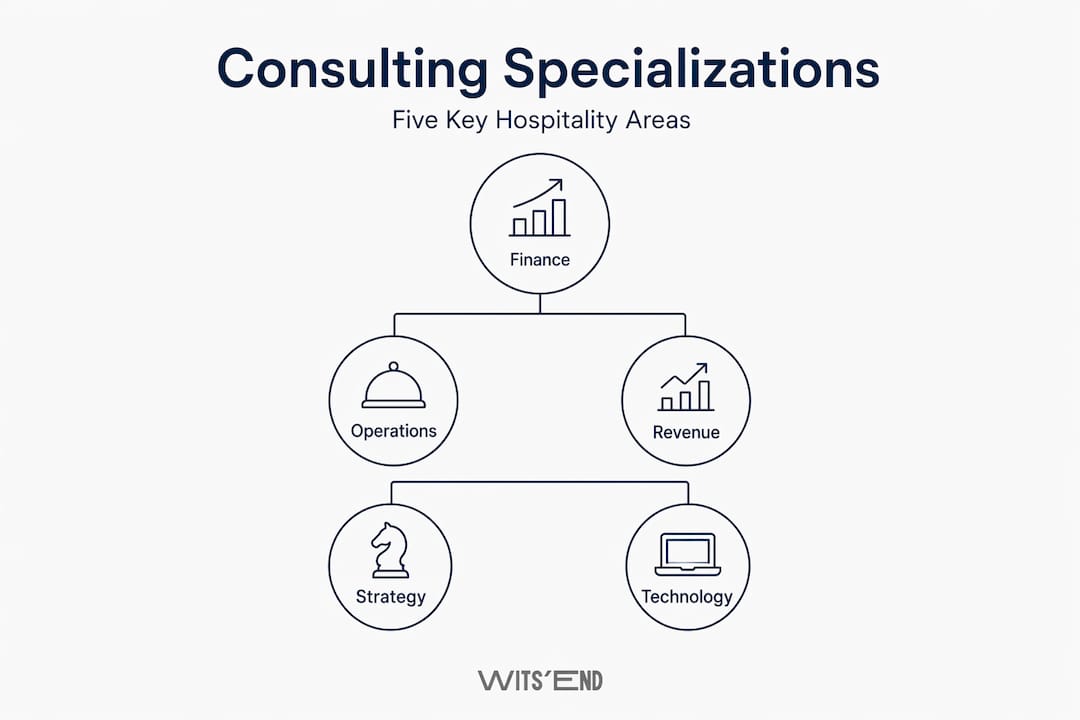
Hospitality consulting specializations break down into five primary types:
- Finance and accounting consulting: Bookkeeping, financial planning and analysis, cash flow management, and fundraising readiness
- Operations consulting: Guest experience standards, staffing models, kitchen efficiency, SOP development, and service quality
- Revenue management consulting: Pricing strategy, channel distribution, yield optimization, and demand forecasting
- Strategy consulting: Market positioning, feasibility studies, concept development, and M&A advisory
- Technology consulting: PMS and POS implementation, automation, data integration, and tech stack assessment
| Consulting type | Core focus | Typical output |
|---|---|---|
| Finance and accounting | P&L health, forecasting, investor readiness | Financial models, reporting systems |
| Operations | Service quality, staffing, kitchen performance | SOPs, training programs, efficiency gains |
| Revenue management | Pricing, distribution, demand optimization | Rate strategies, channel configurations |
| Strategy | Market position, growth, feasibility | Business plans, concept frameworks |
| Technology | PMS, POS, automation | System implementations, tech audits |
Why and when to use hospitality consulting
Knowing what hospitality consulting is only gets you halfway there. The more practical question is when it actually makes sense to engage outside expertise.
The most common triggers fall into three categories. First, operational breakdown. Your covers are flat, your team is turning over, your kitchen is hemorrhaging food cost, and you can't identify the root cause from inside the building. Second, growth initiatives. You're opening a new location, launching a food and beverage program, or repositioning a property. Third, financial restructuring. Ownership is changing, investment is coming in, or the business needs to demonstrate improved performance to lenders or partners.
The benefits of hospitality consulting show up across several dimensions beyond profitability alone. Improved guest satisfaction scores, measurable gains in staff productivity, and reduction in labor cost as a percentage of revenue are all indicators that a consulting engagement delivered real value. These aren't soft metrics. They translate directly to your bottom line and your ability to retain the team you've worked hard to build.
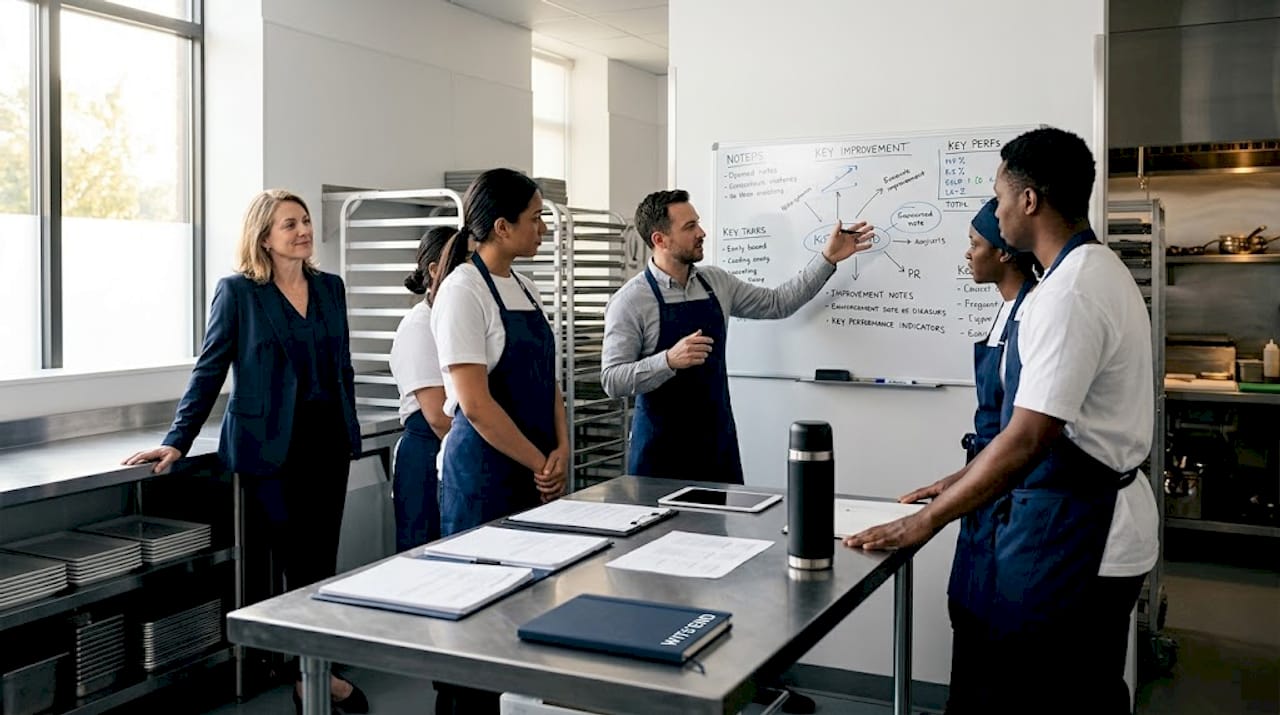
One thing operators consistently underestimate is how much their own resource readiness affects outcomes. Organizations must evaluate their capacity to absorb change before bringing in outside help. If your management team is already stretched thin, a consulting engagement that adds deliverables and meetings to their week will stall quickly. Readiness is not a passive factor. It's part of what determines whether the engagement succeeds.
Pro Tip: Before signing any consulting agreement, assess your team's available bandwidth honestly. A capable consultant can only move as fast as your internal team can implement.
How a consulting engagement actually works
Most operators who've had a disappointing consulting experience describe the same thing. Someone came in, observed the operation, produced a report, and left. The report was accurate. Nothing changed. That outcome is not inevitable. It's the result of a poorly structured engagement.
Well-designed consulting engagements follow a structured workflow that moves through three distinct phases. The diagnostic phase involves audits, interviews, data review, and observation. The planning phase translates findings into specific recommendations with timelines and responsible parties. The implementation phase is where the actual work happens, and it almost always requires the consultant to be present and accountable, not just available.
A few principles separate the engagements that produce lasting results from those that produce expensive binders:
- Every recommendation should have a named owner, a deadline, and a measurable outcome
- Implementation support should include training, SOP creation, and reinforcement cycles
- Progress reviews should happen on a set schedule, not just when something goes wrong
- Knowledge transfer should be explicit. Your team needs to understand the why behind each change, not just the what
Report-only consulting fails to institutionalize change because it skips the part where your team builds capability. The best engagements treat knowledge transfer as a core deliverable, not an afterthought. When the consultant leaves, your team should be operating at a higher level than before, not just following a new set of instructions they don't fully understand.
Pro Tip: Ask any consultant you're considering to describe a specific engagement where they stayed through implementation. If they can't name one, you're likely buying a report, not a result.
The five consulting types in practice
Understanding the five specializations in concrete terms helps you match your actual business problem to the right expertise. Each one produces different outputs and requires different skills from the consultant.
Finance and accounting consulting goes deeper than monthly bookkeeping. At the advisory level, it includes building financial models that reflect your actual cost structure, preparing the business for outside investment, and creating reporting systems that give ownership real visibility into performance. If your P&L is accurate but you still can't tell whether a specific revenue center is profitable, that's a finance consulting problem.
Operations consulting is where most hotel and restaurant operators find the clearest immediate value. This is the work of defining what an excellent guest experience looks like in your specific context, then building the staffing model, training systems, and kitchen processes to deliver it consistently. The output is not a concept. It's a set of standards your team can execute on a Tuesday night in February, not just a Saturday in peak season.
Revenue management consulting addresses the pricing and distribution mechanics that determine how much of your available capacity converts to revenue. For hotels, that means rate strategy, OTA channel management, and demand forecasting. For restaurants, it touches table turn times, menu engineering, and private dining yield. The strategic partnership between advisory firms and operators often extends across the full asset lifecycle, from feasibility through ongoing performance optimization.
Strategy consulting is most relevant during inflection points: a new concept launch, a market entry decision, a rebranding, or a sale process. The work is less about fixing what's broken and more about identifying where the opportunity is and whether your business is positioned to capture it. Brand design and market positioning work falls within this category when it's grounded in competitive analysis and operational reality.
Technology consulting covers PMS and POS selection, implementation oversight, integration between systems, and increasingly, the use of analytics platforms to drive better decision-making. The mistake operators make here is treating technology as the solution rather than the tool. A great PMS won't fix a broken check-in process. It will, however, surface data that helps you identify the problem faster.
How to select and engage the right consultant
Finding the right hospitality consultant is a more specific task than it appears. The process should start with an honest internal assessment before you talk to anyone on the outside.
- Define the problem clearly. Are you losing money in a specific revenue center? Is turnover unusually high? Are you preparing for a growth phase? The more precisely you define the challenge, the easier it is to evaluate whether a given consultant has the right experience to address it.
- Assess your capability gaps. List what your team does well and where the expertise runs thin. A consultant who complements your existing strengths will produce better results than one who duplicates them.
- Write the scope before you start conversations. Vague engagements produce vague outcomes. Defined timelines and measurable milestones protect both sides and keep the work focused.
- Evaluate cultural fit directly. Ask how the consultant works with internal teams. Ask what happens when they disagree with the client's instincts. Ask to speak with a former client whose business resembles yours.
- Build accountability into the contract. Structured reporting and communication frameworks prevent drift and keep the engagement aligned with original objectives.
Pro Tip: The consultant's proposal tells you how they think. A proposal that's vague on deliverables and heavy on process language is a signal, not a coincidence.
My honest take on where consulting goes wrong
I've seen hospitality consulting work extraordinarily well, and I've seen it produce nothing. The difference almost never comes down to the consultant's technical knowledge.
What I've observed is that engagements fail when the scope is written to sell rather than to deliver. Broad language about "optimizing performance" or "improving guest experience" without specific measurable targets gives everyone an exit when results fall short. I've learned to treat a vague scope as a red flag, regardless of how impressive the firm's credentials are.
The second pattern I keep seeing is consultants who arrive with a template and map the client's business onto it, rather than the other way around. Your operation has specific constraints, a specific team, and a specific market. The consultant who starts by listening and diagnosing before recommending is far more likely to deliver something that actually holds after they leave.
I also believe strongly in knowledge transfer as a core deliverable. The most valuable thing a consultant can do is leave your team more capable than they found them. If the improvements depend on the consultant staying in the picture indefinitely, that's not a consulting success. That's a dependency.
Choose the engagement structure that fits your business, hold both sides accountable to specific outcomes, and treat the relationship as a partnership with a purpose-built end date.
— Chris
How Witsendsolutions can help
At Witsendsolutions, we work with hotel and restaurant operators at every stage of the business lifecycle, from the first concept sketch to full daily operations support. Our consulting model is built around the principles this article describes: clear scope, measurable outcomes, and genuine knowledge transfer to your team.
Our business optimization services cover the full range of operational and financial performance work, and our task force teams can step into your operation with senior-level expertise exactly when and where you need it. We've done the work ourselves before we recommend it to anyone else, and that experience shapes every engagement we take on. If you're ready to move from identifying the problem to solving it, Witsendsolutions is built for that conversation.
FAQ
What is hospitality consulting?
Hospitality consulting refers to sector-specific advisory services delivered to hotels, restaurants, bars, and food and beverage groups to improve operational, financial, or strategic performance. It differs from general business consulting because it requires deep knowledge of hospitality-specific metrics, cost structures, and guest experience standards.
What does hospitality operations consulting cover?
Hospitality operations consulting focuses on improving the day-to-day performance of a hotel or restaurant through staffing models, service standards, kitchen efficiency, SOP development, and training programs. The goal is consistent, measurable improvement in guest experience and labor cost management.
When should a hospitality business use a consultant?
The strongest return on investment typically comes during three scenarios: operational breakdown where internal teams can't identify the root cause, growth initiatives like new openings or rebranding, and financial restructuring ahead of investment or ownership transitions.
How do you avoid a bad consulting engagement?
Define the scope precisely before signing, require measurable deliverables with named owners and deadlines, and ask any prospective consultant to describe a specific engagement where they stayed through full implementation. Vague scopes and report-only deliverables are the most common causes of consulting failure.
What's the difference between hospitality consulting and hospitality management?
Consulting is advisory work with a defined scope and timeline, aimed at improving specific aspects of performance. Management means running the operation on an ongoing basis. Some consulting engagements include embedded operational support, but the relationship should still have clear objectives and an exit plan.