

Unclear branding costs hospitality businesses more than most owners realize. When guests cannot quickly grasp what makes your hotel or restaurant different, they default to price comparisons, leave ambiguous reviews, and rarely return with intention. Consistency in brand identity can increase revenue by up to 33%, yet most properties still treat branding as a logo project rather than a business system. This guide walks you through every phase of building a hospitality brand that drives loyalty, commands premium positioning, and actually shows up in your daily operations.
Table of Contents
- What makes a hospitality brand?
- Step-by-step: Creating your hospitality brand
- Branding through guest experience and operations
- Optimizing brand value: Loyalty, measurement and continuous improvement
- A fresh perspective: Why branding is a daily discipline, not a one-time project
- Take your hospitality brand further with expert support
- Frequently asked questions
Key Takeaways
| Point | Details |
|---|---|
| Branding is a holistic system | Hospitality brands go beyond a logo and require strategy, identity, applications, and ongoing execution. |
| Staff behavior influences brand | Trained staff and daily operations are critical for brand consistency and guest experience. |
| Consistency boosts revenue | Consistent brand touchpoints can increase revenue by up to 33% for hotels and restaurants. |
| Loyalty and measurement matter | Tracking NPS, retention, and using loyalty programs drive brand growth and measurable improvements. |
| Continuous improvement is key | Reviewing and optimizing your brand performance leads to sustained guest advocacy and business success. |
What makes a hospitality brand?
Most owners know they need a brand, but the definition gets fuzzy quickly. A hospitality brand is not your logo or your color palette. It is the complete system of signals, behaviors, and experiences that guests encounter from the moment they search for you online to the moment they check out or settle their bill. Every touchpoint contributes to how guests perceive your value, and inconsistency anywhere in that chain weakens the whole picture.
As hospitality branding experts note, a hospitality brand is built through an end-to-end system, not just a logo. That system has four interconnected layers. First, brand strategy covers your positioning, your mission, your target guest, and the promises you make. Second, visual identity brings that strategy to life through design: your logo, typography, color palette, and photography style. Third, brand applications are the physical and digital places where that identity appears, from menus and staff uniforms to your website and social media. Fourth, implementation is how all of it gets operationalized, trained into your team, and consistently delivered.
Think about what restaurant branding engagement actually looks like in practice. A guest walks in, reads a menu written in your voice, is greeted by staff who genuinely embody your concept, eats food that aligns with your positioning, and leaves with a takeout bag that carries your visual identity. Each of those moments reinforces the brand or dilutes it.
| Brand layer | What it includes | Why it matters |
|---|---|---|
| Strategy | Mission, audience, positioning | Defines all decisions that follow |
| Visual identity | Logo, type, color, photography | Creates recognizable consistency |
| Applications | Menus, signage, digital, uniforms | Brings identity into every space |
| Implementation | Training, launch, operations | Ensures the brand is actually lived |
"Your brand is the sum of every single interaction a guest has with your business. One weak link in that chain is enough to change how they feel about the whole experience."
Step-by-step: Creating your hospitality brand
Understanding the brand's elements, you're ready to follow a proven process for creation. Here's how to build your brand step-by-step.
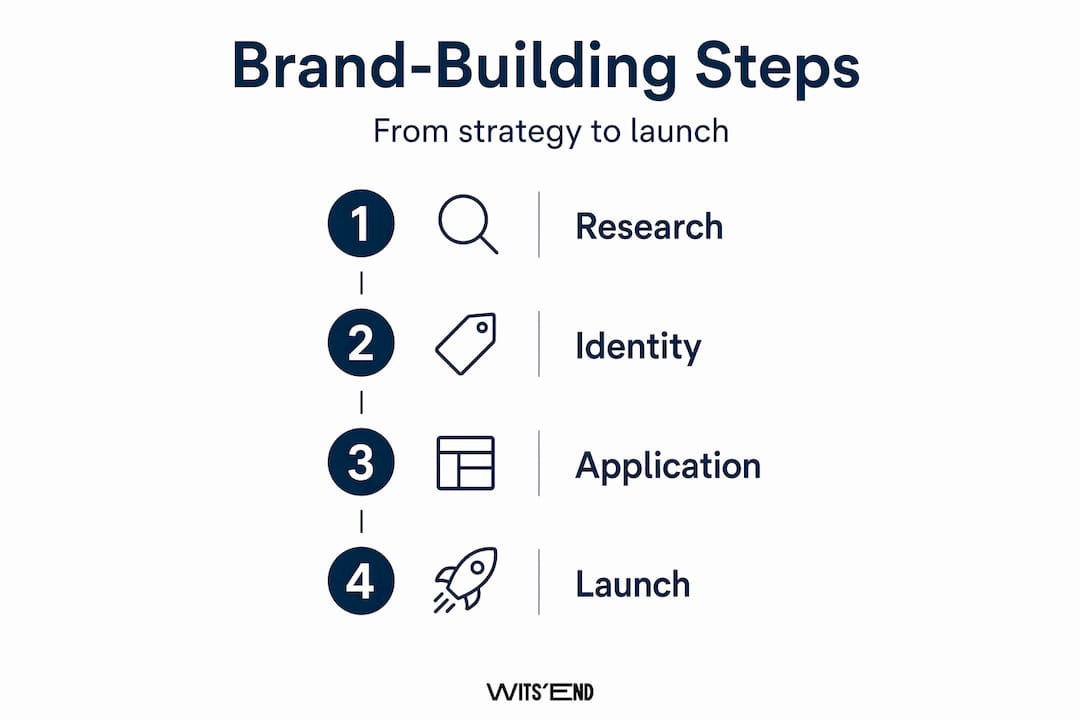
Brand strategy for hotels should include research, mission, target audience definition, and clear positioning before any design work begins. Skipping this phase is the most common and most expensive mistake in hospitality branding. Many owners jump straight to picking colors and fonts before they can articulate what makes their property worth choosing.
Phase 1: Research and strategy
Start with a genuine audit of your competitive landscape. Visit competitors in person. Read their reviews and look for language guests use to describe the experience. Map your target guest with specificity: not just "business travelers" or "foodies," but the mindset, budget, values, and motivations of the person you are most trying to reach. From there, write a mission statement that is specific enough to guide decisions. "A warm, neighborhood-focused restaurant that celebrates seasonal American cooking" is more useful than "a great dining experience for everyone."
Phase 2: Visual identity development
Once strategy is locked, bring in a designer who has hospitality experience. Brief them on your positioning and your guest profile, not just on aesthetics you like. Develop a logo that works across every application, from a six-inch plate stamp to a large exterior sign. Choose a typography system that signals the right personality and remains legible in low-light restaurant environments. Build a color palette that works in print, on screen, and in physical spaces. Establish a photography style that will guide every image you use for the next several years. Document all of this in a brand guidelines file.
Phase 3: Brand applications
This is where identity meets the physical world. Your menu is one of the most powerful branding tools you have, and it should reflect your positioning in both design and language. Signage, tableware, packaging, staff uniforms, website design, and email templates all need to pull from the same guidelines. For multi-outlet properties, you will also need to think through brand architecture: how sub-brands relate to the parent brand and where they share versus differentiate visual identity.
Phase 4: Launch and implementation
Coordinate with vendors early, especially for printed materials, custom packaging, and signage, since lead times are often longer than expected. Train your team on the brand before you open or relaunch. Staff need to understand not just what the brand looks like, but what it feels like to work inside it. Run a soft launch with invited guests before a public social media rollout so you can catch operational gaps while the stakes are lower.
Pro Tip: Keep a living brand checklist that covers every guest-facing surface in your property. Walk through it quarterly to catch drift before it becomes a pattern.
| Phase | Key deliverables | Common pitfall |
|---|---|---|
| Research and strategy | Audience profile, mission, positioning | Skipping research and guessing |
| Visual identity | Logo, type, color, photography, guidelines | Hiring generalists over hospitality specialists |
| Applications | Menus, signage, digital, uniforms | Inconsistent application across touchpoints |
| Launch | Staff training, vendor coordination, rollout | Launching before staff are aligned |
For properties that are revisiting an existing concept, the restaurant rebranding strategies involved in revitalizing a brand require the same research-first rigor, sometimes more, because you are also managing the perceptions of guests who already know you. These hospitality brand-building steps apply whether you are starting from scratch or refreshing a mature concept.
Branding through guest experience and operations
Once the brand is launched, the real work begins: delivering the brand promise daily through operations and staff.

A beautifully designed brand that never makes it past the staff room is one of the most frustrating and common failures in hospitality. The brand lives in every guest-facing interaction, not on the mood board. How your host greets a walk-in, how your front desk handles a complaint, how your server describes a dish, how quickly a room is turned over and to what standard: all of it either confirms or contradicts your brand positioning.
Brand alignment training ensures the brand promise is met in daily operations and is not just a marketing claim on your website. This means your onboarding process must include explicit brand education, not just job function training. New hires should understand what the brand stands for, who it serves, and how their specific role contributes to it. That context transforms a checklist into a mindset.
Consider how brand identity consistency operates at the service level. A high-end boutique hotel that positions itself on personalization needs staff who remember returning guests, anticipate preferences, and communicate in a warm but refined tone. If the front desk team is transactional and hurried, the brand promise collapses regardless of how good the design work is.
Practical areas where operational brand delivery often breaks down include:
- Service language: Staff using generic phrases that conflict with your brand tone
- Problem resolution: Inconsistent approaches to guest complaints that leave different impressions depending on who handles the issue
- Physical environment: Maintenance gaps, like a broken fixture or a stained menu, that signal inattention
- Handoffs: Transitions between departments, like check-in to housekeeping to F&B, where information gets lost and the guest feels like a stranger every time
"The strongest brands in hospitality are not built in boardrooms. They are built shift by shift, interaction by interaction, by team members who actually understand what the business stands for."
Investing in your staff training programs is the most direct way to close the gap between brand design and brand delivery. When roles are vacant or there is a surge in demand, task force services can help maintain brand standards while your permanent team is at capacity.
Pro Tip: Create a simple one-page brand card that captures your mission, your guest promise, and three to five behaviors that reflect your brand values. Give it to every new hire on day one and revisit it in team meetings regularly.
Optimizing brand value: Loyalty, measurement and continuous improvement
Delivering the brand is ongoing. Next, learn how to maximize brand value, capture loyalty, and measure your success.
A brand that is never measured is a brand that drifts. Many hospitality businesses build a strong concept at launch and then assume it is running well because revenue is stable. But guest expectations shift, competitive landscapes evolve, and operational habits quietly erode standards over time. The properties that maintain brand strength are the ones that build measurement into their culture.
Tech-enabled loyalty programs serve as marketing engines that personalize guest engagement, drive repeat visits, and generate data you can act on. A loyalty program tied to your POS and reservation system can tell you which guests visit most frequently, what they spend, what they order, and when they lapse. That data allows you to reach out with targeted offers rather than blanket promotions, which both reduces marketing spend and strengthens the guest relationship.
Key performance indicators for brand health include:
- Net Promoter Score (NPS): Measures guest likelihood to recommend, giving you a single number to track over time
- Retention rate: The percentage of guests who return within a defined window, a direct measure of brand loyalty
- Customer acquisition cost: How much you spend to bring in a new guest, which should decrease as brand awareness builds
- Average spend per visit: Tracks whether brand positioning is translating into the right purchasing behavior
- Review sentiment: Qualitative analysis of online reviews to identify recurring language, both positive and negative
Benchmarking NPS and retention against industry standards gives you context for where your brand stands relative to competitors. A score you think is good might be average for your segment, and knowing that pushes you to improve.
| KPI | What it measures | Review frequency |
|---|---|---|
| Net Promoter Score | Guest advocacy and likelihood to recommend | Monthly |
| Retention rate | Repeat visit behavior | Monthly |
| Customer acquisition cost | Marketing efficiency | Quarterly |
| Review sentiment | Brand perception in guest language | Weekly |
| Average spend per visit | Positioning alignment with revenue | Monthly |
Use hospitality analytics to connect these metrics to operational data, so you can see patterns rather than isolated numbers. If NPS drops during a specific shift or season, that is an operational clue, not just a score. Reviewing your restaurant loyalty best practices alongside your data gives you a framework for acting on what you find.
Pro Tip: Set a standing quarterly brand review that includes your leadership team. Pull your top five KPIs, review three to five recent guest comments, and identify one operational area to improve in the next 90 days. Small, consistent adjustments accumulate into measurable brand strength.
A fresh perspective: Why branding is a daily discipline, not a one-time project
Here is the uncomfortable truth most branding guides skip: building the brand is the easy part. Sustaining it is where most hospitality businesses fall short.
Owners invest real time and money in concept development, design work, and a solid launch. Then day-to-day operations take over, a key manager leaves, the team gets stretched thin during a busy season, and slowly the brand starts to blur at the edges. Staff stop using the right language. The menu hasn't been updated to reflect the season. The social media feed goes quiet for weeks. None of these things feel catastrophic in isolation, but together they erode the clarity your guests once felt.
We have seen this pattern across properties of every size, from single-unit restaurants to multi-property hotel groups. The businesses that maintain strong brands do not have better designers or bigger budgets. They have owners and operators who treat the brand as a living standard, one that requires the same attention as their P&L or their food cost. They build brand accountability into their management structure, not just their marketing calendar.
The other thing that gets underestimated is the role of frontline staff in brand-building. Your general manager and ownership team may be fully aligned on the brand vision, but if your servers, housekeepers, and front desk agents do not understand it or believe in it, the guest never feels it. Investing in staff training insights is not just a performance issue. It is a brand issue. Culture and brand are the same thing when viewed from the guest's side of the table.
The operators we most respect do not talk about their brand as a design project they completed. They talk about it as the way they run their business, every day, through every decision, from hiring to menu development to how they handle a difficult guest. That orientation changes everything about how consistently the brand is delivered.
Take your hospitality brand further with expert support
Building a brand that genuinely connects with guests and sustains that connection through operations, training, and measurement is a significant undertaking. You do not have to figure it out on your own.
At Wits' End, we partner with hotel and restaurant owners at every stage of the brand lifecycle. Whether you are building a concept from scratch, refreshing an existing brand, or trying to close the gap between your brand vision and daily operations, our team brings firsthand experience to every engagement. Explore our brand development services to see how we approach concept creation and identity work. When your team needs support delivering the brand consistently through service, our hospitality training programs are built for real operational environments. And when you need data to guide brand decisions, our analytics and advising platform gives you the clarity to act with confidence.
Frequently asked questions
What is the first step in creating a hospitality brand?
Start with research into your target market and guest preferences to define your brand mission and audience. Brand strategy for hotels begins with research, mission, audience, and positioning before any design or visual work begins.
Why is staff training important for brand consistency?
Staff training ensures every guest interaction reflects the brand promise, turning brand standards from documents into daily behavior. Brand alignment training directly connects the brand promise to operational performance.
How can restaurants measure brand loyalty?
Use Net Promoter Score and retention rate to track guest advocacy and repeat visit behavior over time. Together, these two metrics give you a reliable baseline for brand loyalty measurement.
Do loyalty programs really drive guest engagement?
Yes, especially when they are connected to your POS and guest data. Tech-enabled loyalty programs enable personalization, drive repeat visits, and generate actionable marketing data.
How often should hospitality brands review their brand performance?
Review brand performance quarterly at minimum, using analytics, guest feedback, and operational KPIs. This cadence keeps your team aligned and catches drift before it becomes a pattern that is harder to correct.