

Most hotel and restaurant owners discover their plan has a problem the hard way: a profitable month on paper coincides with a cash crisis in the bank. The gap between projected revenue and actual cash timing catches operators off guard more often than any other single factor in early-stage hospitality businesses. This hospitality business planning guide exists to close that gap. You will learn how to build a plan that covers every critical component, from product definition and competitor analysis to financial modeling, business intelligence integration, and growth strategy execution, so your plan works as a management tool, not just a fundraising document.
Table of Contents
- Understanding the essentials: what makes a hospitality business plan
- Step-by-step planning: from product definition to financial projections
- Financial planning fundamentals for hospitality businesses
- Integrating business intelligence: data-driven decision making to optimize operations
- Strategic growth planning: turning business plans into measurable success
- Why treating your hospitality business plan as a living document is the key to lasting success
- How Wits' End empowers your hospitality business planning and optimization
- Frequently asked questions
Key Takeaways
| Point | Details |
|---|---|
| Comprehensive planning | Your hospitality business plan must cover product, market, operations, marketing, and finances holistically. |
| Cash flow timing | Focus on monthly cash flow and capital timing to prevent fatal financial shortfalls. |
| Living document approach | Transform your plan into a dynamic strategy with measurable KPIs and frequent reviews. |
| Leverage business intelligence | Integrate BI tools to enhance decision-making and operational efficiency. |
| Strategic growth focus | Set clear growth objectives tied to execution for sustained hospitality business success. |
Understanding the essentials: what makes a hospitality business plan
To create an effective plan, you first need to understand these essential building blocks.
A hotel business plan is commonly treated as a 3 to 5 year roadmap covering market analysis, operations, marketing, and financial projections including cash flow and break-even. That framing applies equally to restaurants. The plan is your argument to yourself, your investors, and your lenders that the business model is sound, the market is real, and the numbers work.
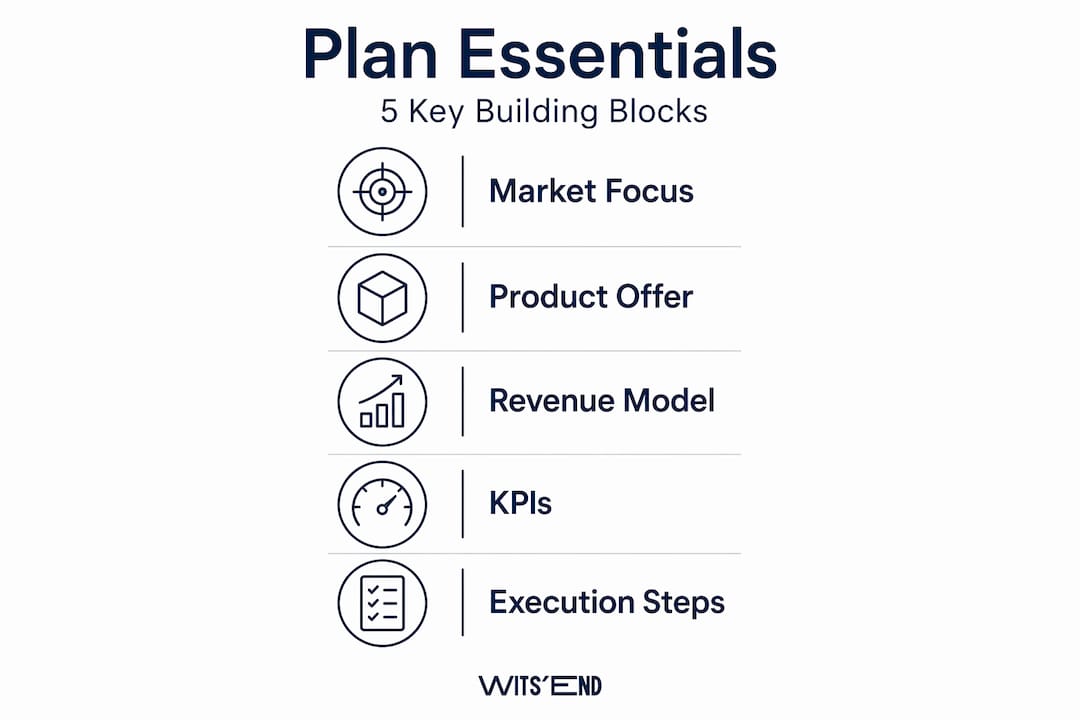
Every credible hospitality business plan covers these core components:
- Product and customer definition: What exactly are you selling, and who is paying for it? A boutique hotel targeting leisure travelers on weekend getaways has a fundamentally different pricing architecture than a select-service property serving corporate road warriors.
- Market and competitor analysis: Where is demand coming from, and who else is capturing it right now?
- Marketing and distribution strategy: How will guests find you, and which channels will generate the best return? Exploring hospitality marketing tips early in this process sharpens your thinking on channel mix and customer acquisition costs.
- Operations plan: Staffing structure, service standards, vendor relationships, and technology stack.
- Financial projections: Revenue, costs, EBITDA, cash flow, and break-even, projected monthly for year one and annually for years two through five.
Clear KPIs tied to each section are what separate a working plan from a document that collects dust. Know your target occupancy rate, average daily rate (ADR), RevPAR (revenue per available room), prime cost ratio, and guest satisfaction scores before you open the doors.
Step-by-step planning: from product definition to financial projections
Now that you know the essentials, let's break down each key planning step to build your own plan correctly.
A practical hotel plan template sequences steps to prevent cash timing shortfalls, covering product definition, market analysis, revenue models, cost structure, capex timing, funding, and sales strategy. Follow this sequence intentionally:
- Define your product and customer. Before any numbers, write a clear one-paragraph description of your hotel or restaurant concept and the specific customer segment you serve. This becomes the lens through which every financial assumption is tested.
- Conduct market and competitor analysis. Identify the top five competitors in your market. Analyze their pricing, occupancy trends, and positioning gaps. This is where you find the white space your business will occupy.
- Build your revenue model. For hotels, project ADR and occupancy by month for year one. For restaurants, model covers per service, average check, and table turns. Layer in ancillary revenue: F&B, spa, events, private dining. Understanding F&B profitability strategies at this stage prevents you from underpricing one of your highest-margin revenue streams.
- Map your cost structure. Separate fixed costs (rent, insurance, base salaries) from variable costs (food cost, hourly labor, credit card fees). This separation is critical when you start running scenario models.
- Plan capital expenditures and funding timing. This is where most plans fall short. Know exactly when you need capital, not just how much. A renovation that runs three weeks over schedule while pre-opening expenses continue draining the account is a cash flow crisis, not a revenue problem.
- Develop your go-to-market plan. Identify your top three sales channels, your pre-opening marketing budget, and your direct booking or reservation strategy. Brand investment at this stage pays dividends for years, and strong brand design and development sets the tone for every guest interaction that follows.
- Build your five-year financial model. Compile everything into a complete model with annual and monthly views.
| Metric | Year 1 target | Year 3 target | Year 5 target |
|---|---|---|---|
| Occupancy rate | 62% | 74% | 80% |
| ADR | $185 | $210 | $240 |
| RevPAR | $115 | $155 | $192 |
| EBITDA margin | 12% | 22% | 28% |
| Prime cost ratio | 65% | 60% | 57% |
Pro Tip: Model three scenarios, conservative, base, and optimistic, and set your funding plan around the conservative case. If your business only survives in the optimistic scenario, the plan needs revision before anything else does.
Financial planning fundamentals for hospitality businesses
Financial metrics and cash flow control are the backbone of your plan's credibility and operational success.

Restaurant planning relies on key ratios like prime cost, food and labor cost percentages, break-even sales, and pro forma cash flow statements tied to fixed and variable costs. Every hotel and restaurant owner needs a working fluency with these numbers.
Here are the calculations that matter most:
- Prime cost ratio: (Food cost + Beverage cost + Total labor cost) divided by total revenue. Target below 60% for full-service restaurants, below 55% for limited service.
- Food cost percentage: Cost of goods sold divided by food revenue. Typically targets 28 to 32% depending on concept.
- Labor cost percentage: Total labor divided by total revenue. This fluctuates with volume, which is why separating fixed management salaries from hourly labor in your model matters.
- Break-even sales: Total fixed costs divided by (1 minus variable cost percentage). Know this number before you open.
| Cost type | Examples | Behavior with volume |
|---|---|---|
| Fixed costs | Rent, loan payments, salaried managers | Stays constant |
| Variable costs | Food cost, hourly labor, supplies | Rises with revenue |
| Semi-variable costs | Utility bills, maintenance | Increases at certain thresholds |
Cash flow projections deserve a separate worksheet from your P&L. Revenue appearing on your income statement in December may not arrive in your bank account until January if you are working with OTA partners or corporate accounts on net-30 payment terms. That gap is where businesses fail.
Pro Tip: Build a 13-week cash flow forecast and update it every week. It is one of the highest-leverage habits an operator can develop, and it takes less than 30 minutes once the model exists.
Connecting your financial model to real operational data is where business optimization strategies become the difference between planning on paper and executing in reality.
Integrating business intelligence: data-driven decision making to optimize operations
Beyond planning and financials, using data strategically unlocks superior operational control and growth.
Hospitality BI collects and analyzes diverse data sources to anticipate trends, optimize pricing, forecast labor, and personalize the guest experience for profitability and operational efficiency. This is no longer a capability reserved for large hotel chains.
"The goal of business intelligence in hospitality is not more data. It is faster, better decisions at every level of the operation."
Here is how to put BI to work in your business:
- Connect your systems. Your property management system (PMS), point-of-sale (POS), revenue management system (RMS), and booking platforms should feed into a single reporting environment. Fragmented data produces fragmented decisions.
- Use demand forecasting. Historical occupancy data, local events calendars, and competitor rate feeds allow you to anticipate high and low demand periods weeks in advance. Adjust pricing and staffing accordingly, not reactively.
- Forecast labor needs with precision. Cross-reference your reservation pacing, F&B cover counts, and historical labor efficiency ratios to build staffing schedules that match demand. This alone can reduce labor cost by two to four percentage points.
- Personalize the guest experience. Guest data captured across stays or visits, whether dietary preferences, room type choices, or service history, enables your team to create moments of recognition that build genuine loyalty.
The investment required for business intelligence integration has dropped significantly with modern platforms. Mid-scale hotels and independent restaurants can now access the same analytical capabilities that enterprise operators have used for years.
Strategic growth planning: turning business plans into measurable success
Sustained growth requires evolving your plan into an executable strategy with clear goals and review rhythms.
A "living" hotel growth plan sets specific objectives and KPIs for 2026 through 2028, aligning strategy with execution, budgeting, marketing, and operational readiness, tracked through consistent performance measurement. That same philosophy applies to every independent restaurant and hotel in the country.
Here is how to build a growth strategy that actually gets executed:
- Set time-bound, specific objectives. "Grow occupancy" is not a goal. "Reach 76% average occupancy in Q3 2026 through a corporate account outreach program targeting 15 new accounts" is.
- Segment your market and guest base. Identify your two or three highest-value guest segments and build acquisition and retention programs around them. Not all revenue is created equal.
- Define your strategic initiatives. Dynamic pricing, a loyalty program, a menu engineering review, a new group sales channel, or a brand refresh all qualify. Each initiative needs an owner, a budget, and a deadline.
- Tie initiatives to quarterly financial targets. A loyalty program that costs $40,000 to build should have a projected impact on repeat visit rate, average check, and annual revenue. If you cannot quantify the expected return, the initiative needs more definition.
- Establish a performance review cadence. Monthly KPI reviews with your leadership team keep execution on track. Quarterly reviews are where you adjust strategy. Annual reviews are where you reset the plan. Reviewing F&B growth optimization metrics as part of this cadence ensures one of your most important revenue streams stays on course.
| Strategic initiative | Owner | Budget | Target KPI impact |
|---|---|---|---|
| Dynamic pricing rollout | Revenue manager | $8,000 | +6% RevPAR |
| Corporate sales outreach | Sales lead | $12,000 | +10 new accounts |
| Loyalty program launch | Marketing lead | $40,000 | +15% repeat visit rate |
| Menu engineering review | F&B director | $5,000 | +2% food margin |
Why treating your hospitality business plan as a living document is the key to lasting success
Here is an opinion that most planning guides will not give you directly: the business plan is not the deliverable. The habits it creates are.
Treating the business plan as a static fundraising document is a common misconception. It should instead be a living set of goals tied to daily execution and measurable outcomes. We have seen operators produce genuinely impressive 80-page plans, raise their funding, and then put the document in a drawer. Six months later, they are operating purely on instinct, with no visibility into whether their actual performance is tracking against the model.
The operators who build lasting businesses do something different. They embed their KPIs into their weekly rhythm. Occupancy pacing, prime cost, cover counts, guest feedback scores, these numbers get reviewed every week, not once a quarter. When the numbers drift, they adjust early. When they beat projections, they understand why and double down.
There is also a function dilution problem that static plans create. When your leadership team is not aligned around a shared set of current priorities, effort scatters. Your front office manager is optimizing for one metric, your F&B team is chasing another, and nobody is connecting their decisions to the annual revenue target. A living plan, embedded in your business optimization routines, solves this by giving every function a shared scoreboard.
Business intelligence capabilities are what make this possible at scale. When your data is connected and accessible, your plan stops being a document and starts being a dashboard. That is the difference between planning and operating with intention.
How Wits' End empowers your hospitality business planning and optimization
If you are ready to move from planning to execution, the right partner makes every step faster and more accurate.
At Wits' End, we work with hotel and restaurant owners across the United States at every stage of the business lifecycle. Whether you are building your first business plan, refining your brand design and development, connecting your systems for real hospitality data analytics, or putting a full hospitality business optimization program in place, our team has done this work firsthand before recommending it to anyone. We can advise, co-manage, or step in as a full operating partner. The model fits what your business actually needs, not a predetermined package. From the first concept sketch to the thousandth night of service, we stand beside you at every step.
Frequently asked questions
What key financial metrics should I include in my hospitality business plan?
Include prime cost ratio, break-even sales point, cash flow forecasts, occupancy rate, ADR, and RevPAR to demonstrate financial viability and operational efficiency. Restaurant-specific ratios like prime cost and pro forma cash flow statements are considered essential components of any credible financial projection.
How often should I update my hospitality business plan?
Treat your plan as a living document and update it at minimum quarterly, adjusting objectives, KPI targets, and budgets in response to actual performance. A living plan approach with ongoing measurement through a defined planning horizon is what separates high-performing operators from those reacting to problems after the fact.
How can business intelligence improve my hospitality operations?
BI tools consolidate data from your PMS, POS, and booking platforms so you can forecast demand, set prices based on real market signals, and staff your property accurately. Hospitality BI integration also allows you to personalize the guest experience in ways that build loyalty and repeat revenue over time.
What common mistakes should I avoid when creating a hospitality business plan?
The most costly mistakes are treating the plan as a static document, underestimating cash flow timing gaps, setting growth targets without measurable KPIs, and skipping business intelligence integration. Many operators underestimate the cash timing aspect specifically, which causes failures even when annual profit projections look healthy on paper.