
TL;DR:
- Third-party operators improve efficiency, reduce costs, and enable strategic growth for hospitality assets.
- They offer expertise, technology access, and scalability, freeing owners to focus on long-term asset development.
Third-party operators are external management and service providers who take over specific operational functions of a hospitality business to improve efficiency, reduce costs, and drive revenue. For hotel and restaurant owners weighing whether to keep operations in-house or delegate them to specialists, the data is clear: companies using third-party models increased operational efficiency by an average of 25%, and those adopting strategic outsourcing grow 2 to 3 times faster than peers relying solely on internal teams. The question is no longer whether third-party management works. It is whether your business is set up to take full advantage of it.
What are the main benefits of choosing third-party operators?
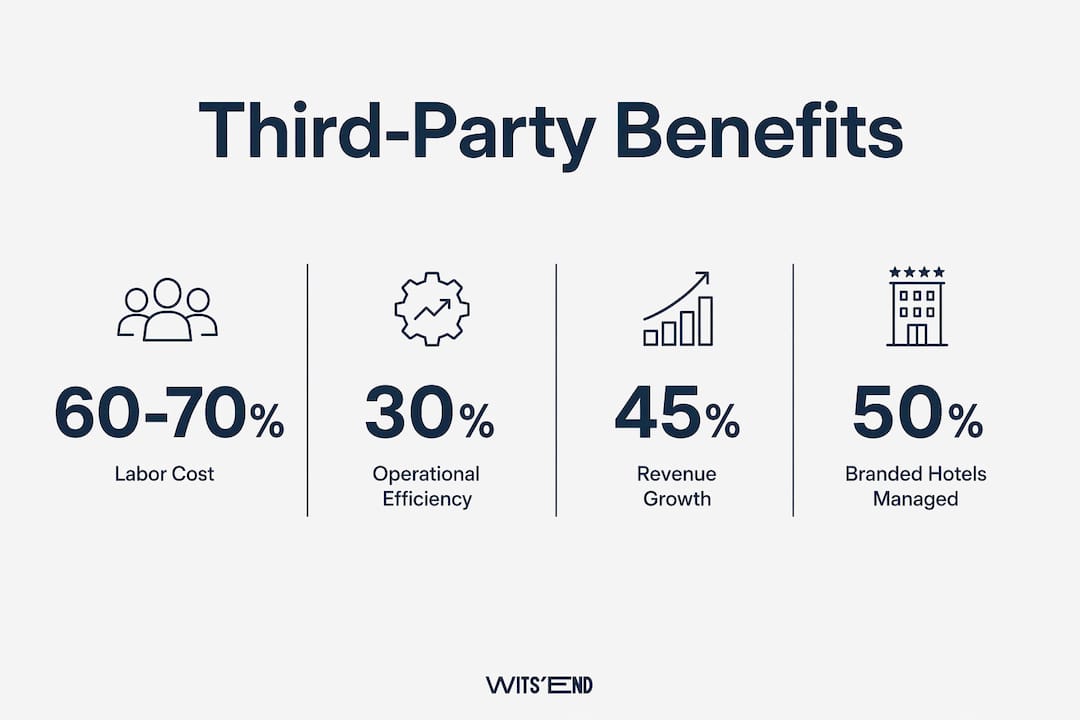
The benefits of third-party operators in hospitality extend well beyond cost reduction, though that alone is significant. Outsourcing can cut labor costs by 60 to 70% compared to maintaining equivalent internal teams. For a mid-scale hotel with a full front-of-house, housekeeping, and F&B operation, that figure represents a material shift in your P&L.
Here is what experienced third-party operators bring to the table:
- Cost reduction at scale. Third-party managers negotiate portfolio-wide vendor contracts, OTA channel agreements, and supply deals that a single-property owner cannot access independently. The savings compound across procurement, staffing models, and distribution.
- Operational efficiency gains. Partnerships facilitate 40 to 50% faster hiring by transferring recruitment and screening to operators with established pipelines. Filling a department head role in two weeks instead of six has a direct impact on service continuity.
- Access to specialized expertise. Third-party operators bring compliance knowledge, HR best practices, and revenue management systems that take years to build internally. Owners see fewer legal disputes, stronger guest satisfaction scores, and improved top-line revenue under well-run third-party management.
- Scalability for portfolio growth. Adding a second or third property becomes operationally manageable when a third-party partner absorbs the incremental complexity. You expand the portfolio without proportionally expanding your corporate overhead.
- Technology access. Cloud-native management platforms outperform legacy systems on labor efficiency and net operating income. Operators who have already built and integrated these stacks give you immediate access without the capital investment.
Pro Tip: When evaluating third-party operators, ask specifically about their technology stack. Request a demo of their property management system, reporting dashboards, and vendor integration capabilities. A firm running on outdated software will cap your operational upside regardless of how experienced their team is.
How do third-party operators free up leadership for strategic growth?
The most undervalued third-party operator advantage is not what they do for your operations. It is what they give back to your leadership team. When daily management, compliance monitoring, vendor negotiations, and staffing issues are handled externally, your general manager and ownership group can focus on asset positioning, brand development, and long-term capital decisions.
"Third-party management allows ownership to step back from the operational weeds and focus on the strategic decisions that actually move asset value." — Joanna Axelrod, cited in Today's Hotelier, May 2026
This shift in leadership capacity is not abstract. Third-party operators handle complex transitions including renovations, brand conversions, property improvement plans, and ownership sales. These are exactly the moments when an owner's attention is most divided and most needed at the strategic level. Delegating the technical execution to a specialist partner means you stay focused on the outcome rather than the process.
For owners managing multiple assets, the compounding effect is significant. Each property handled by a capable third-party team is one fewer daily operational demand on your time. That freed capacity is what allows you to pursue the next acquisition, negotiate a better flag deal, or invest in a concept refresh. If you want a deeper look at how hospitality consulting structures this kind of leadership leverage, the framework applies directly here.

How do third-party operators compare to in-house management?
The honest answer is that neither model is universally superior. The right choice depends on your asset type, ownership goals, and internal capabilities. Here is a direct comparison across the factors that matter most.
| Factor | In-house management | Third-party operator |
|---|---|---|
| Labor cost | Higher fixed overhead | 60 to 70% reduction potential |
| Expertise depth | Limited to internal hires | Specialized teams with portfolio experience |
| Technology access | Capital-intensive to build | Included in operator's existing stack |
| Flexibility | Slower to scale up or down | Adjustable scope and contract terms |
| Owner control | Full day-to-day control | Delegated operations, retained strategic control |
| Risk management | Owner absorbs compliance risk | Operator shares legal and HR exposure |
The co-sourcing model is worth understanding here. Rather than a binary choice, co-sourcing balances in-house control with delegated operational functions. An owner might retain the GM relationship and brand standards oversight while outsourcing revenue management, HR, and accounting to a third-party firm. This hybrid approach is gaining traction among independent hotel owners who want operational support without surrendering strategic authority.
Cultural alignment is the factor most owners underestimate. A technically capable operator who does not share your service philosophy or ownership values will create friction at the property level. Choosing third-party managers requires assessing cultural fit, contract clarity, fee transparency, and alignment with your investment horizon before any agreement is signed.
Pro Tip: Before finalizing any third-party management contract, request a full fee schedule including base management fees, incentive structures, and any pass-through costs. Misaligned incentive fees are the most common source of owner-operator disputes in hotel management agreements.
What steps should you take to integrate a third-party operator successfully?
A third-party partnership delivers its full value only when the transition is handled deliberately. Rushed onboarding creates reporting gaps, staff confusion, and revenue leakage in the first quarter. Here is a practical sequence that works.
- Define your goals before you start the search. Are you trying to reduce labor costs, improve RevPAR, prepare for a sale, or scale to additional properties? Your goals determine which operator profile fits and what contract terms matter most.
- Clean your data before the handoff. Onboarding unmanaged assets into third-party systems requires a 30 to 60 day stabilization period. A data-cleaning phase before full transition prevents financial reporting fragmentation and protects revenue in the initial quarters.
- Set performance metrics and reporting cadence upfront. Agree on KPIs including GOP margin, guest satisfaction scores, labor cost percentage, and RevPAR index before the contract is signed. Ambiguous performance standards are the fastest path to a dysfunctional partnership.
- Communicate the transition to your team clearly. Staff uncertainty during a management change drives turnover. A structured communication plan from ownership, delivered before the operator arrives on property, reduces attrition and maintains service continuity.
- Build in a formal review at 90 days. The stabilization period surfaces operational gaps and cultural mismatches early. A structured 90-day review with the operator's senior leadership gives you the data to course-correct before patterns become entrenched.
Explore hospitality operating partnerships for a closer look at how structured onboarding frameworks apply to hotel and restaurant operations specifically.
What trends are shaping third-party hospitality management in 2026?
The third-party management sector is shifting in ways that directly affect how owners should evaluate and select partners. Two forces are driving most of the change: technology consolidation and portfolio-scale economics.
Approximately half of branded hotels were managed by third parties as of 2024, and that share is growing. The economics favor it. Third-party operators can spread corporate overhead across dozens of properties, negotiate OTA agreements at volume, and deploy technology platforms that individual owners cannot justify purchasing independently.
| Trend | What it means for owners |
|---|---|
| Cloud-native management platforms | Real-time P&L visibility and labor analytics without legacy system investment |
| Portfolio-wide vendor negotiations | Lower food, beverage, and supply costs through aggregated purchasing power |
| Hybrid co-sourcing models | Customizable operator involvement without full management fee structures |
| Technology-first operator selection | Software capability now the primary differentiator between operator tiers |
The line between third-party management firms and technology platform companies is blurring. The operators gaining market share in 2026 are those who lead with software capability and use human expertise to interpret and act on the data. For owners evaluating partners, this means the technology demo matters as much as the reference call. Platforms like RealtevoOS are examples of how OTA channel performance and forecasting tools are becoming central to operator value propositions rather than supplementary features.
Key takeaways
Third-party operators deliver their greatest value when owners treat them as strategic partners from day one, not as vendors brought in to solve a short-term problem.
| Point | Details |
|---|---|
| Cost and efficiency gains are measurable | Outsourcing reduces labor costs by up to 70% and improves operational efficiency by an average of 25%. |
| Technology stack quality determines outcomes | Operators running cloud-native platforms outperform those on legacy systems on labor efficiency and NOI. |
| Cultural fit matters as much as capability | Misaligned values between owner and operator create property-level friction that erodes guest satisfaction. |
| Onboarding requires a stabilization period | Allow 30 to 60 days for data integration and system alignment before evaluating performance. |
| Co-sourcing offers a middle path | Hybrid models let owners retain strategic control while delegating operational complexity to specialists. |
What I've learned about third-party operators after years in hospitality
Most owners come to third-party management looking for relief. They are overwhelmed by staffing issues, compliance demands, or a property that is underperforming relative to its comp set. That is a legitimate reason to make the move. But the owners who extract the most value from these partnerships are the ones who enter with a growth agenda, not a rescue plan.
The best third-party operators I have seen in action are not administrators. They are profit-generating partners who spend their time on forecasting, vendor contract renegotiation, and channel optimization. The administrative relief is a byproduct, not the product. When you frame the relationship that way from the start, you get a different quality of engagement from the operator and a different quality of outcome for the asset.
The misconception I hear most often is that bringing in a third party means giving up control. That is only true if you write a bad contract or skip the cultural alignment conversation. Owners who define their investment horizon clearly, set transparent performance metrics, and stay engaged at the strategic level maintain full authority over their asset while benefiting from operational expertise they could not build internally in a reasonable timeframe.
The shift toward technology-enabled management is not optional anymore. If your current or prospective operator cannot show you real-time reporting, labor analytics, and a clear OTA strategy, you are not getting the full value of what third-party management can deliver in 2026.
— Chris
How Wits' End Solutions supports your operational partnerships
At Wits' End Solutions, we work alongside hotel and restaurant owners at every stage of the business lifecycle, from concept development through daily operations. Our team has run the operations ourselves before recommending anything to a client, which means our guidance on third-party operator selection, contract structure, and performance management is grounded in real experience. Whether you need help evaluating a potential operator, building the metrics framework for a new partnership, or strengthening your brand development before bringing in an external management team, we have the tools and the track record to support it. Reach out to Wits' End Solutions for a consultation on how to structure your next operating partnership for maximum return.
FAQ
What does a third-party operator do in hospitality?
A third-party operator manages specific or full operational functions of a hotel or restaurant on behalf of the owner, including staffing, vendor relationships, compliance, revenue management, and daily service delivery. The owner retains asset ownership and strategic direction while the operator handles execution.
How much can third-party operators reduce costs?
Outsourcing to third-party operators can reduce operational labor costs by 60 to 70% compared to maintaining equivalent internal teams, according to CapStonePlanet's 2026 analysis. Additional savings come from portfolio-wide vendor negotiations and technology efficiencies.
What is the difference between co-sourcing and full third-party management?
Co-sourcing is a hybrid model where the owner retains control over strategic functions while delegating specific operational areas such as HR, accounting, or revenue management to a third-party firm. Full third-party management transfers day-to-day operational authority entirely to the external operator.
How long does it take to onboard a third-party operator?
A proper onboarding and stabilization period runs 30 to 60 days, during which data systems are integrated, reporting structures are aligned, and staff transitions are managed. Skipping this phase increases the risk of financial reporting gaps and revenue loss in the first quarter.
How prevalent is third-party management in branded hotels?
As of 2024, approximately half of all branded hotels in the United States were managed by third-party operators, according to JLL industry data cited by Today's Hotelier. That share is expected to grow as portfolio economics and technology platforms continue to favor the outsourced model.