

A beverage program is one of the highest-leverage decisions you'll make as a restaurant or hotel owner, yet most operators treat it as an afterthought. The drink menu gets assembled reactively, pricing is guesswork, and the operational side is never fully systematized. That gap between intention and execution costs you money every shift. Beverage program design is the structured process of creating and managing your drink offerings, covering selection, menu development, pricing, operations, and brand alignment to elevate guest experience and drive profitability. Done right, it turns your bar into one of the most profitable corners of your business.
Table of Contents
- What is beverage program design?
- Core methodologies for efficient beverage programs
- Profitability, pricing, and menu engineering for beverage programs
- Customization, edge cases, and operational realities
- Leveraging trends and data for ongoing beverage program growth
- What most operators miss: Process over cocktails, profits over hype
- Ready to transform your beverage program?
- Frequently asked questions
Key Takeaways
| Point | Details |
|---|---|
| Strategic design drives profit | A smart beverage program goes beyond a drink list and directly boosts margins and guest satisfaction. |
| Tailor methods to your venue | Optimize beverage menus with customer focus, operational replicability, and menu balancing. |
| Menu engineering lifts margins | Using data, pricing, and mix, most venues can gain 7-15 percent higher profits. |
| Processes matter most | Sustainable success relies on staff training, system building, and ongoing program review—not just creative cocktails. |
| Stay agile with trends and data | Regularly update your beverage program using POS insights and market trends for lasting success. |
What is beverage program design?
Now that we've surfaced what's at stake, let's define exactly what beverage program design entails and why its scope extends well beyond picking bottles.
A beverage program is not a drink list. It is a living operational system that governs everything from what you pour to how your team presents it, how you price it, and how you measure its performance. The structured creation and management of your drink offerings, including selection, menu development, pricing, operations, and brand alignment, is what separates a beverage program from a collection of beverages your team happens to serve.
The main components of a well-designed beverage program include:
- Product selection: Spirits, wines, beers, and non-alcoholic options curated to match your concept and guest profile
- Menu engineering: Category structure, item placement, and pricing designed to guide guest decisions and maximize margin
- Operational standards: Recipe documentation, prep processes, garnish specs, and batch protocols that ensure consistency
- Pricing strategy: Cost-based and market-based approaches that protect your margins without alienating your guests
- Brand and concept alignment: Every pour should feel intentional within your broader identity, which is where brand and concept alignment becomes central to program success
- Staff fluency: Your team's ability to sell, explain, and deliver your program is as important as what's on the page
A beverage program that is intentional and data-driven does not just improve guest satisfaction. It directly strengthens your P&L by raising per-cover spend, reducing waste, and building the kind of consistency that earns repeat visits.
The most effective programs are not built on instinct. They are built on guest data, cost analysis, and a clear vision of what the brand needs to communicate through every glass. Operators who treat their beverage program as a strategic asset, rather than a logistical necessity, consistently outperform those who don't. Connecting that program to your staff training programs is what turns a well-designed menu into consistent, profitable execution.
Core methodologies for efficient beverage programs
Having defined beverage program design, let's break down the most effective methodologies used by top hospitality operators.
The key methodologies that drive successful programs share a common thread: they start with the guest and work backward to the glass. Here is how that process unfolds in practice.
- Customer analysis: Understand who is sitting at your bar or dining table. What is their price sensitivity? What flavors and occasions are they seeking? Are they looking for an experience or efficiency? This data, pulled from your POS and reservation system, forms the foundation of every menu decision.
- Flavor matrix development: A flavor matrix maps your menu across taste profiles, occasions, and intensity levels to ensure balance and variety. A cocktail menu that is all spirit-forward and bitter leaves guests without options. One with clear distribution across light, fruity, citrus-forward, and rich categories serves a wider audience and drives higher attachment rates.
- Category balancing: Across spirits, wine, beer, and non-alcoholic options, you need intentional coverage. Gaps in category create lost sales. Redundancies create confusion and over-investment in inventory.
- Recipe standardization and operational replicability: Every drink your team serves should have a documented recipe, a defined build process, and a consistent presentation standard. This is not about removing creativity. It is about protecting quality and controlling cost at scale.
- Menu engineering application: Place your highest-margin items in anchor positions. Use compelling language to draw attention to your most profitable categories. Price strategically to move guests toward the items that serve both their experience and your bottom line.
| Methodology pillar | What it addresses | Why it matters |
|---|---|---|
| Customer focus | Guest needs, price sensitivity, occasion | Ensures program resonates and sells |
| Menu structure | Category balance, flavor matrix, placement | Guides guest decisions and raises margins |
| Recipe and process control | Standardization, replicability, consistency | Reduces waste and protects quality |
Pro Tip: Use your POS item-level data to run a simple matrix of each beverage item's popularity versus its margin contribution. Items that score high on both are your stars. Items that score low on both are candidates for removal. This simple operational efficiency exercise alone can improve beverage profitability without changing a single recipe.
Profitability, pricing, and menu engineering for beverage programs
To see the impact, let's examine how beverage program design can transform your business's bottom line.
Beverages are the single best margin opportunity on your P&L. The math is straightforward once you understand the benchmarks. Pour cost targets sit at 18 to 24 percent for beverages, compared to 28 to 35 percent for food. That gap represents real dollars. Bars average a net profit margin of 7 to 12 percent, while restaurants typically land between 3 and 9 percent. Non-alcoholic cocktails, when priced and positioned correctly, deliver 60 to 80 percent profitability. And with NA beverage sales up 26 percent in 2025, that category is not a niche. It is a growth driver.

| Beverage category | Target pour cost | Average net margin |
|---|---|---|
| Cocktails (alcoholic) | 18 to 24% | 7 to 12% |
| Wine by the glass | 22 to 28% | 8 to 14% |
| Beer (draft) | 20 to 25% | 10 to 15% |
| Non-alcoholic cocktails | 15 to 20% | 60 to 80% |
| Food (for comparison) | 28 to 35% | 3 to 9% |
Menu engineering is where the margin opportunity becomes actionable. A well-structured beverage menu does not just list drinks. It shapes guest behavior. Key levers include:
- Placement: Anchor high-margin items at the top right or in a featured callout section. Guests scan menus in predictable patterns.
- Pricing architecture: Use a spread of price points that makes your mid-tier items feel like the obvious value choice, which is typically where your strongest margin lives.
- Category sequencing: Lead with approachable, lower-ABV or non-alcoholic options before moving into cocktails and wine. This expands your total addressable guest base per table.
- Descriptive language: Flavor-forward descriptions, not just ingredient lists, increase attachment rates and justify higher price points.
- Strategic bundling: Pairing suggestions between food and beverage categories increase per-cover spend without additional sales pressure.
Connecting your beverage program to business optimization insights means regularly reviewing your margin mix and making proactive adjustments, not waiting until quarterly reviews to catch problems. The operators who win on beverage profitability treat their menu engineering process as a living practice, not a one-time project.
Customization, edge cases, and operational realities
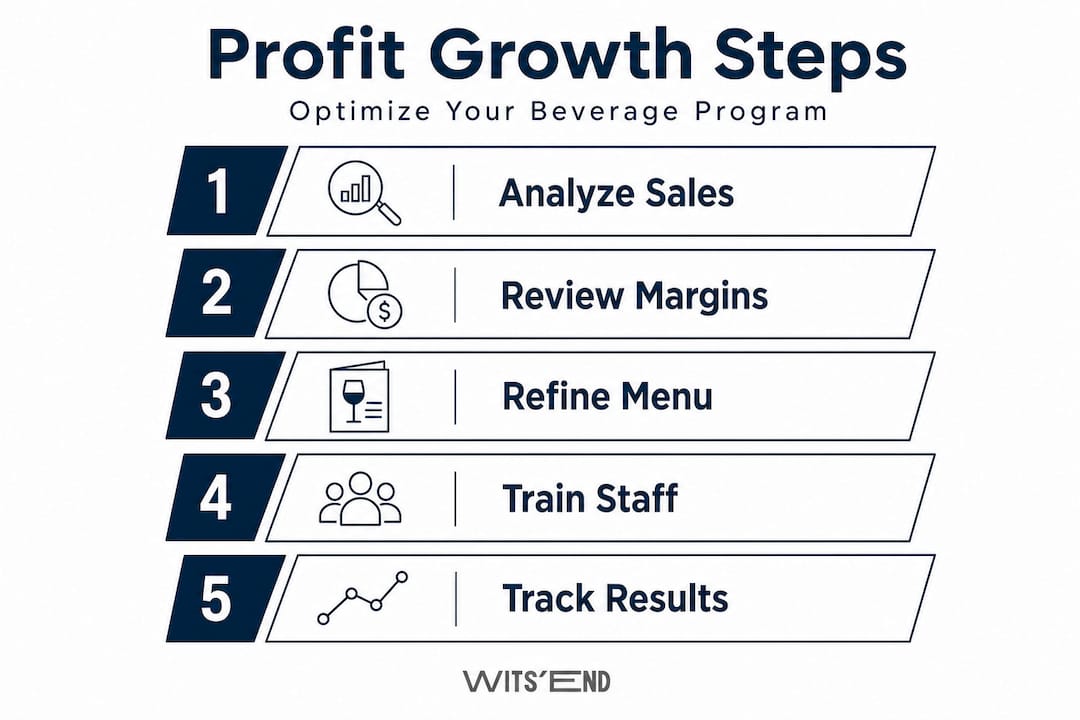
While these frameworks set the foundation, real-world execution means adapting to your unique venue, team, and guest base.
Every property is different. A cocktail bar in a major city, a fine dining room, a boutique hotel lobby bar, and a neighborhood bistro all need beverage programs, but they look dramatically different in scope and structure. Small neighborhood spots typically need 6 to 8 aperitifs and 8 to 12 digestifs to serve their guest flow effectively. Fine dining programs may carry up to 30 digestifs to meet the expectations of their audience. Hotels require broader programs with strong NA options to serve business travelers, families, and a wide demographic range across multiple dayparts.
What you should customize based on your venue type includes:
- Menu breadth: The number of offerings should match your staff's capacity to sell and execute them with confidence, not just what sounds impressive on paper.
- Non-alcoholic depth: Hotels and venues with diverse guest demographics need robust NA programs. A single mocktail is not a program. It is a token gesture.
- Staff training investment: The more complex your program, the more structured your onboarding and ongoing training needs to be. Your team cannot sell what they don't understand.
- Equipment and mise en place: Some programs require specific tools, glassware, or prep infrastructure. Assess your physical capacity before committing to a menu concept.
- Garnish and presentation standards: Expert beverage directors consistently note that garnishes should enhance flavor and aroma, not just decorate. Build this philosophy into your training from day one.
The first 3 to 6 months of any new beverage program are operationally demanding. System building takes time. Your team needs repetitions. Feedback loops need to be established. Owners who expect immediate perfection from a new program often abandon it before it has a chance to work. Build a realistic implementation timeline and invest in staff training solutions that support your team through the adoption period.
Pro Tip: Schedule structured feedback sessions with your bar team at 30, 60, and 90 days after a program launch. They are closest to the guest experience and will surface issues and opportunities that no data report will catch.
Leveraging trends and data for ongoing beverage program growth
Achieving a successful launch is only the beginning. Ongoing success means adapting proactively using data and guest insights.
A beverage program that does not evolve becomes a liability. Guest preferences shift. Ingredient costs change. New categories emerge. The operators who stay ahead of these movements use data as their early warning system and innovation driver. Here is how to build that practice into your operations.
- Establish POS baselines from day one: Track item-level sales volume, revenue, and margin from the moment your program launches. Without a baseline, you have no reference point for measuring improvement.
- Test non-alcoholic innovations quarterly: NA beverage sales are up 26 percent and growing. Quarterly testing cycles let you introduce new options, measure guest response, and rotate out underperformers without overhauling your entire program.
- Align with low-ABV and no-ABV trends: The demand for low-alcohol and alcohol-free options is structural, not seasonal. Major hospitality brands are investing in these categories because the data supports it. Your program should too.
- Apply menu engineering on a rolling basis: Menu engineering that produces 10 to 15 percent margin gains is not a one-time exercise. It is a quarterly discipline that compounds over time.
- Track guest feedback signals: Comment cards, online reviews, and server observations are qualitative data. Combine them with your quantitative POS output to get a full picture of program health.
Regular business optimization reviews that incorporate your beverage program performance data are what separate reactive operators from proactive ones. Build this rhythm into your calendar and protect it.
What most operators miss: Process over cocktails, profits over hype
With foundational frameworks and tools in place, it's time for a candid take on what separates long-term beverage program success from fleeting hype.
Here is the uncomfortable truth: most beverage program failures are not caused by bad drinks. They are caused by poor systems. We see it repeatedly. An operator invests in a creative, visually stunning cocktail menu, hires a talented bartender to build it, and then watches margins erode within six months because the program was never operationalized properly. Recipes aren't documented. Batch prep isn't standardized. Staff turnover means the only person who knows how to make half the menu just walked out the door.
The most effective beverage directors share a consistent philosophy: focus on processes over products. The drink is the output. The system is what produces it reliably, profitably, and at scale. Operators who anchor their program in operational discipline, consistent training, and data-driven decision making will always outperform those who chase trends without infrastructure.
Over-investing in specialty SKUs and short-lived seasonal ingredients is one of the most common margin killers we see. Every unique modifier or boutique spirit you add to a menu increases your ordering complexity, your storage requirements, and the cognitive load on your team. Simplicity with intention almost always beats complexity with ambition. A focused program of 12 to 16 cocktails, built on well-sourced staple spirits with seasonal flexibility at the margins, will generate more consistent revenue than a sprawling menu that nobody can execute confidently.
Measure ROI before you import a trend. Ask whether the guest demand actually exists at your specific property before committing to a new category. Then ask whether your team can execute it at the standard your guests expect. The menu creation process should always start with those two questions, not with what looked impressive at a trade show.
Ready to transform your beverage program?
If you want expert help amplifying your beverage margins and guest satisfaction, here's how the right partner can accelerate your success.
At Wits' End, we work alongside restaurant and hotel owners to design, build, and optimize beverage programs that perform. Whether your program needs a full rebuild or a targeted tune-up, our team brings real operational experience to every engagement.
From brand strategy development that aligns your drinks with your concept identity, to staff training for beverage programs that gives your team the fluency to sell and execute with confidence, to operations task force support that embeds our people alongside yours during critical launch periods, we bring the full toolkit. We've done the work ourselves before we ever recommend it to you. If your beverage program isn't performing where it should, let's build something that does.
Frequently asked questions
What are the different components of a beverage program?
A beverage program includes product selection, menu design, pricing strategies, operations processes, and brand alignment, all working together to support guest experience and profitability.
How do I know if my beverage program is profitable?
Review your pour costs and net margins, targeting 18 to 24 percent pour cost for beverages and comparing your net margin against the 7 to 12 percent bar industry benchmark.
What's the best way to add non-alcoholic beverages to my program?
Test quarterly non-alcoholic innovations, track item-level sales, and build high-margin NA options that reflect your brand identity, because NA cocktail profitability and low/no-ABV demand both support this investment.
How often should I update my beverage program?
Review and engineer your beverage menu at least quarterly using POS data and menu engineering, which can produce 10 to 15 percent margin gains when applied consistently.
What's the biggest mistake restaurants make with beverage programs?
Most operators focus on creative or trendy drinks instead of building sustainable operational processes, which is what actually drives consistent profitability and guest experience over time.