
A working, currently tagged hood suppression system, the last hood-cleaning certificate, and current Class K extinguisher tags are what typically decide a restaurant fire inspection. Add unobstructed exits and clear sprinkler clearance, covering most of what an inspector checks early in the visit. Assemble those documents in a labeled binder, hand one staff member ownership of it, and you have already fixed the most common failure point: paperwork, not equipment.
TL;DR:
- Fire inspections focus mainly on documented compliance, such as hood suppression system inspections, hood-cleaning certificates, and extinguisher tags, which should be organized and easily accessible.
- Local fire authorities, not national standards, decide your restaurant's inspection frequency, often requiring at least annual reviews, with semiannual kitchen suppression checks mandated by NFPA 96.
- Regular in-house monthly checks and semiannual professional maintenance for suppression systems, hood cleaning, and extinguisher servicing help prevent violations and reduce inspection risks.
- Immediate correction is required for missing documentation or critical violations, with prompt vendor contact and proof submission to re-establish compliance quickly to avoid closure.
- Engaging a dedicated compliance manager and using proactive audits can significantly lower the likelihood of citations by maintaining organized records and consistent maintenance routines.
Table of Contents
- Fire Safety Inspection Restaurant Checklist: What Inspectors Actually Check
- Who Decides How Often Your Restaurant Gets Inspected?
- Kitchen-Specific Fire Code Rules That Cause the Most Violations
- Monthly and Semiannual Maintenance Managers Should Own
- How to Handle a Failed Inspection Without Losing Service Days
- Why Most Fire Citations Are Preventable, Not Random
- How Wits' End Solutions Helps Restaurants Stay Inspection-Ready
- Official Fire Code Resources Worth Bookmarking
- Sources
- FAQ
Fire Safety Inspection Restaurant Checklist: What Inspectors Actually Check
Inspectors move through a restaurant in a predictable order, and knowing that order lets you walk it yourself the day before. Most visits start at the front door and end in the mechanical room, with a document check somewhere in between.
In the dining room, an inspector confirms exits are unlocked and unobstructed, emergency lighting functions, exit hardware operates without a key, and occupant load signage is posted where local code requires it. Back of house draws closer scrutiny: manual pull stations for the hood suppression system need clear access, Class K extinguishers should sit within about 30 feet of cooking equipment, and flammable storage (oils, cleaning chemicals) has to be separated from ignition sources.
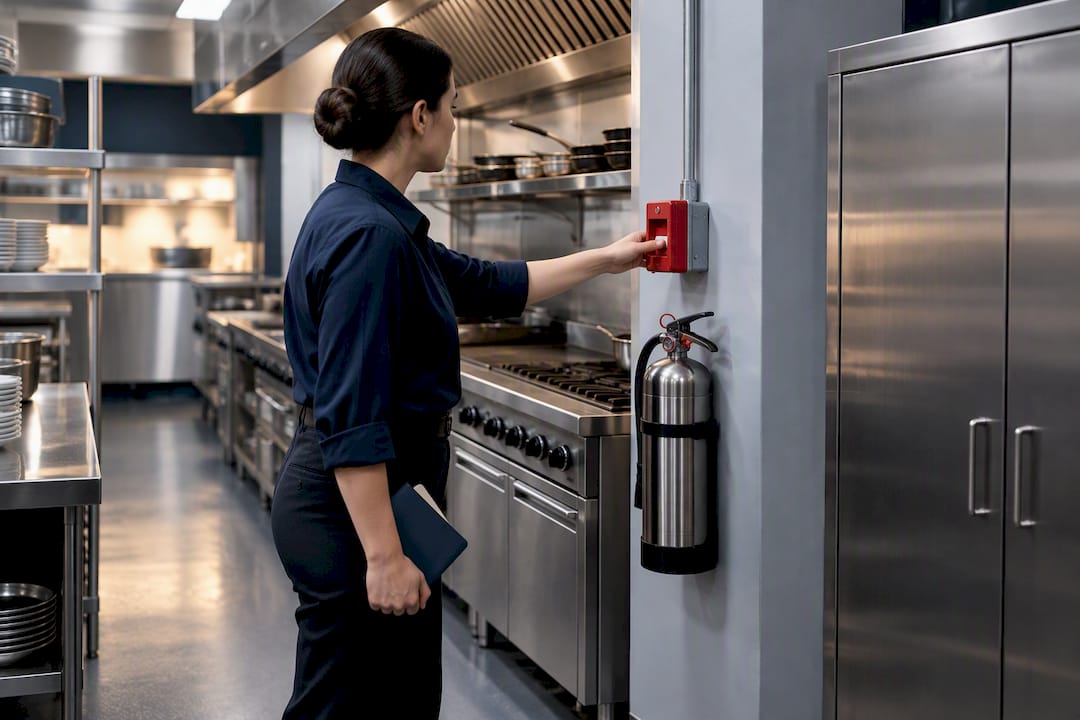
Mechanical areas round out the walkthrough. Sprinkler heads need 18 inches of clearance from stored items, alarm panels must stay accessible and unobstructed, and gas or fuel shutoff actuators should be clearly labeled and reachable.
Then comes the part that catches most operators off guard: the records request. Within minutes of arriving, an inspector will typically ask for:
- The last two semiannual suppression system inspection reports
- The most recent hood-cleaning certificate
- Current Class K extinguisher service tags
- The suppression system's installation and operation and maintenance manual
Municipal self-inspection checklists, like the one used in St. Johns County, Florida, confirm this same pattern: hood-cleaning certificates and semiannual suppression tags are the documents inspectors ask for first, and their absence often triggers overlapping fire and health citations on the same visit.
Who Decides How Often Your Restaurant Gets Inspected?
Your local fire marshal, not a national standard, sets the legal inspection frequency for your restaurant. NFPA publishes risk-based guidance through NFPA 1730, but the Authority Having Jurisdiction (AHJ) in your city or county decides how often that guidance actually gets enforced on your block.
That distinction trips up a lot of new operators who assume one federal rulebook governs every kitchen in the country. It does not. Here is how the pieces fit together:
- Pre-opening acceptance: every new restaurant must pass an initial fire inspection before opening, regardless of local cycle length.
- Local inspection cycles: many jurisdictions require at least one inspection annually, though some AHJs work on biennial or risk-based cycles depending on occupancy and history.
- Kitchen-specific ITM: separate from the AHJ's general inspection schedule, NFPA 96 mandates semiannual inspection, testing, and maintenance for wet-chemical suppression systems no matter where you operate.
To find your actual schedule, call your local fire prevention office directly, check your municipality's permit or licensing portal, or look at the operational permit posted in your building. Fire codes get amended locally more often than most operators expect, so a direct relationship with your fire prevention office beats relying on a national guide alone.
Kitchen-Specific Fire Code Rules That Cause the Most Violations
Your kitchen is where fire inspections are won or lost, and NFPA 96 sets the specific rules that govern it. Cleaning frequency for hoods and ducts depends on what you cook: solid-fuel cooking requires monthly cleaning, high-volume frying needs quarterly service, moderate-volume kitchens fall to semiannual, and low-volume operations can move to annual. Always use a certified hood cleaning company and keep the certificate on site, since that single document is one of the first things an inspector asks for.
Suppression systems carry their own mandatory schedule. NFPA 96 requires semiannual inspection, testing, and maintenance for pre-engineered wet-chemical systems, and FDNY guidance spells out exactly what a certified technician checks during that visit:
- Cylinder pressure and condition
- Nozzle blockages and positioning
- Fusible link condition and placement
- Control panel status and wiring
- Fuel and gas shutoff interlocks
Class K extinguishers need to sit within about 30 feet of cooking appliances along a normal walking path, not tucked behind equipment. Managers should give them a monthly visual check and get a full service tag annually.
Pro Tip: Keep your hood-cleaning certificate and suppression ITM reports as PDFs on a shared drive, not just paper in a binder. Inspectors move fast, and pulling up a file on a phone beats digging through a filing cabinet while they wait.
Missing any of this documentation rarely ends in a warning. It usually means an immediate correction order, and in serious cases, a closure until the system is verified. Insurers take the same view: a lapsed suppression inspection can complicate a claim even if the fire itself had nothing to do with the missed service date.
Monthly and Semiannual Maintenance Managers Should Own
Passing an inspection is really about not letting small gaps pile up between visits. Break the work into two rhythms and it stops feeling like a scramble.
- Monthly, done in-house: check extinguisher pressure gauges, confirm tamper seals are intact, inspect fusible links for grease buildup, verify the suppression control panel shows normal status, and make sure manual pull stations stay clear of stacked equipment.
- Semiannual, scheduled with a certified contractor: suppression system ITM and, depending on your cooking volume, detailed hood and duct cleaning. Book these during slow service windows so the crew isn't fighting a technician for counter space during dinner rush.
- Binder and backup: keep the last two suppression reports, your current hood-cleaning certificate, all extinguisher tags, and the suppression system's O&M manual, both physically on site and as digital backups.
- Training cadence: OSHA requires annual extinguisher training for any employee expected to use one, plus an Emergency Action Plan under 29 CFR 1910.38 with periodic staff drills.
A restaurant operations checklist built around these two cycles turns fire compliance into a routine task instead of a pre-inspection panic.
How to Handle a Failed Inspection Without Losing Service Days
Common critical violations include a failed suppression interlock, overdue hood cleaning, missing or expired Class K extinguisher, and blocked exits. Correction timelines depend on jurisdiction, with serious failures possibly causing immediate closure.
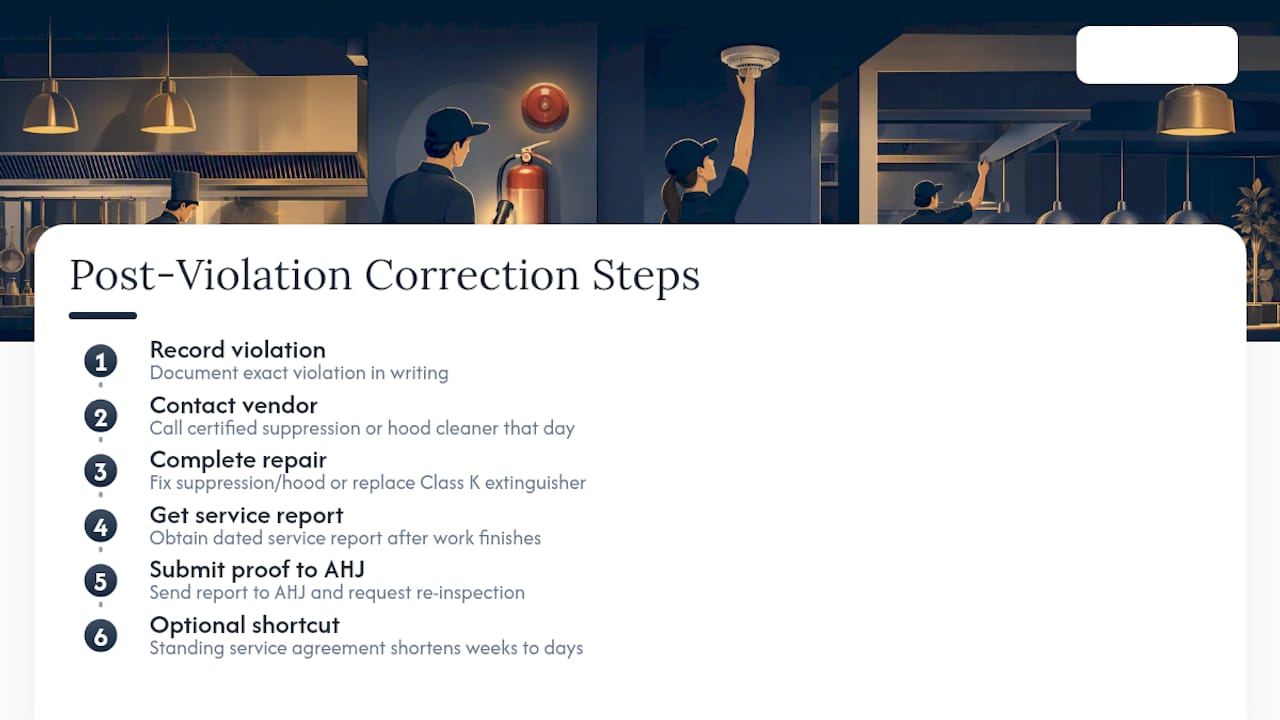
Move fast when a citation lands: document the exact violation in writing, call your certified suppression or hood-cleaning vendor that day, get a dated service report once the repair is complete, and submit that proof directly to your AHJ to request re-inspection. Keeping a standing service agreement with a vendor, rather than searching for one during a crisis, shortens this entire cycle from weeks to days.
Why Most Fire Citations Are Preventable, Not Random
Most restaurants that fail inspection aren't running unsafe kitchens. They're running kitchens where nobody owns the paperwork. A weekly ten-minute walkthrough, done by one designated person, catches a tripped fusible link or an expired tag long before an inspector does.
We build this into every kitchen we work with: a single compliance owner, a standing contractor relationship for suppression ITM and hood cleaning timed to slow periods, and a binder that gets checked as a habit, not a scramble. Such readiness work is packaged into compliance audits and task-force engagements when a kitchen needs a faster fix.
— Chris
How Wits' End Solutions Helps Restaurants Stay Inspection-Ready
Wits' End Solutions is the alternative to hiring a compliance consultant only after a failed inspection. Instead of a one-time scramble, our compliance audits build the binder, the vendor relationships, and the manager routine before an inspector ever walks in.
Services include:
- Compliance audits that flag documentation gaps before they become citations
- Manager training on extinguisher use, EAP drills, and monthly maintenance routines
- Task-force support to coordinate repairs when a violation needs a fast turnaround
Recommended routines are based on direct hospitality operations experience. If your kitchen needs a compliance sweep or a faster path through a failed inspection, request a scope estimate and we'll tell you exactly what it takes to get inspection-ready.
Official Fire Code Resources Worth Bookmarking
- OSHA 29 CFR 1910.157 covers extinguisher placement, maintenance, and training.
- NFPA 96 governs commercial kitchen ventilation and suppression.
- FDNY S-17/S-71 guidance shows technician certification requirements.
- The NFPA 96 compliance checklist lists documents inspectors request most often.
Sources
- OSHA - 29 CFR 1910.157 Portable Fire Extinguishers
- NFPA 96 — Standard for Ventilation Control and Fire Protection of Commercial Cooking Operations
- FDNY — S-17/S-71 Study Material (commercial cooking wet chemical systems)
FAQ
What documents does a fire inspector ask for first?
Inspectors typically request your last two semiannual suppression inspection reports, your most recent hood-cleaning certificate, and current Class K extinguisher tags within the first few minutes. Municipal checklists like St. Johns County's confirm these three items are the most commonly requested during a visit.
How often does a restaurant hood need cleaning?
Frequency depends on cooking volume and fuel type under NFPA 96: monthly for solid-fuel cooking, quarterly for high-volume frying, semiannual for moderate volume, and annual for low-volume kitchens. Keep the certified cleaner's certificate on site regardless of your tier.
Who sets my restaurant's inspection schedule?
Your local fire marshal, known as the Authority Having Jurisdiction, sets the legal inspection frequency for your specific location. NFPA 1730 provides national guidance, but the actual schedule comes from your municipal fire prevention office.
What happens if my suppression system inspection is overdue?
An overdue or failed suppression system inspection is one of the most common triggers for an immediate correction order or closure. Contact a certified technician right away, get a dated service report, and submit it to your AHJ to request re-inspection.
Can Wits' End Solutions help with fire code compliance audits?
Yes. Wits' End Solutions offers compliance audits that review documentation, hood and suppression maintenance records, and manager routines across U.S. restaurant operations. Current pricing for engagements is available directly on our services page.