
A complete manager training program covers nine core areas: operations and shift leadership, people management, food safety and compliance, financial controls, scheduling and labor law, guest experience recovery, technology and POS systems, crisis management, and ongoing assessment. Run these over four to eight weeks, gated by supervised shift sign-off rather than a calendar date.
Most independent operators can build a working manager in four to eight weeks if the program is structured, according to guidance drawn from franchise and independent training curricula. Franchise systems often stretch training to a longer period because their academy models cover multiple concepts and deeper brand-specific process work. You don't need that scale. You need a shorter, sharper track that gets a manager running a solo shift with confidence.
Before you build anything, get the credentials locked in. Every manager candidate should carry, or be actively working toward, a ServSafe Manager certification and, if your state requires it, a responsible alcohol service credential. These aren't optional extras. They're the baseline the health department and your insurance carrier both expect.
Here's what belongs in your training plan:
- Operations and shift leadership (opening, closing, line checks, pacing)
- People management (hiring, coaching, documentation, retention)
- Food safety and compliance (ServSafe, temperature logs, allergen protocols)
- Financial controls (food cost, labor cost, P&L literacy, inventory)
- Scheduling and labor law basics (overtime, payroll, legal red flags)
- Guest experience and complaint recovery
- Technology and POS systems
- Crisis and emergency response
- Assessment and certification gates
Pro Tip: Don't wait until week eight to test competency. Build a mini assessment into every module so gaps surface early, when they're still cheap to fix.
TL;DR:
- Managers should complete certification in food safety and responsible alcohol service before leading solo shifts, as these are non-negotiable requirements.
- A four-week training track suits simple single-concept restaurants, while higher-complexity operations benefit from an eight-week program.
- Training modules must include practical assessments like line checks, guest recovery simulations, and supervised solo shifts to verify competence.
- Building a checklist-based manual with quick-reference guides and documented escalation paths increases daily usability and reduces errors.
- Ongoing micro-skill sessions and regular incident debriefs are essential to maintaining and sharpening manager skills beyond initial training.
Table of Contents
- Core Restaurant Manager Training Topics and What to Test For
- How to Structure a Restaurant Manager Training Program
- What Goes Into a Manager Training Manual
- Certification and How to Verify Manager Competency
- Keeping Manager Skills Sharp After Initial Training
- How Wits' End Solutions Approaches Manager Training
- Training Managers to Handle Suppliers and Vendors
- Sanitation and Pest Control Beyond Food Safety Basics
- Resolving Conflict Between Staff and With Guests
- Editorial Take: Skip the Binder, Build the Blueprint
- Build the Program, Don't Just Buy the Binder
- Key Takeaways
- Sources
Core Restaurant Manager Training Topics and What to Test For
Generic training checklists tell you to "cover food safety" or "teach scheduling." That's not specific enough to build a program from. Here's what each competency actually requires, broken into the subtopics your manager needs to demonstrate, not just hear about once.
Operations and shift leadership
A manager who can't run a line check under pressure isn't ready for a solo shift, no matter how many modules they've completed. Train the mechanics first: opening checklists (equipment startup, prep verification, cash drawer count), closing procedures (breakdown, sanitation, next-day prep notes), and the handover conversation between shifts. Line checks need repetition, not a single walkthrough. Have the trainee run three consecutive line checks with a supervisor before they run one alone.

People management
Structured onboarding beats improvised "shadow someone for a week" training every time. Give new hires a defined 30/60/90-day path, and teach your manager candidates how to deliver it consistently. Coaching conversations are a separate skill from disciplinary write-ups. Train both: how to give real-time feedback that doesn't feel like a lecture, and how to document a performance issue in a way that protects the business if termination ever becomes necessary.

Food safety and compliance
ServSafe Manager certification covers the fundamentals, but daily reinforcement is what actually prevents violations. Temperature logging, allergen handling, and inspection readiness are daily operational habits, not lessons you teach once and check off. Build HACCP basics (critical control points, corrective actions) into your checklist system so a manager reviews them every shift, not just during initial training.
Financial controls
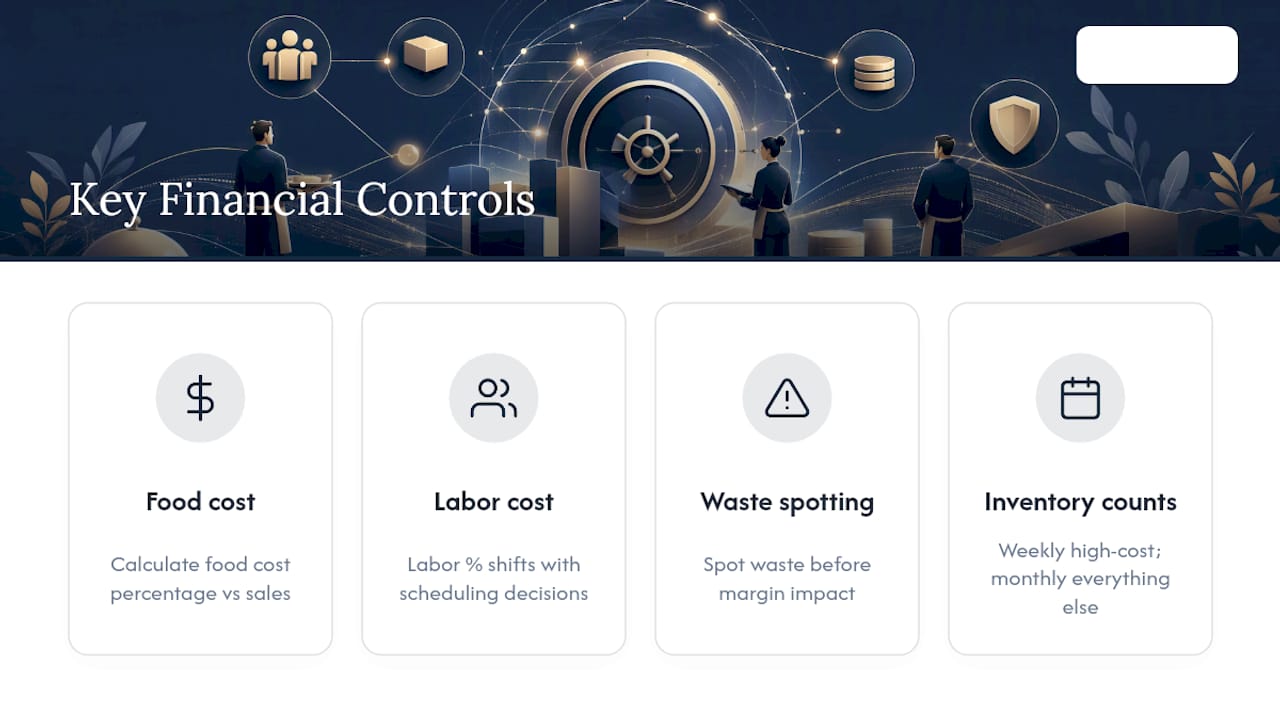
This is where most manager training falls short. Owners assume "financial literacy" means reading a P&L once. It doesn't. Teach the actual math: how food cost percentage is calculated against sales, how labor cost percentage shifts with scheduling decisions, and how to spot waste before it shows up as a margin problem next month. Inventory counts should happen on a fixed schedule, not "whenever there's time." Weekly counts for high-cost items, monthly for everything else, is a reasonable starting point for most independent operations.
Scheduling and labor law basics
A manager who doesn't understand overtime triggers can cost you thousands in a single pay period. Train the fundamentals of fair scheduling (adequate notice, predictable hours where required by local law), overtime avoidance strategies, and the payroll basics that keep you compliant. Flag the legal red flags explicitly: off-the-clock work requests, meal break violations, and minor labor law restrictions if you employ workers under 18.
Guest experience and complaint recovery
Give your managers actual scripts, not vague advice to "handle it professionally." A de-escalation script for an angry guest, a clear comp policy with dollar thresholds a manager can authorize without calling you, and a defined service recovery flow (acknowledge, apologize, act, follow up) turn a soft skill into a repeatable process.
Technology and POS systems, crisis management
POS mastery goes beyond ringing in orders. Managers need to run reports, void transactions correctly, and use whatever digital checklist or temperature log system you've adopted. Pair this with crisis training: what to do when a walk-in fails at 6pm on a Friday, how to respond to a staff injury, and how to prepare for a health inspector who shows up unannounced.
How to Structure a Restaurant Manager Training Program
Structure beats good intentions. A manager training program without a timeline and defined checkpoints tends to drift, with trainees "shadowing" indefinitely and no clear moment when they're actually ready. Build modules with dates attached.
Four-week track (best for single-concept independent restaurants):
- Week 1: Brand standards, food safety certification, POS basics
- Week 2: Line checks, opening/closing procedures, supervised shifts begin
- Week 3: Financial reporting, scheduling, guest recovery scripts
- Week 4: Solo supervised shift, final assessment, sign-off
Eight-week track (better for multi-unit or higher-complexity operations):
- Weeks 1 to 2: Certifications, brand orientation, shadowing
- Weeks 3 to 4: Operations and food safety deep dive with daily practice
- Weeks 5 to 6: Financial controls, labor law, scheduling practice
- Weeks 7 to 8: Supervised solo shifts across multiple dayparts, final assessment
The delivery mix matters as much as the timeline. Blended programs that pair short digital modules with supervised shifts and role-play consistently outperform either approach alone. Use online modules for knowledge that doesn't change often (SOPs, compliance basics, brand history). Reserve supervised shifts for anything that requires judgment: handling an upset guest, managing a rush, coaching a struggling line cook in real time.
Set clear assessment gates instead of just tracking hours completed:
- Quiz scores of 80% or higher on food safety and compliance modules
- A supervised shift sign-off from an existing manager or owner
- Documented completion in whatever digital tracking system you use
- A final "solo shift with safety net" where a senior manager is on call but not present
If your operation runs a single concept with a simple menu, the four-week track is usually sufficient. Multi-concept groups, higher-volume operations, or anywhere alcohol service adds regulatory complexity should lean toward eight weeks.
What Goes Into a Manager Training Manual
A training manual that's just a wall of text gets skimmed once and ignored. A manual built around checklists and quick-reference sections gets used every shift. Structure yours around five sections: brand and culture, operations SOPs, food safety SOPs, reporting templates, and an escalation chain that tells a manager exactly who to call and when.
Sample checklist items you can adapt directly:
- Line check: verify all cold-hold items are under 40°F before service begins
- Shift handover: document 86'd items, VIP reservations, and equipment issues
- Inventory: count high-cost proteins and alcohol weekly, dry goods monthly
- Closing: confirm all equipment is off, cash is reconciled, and prep list is posted for tomorrow
Here's a sample opening SOP excerpt you can adapt:
That last line matters more than it looks. A manual that tells a manager when to escalate, not just what to do, prevents small problems from becoming expensive ones.
Format matters too. A 40-page binder nobody opens is worse than no manual at all. Break content into mobile-friendly checklists for daily use, short video snippets for anything visual (proper knife handling, POS voids, plating standards), and a one-page quick guide for the handful of decisions a manager needs to make fast, like comp authorization limits or who to call for a maintenance emergency. For deeper workflow guidance you can build directly into these sections, a manager's guide to restaurant operations offers a useful framework.
Certification and How to Verify Manager Competency
External certification and internal verification serve different purposes, and conflating them creates gaps. ServSafe Manager should be non-negotiable for anyone running shifts alone. Responsible alcohol service certification follows the same logic wherever your state or municipality requires it. Beyond that, structured programs like the hybrid Restaurant Academy or accredited options through the Restaurant & Hospitality Leadership Center give you a nationally recognized credential to point to, useful if you're building a career ladder across multiple locations.
Internal verification is where most of the actual proof lives. That means:
- An observed solo-shift sign-off from a senior manager or owner
- A completed competency checklist covering every module in your training plan
- Quiz completion rates tracked in whatever system, spreadsheet or LMS, you're using
- Dated records showing when each certification was earned and when it expires
External accreditation matters most when a credential is legally required or when you're building a formal career path that spans locations. Internal sign-off is sufficient for most operational competencies, like running a line check or handling a comp decision, where consistency with your own SOPs matters more than a third-party stamp.
Pro Tip: Keep certification and sign-off records for at least three years. If a health inspector or an insurance auditor ever asks who trained a manager and when, "we don't have that documented" is the answer that costs you.
Keeping Manager Skills Sharp After Initial Training
Training doesn't end at week four or eight. Skills atrophy, and new problems surface that no manual anticipated. Build a rotation of monthly micro-skill sessions, fifteen minutes on a single topic like new allergen labeling requirements, a POS update, or a review of last month's biggest guest complaint pattern.
Post-incident debriefs are free training if you use them right. A documented review of what happened, why, and what changes next time turns a bad night into institutional knowledge rather than a story managers tell each other in the break room.
- Run monthly 15-minute micro-sessions on a rotating topic
- Debrief every significant incident within 48 hours, documented in writing
- Pair new managers with a mentor for structured monthly check-ins, 30 minutes is enough
- Tie completed training milestones to raises or promotion eligibility
That last point matters more than owners often credit. Managers who see a clear line between training completion and career advancement stay longer. Vague promises don't move the needle the way a documented pathway does.
How Wits' End Solutions Approaches Manager Training
Our approach blends structured modules with supervised shifts and the analytics we run through our Ingest platform, which lets us pinpoint exactly where a manager's skill gaps are costing money before they become bigger problems, aligning with insights on the role of food in hospitality to enhance guest experience and operational success.
A typical starter engagement looks like a six-week scope: two weeks of operations and compliance modules, two weeks of supervised shift work, and two weeks of financial and guest-recovery training with a final competency assessment.
- Blended module design combining digital learning with supervised, on-property practice
- Analytics-driven gap identification tied to actual P&L and labor data
Training Managers to Handle Suppliers and Vendors
A manager who can't manage a vendor relationship ends up managing a crisis instead, usually at the worst possible moment. Train your managers on the basics: how to read a delivery invoice against the actual order, how to spot short shipments or substitution issues before they hit the line, and how to escalate a quality problem without burning the relationship.
Teach them to distinguish between a one-off vendor mistake and a pattern worth renegotiating over. A single late delivery is a phone call. Three late deliveries in a month is a conversation with you about whether the vendor relationship still works. Managers also need to understand basic pricing dynamics, when a vendor's price increase is market-driven versus when it's worth pushing back on, and how substitution requests during shortages affect both cost and menu consistency.
Documentation matters here too. A manager who logs vendor issues (date, item, resolution) builds a paper trail that's useful both for renegotiating contracts and for spotting which suppliers are reliable versus which ones create recurring headaches. This ties directly into the financial competency work covered earlier: vendor management and food cost control are the same skill viewed from different angles.
Sanitation and Pest Control Beyond Food Safety Basics
Food safety training covers what happens to product. Sanitation training covers what happens to the building, and it's a distinct skill set that often gets folded into food safety when it shouldn't be. Managers need a defined cleaning schedule that goes beyond the kitchen: dining room surfaces, restrooms, HVAC filters, grease traps, and exterior areas all need documented cleaning frequencies, not "as needed" judgment calls.

Pest control deserves its own training module. A manager should know what conditions attract pests (standing water, unsealed food storage, gaps in door seals), how to recognize early signs of an infestation, and exactly who to call and how fast when something is spotted. Waiting until a health inspector flags it is a failure of training, not bad luck.
Train managers to treat their pest control vendor relationship the same way they treat any other vendor: scheduled visits, documented findings, and a clear escalation path if activity increases between visits. Cleaning protocols and pest prevention aren't glamorous training topics, but they're the difference between passing an inspection with a clean report and scrambling to explain a violation.
Resolving Conflict Between Staff and With Guests
Conflict is inevitable in a fast-paced kitchen and dining room. Untrained managers either avoid it entirely, letting resentment build, or handle it so bluntly that they damage trust. Train a middle path: address issues directly, quickly, and privately.
For staff-to-staff conflict, teach managers to separate the parties, hear both sides without taking one at face value, and focus the conversation on the specific behavior rather than personality. A manager who says "you two need to sort this out" without structure is skipping the training that would actually resolve the friction.
For staff-to-guest conflict, the de-escalation scripts covered earlier apply, but managers also need training on when to step in immediately versus when to let a server handle a situation with support standing by. Undermining a server in front of a guest erodes staff confidence just as fast as an unresolved guest complaint erodes loyalty. The goal is a manager who can defuse a situation without making either party feel dismissed, a skill that takes deliberate practice, not instinct.
Editorial Take: Skip the Binder, Build the Blueprint
Most restaurant manager training fails for one reason: it's built around information transfer instead of competency verification. Owners hand over a binder, assume reading equals readiness, and find out the gap exists during a Friday night rush instead of during training.
The conventional advice, "train for a few weeks and see how it goes," treats readiness as a feeling rather than something you test. It isn't. A manager should demonstrate a solo closing shift, a documented guest recovery, and a correct food cost calculation before they're trusted alone, not after.
What gets underrated is how much of this comes down to sequencing, not content. Cramming financials into week one, before a manager has even run a line check, produces someone who can recite a formula but can't apply it under pressure. Build the blueprint backward from the solo shift you want them running in week four or eight, then work out what has to come before it.
Prioritize the assessment gates first. Everything else in the program should exist to get a manager through them.
— Chris
Build the Program, Don't Just Buy the Binder
Reading about training topics is one thing. Building a program that actually gets a manager to a confident solo shift in six weeks, with the checklists, assessment gates, and documentation to back it up, is a different project entirely. That's the gap Wits' End Solutions closes for owners who don't have the bandwidth to build this from scratch while also running service every night.
We design manager training programs around your specific menu, brand standards, and operational complexity, then pair them with the analytics that show you exactly where a manager's decisions are affecting your margin. If you're opening a new location or trying to fix inconsistent management performance across an existing one, our task force services can deploy on-site training support fast, without waiting for a slow internal rollout.
If you want a program built around your restaurant instead of a generic template, start a conversation with Wits' End Solutions about what a six-week rollout would look like for your team.
Key Takeaways
A restaurant manager becomes shift-ready when training combines certified food safety knowledge, supervised shift practice, and documented competency sign-off across a defined four-to-eight-week timeline.
| Point | Details |
|---|---|
| Cover nine core competencies | Include operations, people management, food safety, financials, scheduling, guest recovery, technology, crisis response, and assessment. |
| Set a defined timeline | Run four weeks for simple, single-concept operations or eight weeks for higher-complexity or multi-unit training. |
| Require certification gates | Mandate ServSafe Manager and responsible alcohol service credentials before solo shift sign-off. |
| Verify with supervised shifts | Use observed solo-shift sign-off and completed checklists, not just quiz scores, as proof of readiness. |
| Build or borrow the blueprint | Wits' End Solutions designs blended manager training programs tied to your specific menu and operational data. |
Sources
- What We Do | National Restaurant Association
- Restaurant Academy | National Restaurant Association Educational Foundation