

Most operators think onboarding is the stuff you do on day one. Hand out the uniform, show someone where the walk-in is, and get them on the floor. That view is costing you staff, guests, and margin. True staff onboarding is a structured process that integrates new hires into the job, systems, and team over a meaningful ramp period. Done right, it reduces early turnover, lifts service quality, and ensures your team meets compliance standards before they ever face a guest. This guide breaks down every stage of an effective restaurant onboarding program, with examples and tactics you can apply immediately.
Table of Contents
- What is staff onboarding in restaurants?
- Key components of an effective onboarding process
- Onboarding frameworks and examples from top restaurants
- Troubleshooting common onboarding challenges
- Our perspective: Why onboarding is your highest leverage investment
- How Wits End can support your restaurant onboarding
- Frequently asked questions
Key Takeaways
| Point | Details |
|---|---|
| Structured onboarding matters | A step-by-step onboarding process strengthens team performance and staff retention in restaurants. |
| Preparation is essential | Ensuring tools, access, and training are ready before new hires start prevents wasted time and confusion. |
| Focus on safety and compliance | Menu, allergen, and safety training reduce risks and are critical components for onboarding success. |
| Ongoing support boosts retention | Milestone check-ins and extended development tracks drive long-term employee engagement and performance. |
What is staff onboarding in restaurants?
With the importance of onboarding established, let us define what it looks like in real-world restaurant settings.
Staff onboarding in a restaurant context is not a single event. It is a multi-stage journey that begins before a new hire's first shift and continues well into their first months on the job. The goal is to move someone from "new to the building" to "confident, productive team member" as efficiently and thoroughly as possible. Onboarding goes beyond day-one paperwork to connect people with the job, the systems, and the culture they are joining.
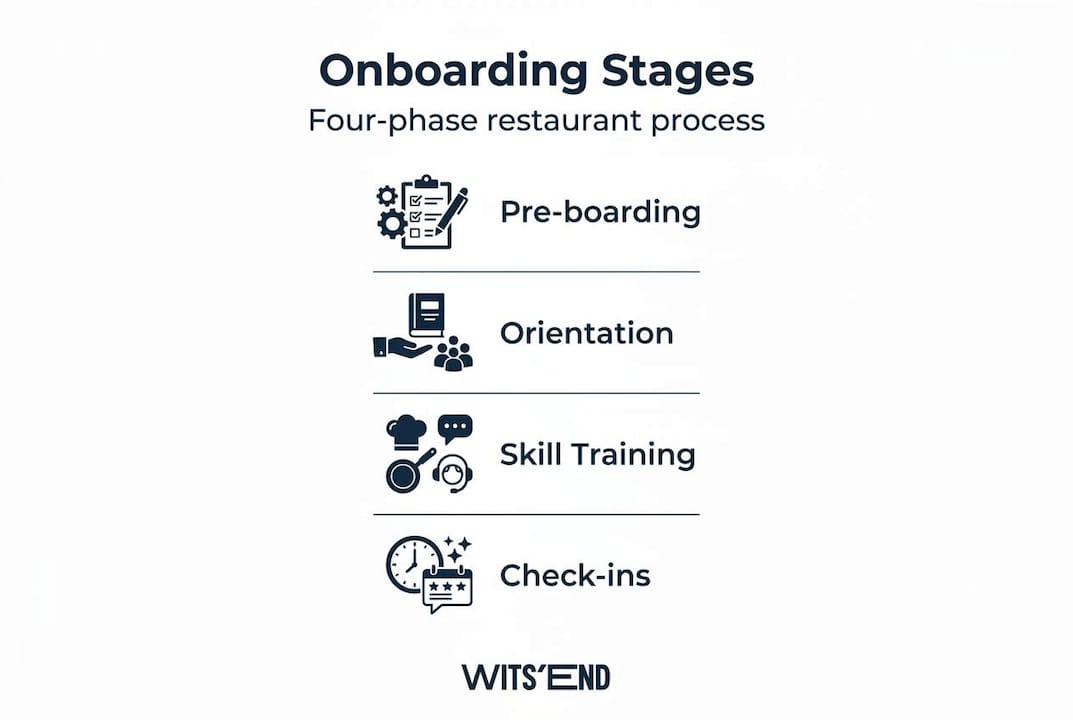
Most effective programs are organized into four distinct phases. Each phase serves a different purpose, and skipping any one of them creates gaps that show up on the floor.
| Phase | Timing | Focus |
|---|---|---|
| Pre-boarding | Before day one | Paperwork, system access, uniform, schedule |
| Day-one orientation | First shift | Introductions, safety, workflow overview |
| Ramp-up training | Weeks 1 to 4 | Menu, POS, service standards, compliance |
| Milestone check-ins | 30, 60, 90 days | Performance review, reinforcement, culture fit |
A phased approach matters because people do not absorb everything at once. Flooding a new server with menu knowledge, POS training, allergen protocols, and table section maps on their first day creates overload, not competence. Spacing training across a structured timeline allows reinforcement to happen naturally, turning individual lessons into reliable habits.
The business case is straightforward. High turnover in restaurants is expensive in both direct costs, such as recruitment and replacement, and indirect ones like inconsistent guest experience. Operators who use a formal checklist for onboarding report faster time to full productivity and lower first-90-day exit rates. When new team members feel prepared and supported, they stay. When they feel thrown into the deep end, they leave, often within the first 60 days.
Key components of an effective onboarding process
Understanding the stages sets a strong foundation. Now, see what actionable steps turn onboarding from rote to results-driven.
Effective onboarding has specific components that need to be handled before, during, and after the first shift. Treating these as a checklist rather than an afterthought is what separates programs that work from those that just take up time.
Pre-boarding actions are the most commonly overlooked piece. Pre-shift readiness for tools and access, including POS logins, payroll enrollment, scheduling app setup, and uniform allocation, should be completed before a new hire walks through the door on day one. When these items are missing, the first shift is spent troubleshooting instead of learning, and that frustration sets a negative tone immediately.
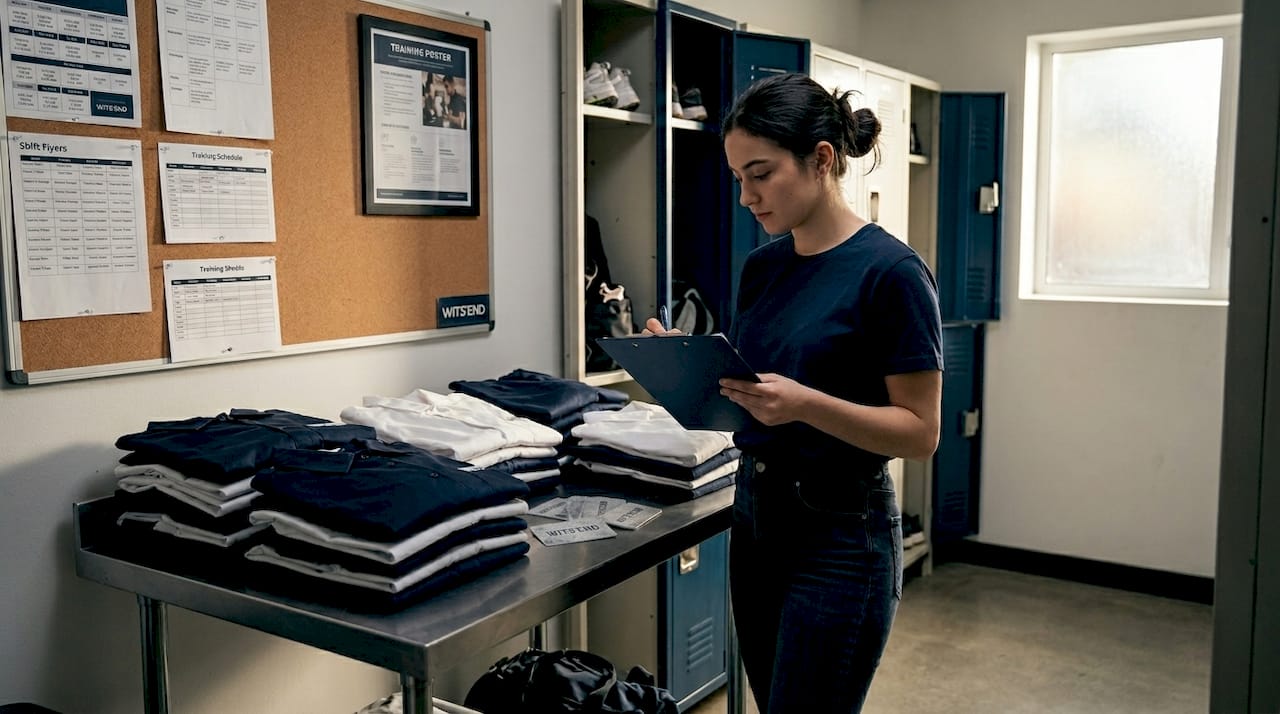
First-day orientation should follow a consistent structure. The goal is not to train deeply on day one. The goal is to make someone feel like they belong and understand the basic shape of their new environment. This includes a warm team introduction, a physical walkthrough of the space, safety and emergency procedures, and a clear overview of the shift schedule and reporting structure. Keep it focused and human.
Training during the ramp-up period is where the depth lives. A well-designed program for a front-of-house team member typically covers:
- Menu knowledge, including ingredients, preparation methods, and signature items
- Allergen and food safety protocols, which are mandatory in most jurisdictions and carry significant liability if missed
- POS system operation, including order entry, modifications, and payment processing
- Guest service standards, including greeting, upselling language, and complaint handling
- Team communication and floor etiquette, including how your team interacts during service
Onboarding also includes training on operational standards and risk-relevant knowledge such as menu basics and allergen information. This is not optional content. In many states, serving a guest food they are allergic to without proper disclosure is a legal liability, not just a service failure.
Scheduled check-ins at the 30, 60, and 90-day marks close the loop. These conversations should assess both skill development and cultural integration. Is the new team member performing to standard? Do they understand your values? Are there gaps in their training that need to be addressed before they become habits? A brief, structured conversation at each milestone does more to retain staff than any bonus or incentive program.
Pro Tip: Build a simple onboarding packet that includes the schedule for each training phase, a contact list for key team members, and a checklist of tasks to complete in the first week. Handing this to a new hire on day one signals that your operation is organized and that their success matters to you. That impression lasts.
Working with established restaurant training programs can give your onboarding structure a professional backbone, especially if you are opening a new location or scaling a team quickly.
Onboarding frameworks and examples from top restaurants
Now that you know which components matter, here is how leading restaurants put onboarding frameworks into action and achieve measurable improvements.
A strong onboarding framework typically rests on three pillars: checklists, mentoring, and milestones. Checklists ensure nothing critical is missed. Mentoring connects new hires with experienced team members who model culture and standards in real time. Milestones create accountability and a sense of progress, both of which are powerful motivators for people in the early weeks of a new job.
The checklist alone is not enough. A list without a mentor leaves new hires reading documents without context. A mentor without a checklist leads to inconsistent training where some people learn everything and others miss critical pieces depending on who happened to train them. Combining both creates reliability.
The power of structured development programs is well documented in the industry. Dishoom's chef development program, the acclaimed UK restaurant group, is directly associated with reduced chef turnover. Rather than treating kitchen onboarding as a brief orientation, Dishoom built a multi-stage academy experience that invested in chef identity and craft over time. The result was a team that stayed longer, performed with greater consistency, and felt genuine ownership over the food they produced.
"When people feel invested in, they invest back. Structured development is not a benefit, it is a retention strategy."
US restaurants can absolutely adapt this model. For line cooks, it might mean a four-week skills progression program with weekly sign-offs from a sous chef. For servers, it could be a tiered certification process where staff earn expanded section responsibilities as they demonstrate competency. For managers, a 90-day leadership track that covers P&L basics, scheduling, and team coaching gives them the tools to actually lead rather than just react.
The pitfall most operators fall into is treating onboarding as a short sprint rather than a sustained effort. A two-day orientation followed by nothing is not a program. It is an introduction. The difference between introduction and integration is what drives the retention numbers that keep your labor cost under control and your team performing at a high level.
Pro Tip: Pair every new hire with a designated mentor for at least their first two weeks. Choose mentors who model the behaviors and attitude you want to reinforce, not just the most experienced or senior person available. Culture is caught, not taught, and mentors are the fastest transmission path.
Exploring structured training programs designed specifically for the hospitality industry can give your framework the rigor it needs without requiring you to build everything from scratch. Similarly, intentional work on developing strong staff culture from day one creates the environment where trained skills actually take root.
Troubleshooting common onboarding challenges
Even strong plans can stumble. Let us address the frequent onboarding problems and how to fix them efficiently.
The most common onboarding failures are preventable. They tend to cluster around the same recurring issues: technical delays, training gaps, poor communication, and an absence of follow-through. Knowing where these problems typically emerge allows you to get ahead of them.
Careful preparation prevents wasted time and compliance gaps. Yet in practice, many restaurants still send new hires into their first shift without a working POS login or access to the scheduling system. This is a preparation failure, and it sends an immediate message to the new hire that the operation is disorganized. Fix this by assigning a pre-boarding coordinator, even if that person is a senior team member, whose job is to confirm all access and materials are ready 48 hours before a new hire's first shift.
- Missing system access: Assign a pre-boarding checklist owner who confirms POS, scheduling, and payroll logins are active before day one. Test them personally.
- Insufficient compliance training: Build allergen, food safety, and harassment prevention training into the first week, not as an optional module but as a required sign-off. Document completion.
- Unclear communication: Give every new hire a written overview of their first two weeks, including who they report to, what they will be learning, and how success will be measured. Ambiguity breeds anxiety.
- No feedback loop: Schedule a brief, informal check-in at the end of the first week. Ask what is working, what is confusing, and what support they need. This takes ten minutes and pays dividends in early retention.
Addressing pre-shift onboarding mistakes before they become patterns is far less costly than replacing a staff member who left because they felt unsupported in their first month.
The cultural side of troubleshooting is often underestimated. New hires who feel like outsiders in the first two weeks rarely become invested long-term team members. Simple actions, like including them in pre-shift conversations, acknowledging their progress publicly, and making sure existing staff know how to welcome someone new, go a long way toward building the connection that makes people stay.
Our perspective: Why onboarding is your highest leverage investment
Addressing the common pitfalls brings us to what we believe is a critical and often underappreciated realization. Onboarding is not an HR task. It is your single highest leverage investment in team performance, and most restaurant operators are massively underinvesting in it.
Think about what you spend to find and hire a new team member. Job postings, interview time, manager bandwidth, and then training overhead on top of that. When a new hire exits in the first 60 days because they felt underprepared or unwelcome, that entire investment disappears. You start over. The cost is not just financial. It is felt in team morale, service consistency, and the confidence of everyone watching the revolving door spin.
We have worked with restaurants that had excellent menus, beautiful spaces, and genuine hospitality vision, but struggled to hold a team together long enough to deliver consistently. In every case, the onboarding process was informal at best and nonexistent at worst. The fix was not a new hire or a new menu. It was a structured 90-day onboarding program that made new team members feel valued, prepared, and connected from day one.
The payoff is measurable. Lower early turnover directly reduces labor cost and management stress. A staff member who finishes a 90-day structured program and stays is a compounding asset. They get better. They mentor the next wave of hires. They build the lasting customer loyalty that comes from guests recognizing and trusting the same faces over and over.
Great onboarding is not a cost. It is the foundation of a team that performs, a culture that endures, and a guest experience that earns repeat business. If you treat it as an obligation, you will get obligation-level results. If you treat it as a strategic priority, your entire operation rises with it.
How Wits End can support your restaurant onboarding
Ready to put these onboarding lessons into practice? Expert support can make a meaningful difference in how quickly and effectively your team gets up to speed.
At Wits' End, we work directly with restaurant operators to build and strengthen the systems that drive team performance, including onboarding. Whether you are opening a new location, scaling a growing concept, or looking to reduce early turnover in an existing operation, we can help you design a program that fits your team, your standards, and your culture.
Our restaurant training programs are built by people who have done this work on the floor, not just in a classroom. We develop customized onboarding frameworks that cover everything from pre-boarding logistics and compliance training to mentor programs and milestone check-ins. For operators who need more hands-on support, our task force services put experienced hospitality professionals on site to run training alongside your team, exactly when you need them most. From the first hire to the full team, we are here to help you build something that lasts.
Frequently asked questions
How long does staff onboarding typically last in restaurants?
Most effective restaurant onboarding spans 30 to 90 days, with structured check-ins at each milestone to reinforce learning and address emerging gaps.
What should be included in day-one onboarding?
Day-one orientation should cover systems access, team introductions, required paperwork, and a clear safety briefing, keeping the focus on connection and orientation rather than deep training.
Why is training on allergens and food safety required for restaurant staff?
Allergen knowledge is mandatory in most jurisdictions because serving a guest food they are allergic to without proper disclosure creates serious legal and safety liability for the restaurant.
How can structured onboarding reduce staff turnover?
When new hires feel supported and prepared, they are far more likely to stay. Dishoom's structured development program demonstrates how longer, intentional training tracks are directly linked to reduced early turnover in demanding kitchen environments.
Recommended
- Restaurant customer experience best practices for loyalty
- Hotel and Restaurant Training Programs — Wits End
- Restaurant launch checklist: Your guide to a smooth opening
- How to Increase Guest Count and Revenue with Apps like inKind — Wits End
- Event success: the strategic role of venue staff
- How food drives real team bonding at work