
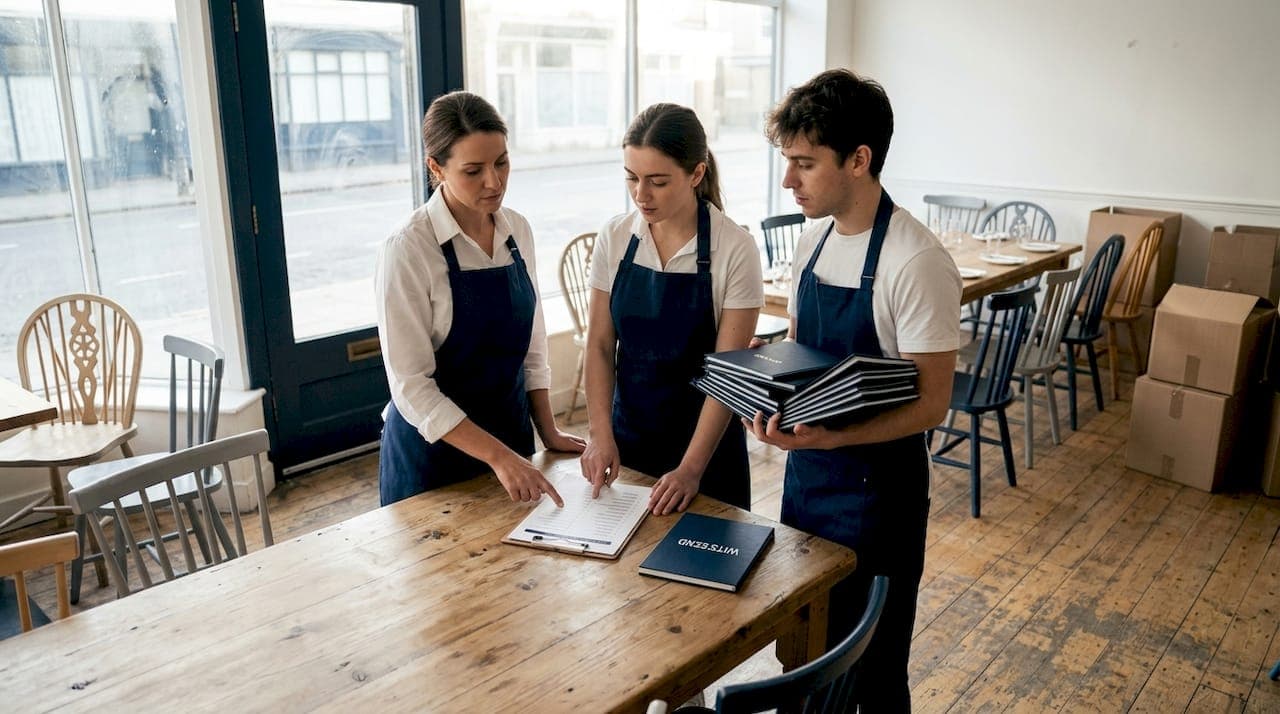
Opening a restaurant means managing dozens of moving parts at once, and the stakes are high from the very first day. You are coordinating a location search, permit applications, supplier contracts, staff hiring, and marketing, all while keeping your concept and budget intact. Miss one step and you risk delays that cost real money and momentum. This checklist pulls from real operational experience to give you a clear, practical path through every phase of your launch, from signing a lease to your first packed house and beyond.
Table of Contents
- Location and lease: Laying the groundwork
- Permits and compliance: Navigating regulations
- Menu, suppliers, and staffing: Building your operational core
- Grand opening and momentum: Promotion, soft launch, and first impressions
- Post-launch: Monitoring, evaluating, and adapting for success
- What most restaurant checklists miss: The power of adaptability
- How Wits' End can support your restaurant launch
- Frequently asked questions
Key Takeaways
| Point | Details |
|---|---|
| Location matters most | Lease rates, zoning, and parking set your foundation for long-term viability. |
| Permits and compliance | Grasp local/state rules to avoid costly opening delays. |
| Menu and staff preparation | A well-planned menu and trained team drive daily operations. |
| Launch with momentum | Soft openings and promotions create buzz and vital feedback loops. |
| Continuous improvement | Monitor results and adapt fast for lasting restaurant success. |
Location and lease: Laying the groundwork
With the bigger picture clear, choosing your location and negotiating the right lease set the foundation for everything else. The right space can accelerate your growth. The wrong one can drain your cash before you serve a single guest.
Start by evaluating every candidate location against a core set of criteria. Visibility from the street matters more than most operators expect, especially for first-time concepts without an existing following. Parking availability, proximity to public transit, and neighborhood foot traffic all directly affect how many guests walk through your door on any given night. Zoning is equally important. Not every commercial space is approved for food service or alcohol sales, and discovering that late in negotiations costs time and legal fees.
Lease cost is where many new operators get into trouble. Lease rates should not exceed 10% of your projected annual revenue, and you should evaluate zoning, foot traffic, and parking before signing anything. If your projected first-year revenue is $1.2 million, your annual rent should stay at or below $120,000. When you are in the excitement of finding a great space, it is easy to rationalize a number that is slightly over. Resist that instinct.
Hidden costs in a lease can be just as damaging as high base rent. Tenant Improvement (TI) allowances, which are funds a landlord provides to help you build out the space, vary widely by market. In New York City, for example, TI allowances typically range from $50 to $150 per square foot depending on the building and deal structure. Understand what your build-out will actually cost before you negotiate, so you know how much TI you need to ask for.
Pro Tip: Before you sign, model three revenue scenarios: conservative, expected, and strong. Run your lease cost as a percentage against all three. If your rent becomes unsustainable even in the expected scenario, keep looking.
Neighborhood trends also deserve attention. A block that feels quiet today may be in the middle of a development wave, or it may be declining. Talk to neighboring business owners, check permit filings for nearby construction, and research any planned infrastructure changes that could affect foot traffic.
Permits and compliance: Navigating regulations
Once you have secured a space, the next phase is getting legally prepared with the right permits and understanding the regulations specific to your city and state. This is one of the most underestimated timelines in the entire launch process.
The core permits most restaurants need include a business license, a food service establishment permit, a certificate of occupancy, a health department permit, and a fire inspection clearance. If you plan to serve alcohol, add a liquor license to that list, and understand that in many states, liquor license approvals can take three to six months or longer. Starting this process late is one of the most common reasons restaurants miss their opening date.
Here is a practical sequence to follow:
- Register your business entity and obtain your federal Employer Identification Number (EIN).
- Apply for your state and local business license.
- Submit your food service permit application to your local health department.
- Schedule a pre-construction meeting with your building department if you are doing any renovation work.
- Apply for your liquor license as early as legally possible.
- Schedule fire and health inspections once construction is complete.
- Confirm your certificate of occupancy before any guests enter the building.
Compliance requirements are not static. State and local permit variations are critical, and new regulations continue to emerge. California's allergen disclosure law for chains with more than 20 locations takes effect in July 2026, and New York City lease build-out provisions specify TI allowances in the $50 to $150 per square foot range. Even if these specific rules do not apply to your concept today, they signal the direction regulations are moving across the country.
Compliance is not a one-time task. Build a recurring review into your operations so that as laws change, your restaurant stays ahead of them rather than scrambling to catch up.
Work with a local attorney who specializes in hospitality or food service to review your permits before you open. The cost of that review is far less than the cost of a failed inspection or a temporary closure.
Menu, suppliers, and staffing: Building your operational core
Paperwork is just the start. Building the right menu, sourcing your essentials, and recruiting a solid team form the daily backbone of your business.
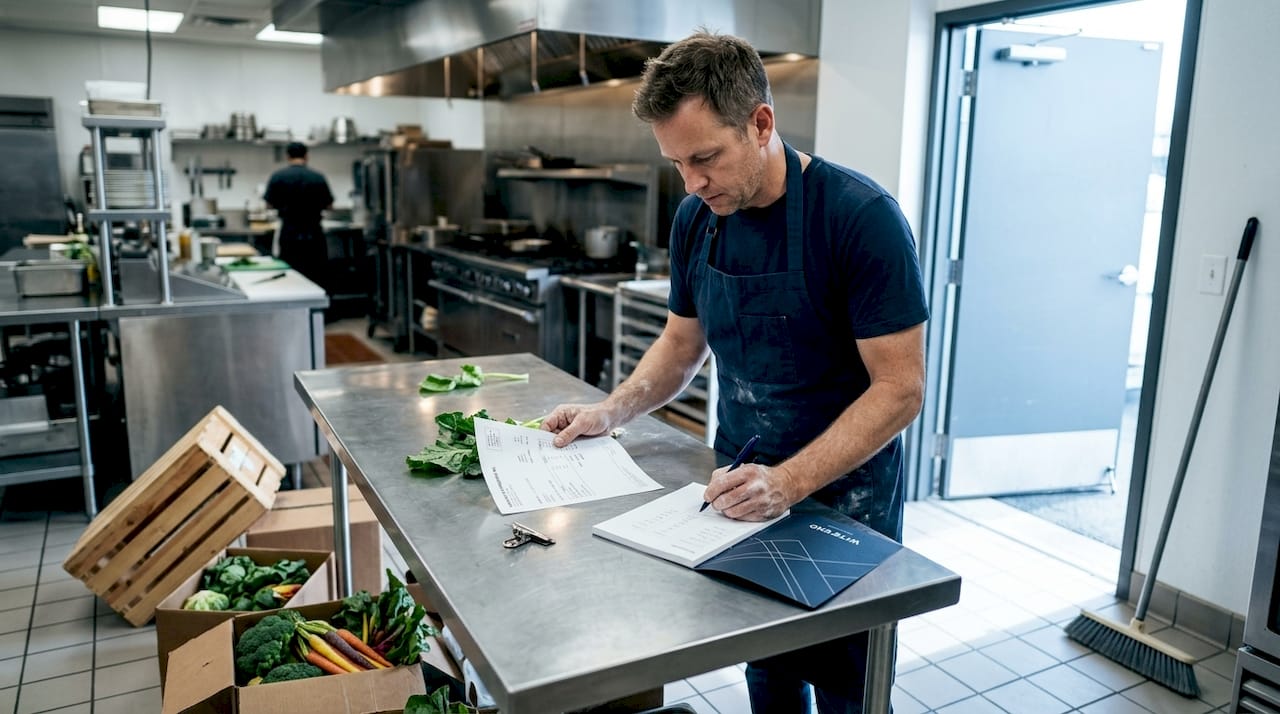
Your menu should be designed with both guest experience and operational efficiency in mind. Approach profitable menu design by identifying your core items, the dishes that define your concept and carry strong margins, and separating them from flexible items that can rotate with seasons or supply availability. A tighter menu is easier to execute consistently, reduces waste, and simplifies training.
Supplier selection deserves the same rigor you apply to your lease negotiation. Identify primary and backup vendors for every major category: proteins, produce, dairy, dry goods, beverages, and disposables. Understand lead times, minimum order quantities, and delivery schedules before you open, not after your first stockout. Build relationships with your sales reps. When supply chain disruptions happen, and they will, those relationships determine how quickly you get back on track.
Staffing is where your concept comes to life. Your front of house (FOH) team shapes the guest experience directly, while your back of house (BOH) team determines whether your food quality and speed hold up under pressure. Hire for attitude and train for skill. Invest in restaurant staff training that covers not just job tasks but your brand standards, your service philosophy, and how you want guests to feel when they leave.
Daily operational checklists are essential for both FOH and BOH opening and closing routines, covering everything from inspecting entries and sanitizing surfaces to restocking stations, running POS checks, logging temperatures, running pre-shift meetings, and practicing FIFO (first in, first out) inventory rotation.
Here is a sample daily checklist framework to build from:
| Task | FOH | BOH | Timing |
|---|---|---|---|
| Inspect entries and dining room | Yes | No | Opening |
| Sanitize all surfaces and equipment | Yes | Yes | Opening |
| Restock service stations | Yes | Yes | Opening |
| POS system check and cash drawer | Yes | No | Opening |
| Temperature logs for all cold storage | No | Yes | Opening |
| Pre-shift team meeting | Yes | Yes | Pre-service |
| FIFO rotation and date labeling | No | Yes | Opening |
| End-of-night cleaning and reset | Yes | Yes | Closing |
| Secure cash and close POS | Yes | No | Closing |
| Waste log and inventory notes | No | Yes | Closing |
Pro Tip: Run your full opening and closing checklist during your soft opening week with a manager timing each task. You will quickly identify where the process slows down and where staff need more reinforcement.
Grand opening and momentum: Promotion, soft launch, and first impressions
With your team and menu ready, it is time to plan how you will introduce your restaurant to the world for maximum impact.
A soft opening, where you invite a limited number of guests before your public launch, is one of the highest-value things you can do. It gives your team real service experience in a lower-stakes environment, surfaces operational gaps you cannot see in a dry run, and generates early word-of-mouth. Soft openings and promotions build momentum, and monitoring performance post-launch with a willingness to adjust is what keeps that momentum going.
Here is how a soft opening compares to a grand opening:
| Factor | Soft opening | Grand opening |
|---|---|---|
| Guest volume | Limited, controlled | Full capacity |
| Purpose | Test operations and train staff | Generate buzz and media coverage |
| Feedback | Direct and immediate | Broader, through reviews and social |
| Risk | Low | Higher |
| Marketing push | Minimal or invite-only | Full promotional campaign |
| Ideal timing | One to two weeks before grand opening | After operations are stable |
Your grand opening should follow once you are confident in your service. Build a promotional plan that includes local media outreach, social media content, email collection starting weeks in advance, and partnerships with neighboring businesses or community organizations. Special offers like a complimentary appetizer or a prix-fixe preview menu give people a reason to show up and share.
Here is a practical grand opening sequence:
- Six weeks out: Finalize your event plan and promotional budget.
- Four weeks out: Begin social media content and start building your email list.
- Two weeks out: Send press releases to local food media and bloggers.
- One week out: Run your soft opening and gather feedback.
- Opening week: Execute your grand opening event with full promotional support.
- Week two: Follow up with guests, respond to early reviews, and adjust service based on feedback.
Investing in building your restaurant brand before you open creates an audience ready to walk through your door on day one. And making sure your team has gone through thorough pre-opening staff training means that audience gets an experience worth talking about.
Pro Tip: Use your soft opening to test your slowest and busiest service periods separately. A lunch soft opening and a dinner soft opening will reveal very different operational challenges.
Post-launch: Monitoring, evaluating, and adapting for success
Launching is not the final step. Ongoing evaluation and fast improvements separate thriving restaurants from those that stall after the opening buzz fades.
Establish a weekly review rhythm from your very first week of service. Track your key metrics consistently:
- Labor cost percentage: Keep this in line with your budget, typically 28 to 35 percent of revenue depending on your concept.
- Food cost percentage: Most full-service restaurants target 28 to 32 percent. Track it weekly, not monthly.
- Guest satisfaction: Monitor online reviews, comment cards, and direct feedback from your floor team.
- Table turn times and cover counts: These tell you whether your service flow is working or creating bottlenecks.
- Sales mix: Which menu items are selling, which are not, and what that means for your food cost and kitchen efficiency.
Continuous adaptation is the key beyond opening day. The restaurants that thrive are the ones whose owners and managers treat the first 90 days as a learning period, not just a performance period. Adjust your menu based on what guests order and what your kitchen executes best. Adjust your staffing based on actual cover counts, not projections.
Technology can accelerate this process significantly. A strong POS system gives you real-time sales data. Reservation platforms provide guest behavior patterns. Inventory management tools reduce waste and catch variance early. Explore restaurant operations optimization resources to understand how to use these tools together effectively.
Pro Tip: Schedule a 30-minute debrief with your management team every week for the first three months. Review one thing that worked, one thing that did not, and one specific action to take before the next meeting. Small, consistent improvements compound quickly.
Understanding how to increase guest count and revenue through platforms and partnerships is also worth exploring early. And if you want a broader view of how outside expertise can accelerate your results, the case for working with a restaurant startup consultant becomes clear once you see how much time and money the right guidance saves.
What most restaurant checklists miss: The power of adaptability
Every checklist in this article is worth following carefully. And yet, after working through hundreds of restaurant openings, the most honest thing we can say is this: no plan survives first contact with real guests.
The operators who build lasting businesses are not the ones with the most detailed pre-opening binders. They are the ones who treat the checklist as a starting point, not a destination. They watch what actually happens during service, listen to their teams, read their data, and make changes without ego getting in the way.
Most opening checklists focus on what to do before you open. Very few give equal weight to what to do in the weeks after, when the real shape of your business becomes clear. Your first 60 days of service will teach you more about your concept than any planning session ever could. The question is whether you are set up to learn from it.
The insights from experienced startup consultants consistently point to the same pattern: operators who build feedback loops into their operations from day one outperform those who treat opening as the finish line. Build the habit of asking, "What did we learn this week?" and your restaurant will keep getting better long after the launch excitement fades.
How Wits' End can support your restaurant launch
If you are working through any phase of this checklist and want a partner who has done it before, Wits' End is built for exactly that. We work with restaurant owners across the United States on everything from concept and brand design and development to daily operations and analytics and advising powered by our Ingest platform.
Whether you need strategic guidance on your lease and concept, hands-on task force support during your opening weeks, or a full operating partner to run alongside your team, we flex around what your business actually needs. Our team has done this work themselves, which means the advice we give is grounded in real operational experience, not theory. Reach out to learn how we can help you move from checklist to a restaurant that runs well from night one.
Frequently asked questions
What permits do I need to open a restaurant in the US?
You need a business license, sales tax registration, health department permit, and likely a liquor license depending on your offering. State and local requirements vary significantly, so confirm all requirements with your city and county before you begin construction.
What makes a restaurant launch successful?
A detailed checklist, strategic promotions, and the ability to adapt quickly to real-world feedback are all critical. Soft openings build momentum and give your team the practice they need before your full public launch.
How do I keep restaurant costs under control from the start?
Keep lease rates below 10% of projected revenue, control labor and food costs, and monitor sales and expenses closely from day one. Lease rates over 10% of revenue are one of the most common early profitability killers.
Why are daily checklists important for restaurant operations?
They ensure all critical opening and closing tasks are completed, prevent errors, and maintain consistent standards across every shift. FOH and BOH daily checklists covering sanitization, POS checks, and temperature logs are the foundation of reliable service.
What are common mistakes when launching a restaurant?
Underestimating permit timelines, overspending on lease, and failing to train staff thoroughly are the most frequent pitfalls. Starting your liquor license application late and skipping a soft opening are two specific mistakes that consistently delay and weaken new restaurant launches.