

Inconsistent training is one of the most common and costly problems in restaurant operations. When your team doesn't know what "good" looks like, guests feel it, and your labor cost absorbs the consequence. Staff turnover in the restaurant industry runs at roughly 75% annually, and a significant share of that churn traces back to poor onboarding and unclear expectations. The good news is that practical, structured training can change this trajectory. The tips below are grounded in real operational data and applied hospitality experience, giving you concrete steps to strengthen your team's performance starting now.
Table of Contents
- Start with structured onboarding
- Mix learning methods for lasting results
- Choose the right training format for each role
- Benchmark training time and cost
- Make training ongoing and measurable
- Perspective: What actually works (and what doesn't))
- Take your staff training to the next level
- Frequently asked questions
Key Takeaways
| Point | Details |
|---|---|
| Structured onboarding matters | A clear onboarding process improves staff retention and day-one performance. |
| Mix training formats | Combining hands-on, visual, and written learning boosts knowledge retention and confidence. |
| Benchmark time and costs | Tracking your training hours and investment ensures you’re meeting industry standards. |
| Value ongoing refreshers | Frequent, brief training sessions adapt your team to new trends and keep standards high. |
| Measure for impact | Use customer and operational metrics to spot issues and show where coaching makes a difference. |
Start with structured onboarding
Once new staff are hired, a structured onboarding process makes their first days count and sets a foundation for long-term growth. Onboarding is not just paperwork and a tour. It is the moment when a new team member decides whether they belong in your operation or not. Get it right, and you build loyalty. Rush it, and you set up a cycle of confusion, frustration, and early turnover.
A well-designed onboarding sequence works in stages. Start with pre-training materials like an employee handbook, role-specific guides, and a digital welcome package. Then move into early sessions focused on your core values, food safety, and basic guest interactions. From there, shift to shadowing with a senior team member, followed by role-specific practice where new hires actually do the work under supervision. This approach applies to both FOH (front of house) and BOH (back of house) teams with adjustments for each role's demands.
A sample onboarding sequence for a FOH server might look like this:
- Day 1: Review the handbook, complete food safety certification, and meet the management team.
- Days 2 and 3: Shadow a senior server through full lunch and dinner services.
- Days 4 and 5: Handle a reduced table section independently while a trainer observes.
- Week 2: Take on a full section with scheduled check-ins at the end of each shift.
- Day 30: First formal milestone review covering guest feedback, menu knowledge, and confidence on the floor.
For BOH roles, swap shadowing for station work alongside an experienced line cook, with clear benchmarks around prep speed, portioning accuracy, and sanitation compliance.
"A new hire's first two weeks are when they form their deepest impressions of your operation. If your process is disorganized, they assume the rest of your operation is too."
Pro Tip: Use a 30/60/90-day milestone structure to track new hire progress. At each interval, review performance against specific, measurable goals. This keeps both the manager and the employee accountable and gives you early signals if someone needs additional support before problems affect service.
Strong onboarding best practices also include introducing new hires to your restaurant's culture and brand standards early, not as an afterthought. When people understand why your restaurant operates the way it does, they make better decisions on their own, which reduces your supervision burden over time. Consider pairing new hires with a dedicated mentor rather than rotating them through multiple trainers. Consistency in the onboarding experience produces consistency on the floor.
If you are opening a new location, your onboarding plan should be part of your pre-opening strategy from day one. A solid restaurant launch checklist integrates staff training timelines with your operational setup so nothing falls through the cracks.
Mix learning methods for lasting results
After onboarding, ensure that learning actually sticks by using a mix of teaching approaches. People retain information differently. Some of your team learns best by watching. Others need to try it themselves before it clicks. A few will absorb written guides and reference them later. If your training program relies on a single method, you are leaving a portion of your team behind every single time.
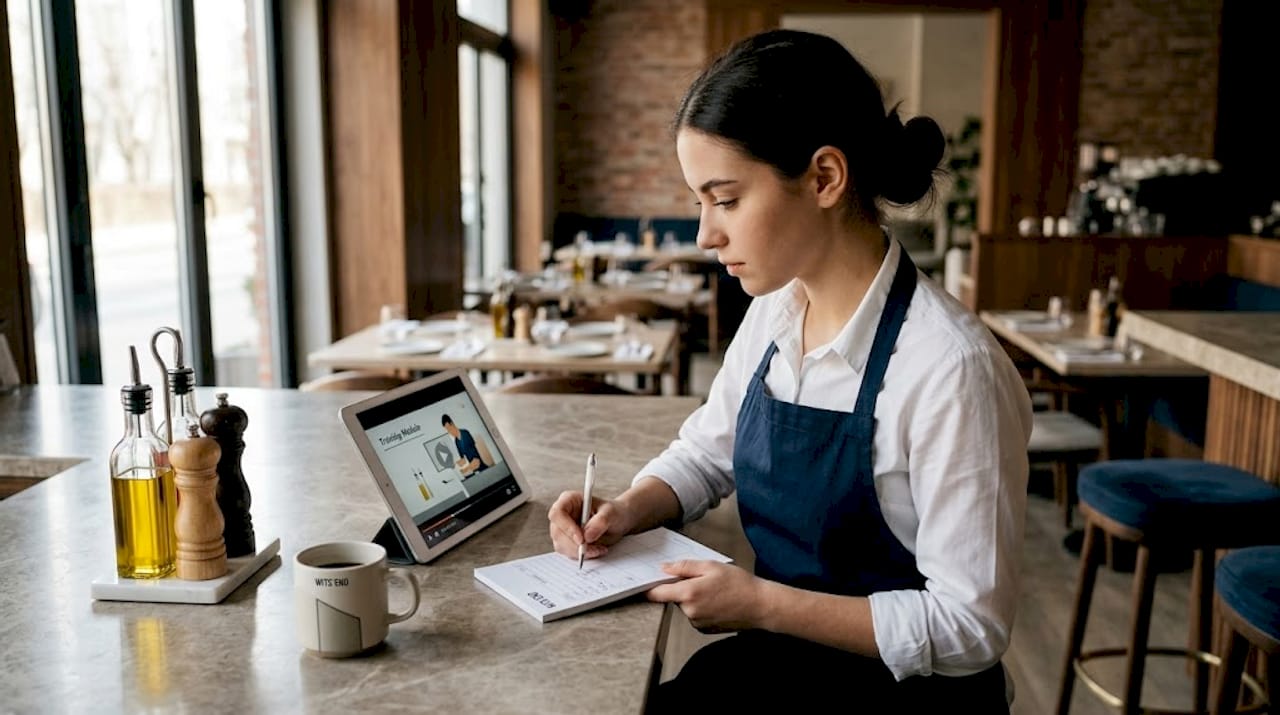
The key to training that lasts is combining multiple approaches in one cohesive program. Show the task, explain the reasoning behind it, let the trainee practice while a trainer gives live feedback, and then reinforce it later with a follow-up check. This is not a one-and-done moment. It is a cycle.
Effective methods to layer into your training include:
- Visual demonstrations: Show the correct way to plate a dish, greet a table, or set up a station before asking anyone to replicate it.
- Written guides and reference cards: Create laminated quick-reference cards for common tasks like table turns, allergen protocols, or POS shortcuts. These reduce errors during the learning curve.
- Live practice with feedback: Give new hires a chance to perform tasks in lower-pressure situations, like a mock service or a slow weekday lunch, before putting them on a Saturday night.
- Trainee summaries: After a training session, ask new hires to write a brief summary of what they learned. This simple step reinforces retention and surfaces gaps in understanding.
Pro Tip: Record short video demonstrations of key tasks, such as proper wine service, burger assembly standards, or opening side work. New hires can review these on their phone before a shift, and your standards stay consistent even when your head trainer is off.
Building a customer experience training component into this mix is especially valuable. Guest-facing staff who understand the connection between their behavior and guest loyalty perform differently than those who see their role as purely transactional. Teach the "why" behind service standards, and your team starts carrying those standards into situations they weren't specifically trained for.
Choose the right training format for each role
With so many ways to teach, choosing the right format for each team role is key for consistent performance across your entire operation. Not every training format fits every role. A kitchen line cook does not benefit from a two-hour roleplay exercise, and a host who needs to navigate difficult guest situations needs more than a written manual.
Multi-format training programs aligned to role-specific goals produce the most consistent results. Here is a comparison of the top five formats and where they work best:
| Training format | Best for | FOH or BOH | Key benefit |
|---|---|---|---|
| Job shadowing | New hires learning culture and flow | Both | Real-time observation of standards |
| Hands-on practice | Skill-building with immediate feedback | BOH primary | Builds muscle memory and confidence |
| Video and digital modules | Policy review, menu knowledge | Both | Flexible, repeatable, self-paced |
| Roleplay and simulation | Guest interaction, complaint handling | FOH primary | Prepares staff for real scenarios |
| Manager-led coaching | Performance gaps, leadership growth | Managers | Personalized and targeted guidance |
Job shadowing is particularly powerful in the first week because it gives new hires a realistic picture of pace and expectations. Hands-on practice is non-negotiable for BOH roles where technique, speed, and consistency are the job. Digital modules are efficient for delivering knowledge that doesn't require demonstration, like allergen awareness, tip reporting, or HR policies. Roleplay is underused in most restaurant settings, but it is one of the most effective ways to prepare FOH staff for difficult guest interactions before those interactions happen in real time.
For your management team, invest in a format that goes deeper. Manager-level coaching should include P&L review, labor scheduling, and conflict resolution. These aren't skills that develop through shadowing alone. They require structured conversations, real data, and accountability to a more senior leader.
Tailoring your restaurant training programs to match the specific demands of each role is one of the highest-return decisions you can make as an operator.
Benchmark training time and cost
To ensure your efforts are paying off, compare your training investment against industry standards for both time and money. Most operators know training matters, but few track what they are actually spending on it or whether that investment is delivering results. Without benchmarks, you have no way to know if you are undertrained, overtrained, or simply inefficient.
Industry survey data from the Hospitality Training 360 report gives operators a useful starting point. Here is a benchmark table by role:
| Role | Average training hours | Estimated training cost |
|---|---|---|
| FOH hourly staff | 20 to 30 hours | $500 to $900 |
| BOH hourly staff | 25 to 35 hours | $600 to $1,000 |
| Shift supervisors | 35 to 50 hours | $1,200 to $1,800 |
| Restaurant managers | 50 to 80 hours | $2,000 to $2,500+ |
Managers require significantly more time and investment because their decisions affect every other role on the team. A manager who doesn't understand labor scheduling or how to coach underperformers will cost you far more than the savings from cutting their training short.
To use these benchmarks effectively, take the following steps:
- Pull your actual training hours from your scheduling system for the last 90 days, broken down by role.
- Calculate your training cost per hire by including trainer labor, materials, and lost productivity during the ramp-up period.
- Compare your numbers against the benchmarks above and identify gaps.
- Set a target for the next quarter and adjust your training calendar accordingly.
Tracking these numbers also supports your broader efficient daily operations goals. When you know how long it takes to bring each role to full productivity, you can plan hiring timelines more accurately and reduce the operational stress that comes from understaffed services.
Make training ongoing and measurable
Training isn't a one-time project. It is a cycle. Here's how to keep it effective even as time budgets shrink across your operation. One of the clearest trends in 2025 and into 2026 is that training time for hourly employees has been shrinking, which means operators need to make every minute of training count. The answer is shorter, more frequent sessions rather than long, infrequent ones.
Microlearning, daily pre-shift briefs, and quick refreshers are the most practical tools for ongoing training in a busy restaurant. A five-minute pre-shift huddle that reviews one menu item, one service standard, or one operational update reinforces knowledge without pulling anyone off the floor. These brief touchpoints compound over time. After a month, your team has absorbed dozens of small lessons that add up to a meaningfully higher standard of service.
To measure whether your training is working, track these indicators consistently:
- Customer satisfaction scores: Use comment cards, online reviews, and direct feedback to assess guest perception of service quality.
- Order accuracy: Monitor ticket errors and comped items as a proxy for kitchen and FOH execution.
- Staff retention: Measure 90-day and 180-day retention rates. High early turnover is one of the clearest signals that onboarding and training are falling short.
- Upsell rates: For FOH teams trained on menu knowledge, track average check size over time as a measure of fluency and confidence.
Pro Tip: Review your training KPIs monthly alongside your labor and sales data. If retention is dropping or errors are climbing, trace the pattern back to your most recent training activity and adjust your focus for the next cycle. Building this habit into your monthly operations review keeps training accountable rather than aspirational.
Supporting customer loyalty through consistent, well-trained service is one of the most direct returns on your training investment. Guests who feel well-served come back, and they bring others with them.
Perspective: What actually works (and what doesn't)
We have worked with enough restaurant teams across enough markets to say this plainly: most training problems are not really training problems. They are culture and follow-through problems wearing a training costume.
You can design the most thorough onboarding sequence, create polished video modules, and build a 90-day milestone framework, and still watch service quality slide by week six if managers don't reinforce what was taught. Quick-fix training, the one-day refresher brought in to address a complaint spike, rarely creates lasting change. What moves the needle is repetition, accountability, and managers who model the behavior they expect from their teams.
The second most common mistake is under-measuring. Most operators have a gut sense of how their training is performing but almost no hard data to back it up. If you are not tracking order accuracy, guest scores, and 90-day retention by role, you are making decisions about your training program based on incomplete information. The onboarding strategies that stick in high-performing operations are the ones tied to real outcomes, not just completion checkboxes.
Consistency beats novelty every time. A simple daily huddle that happens every single shift will outperform a quarterly training event every time. Your team does not need a new program. They need the same standards, communicated clearly and often, backed up by managers who hold the line on slow nights and busy ones alike.
Take your staff training to the next level
Great staff training starts with the right foundation, and expert support makes it faster and easier to build one that lasts.
At Wits' End, we work alongside restaurant teams to design, implement, and scale training that fits the way your operation actually runs. Whether you need to build custom restaurant training programs from scratch, restructure how your team delivers guest experience, or bring in a task force to stabilize operations during a challenging season, we can help. Our business optimization solutions are built around your specific goals and team dynamics, not a generic template. And when you need experienced operators on the floor, our staff task force experts step in as true partners, not consultants watching from the sideline.
Frequently asked questions
How long should restaurant staff onboarding take?
Comprehensive onboarding typically spans one to two weeks of active training including shadowing and hands-on practice, with structured milestone reviews at 30, 60, and 90 days to track ongoing progress.
What is the average cost to train a restaurant employee?
Training costs vary by role, ranging from roughly $500 for hourly staff up to $2,500 or more for managers, depending on training hours, materials, and trainer labor involved.
How often should restaurant training be refreshed?
Training should be reinforced through short ongoing sessions at least monthly, with immediate updates whenever regulations, menus, or operational processes change.
How can I tell if my training program is working?
Track customer satisfaction, order accuracy, and staff retention by role. These three indicators together give you a clear picture of whether training is translating into real operational improvement.
What training works best for FOH vs. BOH roles?
For FOH, shadowing and roleplay build the guest interaction skills that matter most. For BOH, hands-on practice at the station with clear written guides produces the consistency and speed the kitchen demands.