
Service recovery in restaurants is what you do the moment a dish, a wait, or a wrong order threatens to cost you a guest, and the single action that matters most is speed: acknowledge the problem out loud and visibly fix it within minutes, not at the end of the meal. A fast, sincere response can help repair the emotional damage. It does not replace fixing whatever broke in the kitchen or on the floor that caused the failure in the first place.
TL;DR:
- Speed is critical in service recovery, with five minutes as an ideal window to acknowledge and begin fixing the issue at the table.
- The effectiveness of recovery depends on visible, personalized actions, like a manager stepping in or remaking food in front of the guest.
- Not all mistakes require the same response; severity levels determine whether a server alone can fix it or a manager must intervene immediately.
- Building a systematic recovery process with KPIs like median resolution time and repeat complaint rate helps improve long-term restaurant performance.
- High staff turnover and recurring issues often require external consulting to develop measurable, reliable recovery systems beyond scripting.
Table of Contents
- Why Service Recovery Matters More Than Most Managers Think
- The 5-Step Service Recovery Process Every Server Should Know
- Matching the Remedy to the Failure (and Its Severity)
- Building a Team That Can Recover on Its Own
- Turning Recoveries Into a System, Not a Series of Fire Drills
- When to Take Recovery Off the Floor
- Two Templates You Can Paste Into Your SOP Tonight
- De-escalating Guests Who Are Angry, Not Just Disappointed
- What Actually Separates Restaurants That Recover Well
- How Hospitality Consulting Firms Can Build Recovery Into Your Operation
- Sources
- FAQ
Why Service Recovery Matters More Than Most Managers Think
Service recovery does not always guarantee a guest comes back. That is the uncomfortable finding behind the "service recovery paradox," the theory that a great recovery can leave customers more satisfied than if nothing had gone wrong at all. Field and experimental research on restaurants finds mixed evidence for that idea: excellent recovery can lift satisfaction in the moment, but it does not reliably translate into repeat visits, and the effect is highly sensitive to how well the recovery is actually executed. A rushed apology with a free dessert slapped on the check does not carry the same weight as a manager who shows up at the table.
What guests expect also shifts with the type of failure and the type of restaurant. In quick-service settings, slow speed drives most of the frustration, and a fast fix matters more than the dollar value attached to it. In full-service dining, guests weigh the remedy itself more heavily, especially when the failure is severe. Research on failures at chain restaurants found that guests prioritize specific corrective actions over blanket monetary compensation: a wrong order usually calls for a replacement, while slow service usually calls for a genuine apology paired with a manager stepping in.
Timing is the lever you control most directly. Industry guidance on service recovery consistently points to the same principle: speed, personalization, and visible action are what determine whether a recovery lands or falls flat, according to EHL Insights' service recovery guidance. As a working rule, treat five minutes as your target window for acknowledging a problem at the table, even if the full fix takes longer to execute.
The 5-Step Service Recovery Process Every Server Should Know
Train this sequence until it is muscle memory. Each step has one job, and skipping one undermines the rest.
- Find and listen. The server or nearest staff member stops what they are doing, makes eye contact, and lets the guest finish explaining the problem without interruption or excuses.
- Acknowledge and apologize. A specific, sincere apology beats a scripted "sorry about that." Name the problem: "You've been waiting twenty minutes for that appetizer, and that's on us."
- Clarify what will fix it. Ask the guest what outcome they want rather than guessing. Most guests will tell you exactly what would make it right if you give them the chance.
- Resolve it visibly. Take the action in front of the guest whenever possible: pull the dish, comp the item on the spot, or have a manager walk over immediately.
- Follow up. Circle back before the check arrives to confirm the fix worked, and log the incident so it does not repeat.
Decision rules keep this fast instead of turning into a game of telephone. Servers should have standing authority to resolve anything under a set dollar threshold (a common cutoff is a moderate dollar amount that servers can approve without manager permission) without asking permission, cold food, minor order mistakes, and short delays. Anything involving a refund over that threshold, a health or safety concern, or a guest who is visibly angry should trigger an immediate manager page, not a server trying to talk their way through it alone.
Immediate floor fixes look different at each step. At "find and listen," it might be a server flagging a manager with a discreet hand signal instead of leaving the guest waiting mid-story. At "resolve," it might mean voiding an item on the POS before the guest even asks, then telling them it is already done, showing competence rather than damage control. That sequencing (fix first, mention it second) reads as competence rather than damage control.
Keep a laminated card behind the host stand listing the five steps and the dollar threshold for server authority to help new hires recall the procedure under pressure.
Matching the Remedy to the Failure (and Its Severity)
Not every mistake deserves the same response, and over-correcting for a minor issue trains guests to complain harder next time. Match the remedy to what actually went wrong:
- Wrong or incorrect order: Remake or replace the item immediately; this is the remedy guests expect most for order errors, per the Taiwan chain restaurant study.
- Slow service or long ticket times: A verbal apology plus a manager visit to the table, sometimes paired with a comped drink or app rather than a discount on the whole check.
- Food quality issue (cold, undercooked, off): Remake the dish, pull it from the check regardless of whether a remake is requested, and have a manager check back.
- Rude or inattentive staff behavior: Manager intervention is mandatory here. A comp from a server does not repair a guest's sense that they were disrespected.
- Reservation or seating failures: A sincere apology, a complimentary round while waiting, and priority seating next visit if the guest is a repeat customer.
Severity should drive how far up the tiered response you go. A useful five-tier scale runs from Tier 1 (a minor annoyance, resolved by the server alone) through Tier 5 (a health, safety, or allergen incident requiring management, documentation, and likely follow-up beyond the shift). Tier 2 and 3 failures, like a wrong order or a genuinely slow ticket, usually call for a manager to appear at the table even if the server already fixed the immediate issue. Tier 4 and 5 failures require a manager-led resolution from the start, with no server-only fix attempted.
Visible action matters here as much as the remedy itself. A manager walking to the table and comping an item in front of the guest, entering it into the POS on the spot, carries more weight than a generic discount code emailed later. Guests remember whether someone showed up, not just whether the bill changed.
Building a Team That Can Recover on Its Own
Recovery breaks down when every decision has to route through a manager, especially during busy shifts when the manager may be managing multiple issues simultaneously. The fix is a clear authority matrix, not more meetings.
Give servers standing permission to comp items under a set threshold, remake food without approval, and offer a complimentary drink or dessert for minor delays. Reserve manager escalation for anything involving a refund above that threshold, a guest who asks for a manager by name, a safety or allergen concern, or a guest whose tone has moved from frustrated to hostile.
Scripts remove the guesswork that makes new staff freeze up. A simple structure works: Name, Acknowledge, Fix.
- Server script: "I'm so sorry, [Guest Name] mentioned the soup came out cold. Let me get that remade right now, and it's on us."
- Manager script: "Hi, I'm [Manager Name], the manager tonight. I heard your appetizer took longer than it should have. That's not the experience we want for you, so I've taken it off your check and I'd like to bring you something while you wait."
Roleplay this in pre-shift huddles, not annual training sessions. A five-minute drill twice a week, rotating through different failure scenarios, builds the reflex faster than a single onboarding video ever will. Track two coaching metrics: how often servers use the full script correctly during observed shifts, and how many recovery situations get escalated unnecessarily to a manager, which usually signals a confidence gap rather than a judgment problem. Pairing that coaching rhythm with structured staff training on service fundamentals closes the gap faster than recovery drills alone.
Run roleplay drills using the actual dollar thresholds and manager names your team will use, rather than generic placeholders, to build muscle memory.
Turning Recoveries Into a System, Not a Series of Fire Drills
One good recovery fixes one guest's night. A logged, reviewed pattern of recoveries fixes your restaurant. This is the difference between complaint management (reactive logging after the fact) and service recovery (what happens in the moment); you need both processes running side by side.
A minimum viable complaint log needs just nine fields: date, shift, table number, server, failure category, severity tier, action taken, outcome, and a two-sentence narrative of what happened. Anything more elaborate and staff will stop filling it out consistently.
Run a 30-minute weekly review with your management team using that log. The agenda is simple: scan for repeat categories, decide whether each recurring issue is a training problem (one server keeps getting comped for the same mistake) or a systemic problem (the ticket printer in the kitchen keeps jamming during rush), and assign one owner per fix before the meeting ends.
| KPI | What it tells you | Target cadence |
|---|---|---|
| Median resolution time | How fast staff acknowledge and act on a complaint | Under 5 minutes at the table |
| Follow-up completion rate | Whether high-severity guests get contacted after the shift | Within 48 hours, tracked weekly |
| Repeat-complaint rate | Whether the same failure category keeps recurring | Reviewed weekly against prior month |
Tracking recovery triggers and outcomes this way is what lets you demonstrate ROI on the time spent, rather than treating recovery as a soft, unmeasurable cost center, a point Qualtrics' research on service recovery backs consistently. Pair this log with your existing restaurant analytics practice so recovery data feeds the same dashboards your P&L reviews already use.
When to Take Recovery Off the Floor
Some incidents cannot be closed out with a comped entrée and a smile at the table. Tier 3 and above, meaning anything involving a refund beyond server authority, a repeat guest complaint, or a visibly upset customer, deserves personal manager outreach within 24 to 48 hours after the shift. A phone call or a personal email works; an automated survey link does not carry the same weight for a guest who already had a bad night.
Health, safety, and allergen incidents follow a stricter standard regardless of how the guest reacted in the moment:
- Document the exact items served, the allergen or contamination concern, and every staff member involved, in writing, the same shift.
- Loop in your health and safety lead or ownership immediately, without waiting for the guest interaction to finish.
- Preserve any physical evidence (the dish, packaging, receipts) until the incident is reviewed.
Escalating internally should never delay the guest-facing apology. Tell the manager on duty first, start the paperwork in parallel, and make sure legal or HR involvement happens behind the scenes while the guest still gets an immediate, human response at the table.
Two Templates You Can Paste Into Your SOP Tonight
Copy these directly into your training binder or onboarding deck.
- Manager-on-table checklist: Arrive within two minutes of being paged. Open with "I'm [Name], the manager tonight, and I understand [specific issue]." State the fix out loud before the guest asks for one. Enter the comp or adjustment into the POS in front of the guest, not after they leave. Note the table number and issue on the shift log before moving to the next table.
- 48-hour follow-up script: Call or email the guest by name. State the objective plainly: "I wanted to personally follow up after your visit on [date]." Confirm there were no lingering safety or health concerns. Offer a specific invitation back, ideally hand-delivered or personally addressed rather than a generic coupon code, since personalized, manager-led follow-up outperforms generic discounts. Avoid language that admits legal liability; stick to hospitality, not fault-finding.
Record the outcome of both back into your complaint log the same day, while the details are still fresh.
De-escalating Guests Who Are Angry, Not Just Disappointed
A frustrated guest and an aggressive one require different handling, and treating them the same way usually makes things worse. Frustration responds to acknowledgment and speed. Aggression responds to calm, boundaries, and a change of environment.
Lower your voice rather than matching their volume, and keep your body language open rather than defensive. Move the conversation away from the dining room when possible, even a few steps toward the host stand, since removing the audience often de-escalates a guest faster than any script. Never argue about who is right in the moment; that conversation can happen later, once the guest has calmed down and the immediate need is addressed.
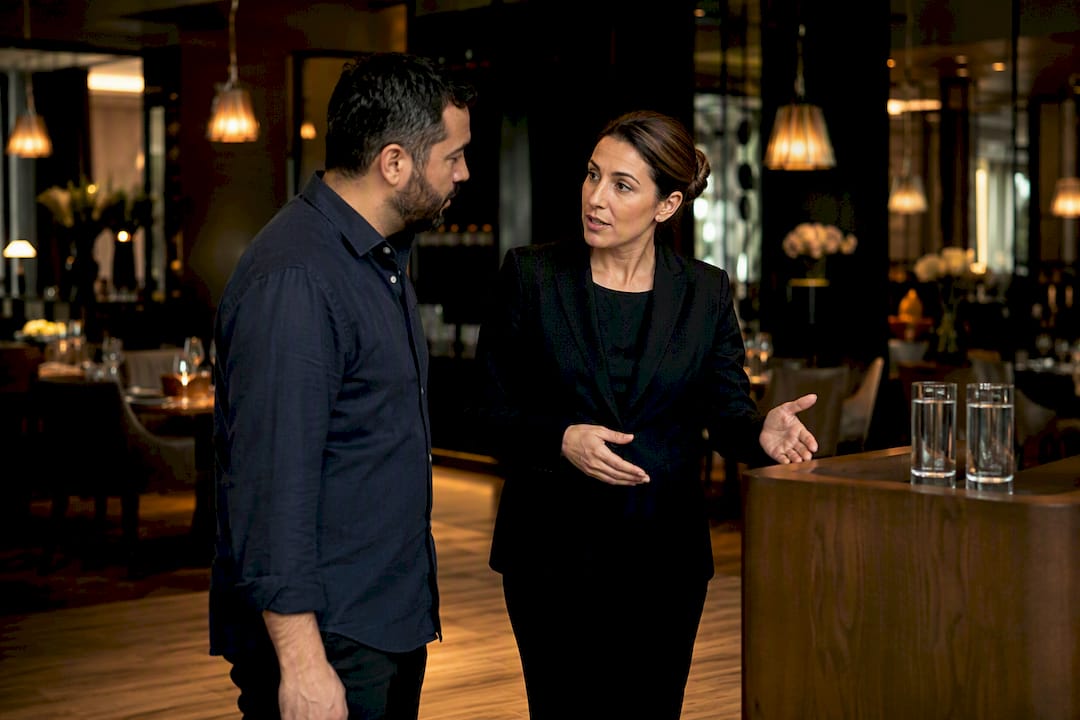
If a guest becomes verbally abusive toward staff, a manager should step in and set a clear, polite boundary: "I want to help you, and I need us to keep this respectful so I can." Staff should never be expected to absorb abuse as part of the job, and pulling a rattled server away from the table is a legitimate, necessary recovery action in itself. If a guest's behavior threatens safety, involve security or law enforcement without hesitation. That threshold is not about being right; it is about protecting your team.
Document these interactions in the complaint log at the highest severity tier regardless of how the financial resolution turns out, since a pattern of aggressive incidents from repeat customers is itself useful information for future staffing and seating decisions. Public visibility raises the stakes further: a bad interaction that ends up in an online review spreads far past the guests who were actually in the room that night.
What Actually Separates Restaurants That Recover Well
Most operators think service recovery is a training problem. It is really a measurement problem. Any manager can teach a server to say sorry and comp a dessert. Far fewer restaurants can tell you their median resolution time, their repeat-complaint rate by category, or whether last month's "fixes" actually reduced this month's complaints.
We have watched clients treat recovery as a personality trait, something certain servers are naturally good at and others are not, rather than a system with inputs and outputs you can coach. The restaurants that get this right build the discipline of the weekly review into their operating rhythm the same way they treat a P&L meeting, not as an afterthought bolted onto a pre-shift huddle. If your recovery process depends on which manager is working that night, you do not have a process. You have a habit that occasionally happens to work.
Handle recovery internally when the issue is training-level, one server, one repeated mistake, one coaching conversation. Bring in outside help when the pattern is systemic across shifts and managers cannot seem to diagnose why.
— Chris
How Hospitality Consulting Firms Can Build Recovery Into Your Operation
A laminated card and a good script only go so far when turnover is high and managers are stretched across multiple priorities. Effective consultants build the systems underneath the scripts: staff training programs that make the five-step workflow second nature, task force deployments for operators facing a rough patch or a leadership gap, and analytics support that turns complaint logs into real KPI dashboards instead of neglected spreadsheets.
If your team already has the scripts but keeps missing the follow-through, that is usually a signal for a short-term task force engagement rather than another training module. If the real gap is knowing whether your recovery efforts are working at all, our analytics and reporting services build the measurement layer most restaurants skip entirely. Visit Wits' End Solutions to talk through which piece fits your operation and get a straightforward next step, not a sales pitch.
Sources
- Service failures and recovery strategies of chain restaurants in Taiwan
- Revisiting the service recovery paradox in the restaurant industry
- Customer Service Recovery and How to Win Back Customers — Qualtrics
FAQ
What Are the 5 Steps of Service Recovery?
The five steps are find and listen, acknowledge and apologize, clarify what the guest wants, resolve the issue visibly, and follow up before the guest leaves or within 48 hours for serious issues.
What Is an Example of Service Recovery?
A common example is a manager immediately comping a cold entrée, remaking it on the spot, and checking back with the table before the check arrives, rather than waiting for the guest to complain further.
What Is the 30/30/30 Rule for Restaurants?
There is no single, widely recognized industry standard defining a "30/30/30 rule" for restaurant service recovery specifically; definitions of this phrase vary across operators and are not grounded in the peer-reviewed research behind this guide.
What Is Service Recovery in Hospitality?
Service recovery in hospitality is the set of actions a business takes to identify, respond to, and resolve a guest's negative experience in real time, aiming to repair satisfaction even though it does not always guarantee repeat business.
Do Restaurants Need Outside Help to Build a Recovery System?
Not always. Many operators can build an effective log-and-review system internally, but restaurants with high turnover or recurring, unresolved patterns often benefit from a structured task force engagement to rebuild the system from the ground up.