

Restaurant analytics tips are defined as the structured strategies operators use to convert raw operational and guest data into decisions that protect margin and build loyalty. The industry term for this discipline is restaurant business intelligence, and it covers everything from prime cost tracking to unified guest profiles. Platforms like Bloom Intelligence, tools like Toast, and advisory firms like LevelCFO have each demonstrated that operators who act on focused metrics consistently outperform those who rely on instinct alone. This article gives you the specific frameworks, review cadences, and data strategies that move the needle.
1. The highest-impact KPIs every restaurant should track
Prime cost is the single most controllable profitability driver in any restaurant operation. It is the combined total of food cost and labor cost, and prime cost typically ranges 55 to 65% of total revenue. That range is your benchmark. If you are above 65%, your margins are already under pressure and the cause is almost always hiding in one of two places: over-ordering or overscheduling.
Food cost percentage and labor cost percentage are the two margin leak indicators you review first. Food cost benchmarks generally sit between 28 and 35% depending on concept type, while labor cost targets vary from 25 to 35%. Beyond those two, table turn rate and Revenue Per Available Seat Hour (RevPASH) tell you how efficiently your floor converts capacity into revenue. Guest retention metrics, including visit frequency and habituation tiers, round out the picture by showing whether your marketing spend is actually building a loyal base.
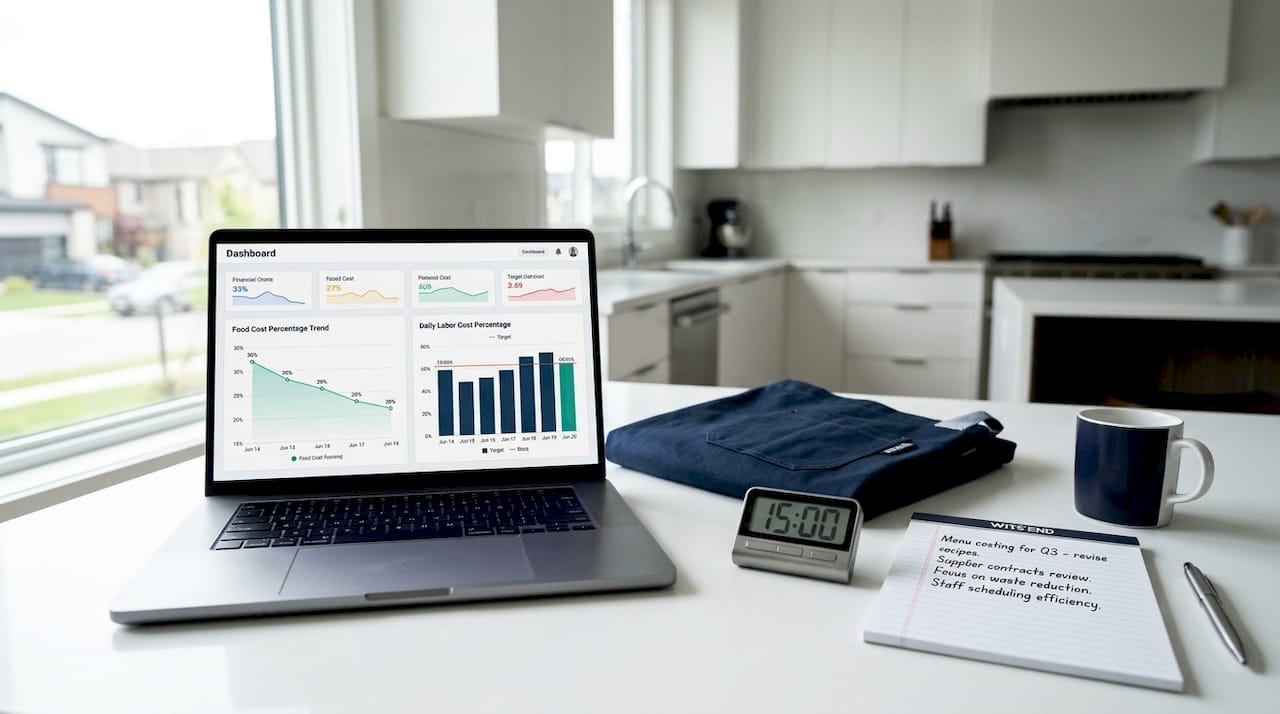
Monitoring voids and comps is a discipline most operators undervalue. A comp rate above 1 to 2% of net sales signals either a training problem, a quality issue, or a controls problem. Any of those three deserves immediate investigation.
Pro Tip: Set a threshold alert for prime cost in your POS or reporting dashboard. If prime cost climbs more than 2 percentage points week over week, that is your trigger to investigate before the month closes.
| KPI | Benchmark | Review Frequency |
|---|---|---|
| Prime cost | 55–65% of revenue | Weekly |
| Food cost % | 28–35% | Weekly |
| Labor cost % | 25–35% | Weekly |
| Table turn rate | Concept-dependent | Weekly |
| Comp/void rate | Under 1–2% of net sales | Daily |
2. How to unify restaurant data across systems
Data unification is the practice of connecting your POS, WiFi, reservation system, online ordering platform, and review channels into a single, identity-resolved guest profile. Most operators are sitting on disconnected data islands, and that fragmentation is the primary reason their marketing feels generic and their retention numbers stay flat.
The gap between manual and automated data capture is significant. A restaurant customer data platform can capture guest data from 84% of guests with valid emails, compared with just 15 to 25% through manual staff collection. That difference in capture rate is the difference between a retention program that works and one that reaches a fraction of your actual guests.
Unified data enables three capabilities that disconnected systems cannot deliver:
- Habituation threshold detection: You can identify when a regular guest's visit frequency drops below their personal baseline, which is an early churn signal.
- Sentiment-led churn prediction: Review sentiment and survey scores that decline ahead of visit frequency drops give you a leading indicator, not a lagging one.
- Behavior-triggered automation: When a guest completes their first visit, a unified system can fire a 48-hour follow-up automatically without any manual intervention.
"In 2026, the competitive edge is not more data collection but unification into identity-resolved profiles with real-time action capabilities." — Bloom Intelligence
Pre-loss intelligence systems take this further by generating real-time alerts on critical EBITDA KPIs within the service window itself. That means you are intervening during a shift, not reading a report three days later.
Pro Tip: Audit your current data capture rate. If you cannot identify more than 30% of your guests by name and visit history, a customer data platform should be your next technology investment.
3. What a disciplined analytics review cadence looks like
Analytics programs fail without a disciplined review cadence and accountability at daily, weekly, and monthly intervals. The cadence is not complicated, but it requires consistency to create the decision visibility that actually changes behavior.
Daily review (10 minutes each morning): Pull net sales from the prior day, food cost percentage, prime cost estimate, Sales Per Labor Hour (SPLH), and your comp and void rate. This is not a deep analysis session. It is a control check. You are looking for anything outside your normal range that needs a same-day conversation with your kitchen or floor manager.
Weekly review (20 minutes, same day each week): Cover table turn rate, RevPASH, average check, customer count trends, and employee turnover. These metrics tell you whether your floor is performing and whether your team is stable. A rising employee turnover number is a labor cost problem before it shows up in your P&L.
Monthly review (60 minutes, within the first five days of the new month): This is your strategic session. Cover Customer Acquisition Cost (CAC), inventory variance, marketing ROI, and break-even analysis. This is also where you review whether your analytics governance is holding. Common KPI definitions and normalized time buckets across your kitchen and management teams prevent the internal misinterpretations that make monthly reviews feel unproductive.
Pro Tip: Build your weekly review into a standing calendar block with your GM and kitchen lead. When the review is a scheduled meeting rather than an ad hoc task, accountability follows naturally.
| Review type | Duration | Key metrics covered |
|---|---|---|
| Daily | 10 minutes | Net sales, food cost %, prime cost, SPLH, comp/void rate |
| Weekly | 20 minutes | Table turn rate, RevPASH, average check, customer count, employee turnover |
| Monthly | 60 minutes | CAC, inventory variance, marketing ROI, break-even analysis |
4. Analytics-driven strategies that build guest retention and spending
A guest's 5th visit is worth approximately 4.5 times their first visit in cumulative spend. That single data point reframes how you should think about retention investment. Getting a guest back for a second visit is not just a nice outcome. It is the gateway to your most profitable customer segment.
Segmentation is the foundation of retention analytics. Bloom Intelligence's framework divides guests into four tiers: one-time visitors, casual guests, regulars, and super guests. Each tier requires a different engagement approach. One-time visitors need a compelling reason to return within 48 hours. Super guests need recognition and exclusivity. Treating all four the same way wastes both marketing spend and guest goodwill.
Second-visit conversion is where most operators leave money on the table. Behavior-triggered email campaigns deliver $10 to $36 ROI per $1 spent, with 48-hour new guest follow-ups producing the highest impact of any retention tactic. That is not a marginal improvement. That is a structural shift in how your marketing budget performs.
Automated retention campaigns built on unified guest data achieve 35 to 45% first-visit return rates compared to the 25% industry average. The mechanism is simple: the system knows who visited, when they visited, and what they ordered, so the follow-up message is relevant rather than generic. Relevant messages convert. Generic ones do not.
Sentiment monitoring from Google reviews, Yelp, and post-visit surveys functions as a leading indicator of visit frequency drops. When your average review score declines by even a fraction of a point over a 30-day window, that is a signal to investigate service quality before the drop shows up in your guest count numbers.
Pro Tip: Set up a birthday and anniversary program tied to your CDP. These campaigns have among the highest open rates of any restaurant email type and cost almost nothing to operate once the automation is in place.
5. How menu engineering and labor scheduling protect your margins
Contribution margin analysis is the correct lens for evaluating your menu. Food cost percentage alone tells you what an item costs relative to its price. Contribution margin tells you what an item actually puts in your pocket after food cost. A high-volume item with a modest food cost percentage but a low contribution margin is often less valuable than a lower-volume item with a strong dollar contribution. Menu engineering requires both numbers together.
Food waste tracking is a direct margin lever that most operators treat as a back-of-house housekeeping issue rather than an analytics target. Food waste represents approximately 4 to 10% of food purchase value. On a $50,000 monthly food spend, that is $2,000 to $5,000 leaving through the back door. Yield variance tracking by ingredient category identifies where the loss is concentrated so you can address it at the source.
Labor scheduling aligned to historical revenue by daypart is one of the fastest ways to reduce prime cost without touching your menu or your suppliers. Many restaurants overschedule by 5 to 10%, which translates directly into labor inefficiency that compounds across every week of the year. Pull your revenue by hour for each day of the week and build your schedule against those bands rather than against habit or manager preference.
Cross-training your team reduces the cost of overscheduling by giving you flexibility to cut a position mid-shift when volume does not materialize. Managing overtime aggressively, with a hard threshold of no more than 5% of total labor hours, keeps your labor cost percentage from drifting above target during busy periods.
Pro Tip: Run a menu contribution margin audit quarterly. Identify your bottom five items by contribution margin and either reprice them, reposition them on the menu, or replace them. This single exercise often recovers 1 to 2 points of food cost.
| Menu item type | Food cost % | Contribution margin | Action |
|---|---|---|---|
| Star | Low | High | Promote and protect |
| Plow horse | Low | Low | Reprice or reposition |
| Puzzle | High | High | Reduce cost or keep as premium |
| Dog | High | Low | Remove or replace |
Key takeaways
Restaurants that combine weekly prime cost tracking, unified guest data, and a structured review cadence consistently outperform those that rely on POS reports alone.
| Point | Details |
|---|---|
| Prime cost is your control lever | Track it weekly against a 55–65% benchmark and investigate any 2-point drift immediately. |
| Data unification multiplies retention ROI | CDPs capture up to 84% of guests vs. 25% manually, enabling behavior-triggered campaigns that convert. |
| Cadence creates accountability | Daily, weekly, and monthly reviews turn analytics from a reporting tool into an operating discipline. |
| Second-visit conversion is the loyalty gateway | A 48-hour follow-up campaign is the highest-ROI retention tactic available to any restaurant operator. |
| Menu and labor analytics protect margin | Contribution margin analysis and daypart scheduling together address the two largest prime cost drivers. |
What I have learned from working inside these numbers
The operators who get the most out of analytics are rarely the ones with the most sophisticated tools. They are the ones who show up to the same review every week and ask the same questions. Prime cost tracking, in my experience, is the single habit that separates restaurants that know they have a problem from restaurants that find out too late. When I started working with clients on weekly prime cost reviews, the most common reaction was surprise at how much drift had been happening unnoticed for months.
The unified guest data conversation is where I see the most resistance, usually because operators assume it requires a large technology investment or a dedicated marketing team. Neither is true. A well-configured CDP connected to your existing WiFi and POS can run retention campaigns with minimal ongoing management. The ROI case is not close. A 35 to 45% first-visit return rate versus a 25% industry average is a structural advantage that compounds every month.
What I push back on most often is the idea that a dashboard is a strategy. Dashboards are visibility tools. They tell you what happened. Pre-loss intelligence and behavior-triggered automation tell you what is happening right now and give you a window to act. The restaurants I have seen struggle with analytics adoption almost always have the data. They just do not have the review discipline or the alert infrastructure to turn that data into a decision before the shift ends.
Start with prime cost. Add a weekly cadence. Build your guest capture rate. The rest follows from there, and it follows faster than most operators expect.
— Chris
How Witsendsolutions can put these strategies to work for you
Witsendsolutions works with restaurant operators across the United States to build the analytics infrastructure and review disciplines that turn data into profit. Our hospitality analytics and advising practice covers prime cost analysis, guest retention program design, unified dashboard setup, and the operational cadences that make all of it stick.
Whether you need a full analytics buildout or a focused review of where your prime cost is drifting, our team has run these numbers inside real restaurants before recommending anything to yours. We also offer business optimization consulting for operators who want a broader look at profitability, labor efficiency, and menu performance together. Reach out to Witsendsolutions to schedule a consultation and see exactly where your data is leaving money on the table.
FAQ
What is prime cost and why does it matter most?
Prime cost is the combined total of food cost and labor cost, typically 55 to 65% of total revenue. It is the most controllable profitability driver in a restaurant and should be reviewed weekly to catch cost drift before it compounds.
How many guests can a CDP actually identify?
A restaurant customer data platform can capture data from up to 84% of guests with valid emails, compared to 15 to 25% through manual collection. That higher capture rate is what makes behavior-triggered retention campaigns viable at scale.
What is the best first step for restaurant analytics?
Start with a daily 10-minute review of net sales, food cost percentage, prime cost, and comp/void rate. Consistency in that one habit builds the visibility and accountability that more advanced analytics depend on.
How much does food waste actually cost a restaurant?
Food waste represents approximately 4 to 10% of total food purchase value, making it a direct and measurable margin target. Yield variance tracking by ingredient category is the most practical way to identify and reduce that loss.
What return rate should I expect from retention campaigns?
Automated CDP-based retention campaigns achieve 35 to 45% first-visit return rates, compared to the 25% industry average. Behavior-triggered email marketing specifically delivers $10 to $36 ROI per $1 spent when campaigns are timed correctly.