
A hotel secret shopper audit is a trained, anonymous guest visit that produces evidence-backed findings your team can act on within 30 to 90 days. It surfaces guest experience gaps that surveys and online reviews miss entirely, and it ties those gaps directly to revenue and loyalty metrics. Your next move: brief a scoped pilot audit, or contact a practitioner who can build that scope for you.
TL;DR:
- A hotel secret shopper audit assesses over 40 service moments across the guest journey, providing evidence-backed findings that surveys may miss.
- Audits are typically conducted quarterly for small properties or monthly for larger portfolios, with trigger events like renovations or leadership changes being key drivers.
- Clear, specific briefs with measurable scoring criteria and verified photo evidence are essential for producing actionable and trustworthy reports.
- Audit reports with timestamped proof and random scheduling help prevent fabrication and ensure insights accurately reflect actual service quality.
- Findings should be linked to revenue, repeat bookings, or guest satisfaction metrics, with follow-up checkpoints to confirm improvements within 30 to 90 days.
Table of Contents
- What Does a Hotel Secret Shopper Audit Actually Cover?
- How Often Should You Run Hotel Quality Evaluations?
- How Do You Build a Brief and Scoring Framework That Works?
- How Do You Know an Audit Report Is Legitimate?
- Turning Audit Findings Into Measurable Results
- When We Recommend Commissioning a Mystery Audit
- How Wits' End Solutions Runs a Verified Hotel Secret Shopper Program
- Sources
What Does a Hotel Secret Shopper Audit Actually Cover?
The audit follows the full arc of a guest's visit, not a snapshot of one department. A trained assessor books like any paying guest and moves through booking, arrival, in-stay, food and beverage, housekeeping, departure, and often a post-stay follow-up. Bespoke Audits notes that a complete mystery guest audit tracks more than 40 distinct service moments, which is why the value comes from spotting patterns rather than flagging one bad interaction.
A typical checklist touches:
- Reservation confirmation accuracy and response time
- Curb-to-lobby arrival flow and check-in speed
- Room condition, amenities, and maintenance
- Restaurant service pace, order accuracy, and staff knowledge
- Housekeeping thoroughness and turnaround
- Checkout efficiency and billing accuracy
- Follow-up communication after departure
This differs fundamentally from survey data or scraped reviews. Surveys capture what guests remember to mention; a trained observer captures what actually happened, including the warmth of a greeting or an awkward handoff between departments that a guest would never write up but would absolutely feel. The deliverable should open with an executive summary a general manager can read in three minutes, backed by scored tables, photographs, and verbatim quotes from staff interactions.
How Often Should You Run Hotel Quality Evaluations?
Cadence depends on property size, complexity, and what you're trying to prove. A boutique property with a tight team might run one audit per quarter to catch drift early. Larger or multi-property portfolios often benefit from monthly rotation, staggered across locations so no single team knows exactly when they're being observed.
Trigger events matter more than a fixed calendar in some cases:
- A brand relaunch or repositioning that needs a baseline before and after
- Guest satisfaction scores flattening or trending down while online reviews still look neutral
- New leadership or a general manager transition
- A significant renovation or new F&B concept going live
On scope, single-night stays work for routine monitoring. Multi-night audits, or audits weighted toward one department like housekeeping or F&B, make more sense when you already suspect a specific weak point. Effective programs typically hand the GM first actionable insights within two weeks of commissioning, which is a reasonable benchmark to hold any provider to.
How Do You Build a Brief and Scoring Framework That Works?
A vague brief produces a vague report, and a vague report gets filed away instead of acted on. The brief is where most audit programs succeed or fail before the assessor even books the room.
A workable brief should include:
- Objectives — what specific question the audit answers (brand consistency, a single department, pre-relaunch baseline)
- Guest profile — the persona the assessor plays (business traveler, family, couple on a milestone trip)
- Booking instructions — channel, rate type, and any special requests to test
- Allowed evidence — what photos, video, or notes the assessor may capture and where
- Timeline — arrival window, length of stay, and reporting deadline
Checklist design matters just as much. Vague items like "check room cleanliness" invite subjective scoring. Specific pass/fail or numeric items, such as rating bathroom fixtures on a 1 to 5 scale with mandatory photo evidence for anything below a 4, remove the guesswork. Severity weighting also matters. A cold cup of coffee and a broken door lock are not the same finding, and your scoring should reflect that difference.
Reporting should follow a consistent structure: a three-minute executive summary up top, then layered scored data, verbatim guest observations, and photographic evidence supporting each flagged item. The report closes with prioritized recommendations, each assigned an owner and a deadline.
Pro Tip: Ask for the checklist before you approve the brief, not after the report lands. If a provider can't show you their scoring logic in advance, you won't be able to challenge or trust their conclusions later.
How Do You Know an Audit Report Is Legitimate?
Some hotel operators have been burned by audits that read like they were written from a lobby brochure rather than an actual stay. Presence verification exists specifically to close that gap.
The accepted standard now includes geo-tagged photos and video, verified selfies at key checkpoints, and locked GPS timestamps that can't be edited after the fact. Audiment's guide to hotel operations audits recommends requiring mandatory photo evidence for every checklist item, not just the ones that fail, so a report can't cherry-pick only the negative findings.
Before accepting a report, check for:
- Timestamps that align with the confirmed booking dates
- Photo evidence attached to every scored item, not just flagged failures
- Random or unannounced scheduling rather than a pre-agreed visit window
- Verbatim quotes that sound like actual staff language, not generic filler
Presence verification and mandatory per-item photos make it technically difficult for an assessor to submit a weak or fabricated report, which protects every operational decision you make based on that data. If a submission is missing timestamps or photo evidence on more than a handful of items, send it back rather than accepting a partial picture.
Turning Audit Findings Into Measurable Results
An audit that ends with a PDF nobody reads again is a wasted expense. The handover should include an executive presentation, a written action register with a named owner and deadline on every item, and checkpoints at 30, 60, and 90 days to confirm the fix actually happened.
Prioritize by:
- Revenue impact — does this touchpoint affect ADR, repeat bookings, or review scores
- Frequency — how many guests encounter this issue per week
- Severity — safety or compliance failures always jump the queue
- Effort — quick wins get scheduled first; capital projects get a longer runway
RLA Global's guidance on operational auditing treats findings as quantifiable commercial data, since service inconsistencies suppress pricing power just as directly as a stale amenity does. Tie every fix back to a metric: ADR movement, complaint volume, repeat-stay rate, or gross operating profit. A dashboard that blends scored audit data with ongoing guest satisfaction tracking makes that connection visible over time instead of burying it in a one-off report.
When We Recommend Commissioning a Mystery Audit
We push audits hardest in three situations: ahead of a reposition, when satisfaction scores sit flat while loyalty quietly erodes, and right before a relaunch when you need a clean baseline. Each of those moments has a narrow window where the data actually changes a decision, and waiting past it usually means reacting to a review pattern instead of getting ahead of one.
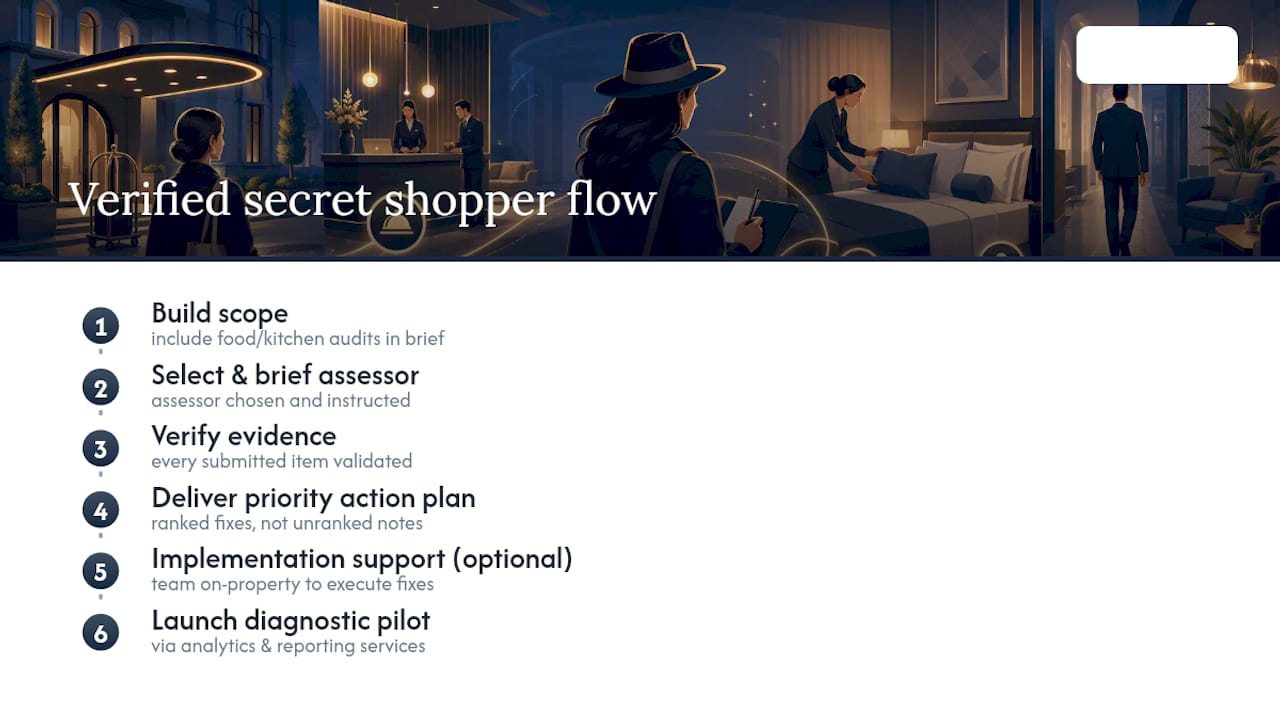
Our scoping process starts with the brief, moves through assessor selection and briefing, and requires verified evidence before we build a priority action plan. We treat the audit as a diagnostic, never a way to catch staff off guard, because a report framed as a trap gets resisted rather than acted on. From there, the findings feed directly into our analytics and reporting work and, when a fix needs hands on property, our task force engagements.
— Chris
How Wits' End Solutions Runs a Verified Hotel Secret Shopper Program
Most audit programs fail for one of two reasons: the brief was too vague to act on, or the findings landed with no owner attached. Wits' End Solutions builds the scope, selects and briefs the assessor, verifies every piece of submitted evidence, and hands you a priority action plan instead of a stack of unranked observations. We also stay through implementation if you need a team on property to execute the fixes, rather than disappearing after the report ships.
If you're weighing whether to run a hotel food safety audit alongside operational scoring, or you need a kitchen hygiene audit folded into the same visit, we scope that in the same brief so you're not paying for two disconnected engagements. Start by scoping a diagnostic pilot through our analytics and reporting services, or visit Wits' End Solutions to talk through where your property stands right now.
Sources
For a deeper look at how audits complement internal quality checks, see Proinsight's comparison of mystery audits and internal reviews. For guest journey fundamentals, Wild Foodz's guide to guest experience offers useful context, and Wits' End Solutions's task force services page details how audit fixes get implemented on property.
- RLA Global — Mastery of hotel & resort operational auditing
- ThroughCustomerEyes — Hotel mystery shopping
- Audiment — How to run a hotel operations audit
- Bespoke Audits — What a mystery guest audit covers