
The highest-impact restaurant marketing ideas for 2026 come down to four moves: complete your delivery app listings, fully populate your Google Business Profile, capture first-party contacts through a wallet pass or email signup, and run dayparted push campaigns to bring guests back. Most of these cost nothing to start.
Start here this week:
- Complete every delivery profile with item photos and descriptions
- Claim and fully populate your Google Business Profile with menu, hours, and photos
- Add a wallet pass or email capture at checkout, on receipts, and at the host stand
- Set up one daypart push (lunch or happy hour) to your existing contact list
- Launch a simple punch-card or points loyalty program that works across dine-in and delivery
Zero-cost fixes (profile completion, GBP, HTML menu) take two to four hours in-house. Small-budget activations (wallet pass tools, sponsored placements) typically run $50–$300/month to test.
Key Takeaways
The single most effective restaurant marketing strategy in 2026 combines complete delivery and search profiles with an owned-data retention layer that converts marketplace customers into direct, repeat guests.
| Point | Details |
|---|---|
| Complete profiles first | Finish DoorDash, Uber Eats, Grubhub, and Google Business Profile before spending on ads. |
| Capture first-party contacts | Install a wallet pass or email capture at POS, receipts, and QR codes in-store this week. |
| Run dayparted retention pushes | Send two targeted pushes per week (lunch, happy hour) to your wallet and email list. |
| Track installs and repeat rate | Measure wallet installs per week and 30-day repeat visit rate as your core retention KPIs. |
| Wits' End Solutions | Provides brand development, analytics, task forces, and training to implement this system. |
Table of Contents
- What are the foundation fixes every restaurant should complete this week?
- How does discovery work in 2026 across delivery apps and local search?
- How do you capture first-party data and turn it into repeat revenue?
- How do you build neighborhood trust with reviews and local signals?
- Which creative activations actually move the needle?
- What KPIs should you track, and how do you build a simple dashboard?
- What does a 30/60/90-day implementation plan look like?
- Why these tactics fit 2026: the evidence behind the playbook
- What operators usually get wrong: a practitioner's note
- Wits' End Solutions helps you build and run this system
- Sources
What are the foundation fixes every restaurant should complete this week?
Before spending a dollar on ads, close the gaps that cost you orders every day.
- Delivery profiles: Add a photo to every menu item and write a two-sentence description. DoorDash's merchant blog confirms that listing completeness directly correlates with conversion and that many first-time orders come from browsing, not direct search. Time: a few hours, in-house.
- Google Business Profile: Claim it, add your full menu, set accurate hours for every day, upload multiple photos including your entrance and a signature dish. Web Tonic's local-search guidance shows that profile completeness and review signals materially affect local-pack visibility. Time: an hour or two, in-house.
- HTML menu: Replace PDF or image menus with crawlable HTML text on your website where possible. AI assistants and search engines cannot parse a PDF to return dish names in answer results. Time: several hours, developer or website platform.
- Direct-order link: Add a "Order Now" button to your GBP and website header that routes to your direct ordering page, not a third-party app.
- QR codes: Place QR codes on receipts, table tents, and the host stand linking to your loyalty signup or wallet pass install.
Pro Tip: Place a QR code on the printed receipt with a single line: "Get $5 off your next visit — scan to save." That placement catches guests at peak satisfaction, right after a good meal, and converts at a higher rate than a table tent mid-service.
How does discovery work in 2026 across delivery apps and local search?
Discovery now splits between two funnels: delivery app browsing and search or AI answer engines. You need to perform in both.
Delivery platform actions:
- DoorDash Marketplace: Complete every item with a photo and a description that mentions key ingredients and dietary notes. Enable sponsored placements and promotions as a paid acquisition channel once your organic listing is complete. DashPass enrollment increases your visibility to DoorDash's highest-frequency customers.
- Uber Eats and Grubhub: Treat these as discovery funnels, not just order channels. Consistent branding, accurate hours, and complete item descriptions across all three platforms compound your reach.
Google Business Profile actions:
- Add structured menu data, select precise category tags (not just "Restaurant"), upload fresh photos monthly, and post a weekly update (a special, an event, a new dish). Owner responses to reviews are a ranking signal for local pack and AI assistants.
When to prioritize marketplace vs. direct search ads: If you are under 12 months old, focus entirely on organic listing completeness before spending on sponsored placements. For established sites, allocate a small test budget ($100–$200/month) to DoorDash sponsored listings and measure cost per new customer against your average order value.
Stat: DoorDash reports that browsing behavior, not direct search, drives a significant share of first-time orders at new restaurants, making photo and description completeness the single highest-leverage zero-cost action on the platform.
How do you capture first-party data and turn it into repeat revenue?
Marketplaces own the customer relationship. Wallet passes, email, and SMS let you own it instead.
Which capture tool to prioritize by stage:
- New opening (0–6 months): Start with a wallet pass linked to a welcome offer. It installs in one tap, requires no app download, and enables lock-screen push notifications. See how apps like inKind work for a practical model.
- Established single site (6+ months): Layer email on top of wallet. Use your POS data to segment by recency, frequency, and spend (RFM), then send targeted win-back messages to lapsed guests.
- Small chain: Add SMS for time-sensitive daypart pushes. Wallefy's 2026 retention playbook documents that wallet push sends outperform SMS on engagement while costing less per send.
Loyalty program design: Keep it simple. A points-per-dollar system that works identically for dine-in, takeout, and delivery orders removes friction. Automate a welcome sequence (Day 0: welcome offer, Day 7: first-visit follow-up, Day 30: re-engagement if no second visit).
Pro Tip: Offer a wallet install incentive of $3–$5 off the next order, not a percentage. A fixed dollar amount feels more concrete to the guest and costs you less on high-ticket checks. Cap push sends at two per week to protect opt-out rates.
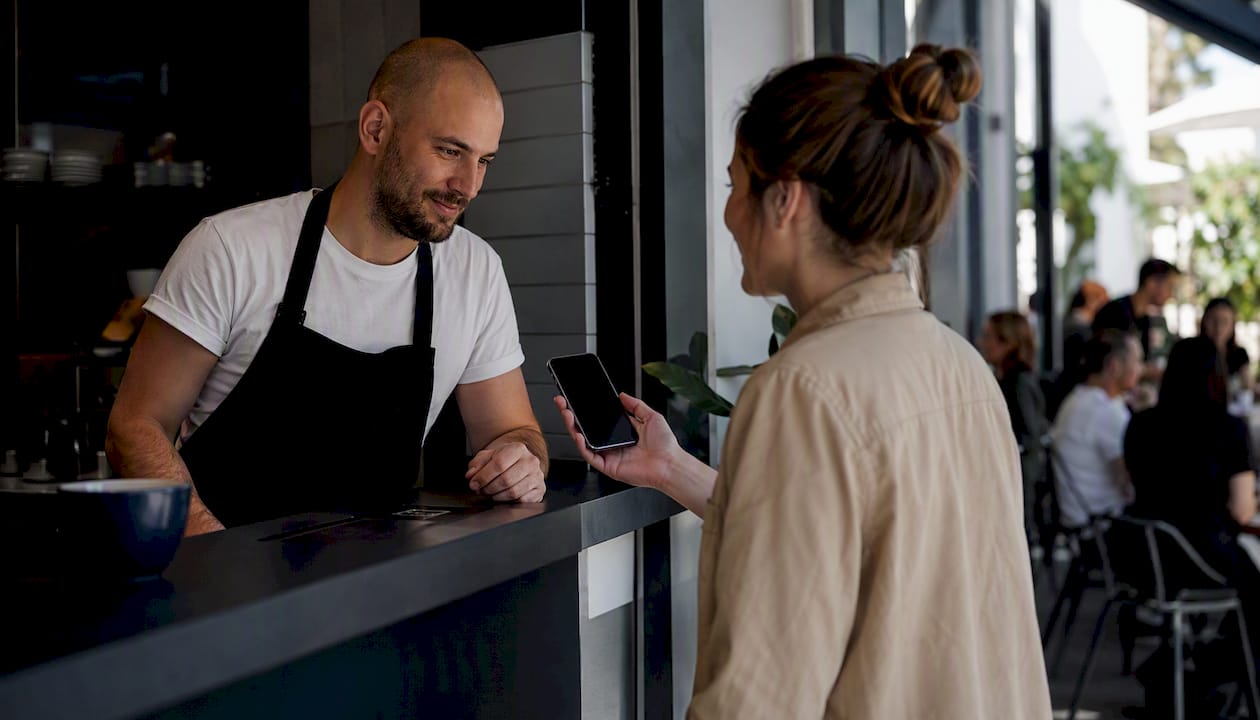
According to Rezku's 2026 strategy guide, direct ordering and owned-channel automation tied to POS data are the highest-ROI retention investments a restaurant can make, precisely because they protect margin that marketplace commissions erode.
How do you build neighborhood trust with reviews and local signals?
In 2026, AI answer engines prioritize dish-level, neighborhood-specific reviews over raw review volume. A guest who writes "the birria tacos on a Tuesday lunch in Wicker Park" does more for your local discovery than ten generic five-star posts.
Tactics to generate specific reviews:
- Send a post-visit push (wallet or SMS) 90 minutes after a check closes: "How were the short ribs tonight? Leave us a quick note on Google." Timing matters. Ninety minutes is long enough for the meal to settle, short enough that the experience is vivid.
- Train staff to mention one dish by name when thanking guests: "Hope you loved the mushroom risotto — if you have a moment, a Google review mentioning it really helps us."
- Add a QR code to the check presenter linking directly to your Google review page, not your homepage.
Owner response templates:
- Positive: "Thank you, [Name]! We're glad the [dish] hit the mark. See you soon."
- Negative: "We're sorry about your experience. Please reach out to [email] so we can make it right."
Pro Tip: Never ask for a review at the table during service. Ask after the visit, when the guest has had time to reflect. Post-visit digital prompts consistently outperform in-moment verbal requests for both volume and specificity.
Manage review velocity by asking consistently, not in bursts. A sudden spike of reviews in one week followed by silence reads as inauthentic to both platforms and AI assistants.
Which creative activations actually move the needle?
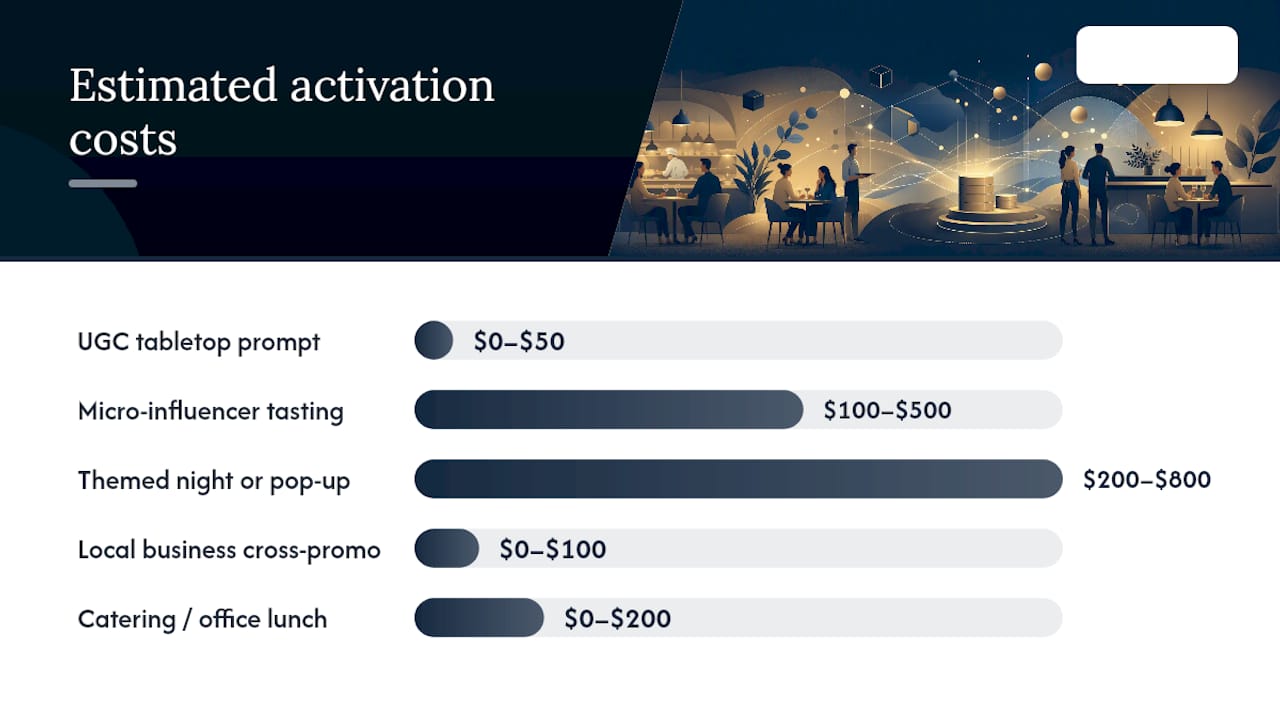
Short-form video and UGC build awareness but rarely convert immediately. Pair every reach tactic with a direct capture action. Tableview's 2026 restaurant marketing guide sets realistic expectations: social video works as a top-of-funnel reach channel, not a direct-revenue driver on its own.
| Activation | Est. Cost | Lead Time | Primary Metric |
|---|---|---|---|
| UGC tabletop prompt (QR + hashtag) | $0–$50 | 1 day | Wallet installs, tagged posts |
| Micro-influencer tasting (local, 5K–50K followers) | $100–$500 | 1–2 weeks | Reservation or order lift in 7 days |
| Themed night or pop-up | $200–$800 | 2–3 weeks | Covers sold, email captures |
| Local business cross-promo | $0–$100 | 1 week | New guest count, referral codes redeemed |
| Catering/office lunch targeting | $0–$200 | 1–2 weeks | Catering inquiries, order value |
"The operators who see the most consistent lift from micro-influencer work are the ones who pair the post with a direct capture mechanic — a promo code, a wallet install link, or a reservation link in the bio. Without that, reach stays reach." For more on creative restaurant branding ideas that support these activations, the Wits' End blog covers positioning and visual identity in depth.
Pro Tip: Brief micro-influencers on two or three specific dishes rather than giving them a full tasting menu. Focused content outperforms "everything on the menu" posts because it gives followers a clear reason to visit.
What KPIs should you track, and how do you build a simple dashboard?
Separate discovery metrics from retention metrics. They answer different questions.
| KPI | What It Measures | Target Direction |
|---|---|---|
| Wallet installs per week | Capture rate from in-store and digital touchpoints | Up week-over-week |
| First-order rate from install | Conversion from wallet install to first purchase | Above 40% in 30 days |
| Repeat visit rate (30-day) | Retention effectiveness of push cadence | Up month-over-month |
| Cost per new customer (marketplace) | Acquisition efficiency on DoorDash/Uber Eats | Declining as listing matures |
| Direct order share | Owned vs. marketplace revenue split | Growing toward 30%+ |
Attribution guidance: Treat DoorDash, Uber Eats, and Grubhub as acquisition channels. Once a guest installs your wallet pass or joins your email list, that relationship belongs to you. Track the conversion from marketplace first-order to wallet install as your key funnel metric.
Operational checklist:
- Connect your POS to a reporting tool (Toast Analytics, Square Dashboard, or a third-party like the Wits' End reporting platform) to enable RFM segmentation.
- Set up one Google Looker Studio dashboard pulling GBP insights, delivery platform data, and email/wallet metrics.
- If running Meta ads, connect the Conversions API to your website for accurate attribution.
What does a 30/60/90-day implementation plan look like?
Days 1–30: Foundation (zero cost, in-house)
- Complete all delivery platform profiles (photos, descriptions, hours)
- Fully populate Google Business Profile (menu, categories, photos, posts)
- Convert website menu to crawlable HTML
- Install wallet pass or email capture at POS and on receipts
- Set up one automated welcome sequence (Day 0 / Day 7 / Day 30)
Days 31–60: Capture and test ($100–$500/month)
- Launch one daypart push campaign (lunch or happy hour) to your wallet/email list
- Run a micro-influencer tasting with one local creator
- Test DoorDash sponsored listings at $100/month; measure cost per new customer
- Begin consistent review request cadence (post-visit push, 90-minute delay)
Days 61–90: Scale retention and paid acquisition ($300–$1,000/month)
- Expand RFM segmentation; build a lapsed-guest win-back flow
- Add a second daypart push or a weekly email digest
- Scale sponsored listings if cost per new customer is below your target
- Plan one themed event or local cross-promotion
Pro Tip: Assign one person ownership of the marketing calendar, even if that person is you. A shared Google Sheet with weekly tasks and owners prevents the most common failure mode: a great plan that nobody executes.
For restaurants at the growth or multi-unit stage, hospitality marketing trends for 2026 covers the broader digital and operational shifts worth planning around.
Why these tactics fit 2026: the evidence behind the playbook
Three structural shifts make this playbook the right one for 2026.
- Marketplace discovery is the new foot traffic. Delivery app browsing drives a material share of first-time restaurant visits, particularly for guests under 40. Listing completeness is the entry fee.
- AI answer engines favor structured, local data. Google's AI Overviews and voice assistants pull from GBP structured data, HTML menus, and review content. Restaurants without crawlable menus and dish-level reviews are invisible to these surfaces.
- Owned channels compound. Rezku's analysis confirms that direct ordering and POS-integrated loyalty automation deliver higher long-term value than marketplace-only strategies, because every owned contact is a near-zero-cost future send.
Wits' End Solutions works with restaurant operators across the United States on exactly these systems: from brand development and menu architecture to analytics infrastructure and operational training. The 2026 hospitality industry trends piece on our blog covers the macro context for operators planning beyond this quarter.
What operators usually get wrong: a practitioner's note
Most restaurant owners try to do everything at once and execute nothing well. The operators who see real traction in 2026 pick two or three tactics, run them for 60 days, measure the result, and then add the next layer.
The most common failure mode is over-investing in viral reach before the retention infrastructure exists. A TikTok video that drives 10,000 views is worthless if there is no wallet install link, no email capture, and no follow-up sequence to convert that attention into a second visit. Reach without capture is a leaky bucket.
The second failure mode is ignoring the basics because they feel unglamorous. A fully completed Google Business Profile and a clean delivery listing will outperform a micro-influencer campaign for most single-location restaurants, every time, at zero cost. Start there. Add the creative activations once the foundation holds.
Wits' End Solutions helps you build and run this system
Running a marketing system alongside daily operations is where most restaurant teams run out of bandwidth. Wits' End Solutions works with restaurant and hospitality operators across the United States to build the infrastructure this guide describes: brand and concept development, analytics and reporting, staff training, and short-term task force engagements for openings, turnarounds, or marketing resets.
A diagnostics audit with Wits' End covers your current discovery footprint, owned-channel gaps, and a prioritized action list you can execute in-house or with our team. For operators who want a partner to run the system, not just advise on it, that option is available too. Schedule a discovery call to see where the highest-leverage gaps are in your operation.
Sources
- 25 Restaurant Marketing Ideas to Increase Sales in 2026
- 10 Restaurant Marketing Strategies to Boost Your Business
- Restaurant Marketing: The Complete 2026 Playbook | Wallefy
- Restaurant marketing that fills tables | Web Tonic™
- How to Do Restaurant Marketing in 2026: Proven Strategies That Increase Sales, Online Orders & Repeat Customers | Rezku Blog
- Restaurant Marketing: 2026 Guide - Tableview