
TL;DR:
- In 2026, hospitality focuses on operational ease, guest control, and sustainability over flashy amenities. AI adoption emphasizes logistics and unified data, with targeted upgrades improving guest experience and revenue. Operators succeeding fix basic issues first and strategically focus on data, pre-arrival upsells, and guest communication.
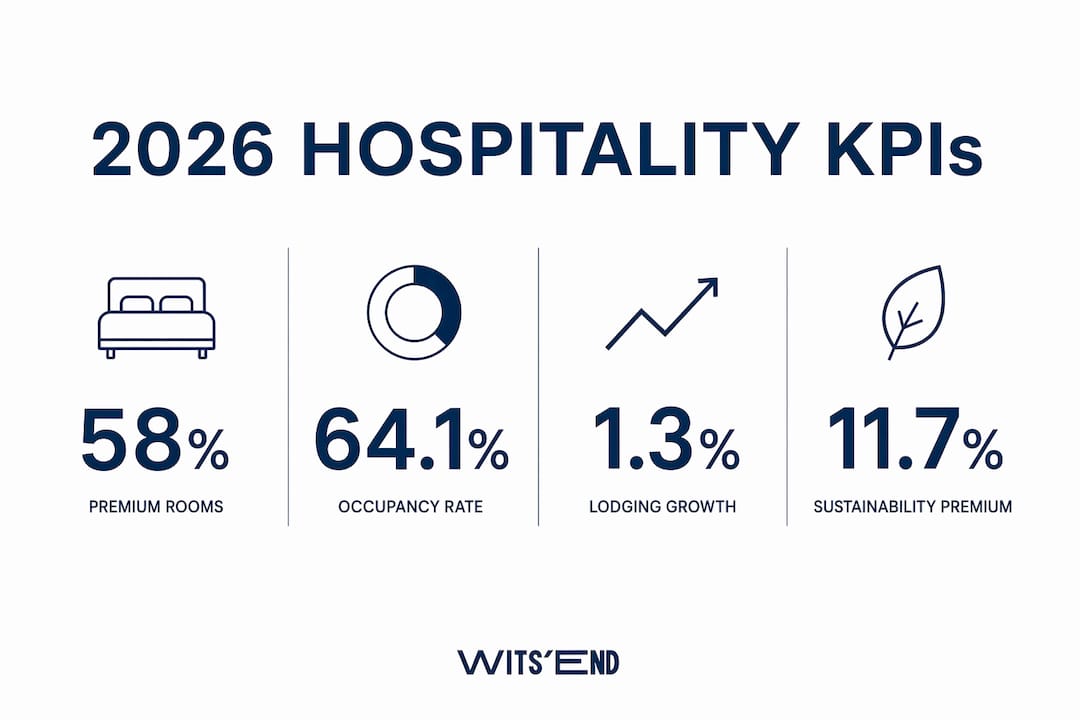
The hospitality industry trends shaping 2026 are defined by three forces: AI adoption, shifting guest expectations, and a market that rewards operational precision over amenity arms races. Lodging demand in top U.S. markets is forecast to grow 1.3%, with occupancy stabilizing at 64.1%. That is a market asking you to compete on experience and efficiency, not expansion. The operators who understand this will allocate capital and staff time very differently from those still chasing the last cycle's playbook.
What are the key hospitality industry trends for 2026?
The dominant shift in 2026 is from flashy amenities to operational ease. Guests are not asking for more features. They are asking for fewer friction points. Value for money is the primary travel factor for 90% of consumers, which means every dollar you spend on experience must be visible and felt by the guest. Sustainability is also no longer a niche concern. Seventy-five percent of travelers consider it when booking, and they will pay an 11.7% premium for it.

The hospitality trends forecast for 2026 also reflects a technology reckoning. AI investment in hospitality crossed $1 billion in venture capital since 2025, yet less than 10% of businesses are what analysts call "AI future-built," meaning they have embedded AI with measurable returns. The gap between AI spending and AI results is the defining operational challenge of this year.
How is AI reshaping guest experiences and hotel operations?
AI's clearest wins in hospitality are in logistics, not conversation. Reservation management, dynamic pricing, pre-arrival communication, and demand forecasting all benefit from AI without requiring the technology to replace human judgment. Hybrid hospitality is the industry term for this model: AI handles the repeatable, data-driven tasks while trained staff manage the interactions that require empathy and situational judgment. This approach expands service capacity rather than cutting headcount.
The risk is what practitioners at HITEC 2026 called "AI-washing." That is the practice of applying disconnected AI tools without unified data and integrated workflows. The result is staff frustration, inconsistent guest experiences, and no measurable ROI. AI adoption among Millennials and Gen Z rose from 10% to 18% between 2024 and 2025, which means guests increasingly expect AI-powered interactions to work correctly. A broken chatbot or a misfire in personalization now carries real reputational cost.
The operational improvements worth prioritizing include:
- AI-powered pre-arrival communication that surfaces upsell offers, check-in instructions, and local recommendations at the right moment
- Robotic services for high-volume, low-complexity tasks like luggage transport or room service delivery in large-format properties
- AI-driven revenue management that adjusts pricing in real time based on demand signals, competitor rates, and booking pace
- Unified guest data platforms that connect PMS, CRM, and point-of-sale systems so AI tools have clean data to work with
Pro Tip: Before adding any AI tool, audit whether your current systems share data with each other. A personalization engine fed by siloed data will produce generic outputs and frustrate both staff and guests.
What guest behaviors define the hospitality trends forecast for 2026?
Guest behavior in 2026 is measurable in ways it never was before. Analysis of over 10,000 chatbot conversations reveals that check-in time is the most-clicked item at 21.6% of interactions. Timing flexibility requests account for 11.3% of all guest interactions. Guests are not asking for luxury. They are asking for control over their own schedules.
The booking path has also changed structurally. OTA platforms now overtake search engines as the primary starting point for hotel research. That is a significant shift in where guests form their first impression of your property. At the same time, 18% of OTA research converts to direct bookings, as guests seek better service and more control. Your direct booking channel is not dead. It is, however, competing harder than ever for attention.
Here is what the data tells operators to act on:
- Offer early and late check-in as a bookable product. Timing flexibility is the top guest request. Charging a modest fee for guaranteed early check-in converts a complaint driver into a revenue line.
- Build multilingual, instant-response chatbot capability. Guests expect answers in their language, immediately. A delayed or English-only response is a friction point that costs bookings.
- Treat your direct booking channel as a product. If OTA research converts to direct at 18%, your website and booking engine need to close that deal with speed, clarity, and a compelling reason to book direct.
- Audit your digital check-in flow quarterly. Payment failures and broken check-in flows are the top drivers of guest complaints and direct revenue loss. This is a retention issue, not an IT ticket.
The premium room trend reinforces the value-over-volume story. 58% of guests chose premium rooms in 2026, up four percentage points. Guests are willing to spend more when the value is clear. The job is to make that value obvious before they arrive.
What do market performance metrics tell us about 2026 investment strategy?
The Colliers U.S. Hospitality Outlook for 2026 paints a picture of a market in measured recovery, not a boom. ADR growth moderates to 1.35%, which reflects real price sensitivity among travelers. Operators who pushed rate aggressively in 2023 and 2024 are now facing guests who have recalibrated their expectations. Value-for-money pressure is not a temporary sentiment. It is the new baseline.
| Metric | 2026 Forecast |
|---|---|
| Lodging demand growth (top 50 U.S. markets) | 1.3% |
| Occupancy rate | 64.1% |
| ADR growth | 1.35% |
| Sustainability premium guests will pay | 11.7% |
| Guests choosing premium rooms | 58% |
Investment is flowing toward quality assets and technology integration rather than new builds. Hoteliers plan roughly 7% of expenditure on sustainability for 2026. That number reflects both guest demand and regulatory pressure. The operators treating sustainability as a cost center are misreading the market. Guests who book based on sustainability criteria are higher-value guests who pay premiums and return more often.
International travel patterns are also reshaping demand segmentation. Upper-income travelers are driving disproportionate demand growth, which means mid-market properties face the sharpest value-for-money pressure while luxury and upper-upscale assets hold rate more effectively.
Which operational improvements deliver the highest return in 2026?
The highest-return investments in 2026 are not the most visible ones. Sleep quality, air quality, and check-in flexibility consistently outperform flashy tech in guest satisfaction scores. These are the improvements that guests feel but rarely photograph. They drive repeat bookings and review scores without generating press releases.
The upsell window is one of the most underused revenue tools in hospitality. The 24 to 48 hours pre-arrival period is the highest-converting upsell window, with breakfast converting at 4.7%, parking at 4.5%, and child equipment at 4.3%. Most properties either miss this window entirely or send a generic email that guests ignore. A targeted, personalized pre-arrival message tied to the guest's booking profile is a straightforward revenue gain. For more on converting ancillary services, the upsell strategies that work in food and beverage translate directly to hotel pre-arrival offers.
Payment infrastructure is another area where operators leave money on the table. Integrated payment systems that handle deposits, incidentals, and checkout in a single flow reduce friction and reduce chargebacks. A guest who hits a payment error at checkout does not just complain. They do not come back.
Pro Tip: Map your guest's digital journey from booking confirmation to post-stay review. Every point where they have to call the front desk or re-enter information is a friction point you can eliminate with the right system integration.
The precision hospitality model treats each of these touchpoints as a data point. When you connect PMS data, chatbot interactions, and payment records, you can see exactly where guests drop off, complain, or convert. That visibility is what separates operators who react to problems from those who prevent them. For a broader view of where hospitality business optimization is heading, the operational priorities in 2026 align closely with technology integration and guest communication improvements.
Food and beverage operators face a parallel set of decisions. The gastronomy trends for 2026 reflect the same value-for-money pressure and sustainability expectations shaping the broader hospitality market.
Key Takeaways
The most effective hospitality strategy for 2026 combines unified data infrastructure, targeted pre-arrival upsells, and operational friction reduction to convert guest expectations into measurable revenue.
| Point | Details |
|---|---|
| AI requires clean data first | Fragmented systems produce poor AI outputs; unify PMS, CRM, and POS before adding AI tools. |
| Upsell at the right moment | The 24–48 hour pre-arrival window converts best, led by breakfast, parking, and child equipment. |
| Digital friction costs revenue | Payment failures and broken check-in flows are retention issues, not IT problems. |
| Sustainability drives premium spend | Guests pay an 11.7% premium for sustainable properties; plan expenditure accordingly. |
| Direct bookings remain viable | 18% of OTA research converts to direct; invest in your booking engine and channel strategy. |
What I've learned from watching operators chase the wrong trends
The operators I see struggle most in 2026 are not the ones who ignored technology. They are the ones who adopted it without a plan. They installed a chatbot that could not answer the three questions guests actually ask. They added a mobile check-in app that broke when the PMS updated. They called it AI and moved on. The result is staff who distrust the tools and guests who distrust the property.
The operators doing this well share one habit: they fix the boring stuff first. They audit their check-in flow. They test their payment system under real conditions. They train their front desk team on how to hand off from digital to human without losing the thread of the guest's experience. None of that is glamorous. All of it shows up in review scores and repeat visit rates.
The sustainability conversation is also more nuanced than the headline numbers suggest. A 75% consideration rate does not mean every guest will choose you because you have solar panels. It means guests are paying attention to whether your values match theirs. The properties winning on sustainability are the ones where it is embedded in the operation, from sourcing to staffing to waste management, not the ones with a green leaf logo on the website.
My honest advice: pick two or three of the trends in this article that directly address your biggest operational gap, and go deep on those. Spreading investment across every trend produces mediocre results across the board. Focused execution on the right priorities produces the kind of guest experience that generates loyalty.
— Chris
How Wits' End Solutions supports hospitality operators in 2026
Wits' End Solutions works with hotels, restaurants, and food and beverage groups across the United States to translate trend data into operational decisions that hold up in practice. Our work covers brand development, deep analytics and reporting, task force deployment, and staff training programs built around the realities of your specific business. We have run these operations ourselves, which means our recommendations come from experience, not theory. If the trends in this article raised questions about where your business stands, we are a practical next step.
FAQ
What is hybrid hospitality?
Hybrid hospitality is a model where AI handles repeatable, data-driven tasks while trained staff manage guest interactions that require empathy and judgment. It expands service capacity rather than replacing human roles.
When is the best time to upsell hotel guests?
The 24 to 48 hours before arrival is the highest-converting upsell window. Breakfast, parking, and child equipment are the top-performing categories at that stage.
How much will guests pay extra for sustainable hotels?
Guests willing to pay a sustainability premium will pay an average of 11.7% more. Seventy-five percent of travelers consider sustainability when making booking decisions.
What is causing the most guest complaints in 2026?
Payment failures, broken digital check-in flows, and unresponsive chatbots are the top drivers of guest complaints and direct revenue loss in 2026.
What is the occupancy forecast for U.S. hotels in 2026?
U.S. hotel occupancy is forecast to stabilize at 64.1% in 2026, below pre-pandemic peaks, with lodging demand growing 1.3% across top 50 markets.