

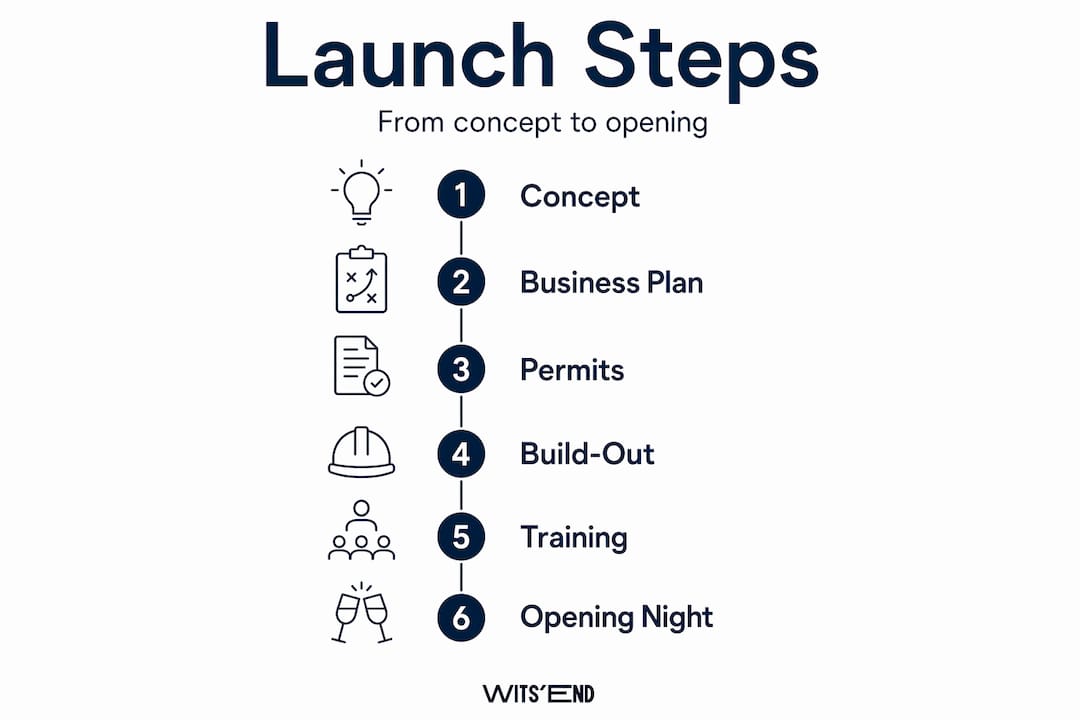
Most restaurant owners underestimate how much happens before a single guest sits down. A successful step by step restaurant launch takes between 6 and 12 months from concept to opening day, and the entrepreneurs who reach opening weekend on time and on budget are the ones who treated the process as a connected system, not a checklist. This guide walks you through every phase of that process, from writing your first business plan to running your soft opening, with the operational honesty that the standard restaurant opening guide often leaves out.
Table of Contents
- Key takeaways
- Step by step restaurant launch: concept and business plan
- Location, financing, and permits
- Design, build-out, and menu development
- Hiring, training, technology, and opening day
- What I have learned about restaurant launches that most guides skip
- How Witsendsolutions supports your restaurant launch
- FAQ
Key takeaways
| Point | Details |
|---|---|
| Plan for 6 to 12 months | A realistic timeline accounts for permitting delays, construction, and staff training before opening day. |
| Concept drives every decision | Your service model, location criteria, and menu all flow from a clearly defined restaurant concept. |
| Permits take longer than expected | Start license and permit applications early; approval timelines vary widely across US jurisdictions. |
| Soft openings are system tests | Use your soft opening to find POS, staffing, and ticket-time problems before the public arrives. |
| Financial modeling must be conservative | Stress-tested projections prevent the budget overruns that derail most restaurant startups in year one. |
Step by step restaurant launch: concept and business plan
Every restaurant startup process begins with a concept, and that concept needs to be specific enough to make real decisions. Casual neighborhood Italian is not a concept. A 45-seat neighborhood trattoria with an all-Italian wine program, a $58 average check, and a focus on weeknight regulars is a concept. That level of specificity tells you who you are hiring, what your kitchen equipment list looks like, and how your space should feel.
Once your concept is clear, your restaurant business plan steps can begin in earnest. The business plan is not a formality for the bank. It is the first time you stress-test whether your idea actually works.
Key elements to address at this stage:
- Target market and competitive landscape. Identify who your guests are, where they currently eat, and what gap your concept fills. A genuine feasibility analysis here prevents you from opening a third sushi bar on a block that already has two.
- Service model and menu structure. Decide whether you are running full service, fast casual, or counter service. Your staffing costs, ticket times, and kitchen design all depend on this choice.
- Three-year financial projections. Build a P&L that models revenue by covers per shift, average check, and days open. Include a conservative scenario where early occupancy runs at 50 to 60 percent. Overly optimistic financial assumptions create structural risk post-launch, so your numbers need to survive pressure.
- Operational feasibility. Can you source the ingredients your menu requires? Can you staff the roles your service model demands in your specific market?
Pro Tip: Before you finalize your concept, spend two or three shifts working in a restaurant that operates the way you want to. Nothing reveals operational blind spots faster than standing on the floor during a Friday dinner rush.
Restaurant development works best as connected phases, not isolated steps. The decisions you make in your business plan will directly shape your location search, your build-out budget, and your staffing model. Get those foundations right and the rest of the process becomes significantly more manageable.
Location, financing, and permits
With a validated concept and a business plan in hand, the next phase of the restaurant startup process involves three activities that happen largely in parallel: finding your location, securing your funding, and beginning your permit applications.
Here is the sequence that works best for most operators:
- Identify candidate locations based on your concept requirements. Consider foot traffic patterns, proximity to your target demographic, parking, and the physical dimensions of the space.
- Confirm legal use before signing a lease. Boston's permitting guidance makes it explicit: verify restaurant zoning and legal use of the space before you commit. Discovering a zoning restriction after signing a lease is an expensive and avoidable mistake.
- Secure your financing. Options include SBA loans, conventional bank financing, private investors, and seller financing on existing restaurant spaces. Your business plan is the primary document lenders and investors will evaluate.
- File permit and license applications as early as possible. In Boston, for example, obtaining a Food Service Permit requires a Certificate of Occupancy, a Common Victualler License, certifications, and a pre-service inspection. Getting into that queue early is not optional.
- Engage a restaurant consultant or attorney familiar with your local jurisdiction. Permit requirements vary enormously across US cities and counties, and a missed dependency can cost weeks.
| Permit / License | Who Issues It | Typical Timeline |
|---|---|---|
| Food Service Permit | Local health department | 4 to 12 weeks |
| Certificate of Occupancy | Local building department | 2 to 8 weeks post-construction |
| Liquor License | State ABC board | 60 to 120+ days |
| Sign Permit | Local municipality | 2 to 6 weeks |
| Employer Identification Number | IRS | Days (online application) |
Pro Tip: The critical path for permits and construction is where most timelines fall apart. Map out every permit dependency before your contractor swings a hammer, so your build-out and your paperwork finish at the same time.
A restaurant startup consultant can be genuinely valuable during this phase, particularly for navigating local health department requirements. Jefferson County's health department, for instance, mandates plan review and pre-opening inspection covering layout, menu, and equipment before any food establishment can operate. That kind of review takes time and requires your design drawings to be complete.
Design, build-out, and menu development
Once your lease is signed and permits are in motion, the physical build-out and menu finalization happen concurrently. Both deserve more rigor than most first-time owners give them.
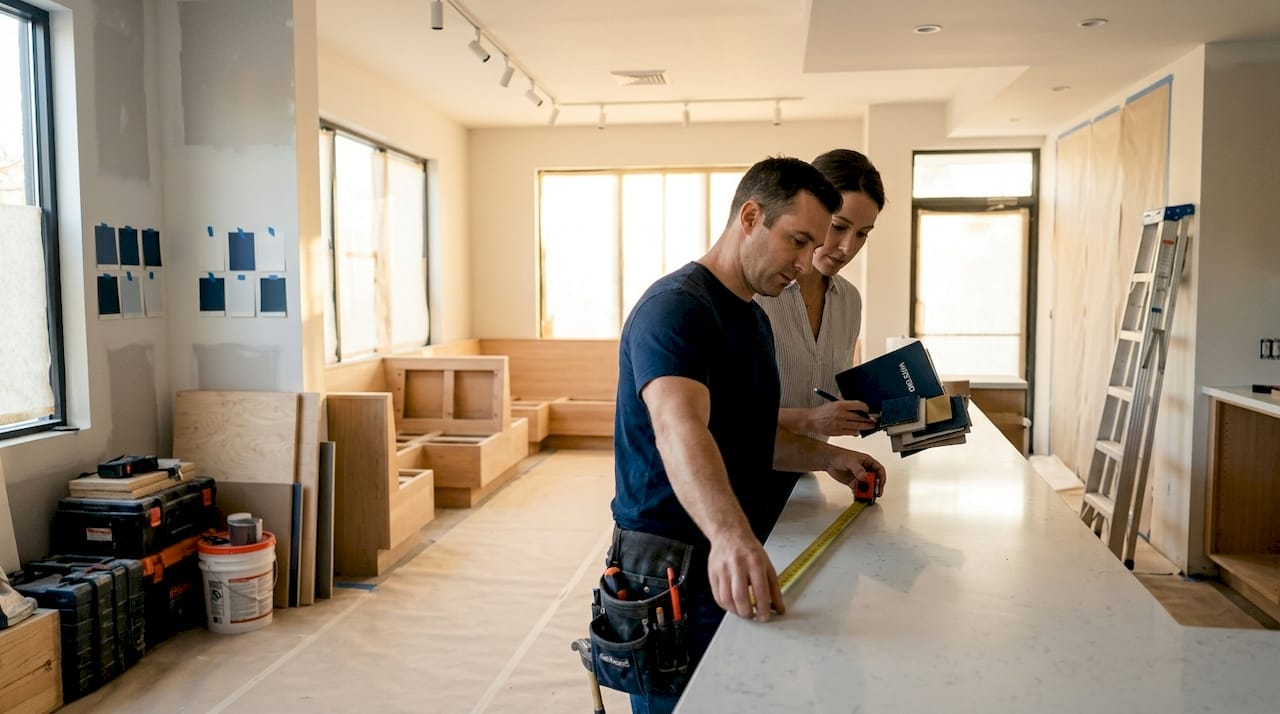
Your space layout should follow your service model, not the other way around. A fast-casual operation that seats 60 needs a dramatically different kitchen configuration than a fine dining room with the same footprint. Work with a designer who understands restaurant operations, not just aesthetics. Poor kitchen flow is one of the most common sources of labor inefficiency during early trading.
Key areas to address in your build-out planning:
- Kitchen equipment selection. Every piece of equipment should be justified by your menu. Over-equipped kitchens inflate startup costs; under-equipped kitchens create bottlenecks during service.
- Budget buffer. Build a 10 to 15 percent contingency into your construction budget. Build-outs almost always surface unexpected conditions, whether structural, electrical, or mechanical.
- Health department plan review. Many jurisdictions require your layout, equipment list, and menu to be reviewed and approved before construction is complete. Coordinate your design timeline accordingly.
On the menu side, budgeting for restaurant launch means costing every menu item before you print a single menu. Recipe costing gives you your food cost percentage per dish, which tells you whether your pricing will produce the margins your P&L requires.
| Menu Item | Recipe Cost | Menu Price | Food Cost % |
|---|---|---|---|
| Pasta Carbonara | $4.80 | $22 | 21.8% |
| Roasted Chicken | $6.20 | $28 | 22.1% |
| Tiramisu | $2.10 | $12 | 17.5% |
| House Cocktail | $3.50 | $16 | 21.9% |
Run tasting sessions and speed tests with your kitchen team before opening. A dish that takes 22 minutes to execute during a slow afternoon will crush your ticket times during a busy Friday service.
Hiring, training, technology, and opening day
The final six to eight weeks before opening are where all the preparation becomes operations. This phase is demanding precisely because most of the work happens simultaneously, and missed dependencies can postpone opening day entirely if you are not managing the sequence tightly.
Your hiring timeline should begin no later than eight weeks out. For a 60-seat restaurant, you are typically looking at one to two managers, a full kitchen brigade, a front-of-house team, and a bar staff if applicable. Hire your key leaders first so they can participate in systems setup and help train the rest of the team.
Staff training is where the real work lives. A team that understands your menu technically but cannot describe a dish with confidence, upsell naturally, or handle a complaint gracefully will cost you guests in the first weeks. Effective staff training programs cover product knowledge, service standards, and table management well before the first cover is served.
Your technology setup runs parallel to training and includes:
- POS system programming. Menu items, modifiers, pricing, comps, and voids all need to be configured before training begins, so your team learns the real system, not a placeholder version.
- Inventory and ordering tools. Set up par levels and ordering templates before opening so your first week of purchasing is systematic rather than reactive.
- Reservation and waitlist platform. Configure table management to reflect your actual floor plan, with accurate turn times based on your service model.
Pro Tip: Start your marketing campaign six to eight weeks before opening. Pre-opening marketing, email list building, social content, and local press outreach should be building an audience before the doors open, not after.
Marketing should start 6 to 8 weeks before opening, and your soft opening should run two to three nights before your grand opening date. Treat the soft opening as a systems test. Invite a controlled number of guests, run your full service sequence, and debrief after every night. Soft openings surface ticket time, POS, and staffing challenges under realistic conditions, and the problems you find there are far less costly than the ones you find on opening night in front of a full room.
What I have learned about restaurant launches that most guides skip
I have been through enough restaurant launches to know that the guides covering this topic tend to make it look cleaner than it actually is. They present the steps in sequence, neatly numbered, as if the permitting approval lands right before construction ends and your chef shows up fully trained on day one. The reality is messier, and the operators who succeed are the ones who plan for that mess explicitly.
The biggest mistake I see is treating financial modeling as a formality. Founders run the numbers once, arrive at a projection that supports their enthusiasm, and move on. What you actually need is a model you have tried to break. Run scenarios where your average check comes in $8 lower than projected. Model what happens if you open at 40 percent occupancy for the first six weeks. Conservative, stress-tested modeling is not pessimism. It is the difference between having a cash reserve when you need one and running out of runway before you find your footing.
The second thing I would emphasize: your soft opening is not a party for your friends. It is a controlled experiment. Run it with the same rigor you would bring to any operational test. Use full ticket flow, real POS transactions, and honest post-shift debriefs. The problems you surface in a soft opening are gifts.
The operators I have seen open well are the ones who build their launch as connected phases with clear dependencies, not isolated tasks. Concept informs location criteria. Location criteria inform design. Design informs permits. Permits inform construction timeline. Construction timeline informs your opening date. Pull one thread and the whole sequence shifts. When you see it that way, planning becomes less about perfection and more about honest sequencing.
— Chris
How Witsendsolutions supports your restaurant launch
Launching a restaurant is one of the most operationally complex things you can do in the hospitality business. At Witsendsolutions, we have done this work ourselves before we ever recommend it to someone else.
Our team works with restaurant owners across the United States at every stage of the launch process. We help you develop your restaurant brand and concept from the ground up, create menus that hit your target food cost margins, and design training programs that turn a hired team into a confident, connected service crew. For operators who need hands-on support during the critical pre-opening and opening period, our restaurant task force services put experienced operators on property when the stakes are highest. Whether you need a partner for the full launch or expert support for one specific phase, we build our involvement around what your business actually needs. Reach out to the Witsendsolutions team and let us help you open with confidence.
FAQ
How long does a restaurant launch typically take?
A typical US restaurant startup takes 6 to 12 months from concept to opening day, with permitting and construction often determining the longest lead times.
What permits do I need to open a restaurant in the US?
Requirements vary by city and state, but most restaurants need a Food Service Permit, Certificate of Occupancy, and liquor license if serving alcohol. Local health departments also typically require plan review and a pre-opening inspection before you can begin service.
What should I include in a restaurant business plan?
Your business plan should cover your concept, target market, menu structure, staffing model, and three-year financial projections with conservative revenue assumptions and a detailed cost breakdown.
When should I start hiring and training staff?
Begin hiring no later than eight weeks before your opening date so your team has time for full product training, POS practice, and at least two to three soft opening services before your grand opening.
What is the purpose of a soft opening?
A soft opening is a controlled service run with limited guests designed to test your POS, staffing, and kitchen flow under real conditions before your public launch. It surfaces operational problems while the stakes are still manageable.