
Mandatory service charges are generally not tips under U.S. federal law. When you distribute them to staff, they become wages, not gratuity, and every payroll, tax, and overtime rule that applies to wages now applies to that money. Before rolling out or auditing any service charge policy, do three things: disclose the charge clearly on the menu and receipt, configure your POS to code service-charge proceeds as employer wages, and draft a distribution formula you can actually run through payroll.
TL;DR:
- Mandatory service charges are classified as wages, and their distribution must be properly coded and documented as payroll wages, not tips.
- Federal law considers any automatic, business-controlled charge as a service charge, regardless of labeling, especially for large parties, online delivery fees, or banquet charges.
- State and local regulations may impose additional disclosure and labeling requirements, so businesses should verify current guidance before policy implementation.
- Proper setup includes clear menu and receipt language, distinct line items on POS, and reconciling transaction data with payroll for compliance and audit readiness.
- Most compliance issues arise from terminology inconsistency, disguised surcharges, or poor recordkeeping, highlighting the importance of thorough testing and documentation before rollout.
Table of Contents
- What Legally Distinguishes a Service Charge From a Tip?
- How Do DOL and IRS Rules Treat Service Charges?
- Which States Have Changed Service Charge Rules Recently?
- Operational Compliance Checklist for POS, Receipts, and Payroll
- What Are the Most Common Service Charge Compliance Mistakes?
- What a Sample Rollout Looks Like in Practice
- How Wits' End Solutions Supports Service Charge Rollouts
- Sources
- FAQ
What Legally Distinguishes a Service Charge From a Tip?
The test isn't what you call the line item. It's who controls it. A tip is a voluntary payment the guest chooses to leave, in an amount the guest sets. A service charge is a mandatory amount the business sets and adds automatically, regardless of guest satisfaction. Labeling an add-on as a "gratuity" on the receipt doesn't change its legal character if it is mandatory and business-controlled. If your business decides the amount and forces its application, the law treats it as a service charge, not a tip, no matter what word appears on the check.
Common examples that fall on the service charge side of the line:
- A large-party auto-charge added to tables of eight or more
- Room service or banquet service charges built into the bill
- Mandated delivery fees applied to every online order
- Contracted charges like luggage assistance or bottle service fees
Voluntary tip prompts on a payment screen, where the guest picks the percentage or opts out entirely, stay on the tip side. Our guide comparing service charges and gratuities breaks down more edge cases operators run into at the point of sale.
How Do DOL and IRS Rules Treat Service Charges?
The Department of Labor's Fact Sheet #15 draws the federal line plainly: a compulsory service charge, even one set at a familiar rate like 15% or 20%, is not a tip under the Fair Labor Standards Act. Once you distribute that money to employees, it's wages, and it must be folded into the regular rate used to calculate overtime.
A compulsory service charge is not considered a tip under the FLSA. Sums distributed to employees are wages and must be included in the regular rate used for overtime.
That regular-rate requirement trips up a lot of payroll setups. If a server works 45 hours in a week and receives $200 in distributed service-charge proceeds, that $200 has to factor into the overtime calculation on those extra five hours, the same way a shift differential or a nondiscretionary bonus would.
The IRS treats distributed service charges the same way: as wages reportable on Form W-2, subject to Social Security, Medicare, and federal income tax withholding. There's no separate tip-reporting mechanism for this money because it isn't a tip in the government's eyes.

Tip pooling adds another layer. Under FLSA section 3(m), managers and supervisors generally cannot keep a share of tips collected in a pool with other staff. A Department of Labor opinion letter walks through the duties test used to decide whether someone counts as a manager for this purpose, which matters if your shift leads occasionally bus tables or expedite.
Which States Have Changed Service Charge Rules Recently?
Federal law sets the floor, not the ceiling. Several states and cities have tightened or clarified how automatic service charges must be disclosed, and some have restricted using the word "gratuity" or "tip" on a line item the business controls. That gap between federal permission and state restriction is where a lot of well-intentioned operators get caught.
Before you launch or revise a policy, check:
- Your state labor department's current guidance on mandatory service charges
- Your state attorney general's consumer-protection rules on receipt wording
- Any municipal ordinances specific to your city, since some restrictions sit below the state level
- Whether your state requires the charge to appear as a distinct, clearly labeled line separate from any optional tip field
Rules in this area shift fast, and a policy compliant in 2024 may not survive a 2026 update. A quick call to counsel or a review of your state's current labor bulletin before rollout costs far less than unwinding a noncompliant policy after guests have already been charged under it.
Operational Compliance Checklist for POS, Receipts, and Payroll
Getting the legal definition right doesn't matter if your point-of-sale system and your payroll software disagree about what a service charge is. This is where most real-world compliance failures happen, not in the legal reasoning but in the plumbing between systems.
- Decide the policy first. Will the business retain the full charge, distribute it entirely to staff, or split it by a fixed formula? Write the formula down before touching your POS.
- Configure the POS to apply the charge equally across every payment method. A service charge that only appears on card transactions looks like a disguised surcharge to a regulator.
- Keep the charge as its own line item, mapped to a distinct revenue and payout code, never blended into the tip field or the base check total.
- Write receipt and menu language that states the charge is mandatory, and keep that wording separate from any optional tip prompt so guests can see the distinction.
- Route distributed amounts through payroll as wages. Withhold the standard taxes, report the amounts on Form W-2, and include them in regular-rate overtime math.
- Run sample transactions across every channel you operate, dine-in, delivery, banquet, and room service, then reconcile the POS batch report against the payroll distribution before going live.
Pro Tip: Pull five real receipts from five different channels the week before launch, dine-in, takeout, delivery, banquet, and room service, and walk each one by hand from POS entry to payroll line. If the numbers don't match on paper, they won't match in an audit either.
Keeping a written distribution formula and reconciling POS reports against payroll before you go live catches the majority of errors while they're still cheap to fix.
What Are the Most Common Service Charge Compliance Mistakes?
Most contested compliance issues trace back to a handful of preventable errors, not novel legal questions.
- Terminology drift: the menu says "service charge," the receipt says "gratuity," and the POS system codes it as a tip. Pick one term and use it everywhere, including in your POS backend.
- Disguised card surcharges: a service charge that only shows up on credit card transactions isn't a service charge, it's a payment surcharge wearing a different label, and it invites scrutiny.
- Manager tip pool participation: a supervisor who occasionally dips into the tip pool "to help out" during a rush is still bound by the duties test in the DOL's opinion letter, and casual participation doesn't excuse a violation.
- Thin recordkeeping: keep POS transaction logs, payroll mapping documentation, and distribution records on hand. An auditor will ask for all three, and gaps between them create exposure even when the underlying policy was sound.
What a Sample Rollout Looks Like in Practice
The sequence matters as much as the policy itself. A clean rollout follows a fixed order: decide the policy, put the distribution matrix in writing, configure the POS, finalize receipt wording, run a payroll dry run, then reconcile live transactions before calling the launch complete. Skip a step, especially the dry run, and you find out about a mapping error from a confused paycheck instead of a test transaction.
Operations-first testing catches problems while they're still hypothetical. A payroll dry run against three or four sample shifts, banquet, high-volume dinner, slow lunch, delivery-heavy weekend, surfaces mismatches between what the POS reports and what payroll actually processes. That's a much cheaper place to find an error than a wage claim six months later. The businesses that get this right treat the rollout like a soft opening: test small, reconcile hard, then scale.
— Chris
How Wits' End Solutions Supports Service Charge Rollouts
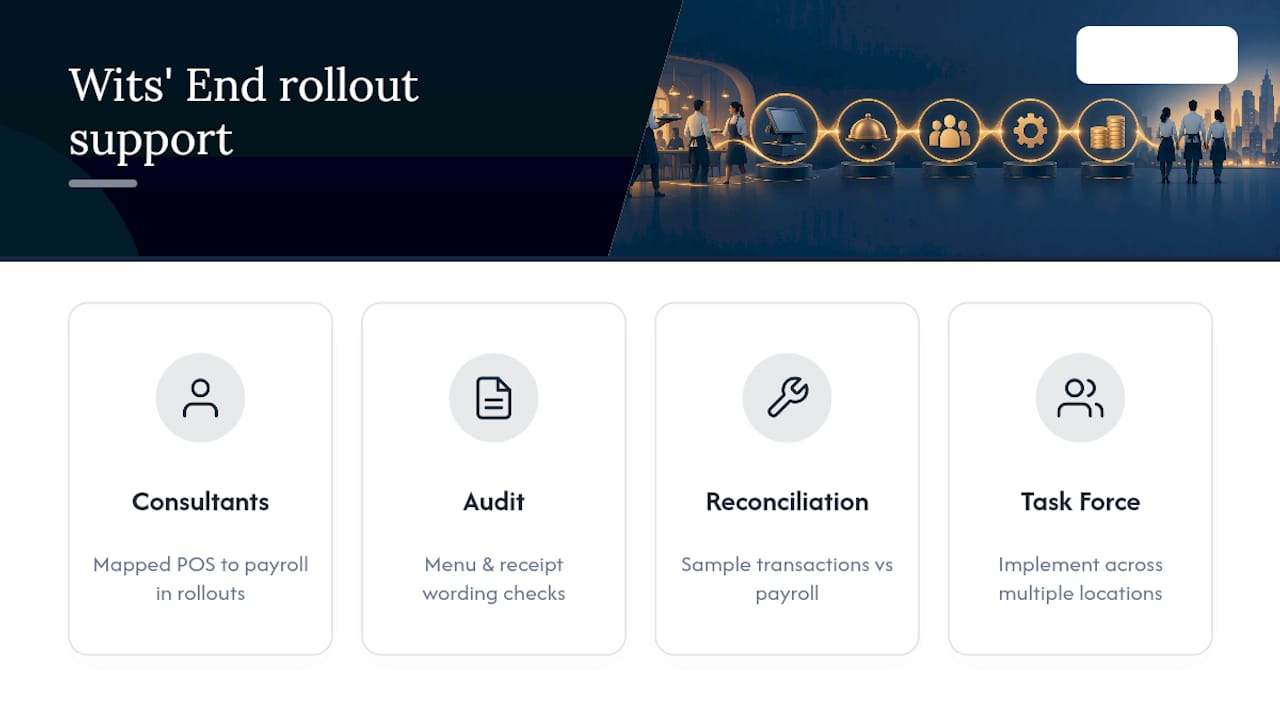
Getting a service charge policy right takes more than reading the fact sheet. It takes someone who has actually mapped a POS system to a payroll run and watched where the numbers diverge. Wits' End Solutions built its compliance audit process around exactly that gap: consultants who have executed these rollouts themselves, not just advised on them from a distance.
A short compliance audit can cover menu and receipt wording, POS coding, and sample-transaction reconciliation against payroll, following the testing sequence outlined above. If your business is opening new locations or rolling out a policy change across multiple properties, our task force team can run the whole implementation alongside your managers. Request a compliance audit through the services page to get your POS-to-payroll mapping checked before your next payroll cycle runs.
This article is general information, not a substitute for advice from a qualified lawyer. Consult a qualified legal professional about your own circumstances before acting on anything here.
Sources
- Fact Sheet #15: Tipped Employees Under the Fair Labor Standards Act (FLSA) | U.S. Department of Labor
- Topic No. 761, Tips — withholding and reporting | Internal Revenue Service
FAQ
Is a Service Charge Legal in the USA?
Yes. Mandatory service charges are legal nationwide under federal law, but they must be treated as employer-controlled charges, not tips, and distributed amounts count as wages under DOL guidance. Some states add disclosure or wording requirements on top of the federal baseline, so check your state labor department before finalizing your policy.
Can a Customer Refuse to Pay a Service Charge?
Generally, no, if the charge is disclosed clearly as mandatory before the guest orders, since it functions as part of the price of the meal or service rather than a discretionary gratuity. Some states or local consumer-protection rules may give guests more leverage if disclosure was unclear or buried, which is why receipt and menu wording matter as much as the payroll side.
What Happens if a Guest Refuses to Pay a Service Charge?
Handle it the way you'd handle a disputed menu price: explain the mandatory charge was disclosed upfront, point to the menu or posted signage, and offer to walk through the receipt. If disclosure was genuinely inadequate, waiving the charge for that guest is usually the lower-risk move than escalating a dispute over a policy your own signage didn't clearly state.
Is a 20% Service Charge the Same as a Gratuity?
No. A mandatory 20% service charge is a wage-related payment controlled by the business, while a gratuity is a voluntary amount the guest chooses to leave. The IRS treats distributed service charges as wages subject to standard payroll withholding, not as tip income, regardless of what the receipt calls it.
Can Managers Keep a Share of Pooled Tips?
Generally no. Under FLSA section 3(m) and a 2025 DOL opinion letter, managers and supervisors are generally barred from keeping tips from a pool shared with non-management staff, even if they occasionally perform service duties during a rush.