
A mandatory service charge is employer revenue that becomes taxable wages once distributed to staff. A gratuity is a voluntary payment the guest chooses to leave, and it belongs to the employee, not the house. The line between the two is not what your menu calls it. It's whether the guest had a real choice, and the IRS decides that with a specific four-part test.
TL;DR:
- Mandatory service charges are treated as wages and are subject to payroll taxes, unlike voluntary tips which qualify for the FICA tip credit.
- The IRS applies a four-part test to determine if a payment is a tip; failing any part requires classifying it as a service charge, regardless of menu language.
- Implementing a service charge requires careful POS coding, payroll setup, and clear disclosure to prevent audit issues and guest complaints.
- Charging 18% auto-gratuity or fixed banquet fees typically qualifies as a service charge, which must be routed through payroll as wages.
- Pilot new policies at banquets or private events first, and monitor guest and staff responses before rolling out system-wide.
Table of Contents
- Service Charge vs Gratuity in the US: The IRS Four-Part Test
- Payroll and Tax Rules: Withholding, W-2s, and the Tip Credit
- Should You Adopt a Service Charge or Keep Tipping?
- Menu Wording, Receipts, and Staff Communication
- Common Scenarios: How to Classify and Handle Real Charges
- Wits' End Checklist for a Compliant Service-Charge Rollout
- Where We Land on Fairness and Compliance
- How Wits' End Helps You Implement a Compliant Policy
- Sources
Service Charge vs Gratuity in the US: The IRS Four-Part Test
The IRS doesn't care what you print on the check. It applies a four-factor test to decide whether a payment is a tip or a service charge, and getting this wrong creates payroll liability you won't see coming until an audit.
A payment only counts as a tip when all four conditions are true:
- The payment is made free from compulsion.
- The customer has the unrestricted right to determine the amount.
- The payment is not subject to negotiation or dictated by employer policy.
- The customer generally has the right to decide who receives the payment.
Fail even one factor, and the payment is a service charge. So does a pre-set banquet gratuity line or a mandatory bottle-service fee at a nightclub table. Calling it a "gratuity" on the receipt changes nothing legally.
The IRS Fact Sheet FS-2015-8 lays out this test directly, and it's worth keeping a printed copy in your operations manual. Auditors will ask for POS reports showing whether the charge was editable at the terminal. If servers could waive or adjust it, that's evidence favoring tip status. If the system locked it in, that's evidence against you.
Payroll and Tax Rules: Withholding, W-2s, and the Tip Credit
Once a payment is classified as a service charge, it changes how you run payroll. Distributed service charges are treated as regular wages: subject to federal income tax withholding, Social Security, and Medicare, and they count toward the regular rate used to calculate overtime. Voluntary tips work differently. Employees report them, and employers can potentially claim the Section 45B FICA tip credit against payroll tax liability. Service-charge dollars never qualify for that credit, no matter how they're eventually split among staff.
Pro Tip: If you convert tipped staff to a service-charge model, recalculate their regular rate for that pay period before running overtime. The added distribution raises the base, and skipping this step is the most common wage-and-hour mistake operators make in year one.
Three operational changes matter most:
- Create a distinct POS sales code for service-charge revenue, separate from food and beverage sales.
- Set up a dedicated payroll distribution code so W-2 reporting reflects wages, not tip income.
- Keep records showing gross receipts, the distribution formula, and withheld amounts for every pay period.
Patriot Software's payroll guidance walks through this coding structure in more detail, and it's a useful reference to hand your bookkeeper before you flip the switch.
Should You Adopt a Service Charge or Keep Tipping?
The right model depends on your concept, your labor cost structure, and how much control you want over pay equity between front and back of house.
- Service charges stabilize back-of-house pay. Kitchen staff never touch tip pools in most states, so a service charge is often the only legal way to share hospitality revenue with cooks and dishwashers.
- Service charges cost you the tip credit and add payroll tax exposure. You lose the FICA tip credit, and every dollar distributed carries employer-side Social Security and Medicare tax.
- Tipping preserves guest familiarity but keeps pay uneven. Servers in high-volume sections earn more than hosts, bussers, or kitchen staff, and that gap can hurt retention.
Fine dining and banquet operations tend to adopt service charges most smoothly, since guests already expect built-in fees for private events. Casual, high-turnover concepts risk guest pushback if service charges replace an established tipping culture guests understand and expect. A pilot on banquets and private events first, then a measured expansion, limits your downside.
Menu Wording, Receipts, and Staff Communication
Confusing disclosure is the fastest way to turn a defensible service charge into a wave of guest complaints and one-star reviews. Guests need to see the charge before they order, not discover it when the check arrives.
- Disclose mandatory charges on printed menus, online ordering platforms, reservation confirmations, and event contracts.
- State both the percentage and its purpose, such as "18% service charge supports wages for our full team."
- Place the disclosure near the price, not buried in footnote text.
- Train hosts and servers to explain the charge in one sentence if a guest asks, without sounding defensive, emphasizing the role of customer service in hospitality.
Clear, upfront language keeps voluntary tips flowing on top of the mandatory fee when guests understand what the charge covers and see it early. Vague or hidden wording does the opposite. Consider testing your disclosure language on pre-check screens the same way you'd test messaging that drives guest counts and revenue elsewhere in your guest journey.
Common Scenarios: How to Classify and Handle Real Charges
- 18% auto-gratuity on parties of eight or more: This is a service charge, full stop. Route it through payroll as wages, not tip income, and recalculate overtime for any tipped employee it touches.
- Banquet or catering service fee: Contract language usually locks the amount, which makes it a service charge. Whether it flows to staff as wages or stays as house revenue depends entirely on your written distribution policy.
- Suggested tip line on a check: This preserves tip status only if the guest can freely change or remove the amount. A pre-filled default that requires staff intervention to waive starts drifting toward service-charge territory.
Wits' End Checklist for a Compliant Service-Charge Rollout
Launching a service charge without a legal and payroll review is how operators end up with back wages and penalties years later.
- Get an attorney or accountant to confirm classification and check for state-specific distribution rules.
- Flag the charge in your POS as a distinct revenue category, not a tip line.
- Map a payroll distribution code that ties directly to your written policy document.
- Update menus, your website, and event contracts with disclosure language before launch, not after.
- Train hosts and servers with a short script explaining the charge and its purpose.
- Track voluntary tip volume, guest complaints, and your payroll-tax delta for 60 to 90 days after rollout.
Pro Tip: Run the service charge on banquets and private events for one full quarter before touching your regular dining room. It's the lowest-risk way to see how your guests and staff actually respond before committing system-wide.
Where We Land on Fairness and Compliance
We tend to recommend service charges when an operator's back-of-house pay has fallen behind front-of-house tip income, especially in kitchens carrying heavy labor costs with no legal path into the tip pool. A service charge fixes that gap directly.
We're more cautious in markets where guests strongly expect traditional tipping, or where a restaurant relies on the FICA tip credit to keep payroll tax manageable. Losing that credit without a clear revenue plan to offset it can hurt margins fast.
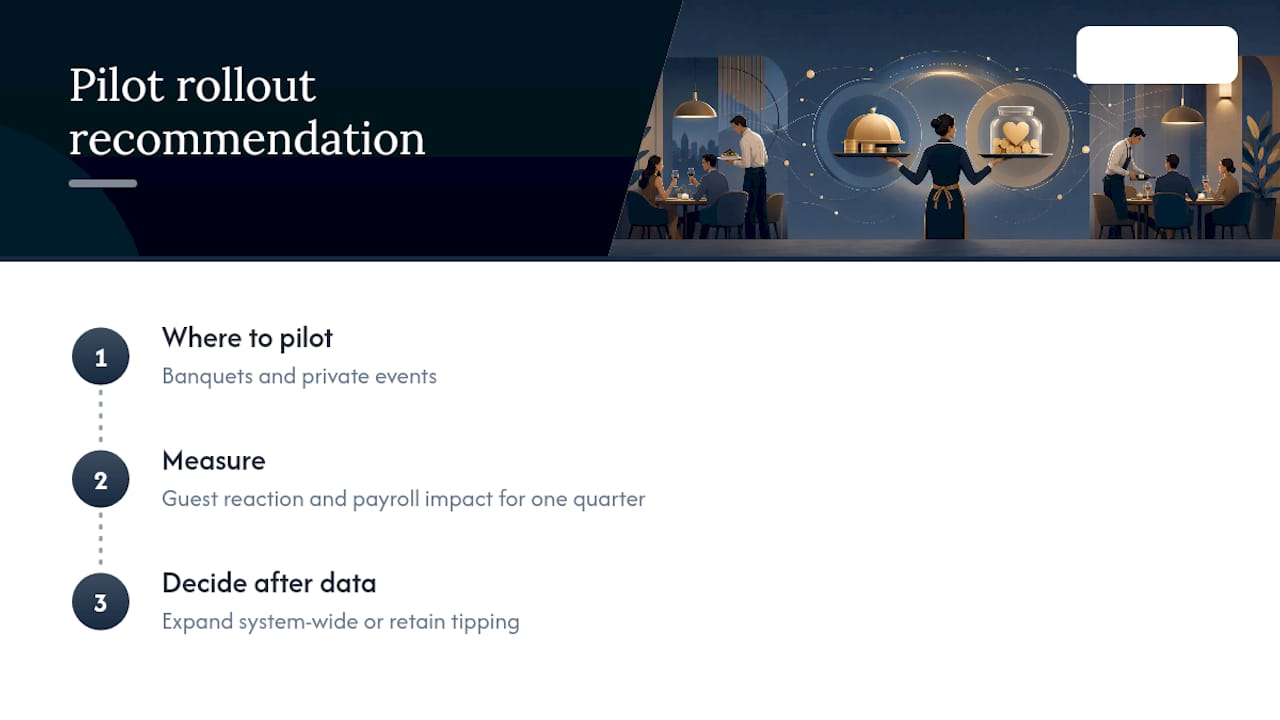
Our default advice is conservative: pilot on banquets and private events, measure guest reaction and payroll impact for a full quarter, then decide whether to expand. Jumping straight to a system-wide rollout skips the data you need to know if it's working.
— Chris
How Wits' End Helps You Implement a Compliant Policy
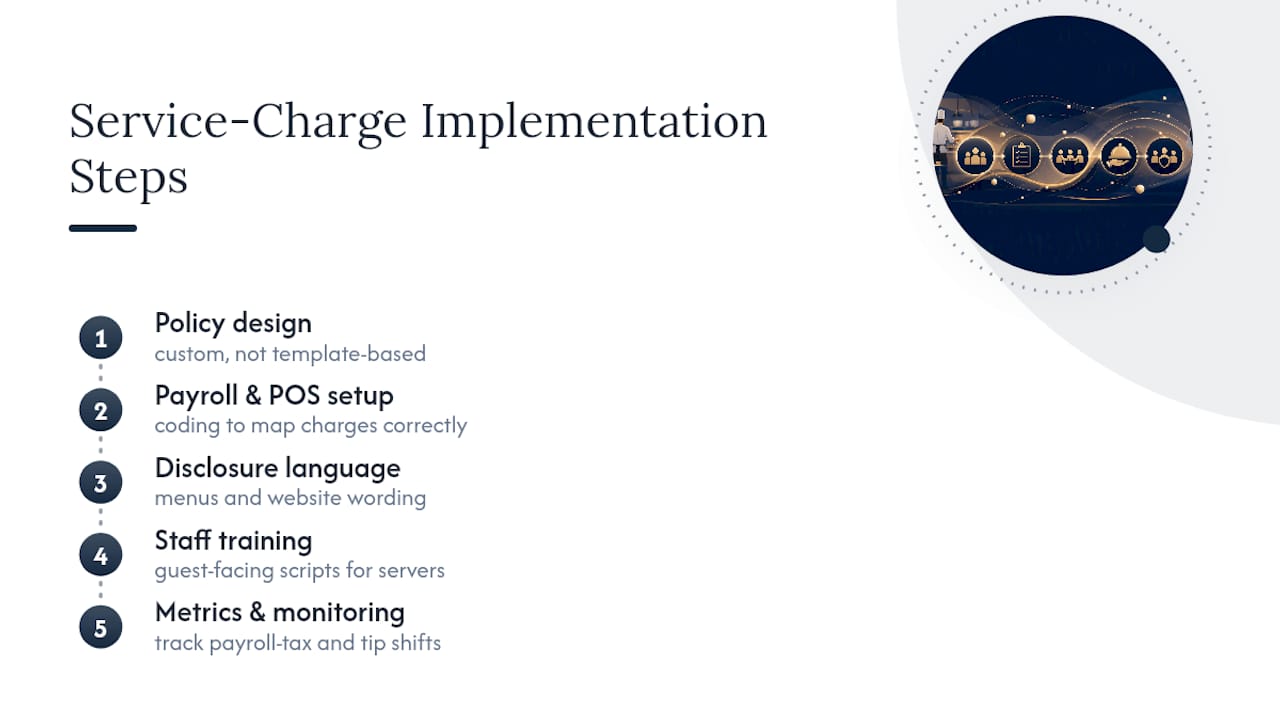
Our firm offers expert guidance to help you implement a service-charge rollout without relying on generic templates. We assist with policy design, payroll and POS coding setup, disclosure language for menus and websites, staff training on guest-facing communication, and establishing metrics to measure pilot performance.
That combination matters because most operators get one piece right and miss another. A clean legal review with no staff training still produces confused servers. Clean disclosure with no payroll mapping still produces a W-2 mess. Our training programs cover the guest-facing scripts, and our analytics services track the payroll-tax and tip-volume shift once you launch.
If you're weighing a service charge for your next quarter, reach out to Wits' End Solutions to scope the engagement before you touch your menu.
Sources
Keep these on hand for audits and payroll setup: the IRS Fact Sheet FS-2015-8 on tips versus service charges, IRS newsroom guidance on reporting rules, and Patriot Software's payroll walkthrough for coding distributions correctly.
- Tips Versus Service Charges: How to Report (IRS Fact Sheet FS-2015-8)
- Tips vs auto-gratuities (Patriot Software)
- Service charge vs tip (DoorDash merchants blog)