
Expect to pay a restaurant consultant an hourly rate roughly in the low hundreds, project fees often in the low to mid tens of thousands, and monthly retainers typically starting in the low thousands, with exact amounts varying by experience, scope, and market. Where you land depends on factors such as the consultant's experience, your market, and how well you define the project scope. For tighter pricing, owners are advised to seek fixed-fee deliverables or small initial audits before proceeding with larger engagements.
TL;DR:
- A restaurant consultant’s hourly rate typically ranges from $150 to $350, with project fees starting around $3,000 and often exceeding $50,000 for larger scopes.
- Retainer packages usually cost several thousand dollars per month, but travel, expenses, and specialist premiums are almost never included in the base fee.
- Clear, measurable KPIs, a detailed scope of work, and capped expenses are essential contract terms to ensure transparency and accountability.
- Smaller projects like menu engineering or delivery optimization often have quick returns and are best priced as flat fees; larger turnarounds often require hourly or retainer arrangements.
- Owners should prioritize defining scope and testing with a paid audit before committing to full-scale engagements to avoid vague deliverables and unexpected costs.
Table of Contents
- How Much Does a Restaurant Consultant Cost in the U.S.?
- Common Pricing Models: Hourly, Flat Fee, Retainer, or Performance
- Typical Costs by Engagement Type
- What Actually Drives Your Price
- How to Evaluate a Proposal Before You Sign
- Wits' End Solutions: How We Structure Fees
- Tax Treatment and Extras You Should Budget For
- What the Benchmarks Don't Tell You
- Get a Scoped Proposal From Wits' End Solutions
- Sources
How Much Does a Restaurant Consultant Cost in the U.S.?
The range is wide because "restaurant consultant" covers everyone from a chef who spends two days fixing your kitchen line to a former multi-unit CEO who rebuilds your entire brand strategy. Recent market summaries place common U.S. benchmarks at roughly $100 to $500 an hour, $5,000 to $50,000-plus for a defined project, and $3,000 to $15,000 a month for ongoing retainer work. A separate U.S.-focused breakdown narrows the hourly band to $150 to $350, with retainers running $2,500 to $10,000-plus and projects landing in that same $5,000 to $50,000-plus zone. Senior specialists charge toward the top of every range.
The table below lines up what you'll actually see in a proposal, translated into the kind of work each price tag buys.
| Engagement Type | Typical Price Range | What You're Buying |
|---|---|---|
| Hourly advisory | typically in the low to mid hundreds per hour | Ad hoc problem solving, kitchen walk-throughs, one-off menu reviews |
| Flat-fee project | from a few thousand up to tens of thousands | Menu engineering, opening plans, turnaround diagnostics |
| Monthly retainer | generally several thousand per month with possible higher ranges | Ongoing P&L oversight, recurring training, fractional leadership |
| Specialized food-science work | usually commands premium pricing in the mid to upper range of projects | Recipe formulation, shelf-life testing, food-safety compliance |
At the low end, you'll usually find a chef-consultant doing hands-on kitchen work: line audits, recipe standardization, a few days of staff coaching. At the high end, you're paying for someone who has run P&L across multiple units, negotiated leases, or turned around a failing brand before. Project-level work for smaller engagements often starts around $3,000 and can exceed $40,000 for larger scopes, with specialized food-science consulting commanding the premium end of that range.
A few caveats before you budget off these numbers. First, travel and expenses are almost never included in the headline rate. If your consultant is flying in from another market, add flights, lodging, and per diem on top of the fee. Second, specialist premiums are real. A food scientist validating shelf life or a beverage director building a full cocktail program will price above a generalist operations consultant, even for a similarly sized project. Third, retainer pricing usually assumes a minimum monthly hour allotment. Ask what happens when you exceed it before you sign anything.
Common Pricing Models: Hourly, Flat Fee, Retainer, or Performance
Every consultant defaults to one of four billing structures, and each one shifts risk differently between you and them.
Hourly billing works best for open-ended, hard-to-scope problems: a first diagnostic visit, an emergency kitchen fix, or advice you need in small doses. It's the most transparent model but the hardest to budget for, since a "quick consult" can balloon if the scope creeps.
Flat-fee (project-based) pricing suits well-defined deliverables: a new menu, a pre-opening plan, a single turnaround diagnostic. You know the total cost going in, which makes it easier to compare proposals side by side. The tradeoff is that a consultant pricing flat-fee work will often pad the number to cover scope surprises on their end.
Retainers fit ongoing relationships: fractional executive support, recurring analytics review, or a consultant embedded in your monthly P&L cycle. They're efficient for long-term work but carry the highest administrative overhead if you're not using the hours you're paying for.
Performance-based fees tie a portion of pay to results, like a percentage of food-cost savings or a bonus tied to hitting a revenue target. This model aligns incentives well, but it's rare in this industry because measuring true causation is messy. Most consultants who offer it will blend it with a smaller base retainer.
Whichever model you choose, insist on these terms in the contract:
- A written scope of work with specific, numbered deliverables, not a vague "operational review."
- A capped expense budget, itemized separately from the fee.
- A defined change-order process for anything added mid-engagement.
- A clear end date or renewal trigger, especially for retainers.
If a proposal is missing any of these four, that's your cue to ask for a revision before you sign.
Typical Costs by Engagement Type
Pricing benchmarks only mean something once you map them to the actual project sitting on your desk. Here's how the common engagement types typically shake out.
-
Pre-opening and full opening packages. These bundle concept development, menu build, staffing plans, and vendor sourcing into one engagement, and they typically run from $10,000 into the tens of thousands depending on scope. A full opening consultant engagement usually spans weeks to a few months and covers everything from layout review to opening-week support.
-
Menu engineering, recipe costing, and menu photography are key steps that benefit from sustainability in food services guidance to optimize ingredient sourcing and menu impacts. This is one of the fastest-ROI categories in the industry, since food-cost reductions and check-average lifts show up within weeks of relaunch. A properly run menu engineering process typically falls in the low-to-mid thousands and pays for itself through margin recovery alone.
-
Turnaround engagements and short-term task forces. When a location is bleeding money or a management team just walked out, consultants step in for a defined sprint, often four to twelve weeks, with day rates or a flat project fee in the $5,000 to $40,000-plus range depending on unit count and complexity.
-
Delivery and digital optimization projects. Reworking third-party delivery menus, packaging, and app presentation is a narrower, cheaper engagement, frequently priced in the low thousands, and it tends to show returns fast because delivery-platform changes go live almost immediately.
Smaller, faster-turnaround projects like menu photography or delivery-app cleanup are good candidates for flat fees precisely because you can measure the ROI within weeks rather than months. Bigger, messier engagements, like a full turnaround, are harder to price upfront and often start as an hourly or retainer arrangement until the scope firms up.
What Actually Drives Your Price
Two operators can hire consultants for the same kind of project and pay wildly different fees. Here's what explains the gap.
- Track record. A consultant who has led three successful brand turnarounds charges more than one on their first solo engagement, and rightly so, since experience compresses the time it takes to diagnose your actual problem.
- Unit count and complexity. Auditing one location's P&L is a different job than standardizing recipes across an eight-unit group. Fees scale with the number of P&Ls a consultant has to actually understand.
- Geography. Expect fees 30% to 50% higher in New York, Los Angeles, and San Francisco compared to secondary markets, which roughly tracks compensation data showing restaurant consultant salaries running higher in Los Angeles than the national average.
- Scope clarity. A tightly written brief with numbered deliverables gets a tighter, more competitive quote than "help us figure out what's wrong."
- Your internal bandwidth. If your team can't execute recommendations without hand-holding, budget for more consultant hours embedded in implementation, not just diagnosis.
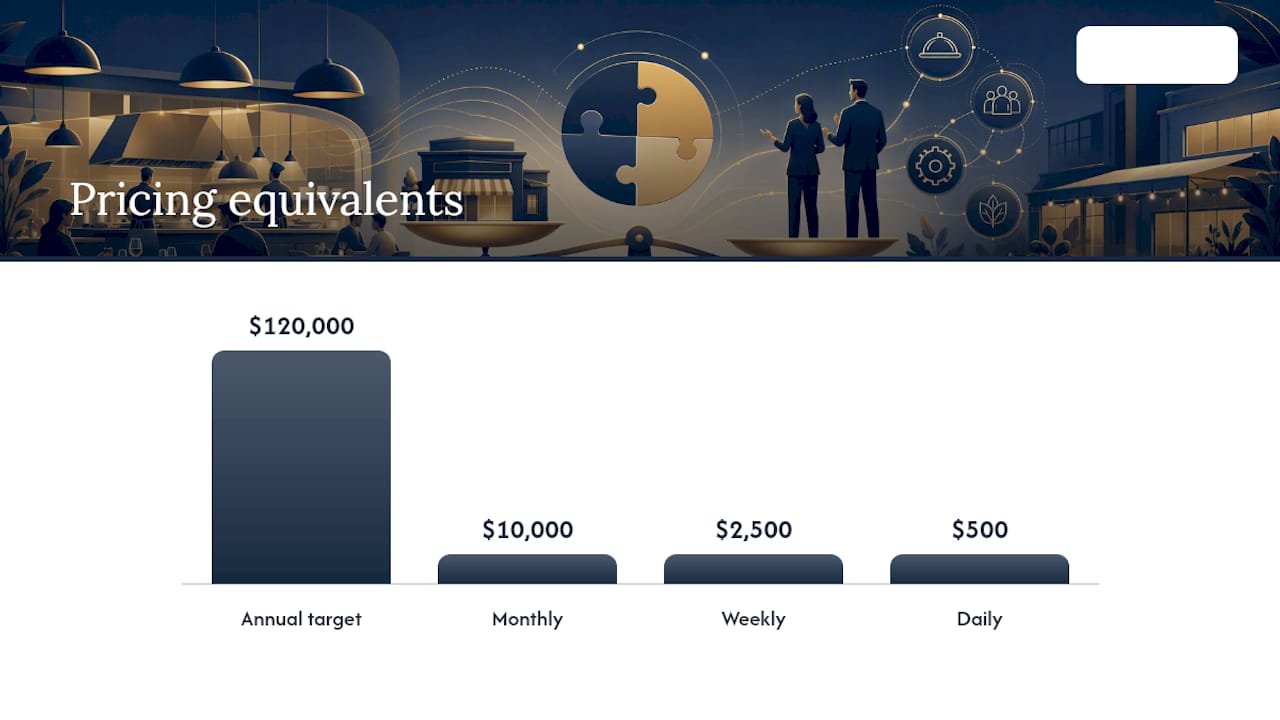
Consultants often reverse-engineer their day rate from an annual income target. A common industry rule of thumb has a consultant targeting roughly $120,000 a year pricing out to about $500 a day, $2,500 a week, or $10,000 a month, which lines up closely with national salary averages near $103,000 a year.
Pro Tip: Ask any consultant quoting a day rate what their annual income target is behind it. If the math doesn't roughly check out against their stated experience level, you're either overpaying or underestimating who you're hiring.
How to Evaluate a Proposal Before You Sign
A polished proposal deck tells you almost nothing about whether a consultant will deliver. Ask these questions before any money changes hands.
- What specific, measurable KPIs will this engagement move, and by how much? A vague "improve profitability" isn't a deliverable. A target like an 8% increase in average check within 90 days is.
- What's the exact reporting cadence, weekly, biweekly, monthly, and in what format?
- Who on the team will actually be doing the work versus who's just on the sales call?
- Can you provide two or three references from engagements similar in size to mine?
- What happens if the scope changes mid-project, and how is that priced?
- Are travel and expenses capped, itemized, or billed at cost?
- What does a typical week of the engagement look like, on-site versus remote?
- What's included if the first version of a deliverable misses the mark?
- Is there a smaller paid audit option before we commit to the full engagement?
- What's your average client retention or repeat-engagement rate?
Roughly one in five new restaurants close within their first year, according to federal small-business survival data, which is exactly the kind of risk a scoped, KPI-tied engagement is meant to reduce. If a consultant can't answer question one with a specific number, that's a red flag worth pausing on.
The safest way to de-risk a bigger commitment is a short paid audit, a one to three day in-person diagnostic or a compressed remote review, priced well below the full engagement. It lets both sides confirm fit before either commits real money to a multi-month contract.
Wits' End Solutions: How We Structure Fees
Wits' End Solutions structures engagements around what the business actually needs rather than a one-size price sheet. We run three general models: fixed-scope projects for defined deliverables like menu development or pre-opening builds, monthly retainers for ongoing analytics and advisory support, and full operating-partner or task-force placements when a property needs senior leadership on-site during a crisis or transition.
Our pricing generally tracks the U.S. benchmarks covered above, with fixed-scope work priced to the deliverable and retainer work scaled to the depth of P&L involvement required. What differs is how we work: our team has run the businesses we advise before we ever recommend a change, and our analytics platform gives clients visibility into results as they happen rather than a report six weeks after the fact.
Before requesting a proposal, have these ready:
- Current unit count and, if possible, trailing twelve-month P&L
- A clear statement of the problem you're trying to solve, not just the symptom
- Any prior consulting history and what worked or didn't
- A realistic timeline for the outcome you need
Owners who come to us with that information get a scoped, priced proposal faster, and a more accurate one, than those who start with "we need help."
Tax Treatment and Extras You Should Budget For
Consultant fees for a legitimate business engagement are generally deductible as ordinary business expenses, the same category as most professional services fees. That said, tax treatment depends on how the engagement is structured and your specific entity type, so confirm the deduction details with your accountant rather than assuming every dollar is automatically written off.
Beyond the base fee, budget for the extras that rarely make it into the headline number. Travel, lodging, and per diem for out-of-market consultants typically bill separately and should be capped in the contract. Some consultants also pass through third-party costs, photography for a menu relaunch, lab testing for a food-science project, or software licensing for a new POS integration.
The most overlooked cost isn't billed by the consultant at all: it's your own team's time executing the recommendations.
What the Benchmarks Don't Tell You
Most pricing guides stop at the range and leave you to guess where you fall in it. That's the wrong place to stop. The real skill in hiring a consultant isn't finding the cheapest hourly rate, it's writing a scope tight enough that the price becomes almost incidental to the decision.
Conventional advice treats consultant selection like a procurement exercise: compare rates, pick the middle number, move on. That misses the bigger risk, which is hiring someone whose fee is reasonable but whose deliverables are vague. A $15,000 flat-fee project with numbered KPIs beats a $150-an-hour consultant with no defined endpoint, even if the total cost ends up similar.
If you take one thing from this, it's this: price the scope, not the person. Ask for the paid audit before the big contract. Owners who skip that step are the ones who end up back here in six months, searching for a different consultant to fix what the first one never finished.
— Chris
Get a Scoped Proposal From Wits' End Solutions
If the ranges above left you wondering where your project actually falls, that's exactly the gap Wits' End Solutions is built to close. Instead of a generic hourly quote, we price against a defined scope, whether that's a pre-opening build, a menu overhaul, or an ongoing analytics retainer, so you know the total investment before work starts. Our team has operated the businesses we advise, which means the recommendations you get come from people who've already lived with the consequences of them. Explore our brand development services for pre-opening and rebrand work, or bring us in as a task force for a turnaround that needs senior leadership on-site now. Ready to see where your project fits? Reach out to Wits' End Solutions for a scoped proposal built around your actual numbers, not a generic rate card.
Sources
- Restaurant Consultant: What They Do, Cost & When to Hire One | FoodShot AI
- Restaurant Consulting Cost: Average Fees, Pricing Models & What to Expect (2026)
- Hiring Food Consultant – Why, When & How to Choose the Right Expert | Restaurant Times
- Restaurant consultant salary data | ZipRecruiter
- Calculating consulting fees | Restaurant Business Online