
TL;DR:
- Restaurant consulting involves industry experts analyzing and improving restaurant operations, profitability, and guest experience.
- It follows a structured process of diagnosis, recommendation, implementation, and measurement to deliver measurable results.
Restaurant consulting is the practice of hiring experienced industry professionals to analyze and improve your restaurant's operations, profitability, and guest experience. The field covers everything from menu engineering and labor scheduling to P&L management and brand development. Restaurant owners operate on margins that leave almost no room for guesswork, and a qualified consultant brings the outside perspective needed to find and fix the problems that are hardest to see from the inside.
What is restaurant consulting, and what do consultants actually do?
Restaurant consulting is a professional advisory service where specialists diagnose operational, financial, and brand challenges in a restaurant business and then recommend or implement solutions. The industry term you will hear most often is "hospitality consulting," which covers the full spectrum of food and beverage operations. Both terms describe the same core practice: an experienced operator or advisor steps into your business, assesses what is working and what is not, and builds a path toward measurable improvement.
Consultants take on several distinct roles depending on the engagement:
- Operations advisor: Reviews kitchen workflow, daily service systems, scheduling, and inventory to reduce waste and improve throughput.
- Menu and F&B specialist: Analyzes recipe costing, sourcing, pricing architecture, and menu layout to improve food cost percentage and guest satisfaction.
- Financial advisor: Examines P&L statements, cost of goods, and labor ratios to identify margin leaks and build sustainable financial models.
- Marketing and brand strategist: Develops positioning, guest acquisition channels, and brand identity to drive covers and loyalty.
- Concept developer: Works with owners from the ground up on concept creation, interior design direction, and pre-opening planning.
The most important thing a consultant brings is objectivity. Consultants provide external perspective to spot issues operators are too close to see. Owners who built their restaurant from scratch often carry blind spots that cost them real money every week.
Pro Tip: Before hiring a consultant, write down the three specific problems you want solved. Consultants deliver the best results when the problem scope is clear from day one.

How does the restaurant consulting process typically work?
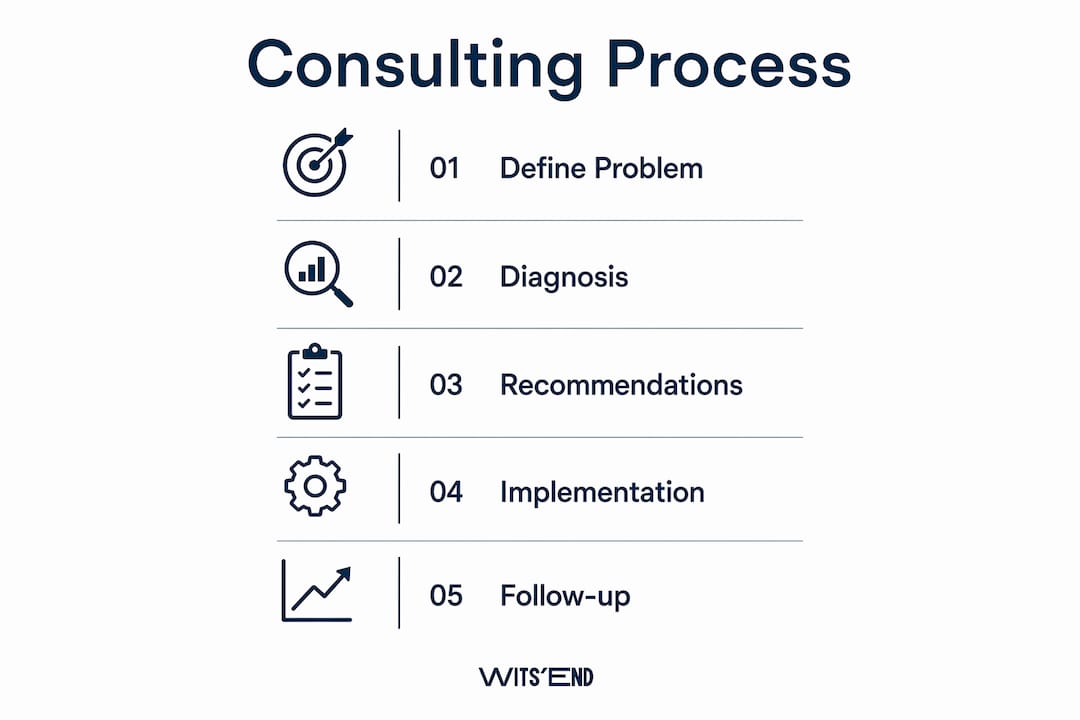
The standard consulting engagement follows four stages, and understanding them helps you set realistic expectations before you sign a contract.
- Diagnosis: The consultant audits your current state. This includes reviewing financials, observing service, interviewing staff, and mapping workflows. The goal is to identify root causes, not surface symptoms.
- Recommendation: The consultant delivers a findings report with prioritized recommendations. This is where you see the gap between where you are and where you need to be.
- Implementation: Changes get executed. This may involve rewriting SOPs, retraining staff, renegotiating supplier contracts, or restructuring the menu. The consulting process is outcome-driven and structured for defined results.
- Measurement: Performance is tracked against baseline metrics. Labor cost percentage, food cost, table turn times, and guest satisfaction scores are common benchmarks.
One distinction that owners often miss is the difference between an advisory consultant and an operator consultant. Advisors recommend strategies while operators also execute implementation. Operators typically deliver results faster but cost more. Neither model is universally better. The right choice depends on your team's capacity to implement change without outside help.
| Engagement type | What you get | Best for |
|---|---|---|
| Advisory only | Diagnosis and recommendations | Owners with strong internal teams |
| Operator model | Diagnosis plus hands-on execution | Understaffed or turnaround situations |
| Retainer model | Ongoing guidance and monitoring | Multi-unit or growth-stage operators |
What are the main types of restaurant consulting?
Restaurant consultancy services are not one-size-fits-all. Different specialties address different problems, and knowing which type you need saves time and money.
- Operations consulting: This is the most common engagement type. The focus is on workflow, staffing models, inventory systems, and service standards. Labor costs represent 25–35% of restaurant revenue, making scheduling and staffing optimization one of the highest-return areas a consultant can address. The role of operations consulting for restaurants is to replace vague management habits with documented, repeatable systems.
- Menu and F&B consulting: Covers recipe development, ingredient sourcing, food cost analysis, and menu pricing. A skilled F&B consultant can often reduce food cost by several percentage points without changing what guests order.
- Marketing and branding consulting: Addresses positioning, digital presence, loyalty programs, and community engagement. This type of consulting matters most during a rebrand, a new opening, or when guest counts are declining without an obvious operational cause.
- Startup and concept consulting: Guides owners through the pre-opening phase, including concept definition, brand development, build-out planning, and pre-launch marketing. A restaurant startup consultant can prevent the most expensive mistakes before the doors ever open.
- Turnkey restaurant consulting: The most comprehensive engagement type. A turnkey consultant manages the full lifecycle from concept through opening, covering design, construction guidance, hiring, training, and systems setup. This model suits owners who are entering the industry for the first time or expanding into a new market.
Quality food service standards are a common thread across all these specialties. Regardless of the consulting type, the end goal is always a guest experience that is consistent and worth repeating.
Why is investing in restaurant consulting worthwhile?
Restaurant margins are thin by any standard. Operational efficiency is critical for survival when margins sit in the low single digits. A consultant who identifies and closes even a small margin leak can pay for the engagement many times over.
Restaurant consultants typically charge between $100 and $500 per hour, $5,000 to $50,000 per project, or monthly retainers from $3,000 to $15,000 depending on scope and expertise. Those numbers sound significant until you compare them to the cost of a poorly designed menu, an overstaffed floor, or a supplier contract that has not been renegotiated in three years.
Most operational profitability problems stem from small, interconnected inefficiencies in labor, prep, purchasing, and service flow. No single issue looks catastrophic on its own. Together, they erode margin every shift. A consultant sees the full picture because they are not managing the lunch rush at the same time.
Pro Tip: Calculate the monthly cost of your biggest known inefficiency before your first consultant meeting. If the number exceeds the consulting fee, the decision is already made.
Consulting engagements deliver the best ROI when owners have specific, measurable problems and the cost of inaction exceeds the consulting fees. Consultants are not a fix for a broken location or a concept with no market fit. They are most effective when the fundamentals are sound and the gaps are operational.
How should you select and work with a restaurant consultant?
Choosing the right consultant is as important as deciding to hire one. A poor fit wastes money and creates friction with your team.
- Match specialization to your problem. An operations expert is not the right hire for a brand identity crisis. Define your problem first, then find the specialist who solves that specific problem.
- Verify real operator experience. Consultants who have run restaurants, managed P&Ls, and hired and fired staff bring a different quality of insight than those who have only advised from the outside. Ask for specifics.
- Set measurable goals before the engagement starts. Agree on the metrics that will define success. Labor cost percentage, food cost, average check, and guest return rate are all trackable. Vague goals produce vague results.
- Get your team on board. Standardized restaurant processes only hold if the people executing them understand why the changes matter. Resistance from managers or kitchen staff can undermine even the best consulting work.
- Plan for life after the engagement. Effective operations consulting replaces vague goals with concrete systems for schedule ownership, prep standards, and performance reviews. The systems need to outlast the consultant's involvement.
Key Takeaways
Restaurant consulting delivers measurable results when owners enter engagements with clear problem definitions, realistic timelines, and the internal commitment to implement what the consultant recommends.
| Point | Details |
|---|---|
| Define the problem first | Consultants perform best when the scope is specific and the target metrics are agreed upon upfront. |
| Match the consultant type to your need | Operations, F&B, marketing, and startup consulting each address different problems. |
| Expect structured stages | Diagnosis, recommendation, implementation, and measurement are the four phases of every effective engagement. |
| Labor is the highest-return target | At 25–35% of revenue, scheduling and staffing optimization typically yields the fastest ROI. |
| Systems must outlast the consultant | Sustainable improvement requires documented SOPs and team buy-in, not just good advice. |
The value of an outside set of eyes
The most common thing I hear from restaurant owners after a consulting engagement is some version of "I knew something was wrong, I just couldn't see it clearly." That is not a failure of intelligence. It is what happens when you are too close to the operation to see it as a system.
What I have found, working across restaurants at different stages and scales, is that the owners who get the most from consulting are not the ones in the most trouble. They are the ones who are honest about what they do not know. The owner who says "our food cost is fine" without being able to show me the weekly variance report is the one who needs help the most and is the least ready to receive it.
The other thing worth saying plainly: consulting is not a one-time fix. The best engagements I have seen build rhythms that the team can sustain independently. A consultant who leaves behind a binder of recommendations and nothing else has not done the job. The measure of a good engagement is whether the operation runs better six months after the consultant is gone.
If you are considering bringing in outside help, the hospitality consulting guide we put together covers the full scope of what to expect from a professional engagement.
— Chris
How Wits' End Solutions supports restaurant owners
Wits' End Solutions works with restaurant owners and food and beverage groups across the United States, from concept development through daily operations. The team covers brand design and development, menu creation, staff training, task force deployment, and deep analytics and advising powered by real operational data. Every member of the Wits' End Solutions team has run the work before recommending it. The model flexes from pure advisory to full operating partner, depending on what your business actually needs. If you are ready to close the gap between where your restaurant is and where it should be, Wits' End Solutions is the place to start.
FAQ
What is restaurant consulting in simple terms?
Restaurant consulting is when an experienced industry professional analyzes your restaurant's operations, finances, and guest experience, then recommends or implements improvements to increase profitability and consistency.
How much does a restaurant consultant cost?
Restaurant consultants typically charge $100–$500 per hour, $5,000–$50,000 per project, or monthly retainers from $3,000–$15,000, depending on the scope and the consultant's level of expertise.
What is the difference between an advisory and an operator consultant?
An advisory consultant delivers recommendations for your team to execute, while an operator consultant also handles implementation directly. Operator consultants tend to produce faster results but carry higher fees.
When should a restaurant owner hire a consultant?
The best time to hire a consultant is when you have a specific, measurable problem and the cost of leaving it unresolved exceeds the consulting fee. Consultants are not effective substitutes for a viable concept or a workable location.
What does restaurant operations consulting focus on?
Restaurant operations consulting focuses on labor scheduling, kitchen workflow, inventory management, and service standards. The goal is to build repeatable systems that maintain consistent quality and control costs across every shift.