
TL;DR:
- Standardizing restaurant processes creates consistent food and service quality across all locations. Implementing verified, digital SOPs improves operational efficiency and accelerates growth, reducing costs and onboarding time. Regular audits prevent process drift and ensure standards stay current as menus and staff change.
Standardizing restaurant processes means creating uniform procedures and systems that produce consistent food quality, service, and operational results at every location, every shift. This is the foundation of what the industry calls standard operating procedures, or SOPs. Operators who treat SOPs as living, enforced systems rather than binders on a shelf see measurable gains: lower operating expenses, tighter food cost control, faster staff onboarding, and a guest experience that holds up whether it is a Tuesday lunch or a Saturday dinner rush. Tools like Toast POS and digital checklist platforms make those standards verifiable, not just aspirational.
Why standardize restaurant processes in the first place?
Process standardization is the single most reliable path to predictable profitability in a restaurant. Without it, every location and every manager effectively runs a different business under the same name. The financial case is direct: standardized chains achieve 18–30% lower operating expenses and improve EBITDA margins by 200–500 basis points compared to non-standardized peers. That gap compounds fast across multiple units.

The staffing case is equally strong. Early staff turnover is most often linked to new employees feeling unsupported and unclear on expectations. Documented SOPs give new hires a defined path from day one, which reduces that early exit rate significantly. Standardized chains can also cut new hire training time by up to 60%, which directly reduces labor cost during the onboarding window.
Guest experience consistency is the third driver. A customer who visits your concept twice and gets two different experiences will not come back for a third. Uniform recipes, service scripts, and table turn procedures remove that variability. The result is repeat business, which is far cheaper to generate than new customer acquisition.
Pro Tip: Aim for roughly 80% standardization across your processes and leave 20% for local flexibility. Over-standardization risks stifling the small adaptations that make a location feel relevant to its neighborhood.
Which processes should you standardize first?
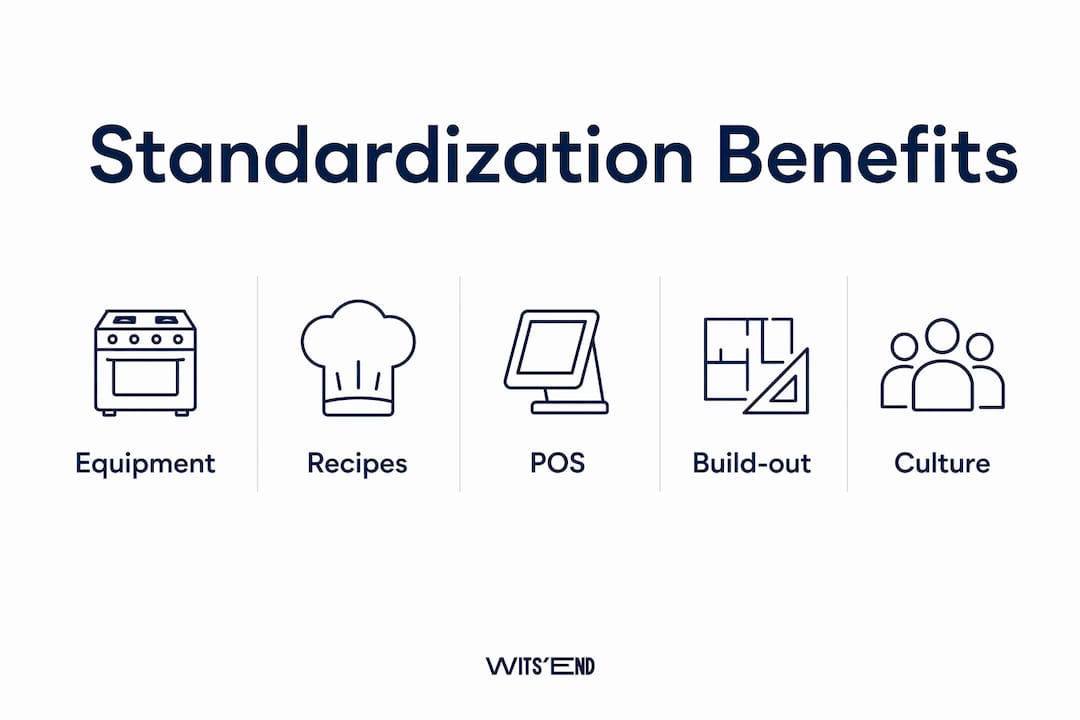
Seven categories deliver the highest return when standardized: equipment, vendors, service contracts, recipes and SOPs, your POS and tech stack, build-out specifications, and company culture. Each one compounds the others.
Equipment
Uniform kitchen equipment across locations reduces onboarding time by up to 50% because staff already know how to operate every piece of equipment when they transfer or join a new unit. Equipment standardization also delivers 5–12% savings in capital expenditure and 15–30% savings in maintenance and service contracts. Centralized spare parts inventory becomes possible, which cuts repair downtime.
Recipes and SOPs
Recipes and service SOPs are the core of what your brand delivers. A written, verified SOP for every dish, every opening procedure, and every guest interaction removes the guesswork from execution. Standards kept only in managers' heads lead directly to inconsistency and operational drift. The SOP has to live in a system that staff can access and that managers can verify.
POS and technology stack
A unified POS system like Toast or Restaurant365 across all locations gives you real-time visibility into sales, voids, labor, and food cost. Standardized POS platforms enable variance tracking across units, so you can catch a food cost spike at one location before it becomes a P&L problem. Fragmented tech stacks make that kind of oversight nearly impossible.
Build-out and culture
Standardized build-out specs reduce the cost and timeline of new openings by eliminating custom design decisions at every site. Culture standardization is less tangible but equally important. When your hiring criteria, training language, and management expectations are uniform, employee behavior aligns across locations without constant supervision.
| Category | Primary benefit |
|---|---|
| Equipment | 50% faster onboarding, 15–30% lower maintenance costs |
| Recipes and SOPs | Consistent food quality and service across all shifts |
| POS and tech stack | Real-time variance tracking and centralized data |
| Build-out specs | Faster, lower-cost new unit openings |
| Culture and training | Aligned behavior without constant direct oversight |
What are the common challenges in standardizing restaurant operations?
The most common mistake operators make is treating standardization as a one-time project. Standard drift sets in within 3–6 months when SOPs are not continuously audited, updated, and retrained. A standard that was accurate at launch becomes outdated as menus change, equipment gets replaced, and staff turns over. The SOP is only as good as its last review date.
Paper checklists create a false sense of control. A manager can sign off on a paper opening checklist without a single item being verified. Digital photo-verified checklists provide real accountability because they require proof of completion, not just a signature. Platforms built for restaurant operations make this verification automatic and auditable.
Role ambiguity is the other major failure point. When a task is "everyone's responsibility," it becomes no one's responsibility.
- Assign every SOP task to a specific role, not a person by name.
- Role-based task ownership increases procedure compliance during unsupervised shifts.
- Review ownership assignments whenever a role changes or a new position is added.
- Audit compliance data monthly, not just during inspections.
Pro Tip: Use photo-verified digital checklists for your highest-risk procedures, such as food safety checks and opening and closing tasks. The photo requirement alone changes staff behavior because accountability becomes visible.
How does standardization accelerate restaurant growth?
Standardization is the mechanism that makes scaling possible without proportional increases in management overhead. The numbers make this clear: standardized operators open new units in as little as 18 weeks, compared to 8–14 months for non-standardized operators. That difference comes directly from having uniform equipment specs, pre-negotiated vendor agreements, and a training program that works the same way every time.
Staff mobility across locations becomes practical when every unit runs the same equipment and the same procedures. A strong line cook from your first location can transfer to your third and be productive on day one. That kind of internal mobility reduces recruiting costs and builds loyalty. You can read more about building that foundation in this guide to restaurant staff onboarding.
Centralized vendor and service contracts also scale better than location-by-location negotiations. As you add units, your purchasing volume grows and your contract terms improve, but only if you are buying the same things across locations.
| Metric | Non-standardized operator | Standardized operator |
|---|---|---|
| New unit opening timeline | 8–14 months | As little as 18 weeks |
| Food cost variance | ±4 points | ±1 point |
| New hire training time reduction | Baseline | Up to 60% faster |
| Maintenance and service contract savings | Baseline | 15–30% lower |
Data-driven variance tracking becomes a real management tool once your tech stack is unified. You can compare food cost, labor cost, and guest satisfaction scores across every unit on the same dashboard. That visibility is what separates reactive management from proactive operations. For operators building toward a multi-unit model, this guide on restaurant shared services covers how centralized functions support that growth.
What practical steps can restaurant owners take to standardize operations?
Start with documentation. Every critical procedure needs a written SOP before you can train, verify, or improve it. Prioritize the processes with the highest impact on food cost, labor cost, and guest experience first.
- Document all critical SOPs in a single, accessible system. Include photos or short videos for complex tasks. Avoid PDFs that no one updates.
- Implement digital task management for daily checklists. Require photo verification for high-risk tasks. This creates an audit trail and removes ambiguity.
- Standardize your equipment and POS system before opening a second location. Retrofitting is far more expensive than building right the first time.
- Train multi-unit managers to track variances across locations, not just manage individual units. Variance data is your early warning system.
- Audit and update SOPs every 3–6 months. Assign a specific manager as the owner of each SOP category so updates actually happen.
Pro Tip: Involve frontline staff in SOP refinement. The line cook who runs the station every day knows where the procedure breaks down. Their input improves accuracy and increases buy-in, which means better compliance without extra enforcement.
Consistent service standards are the output of all of this work. If you want to understand how documented procedures translate into guest-facing results, this piece on consistent service standards is worth reading alongside your SOP build-out.
Key takeaways
Standardizing restaurant processes is the most direct path to lower costs, faster growth, and consistent guest experiences across every location and shift.
| Point | Details |
|---|---|
| Financial impact is measurable | Standardized chains achieve 18–30% lower operating expenses and 200–500 basis point EBITDA improvements. |
| Equipment standardization pays fast | Uniform equipment cuts onboarding time by up to 50% and reduces maintenance costs by 15–30%. |
| SOPs must be digital and verified | Paper checklists do not create accountability. Photo-verified digital systems do. |
| Standard drift is a real risk | Audit and retrain on SOPs every 3–6 months or gains erode within the same quarter. |
| Scalability depends on uniformity | Standardized operators open new units in as little as 18 weeks versus 8–14 months for non-standardized peers. |
The part most operators underestimate
I have worked with single-unit operators who run tight, excellent restaurants. When they open a second location, many of them assume the first one will just teach the second. It does not work that way. What made the first location good was the owner's presence, judgment, and daily corrections. None of that transfers automatically.
The operators who scale well are the ones who figured out, usually the hard way, that their standards need to exist outside their own heads before they can be replicated. That means writing them down, putting them in a system, assigning ownership, and checking the data. The technology exists to make this manageable. Toast, Restaurant365, and purpose-built checklist platforms handle the verification work that used to require a manager standing over someone's shoulder.
The other thing I see underestimated is the maintenance requirement. Operators invest real effort in building out their SOPs, then treat them as finished. Six months later, the menu has changed, two managers have turned over, and the SOPs describe a restaurant that no longer exists. The standard is only as good as the last time someone reviewed it. Build the review cycle into your calendar before you need it, not after you notice the drift.
— Chris
How Wits' End Solutions supports restaurant standardization
Wits' End Solutions works with restaurant owners and operators across the United States to build and enforce the systems that make consistent operations possible. Our work covers SOP development, staff training programs, task force deployments for locations that need hands-on correction, and deep analytics that surface variance across your units before it becomes a P&L problem. We have built these systems ourselves in operating environments, which means our recommendations are grounded in what actually works on a busy service floor. If you are building toward a multi-unit model or trying to get your current locations running to the same standard, Wits' End Solutions is the right partner to have in your corner.
FAQ
What does it mean to standardize restaurant processes?
Standardizing restaurant processes means creating written, verified procedures for every critical operation, from food preparation to opening and closing tasks, so results are consistent regardless of who is working.
How much does standardization reduce restaurant operating costs?
Standardized chains achieve 18–30% lower operating expenses compared to non-standardized peers, with EBITDA margins improving by 200–500 basis points.
What are standard operating procedures in restaurants?
SOPs are written, step-by-step instructions for recurring tasks. They cover everything from recipe execution and food safety checks to service scripts and equipment maintenance.
How often should restaurant SOPs be updated?
SOPs should be audited and updated every 3–6 months. Operators who skip this cycle experience standard drift, losing the consistency gains within the same period.
Does standardization work for single-location restaurants?
Yes. Single-location operators benefit from reduced training time, lower food cost variance, and a stronger foundation if they ever expand to a second unit.