

Walk into a restaurant or hotel twice, receive two completely different levels of service, and the math becomes simple: 73% of customers switch after multiple poor service experiences. That one number explains why consistent service standards are not a management nicety. They are the foundation on which guest loyalty, team performance, and profitable operations are built. For hospitality managers and owners, the gap between knowing standards matter and actually maintaining them across shifts, locations, and seasons is where businesses either grow or stagnate. This guide gives you the specific strategies to close that gap.
Table of Contents
- Key Takeaways
- Why consistent service standards matter in hospitality
- Common barriers to maintaining consistent standards
- Strategies for establishing and maintaining standards
- How consistency shapes guest experience and business performance
- Tools that support consistent service delivery
- My take on why most standards programs fail
- How Witsendsolutions can help you build and hold your standard
- FAQ
Key Takeaways
| Point | Details |
|---|---|
| Consistency drives loyalty | Customers return when they know what to expect; variability erodes trust faster than any single bad experience. |
| Documentation is non-negotiable | Written service standards give your team a shared reference point that survives turnover and shift changes. |
| Training must be continuous | One-time onboarding is not enough; regular coaching sessions reinforce standards until they become habit. |
| Leadership shapes culture | When managers model the standard in every interaction, the team follows without being told repeatedly. |
| Measurement closes the loop | Tracking KPIs and guest feedback turns service standards from aspiration into measurable operational discipline. |
Why consistent service standards matter in hospitality
Service standards are the defined behaviors, responses, and outcomes your team commits to delivering every time a guest interacts with your business. They cover everything from how a host greets a party at the door to how a front desk agent handles a billing dispute at checkout. In hospitality specifically, these standards carry more weight than in almost any other industry because guests are not just buying a product. They are buying an experience, and that experience is only as good as its least consistent moment.
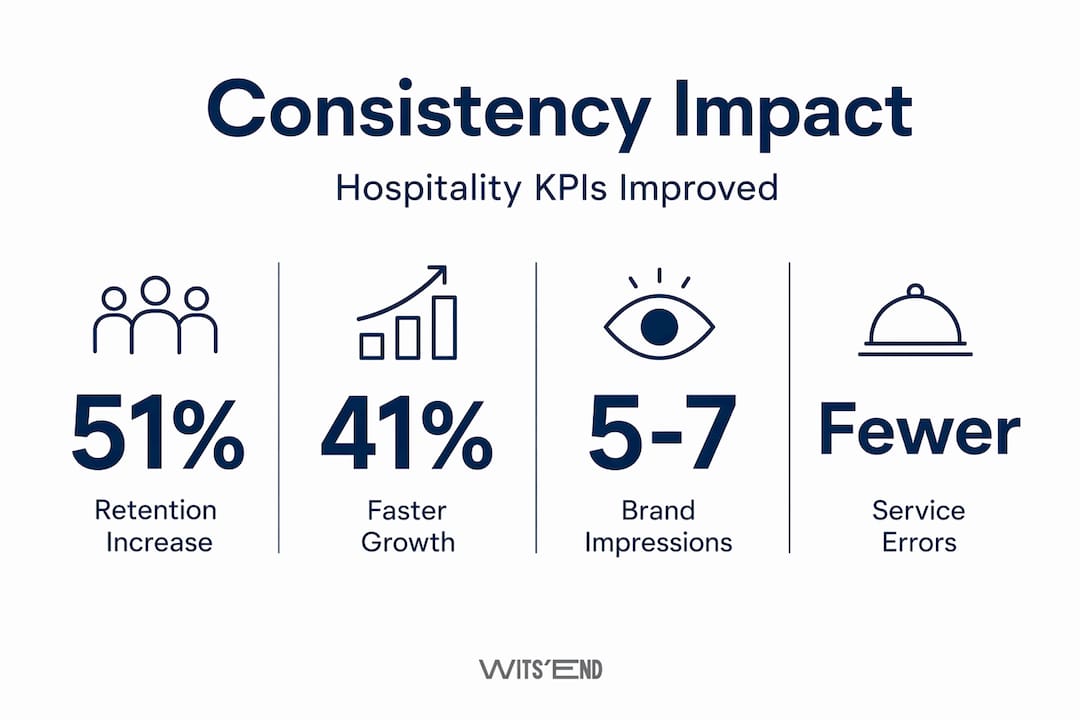
The business case is clear. Customer-obsessed companies report 51% better retention and 41% faster revenue growth. Those numbers do not happen by accident. They happen because consistent standards create predictability, and predictability creates trust. When a guest trusts your property or your restaurant, they come back, they recommend you, and they forgive the occasional slip because the baseline has been set high enough to warrant it.
Consistency also does significant work on the operational side. When your team knows exactly what is expected, less time is spent second-guessing, improvising, or correcting mistakes. Standardized service processes reduce rework, reduce costs tied to guest dissatisfaction, and create a floor beneath which service quality rarely falls. That operational efficiency compounds quickly across a busy hotel or a multi-unit restaurant group.
Finally, consider brand reputation. Guests form impressions across multiple touchpoints, and customers need 5 to 7 brand impressions before recognition and trust solidify. Every one of those impressions needs to tell the same story. Inconsistency does not just frustrate guests. It confuses them about who you are, which makes differentiation in a competitive market nearly impossible.
Common barriers to maintaining consistent standards
Most hospitality managers understand the importance of service consistency in theory. The harder part is diagnosing why it breaks down in practice. The most common culprits fall into a few categories.
Shift and staff variability tops the list. A Friday dinner service run by your most experienced team may feel like a completely different restaurant than a Tuesday lunch covered by newer hires. Without documented standards that every team member has internalized, service quality becomes personality-dependent rather than system-dependent.
The absence of clear, written documentation compounds this. When standards exist only in the mind of a manager or a founding chef, they do not survive turnover. Every hire becomes a fresh interpretation of what "good service" means, and that interpretation drifts further from the original with each new wave of staff.
Communication silos create another layer of inconsistency. Siloed customer interaction channels fragment the guest experience and reduce service quality because your team cannot see the full picture of a guest's history with your property. A guest who complained about a room temperature issue last visit should never have to repeat that story on the next visit.
Resistance to change also appears frequently, particularly in properties where long-tenured staff have developed their own service habits. Without clear leadership commitment, standards feel optional rather than foundational.
Pro Tip: Before launching any new standards initiative, audit where your current service breaks down most often. Guest feedback, comment cards, and your own shift observations will show you the patterns. Address those specific gaps in your standards documentation first, and you will see faster adoption from your team.
Strategies for establishing and maintaining standards
Building a system that holds across shifts, seasons, and staff changes requires more than good intentions. Here is a structured approach that works in real hospitality operations.
1. Document everything, specifically. Vague standards produce vague results. "Be friendly" is not a standard. "Greet every guest by name upon second visit" is. Write your standards in behavioral terms so any team member can read them, understand them, and execute them without interpretation.
2. Align standards to your brand values. Your standards should reflect who you are as a property or concept. A boutique hotel built around local culture has different service standards than a business-class hotel serving road warriors. Connecting standards to brand identity gives your team context for why the behavior matters, not just what the behavior is. Exploring how to build your brand identity first makes this alignment much more natural.
3. Build training that reinforces, not just introduces. One-time onboarding plants a seed. Consistent reinforcement makes it grow. Regular role-play sessions, shift briefings that reference standards by name, and coaching conversations that tie observed behavior to documented expectations are how standards become habits.
4. Use quality assurance audits as learning tools. Quality assurance audits must be tied to specific standards and used as continuous improvement tools rather than administrative checkboxes. When an audit reveals a gap in how reservations are confirmed or how complaints are escalated, that finding becomes the curriculum for the next team meeting.
5. Centralize your communication and guest data. A unified CRM that stores guest preferences, past complaints, and stay history means any team member can pick up a conversation where another left off. Centralizing communication history in one platform avoids the experience-breaking moment of asking a returning guest for information you should already have.
6. Measure what you manage. Defined service levels help staff prioritize and deliver outcomes aligned with guest expectations. Track response times, complaint resolution rates, Net Promoter Scores, and online review sentiment on a regular cadence. When the data shows a dip, you have the information needed to act before it becomes a pattern.
Pro Tip: Set a monthly 30-minute standards review with your department heads. Use it to surface one area where execution slipped and one area where the team excelled. This keeps standards alive in conversation, not just on paper.
| Approach | One-time onboarding | Ongoing standards program |
|---|---|---|
| Staff retention of expectations | Low after 60 days | High with regular reinforcement |
| Consistency across shifts | Variable | Measurable and manageable |
| Guest satisfaction trajectory | Flat or declining | Upward with course corrections |
| Manager time spent firefighting | High | Significantly reduced |
How consistency shapes guest experience and business performance
The relationship between service consistency and guest loyalty is direct. When guests know what to expect, they stop evaluating you with every visit and start enjoying the experience instead. That psychological shift from evaluation to enjoyment is where repeat business and genuine advocacy are born.
"Consistency is not the enemy of creativity in hospitality. It is the container that makes creativity possible. When your team knows the standard, they have the confidence to go above it."
The operational payoff is equally real. Fewer service errors mean fewer comps, fewer apology calls, and less management time spent on recovery. Organizations with consistent standards achieve 41% faster revenue growth, and a significant portion of that advantage comes from not losing money on preventable failures.
Brand differentiation is the third lever. In a market where a traveler has dozens of hotel options and a diner has hundreds of restaurant choices, the consistent customer experience becomes your competitive moat. It is harder to copy than a menu or a room design. It lives in the culture of your team.
| Business metric | Impact of inconsistent service | Impact of consistent standards |
|---|---|---|
| Guest return rate | Declining with each poor experience | Strong and predictable |
| Online review scores | Volatile and unpredictable | Stable with upward trend |
| Staff confidence and morale | Low due to unclear expectations | High with clear direction |
| Cost of service recovery | High and recurring | Minimal with proactive standards |
Understanding restaurant customer experience at a deeper level makes it much easier to see where your current standards are leaving loyalty on the table.
Tools that support consistent service delivery
Maintaining consistent service standards across a team requires the right infrastructure. These are the categories of tools that make the biggest difference in practice.
A quality CRM platform sits at the center of any serious standards program. It stores guest preferences, documents past interactions, and gives your entire team the context they need to deliver personalized, consistent service without starting from scratch each time. The alternative, fragmented notes across email threads and spreadsheets, degrades service quality and frustrates both guests and staff.
Training management systems give you a structured way to onboard new hires against your documented standards and run refresher programs for your existing team. Rather than relying on a manager's availability or memory, these platforms deliver consistent content and track completion so you know every team member has received the same foundation. Detailed guidance on staff training best practices shows how this works across different hospitality contexts.
Quality assurance and guest feedback tools complete the loop. When you can track guest sentiment in real time and tie it directly to specific service standards, you stop guessing about where breakdowns occur. Quality assurance audits that measure empathy, accuracy, and responsiveness with immediate feedback loops give managers the data needed to coach with precision rather than generality.
Finally, reporting and analytics platforms convert all of this data into patterns you can act on. Weekly performance dashboards, review aggregators, and labor-to-satisfaction correlation reports tell you whether your standards are producing the outcomes your guests and your P&L actually need.
My take on why most standards programs fail
I have worked inside enough hotels and restaurants to see the same pattern repeat. A manager invests serious energy in writing up service standards, runs a training session, and then checks the box. Six months later, the standards document lives in a binder on the office shelf and service is back to running on individual instinct.
The failure is almost never about the standards themselves. It is about the assumption that documentation alone creates culture. Leadership commitment integrated into daily activities is what drives sustainable improvement, not the act of writing things down.
What I have seen work: when a general manager or owner references the service standards by name during pre-shift, when a floor manager gives specific, standards-referenced feedback in the moment rather than a vague "good job," and when the whole team sees that the people setting the standard also live by it. That behavioral consistency at the leadership level is what turns quality standards from compliance into genuine operational discipline.
My honest advice: treat your standards program as a living document. Review it quarterly. Update it when your concept evolves. And never let the standards conversation happen only once.
— Chris
How Witsendsolutions can help you build and hold your standard
If you recognize your operation in the challenges above, you are not alone, and you do not have to figure it out from scratch. Witsendsolutions works directly with hotel and restaurant owners to build the systems, training, and leadership frameworks that make consistent service quality stick across your team.
Our hospitality training programs are built around your specific standards, your brand voice, and your service context. Not generic modules, but training that your team actually retains and applies during service. For situations that need faster intervention or senior-level operational support on property, our task force services put experienced hospitality operators alongside your leadership team to embed standards at every level of the operation. Reach out to start the conversation about what your operation actually needs.
FAQ
What are consistent service standards in hospitality?
Consistent service standards are documented, specific behaviors and outcomes that every team member delivers in every guest interaction. They create a predictable guest experience that builds trust and loyalty over time.
Why do service standards break down across shifts?
Standards break down when they exist only in informal understanding rather than written documentation and regular reinforcement. Without structured training and leadership modeling, execution becomes personality-dependent and varies by shift.
How do you measure service standard consistency?
Track guest satisfaction scores, online review sentiment, complaint resolution rates, and return visit frequency on a regular cadence. Quality assurance audits tied to specific standards give you the most precise view of where gaps exist.
How long does it take to establish consistent service standards?
Initial documentation and training can be completed in weeks, but genuine cultural embedding typically takes three to six months of consistent reinforcement, coaching, and leadership modeling before the standards become habitual across the whole team.
What is the business impact of inconsistent service in hotels and restaurants?
Inconsistent service directly reduces guest retention, increases recovery costs from complaints and comps, and weakens your brand reputation online. Companies that maintain high service consistency report significantly higher retention and faster revenue growth than those that do not.