

Most operators assume pre-opening support means posting jobs, signing vendor contracts, and showing up with a key on launch day. It means far more than that. What is pre-opening support, really? It's the full system of coordinated planning, staffing, training, operations setup, and milestone management that runs from the moment you commit to a concept until the moment your first guest walks through the door. Get it right, and your team performs with confidence from day one. Miss the framework, and you spend your first six months fixing problems that should never have existed.
Table of Contents
- Key takeaways
- What pre-opening support actually covers
- Staffing timelines and induction readiness
- Operational readiness: SOPs, technology, and mock services
- Phased pre-opening timeline and milestones
- Financial discipline and leadership during pre-opening
- My take on what actually makes pre-openings succeed
- How Wits' End supports your pre-opening launch
- FAQ
Key takeaways
| Point | Details |
|---|---|
| Pre-opening is a full system | It covers hiring, training, SOPs, vendor coordination, and technology setup, not just staffing. |
| Induction timing is a gated milestone | Staff must arrive in phases with structured induction days before any guest service begins. |
| SOPs need timed checkpoints | Vague guidelines create operational inconsistencies; SOPs tied to mock services catch problems early. |
| A phased timeline drives accountability | Breaking the 6 to 12 month window into phases with deliverables keeps every department on track. |
| Leadership sets the culture early | Managers who engage fully during pre-opening shape team behavior for the first six months of service. |
What pre-opening support actually covers
The hospitality industry uses "pre-opening support" loosely, and that vagueness costs operators real money. At its core, pre-opening support is the 6 to 12 month period covering hiring, training, technology rollout, and operational setup that shapes the guest experience before a single reservation is honored. For a restaurant, that means translating your concept into a functioning operation. For hotel F&B, it means aligning your outlets with the broader property experience while managing their own distinct moving parts.
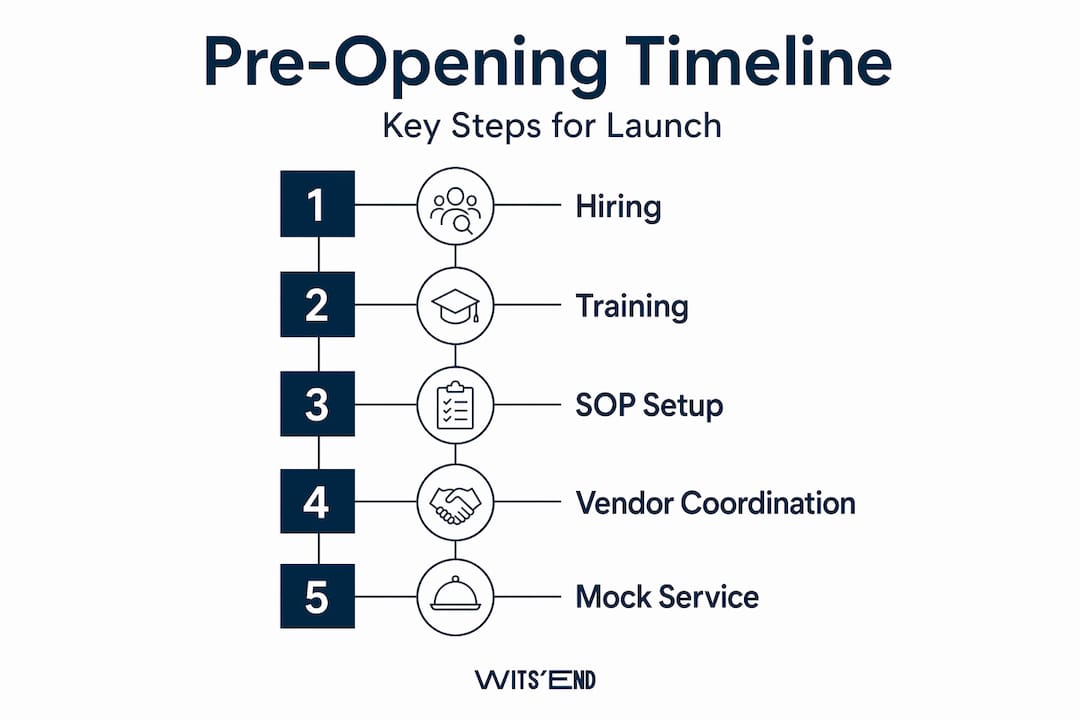
The core components of pre-opening support include:
- Staffing plans and phased recruitment tied to department-specific timelines
- Training programs covering service standards, menu fluency, and systems operation
- SOP development and distribution so every team member knows exactly what right looks like
- Vendor coordination including delivery schedules, setup dates, and quality inspections
- Technology implementation covering PMS, POS, reservations, and inventory systems
- Mock service rehearsals to stress-test operations before opening day
What separates strong pre-opening support from a loose launch plan is specificity. Each component needs an owner, a deadline, and a measurable outcome. Without those three things, tasks slip, teams arrive unprepared, and you open with reactive energy instead of confident execution.
Pro Tip: Treat every component of pre-opening support as its own mini-project with a named lead and a completion date. Ambiguous ownership is where most pre-opening timelines fall apart.
The distinction between hotel and restaurant pre-opening is worth noting. Hotel F&B managers face an added layer of complexity because their outlets must be ready when the property opens, regardless of where the broader hotel construction or setup stands. Restaurant operators have more control over their own timeline but often underestimate how long the hiring, training, and SOP cycles actually take. Both share the same truth: pre-opening lays the foundation for online reviews, staff stability, and long-term business health.
Staffing timelines and induction readiness
Hiring enough people is not the same as having a ready team. This distinction is where a surprising number of pre-openings go wrong. Induction timing errors are a root cause of early operational failures, not insufficient headcount. You can have a full roster and still open in chaos if your team hasn't had structured time to learn the property, practice procedures, and align with department leads.
The industry standard is a phased arrival model. Here's how a well-structured sequence typically runs:
- Department heads arrive 8 to 12 weeks before opening. They finalize SOPs, receive their teams' training materials, and establish the standards they will hold their staff to.
- Support leaders and trainers arrive 4 to 6 weeks out. They prepare training stations, conduct systems walkthroughs, and support department heads in building the schedule.
- Demand letters go out 6 weeks before the staff-ready date. These letters coordinate the phased staff arrivals with housekeeping teams typically arriving before F&B teams, based on property readiness.
- Line staff arrive 3 to 4 weeks before opening. They complete a structured induction lasting 3 to 5 days before moving into departmental training.
- Staff-ready milestone is confirmed when all department heads sign off that their teams can execute service to standard.
The "staff-ready" concept is one of the most underused tools in pre-opening planning. It's a gated milestone, not a loose goal. It means your team has completed induction, passed a systems check, and participated in at least one mock service. Calling your team "ready" before those boxes are checked is one of the most expensive assumptions you can make.
Pro Tip: Issue formal demand letters with specific arrival dates by department, not a general "report by" date. Staggered arrivals prevent overcrowding during induction and give each department focused time with leadership before the next group arrives.
For pre-shift preparation to function well during those first weeks of service, the groundwork must be laid during pre-opening. Teams that haven't been properly inducted struggle with even basic shift readiness, regardless of how talented individual staff members are.
Operational readiness: SOPs, technology, and mock services
Operational readiness is where pre-opening support transitions from planning into practice. The difference between a smooth launch and a shaky one often comes down to how well your systems, procedures, and vendor relationships were tested before opening day.

SOPs are only as useful as the specificity behind them. Non-timed and vaguely defined SOPs weaken operational readiness. A standard that says "greet guests warmly" is not an SOP. A standard that defines the greeting script, timing, table-check cadence, and escalation path when a problem arises is. Tying each SOP to a mock service date forces your team to test procedures under simulated pressure before real guests experience them.
Here's a comparison of what operational readiness looks like with and without structured pre-opening support:
| Area | Without structured support | With structured pre-opening support |
|---|---|---|
| SOPs | Generic, untested guidelines | Timed, practiced, and signed off by department heads |
| Technology | Staff learn systems on the job | Full POS and PMS training completed before mock service |
| Vendors | Last-minute deliveries and setup | Confirmed schedules with lead times built in |
| Mock service | Skipped or informal | Structured rehearsal with real-time issue tracking |
| Opening day | Reactive, high error rate | Confident execution, faster problem resolution |
Technology implementation deserves its own attention. POS systems, reservation platforms, and inventory tools all require staff familiarity before service begins. A server who is also trying to learn the ticket system during a real guest interaction will not deliver a good experience. Schedule technology training sessions with your actual systems in place, not simulations, at least two weeks before your first mock service.
Mock services function as your pre-opening dress rehearsal. Run them with your actual team, your actual menu, and your actual setup. Track every issue in real time, assign a fix, and retest before the next mock run.
Phased pre-opening timeline and milestones
The 6 to 12 month pre-opening window sounds like plenty of time. It rarely feels that way once you're inside it. The solution is a phased framework that breaks the timeline into defined periods, each with non-negotiable deliverables. A multi-phased timeline framework aligns activities across departments and keeps the launch on track.
A practical breakdown looks like this:
- 90 to 120 days out. Finalize concept, menu, and brand standards. Complete vendor agreements, staffing plans, and technology selection. Begin recruiting department heads.
- 60 to 90 days out. Start department head onboarding. Finalize SOP drafts. Confirm delivery schedules and begin equipment installation.
- 30 to 60 days out. Begin line staff recruitment. Complete technology installation and testing. Begin training program delivery with department heads.
- 7 to 30 days out. Full team arrives and completes induction. Run first and second mock services. Track issues and complete corrective actions. Confirm inventory and conduct opening stock counts.
- Opening week. Daily problem tracking and real-time labor adjustments. Opening week sets habits that shape the first six months of operations.
Using a shared project tracking tool, whether a spreadsheet or a purpose-built platform, keeps every department accountable. Each milestone should have a named owner and a completion date visible to the full leadership team. Accountability without visibility is just hope.
For hotel F&B specifically, your timeline must align with the broader hotel pre-opening checklist while remaining independent enough to manage your own department's readiness. Don't assume the property's schedule is your schedule. Build yours separately, then align the two.
Financial discipline and leadership during pre-opening
Pre-opening is expensive before it generates any revenue, which makes financial discipline non-negotiable. Extra labor and emergency purchases during pre-opening can quickly erode your early financial performance. Common financial risks include:
- Over-hiring staff too early before the property is ready for training
- Placing inventory orders without firm opening date confirmation, leading to spoilage
- Under-budgeting for training hours, which leads to compressed and ineffective induction
- Failing to track P&L against a pre-opening budget, making it impossible to course-correct
Build a dedicated pre-opening budget that accounts for training labor, vendor setup fees, mock service food costs, and technology implementation. Review it weekly. Surprises at this stage are usually the result of not looking at the numbers closely enough.
Leadership engagement during pre-opening shapes more than operations. Opening managers who understand their standards and take ownership of team culture create teams that perform under pressure. Managers who show up in reactive mode create teams that wait to be told what to do. The culture you set during pre-opening is the culture your guests experience on night one.
Pro Tip: Schedule a daily leadership huddle throughout the final four weeks of pre-opening. Short, focused, and consistent. It builds the communication habit your team will rely on once service is live.
My take on what actually makes pre-openings succeed
I've seen pre-openings with perfect decor, fully printed menus, and a team that genuinely had no idea what they were doing when doors opened. The failure wasn't a hiring problem. It was an induction problem. The team existed on paper weeks before opening but had never been put through a structured sequence that built their confidence, tested their knowledge, and let leadership catch gaps before guests did.
What I've found is that the operators who run the smoothest launches treat pre-opening as an operational system, not a promotional countdown. They don't announce their opening date until the staffing and training milestones are confirmed. They run mock services with the same intensity they expect on opening night. They build real-time issue logs and fix things immediately, not after they accumulate.
Early leadership involvement is the single biggest differentiator I've observed. When senior team members are present, hands-on, and communicating standards clearly during the final four weeks, line staff absorb that confidence. When leaders are distracted or absent, teams fill the vacuum with guesswork. The habits formed during pre-opening, for better or worse, tend to stick. Fixing a culture problem that started on opening day is far harder than building the right culture from the first induction session.
My honest advice: don't let the excitement of opening day become your team's only motivation. Give them the preparation that makes confidence on opening day feel earned.
— Chris
How Wits' End supports your pre-opening launch
Getting pre-opening right takes more than a checklist. It takes people who have run the process themselves and can anticipate where things will slip before they do.
Witsendsolutions works with new restaurant operators and hotel F&B teams across the United States, providing hands-on support through every phase of the pre-opening process. From staff training programs that prepare your team for real service, to task force deployment that puts experienced operators on the ground when you need them most, the work is done alongside your team, not handed off as a report. Whether you need full pre-opening management or targeted support in staffing, SOP development, or operations setup, Witsendsolutions has the experience to help you open with confidence and stay strong through those critical first months of service.
FAQ
What is pre-opening support in hospitality?
Pre-opening support is the coordinated set of activities covering staffing, training, SOP development, vendor coordination, and systems setup completed during the 6 to 12 months before a restaurant or hotel opens to guests.
How long does pre-opening support take?
The pre-opening window typically runs 6 to 12 months depending on the size and complexity of the property, with key milestones at 90, 60, 30, and 7 days before opening.
Why is induction timing important in pre-opening?
Induction timing errors are a leading cause of early operational failures. Staff must arrive in phases and complete structured induction before service begins, not on the same day guests arrive.
What are mock services and why do they matter?
Mock services are full rehearsals of your operation run with your actual team, menu, and setup. They allow you to identify and fix procedure gaps before real guests experience them.
What is the biggest financial risk during pre-opening?
The most common financial risk is unplanned labor and emergency purchasing caused by poor timeline planning. A dedicated pre-opening budget reviewed weekly helps prevent cost overruns before the property generates any revenue.