

Team training in hospitality is a direct driver of guest satisfaction, employee retention, and revenue performance. Known formally as competency-based workforce development, it covers everything from soft-skill fluency and service standards to leadership readiness and operational execution. Hospitality managers who ask why invest in team training hospitality are really asking a sharper question: what does it cost not to? The answer, backed by 2026 research from MDPI, JLL, and Accor, is measurable and significant. This article breaks down the returns, the frameworks, the failure points, and the practical strategies your operation can act on now.
What measurable benefits does team training deliver in hospitality?
Team training produces quantifiable outcomes across guest satisfaction, staff retention, and operational efficiency. These are not soft benefits. They show up in your P&L, your review scores, and your labor cost ratios.
Turnover is the clearest financial signal. High staff churn above 66% over 12 months correlates with an 11.15% revenue decline, while locations with lower churn achieved close to 30% revenue growth. That gap is not explained by location or brand alone. It reflects whether your team is developed and retained or constantly replaced at cost.
On the ROI side, well-designed training programs return between 25% and 300% when measured against concrete KPIs like guest satisfaction scores and weekly sales per employee. That range is wide because program quality varies, but even the lower end justifies the investment. The key is measuring against real business metrics, not just completion rates.
Guest satisfaction improvements are also trackable. Properties that invest in consistent service standards see higher review scores and repeat visit rates. Training that builds genuine service fluency, not just procedural compliance, turns a single shift into a repeatable guest experience.

Pro Tip: Track training impact through three metrics at minimum: guest satisfaction scores, 90-day new hire retention, and upsell revenue per server or front desk agent. These three together give you a clear picture of whether your training is working.
The operational benefits extend to upselling confidence, faster service recovery, and reduced manager intervention during peak periods. When your team knows what to do and why, service runs more smoothly and your labor cost per cover or per occupied room improves.
What core competencies should hospitality training focus on?
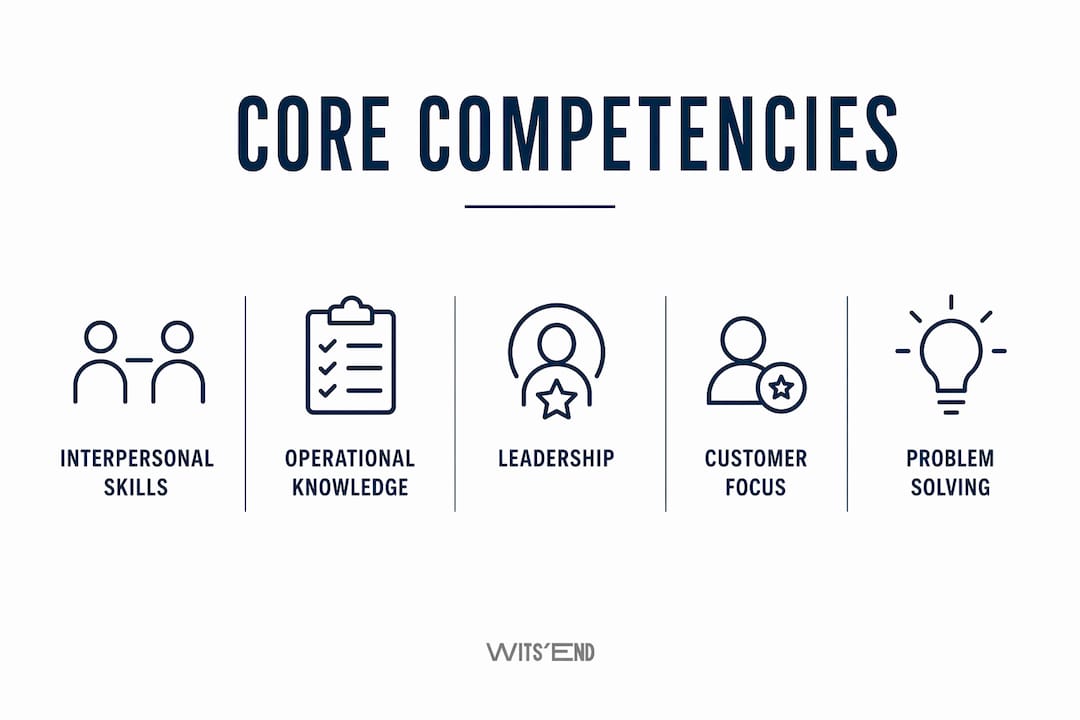
A 2026 Delphi study published by MDPI identified 43 competencies in hospitality management, with interpersonal skills and leadership dimensions ranked as the most critical for training investment. This is the competency matrix your training program should be built around, not a generic onboarding checklist.
The study also found that soft-skill readiness gaps persist across hospitality teams even when managers acknowledge their importance. Communication readiness scored a mean of 3.85 out of 5 in surveyed employees. That gap between awareness and actual preparedness is exactly where structured training creates value.
The table below maps the four core competency dimensions to their primary training focus and the business outcome each one drives.
| Competency dimension | Training focus | Business outcome |
|---|---|---|
| Interpersonal skills | Active listening, guest recovery, empathy | Higher guest satisfaction scores |
| Leadership readiness | Decision-making, team coaching, accountability | Reduced manager dependency during service |
| Operational execution | SOPs, speed, product knowledge | Lower labor cost per transaction |
| Strategic thinking | Upselling, menu engineering, P&L awareness | Increased revenue per guest |
Ongoing development matters as much as initial onboarding. Competency-based education enables hospitality professionals to adapt and regulate their performance in volatile, high-pressure service environments. One-time training does not build that capacity. A structured, multi-month learning path does.
Why do some hospitality training programs fail to deliver results?
Training programs fail when they are disconnected from the operational reality your team works in every day. The Kirkpatrick Model research on homestay management training found that 66% to 70% of participants rated training effective for improving guest service behaviors. But only moderate improvements appeared in business results like occupancy, because 48% of respondents cited capital constraints and infrastructure gaps as limiting factors.
This is the training transfer gap. Your team can learn the right behaviors in a workshop and still be unable to apply them on the floor if the systems, staffing levels, or decision authority are not in place to support those behaviors. Training a front desk agent to offer room upgrades confidently means nothing if the property management system does not surface availability in real time.
Pairing training with governance changes and clear decision rights is what closes that gap. Employees need to know what they are empowered to do, not just what they have been taught to do.
The other common failure is measuring participation instead of capability. Completion rates tell you who sat through a session. They do not tell you whether behavior changed or whether guest scores moved. Properties that track only participation are measuring the input, not the output.
Pro Tip: After every training cycle, run a short service audit alongside your guest feedback review. If scores are not moving within 60 days, the issue is usually transfer, not content. Look at what is preventing your team from applying what they learned.
The structural constraints worth auditing before you design a training program include:
- Staffing ratios during peak service periods
- Manager availability to coach and reinforce on the floor
- Technology systems that support trained behaviors
- Clear escalation paths and decision authority for frontline staff
How can managers measure training ROI tied to asset performance?
Measuring training ROI requires connecting your learning investments to the KPIs that actually determine asset value. JLL's research shows that assets with training aligned to revenue, labor-cost ratios, and guest satisfaction consistently outperform their competitive set, even when operating with similar budgets. The difference is not spend. It is alignment.
The shift in mindset is from training as an operational expense to training as a capital investment. When you view your training budget through an asset lens, you start asking different questions. Not "how much did we spend on training?" but "what did RevPAR, guest satisfaction, and 90-day retention do after this program ran?"
The table below outlines the core metrics to track and the training activities most likely to move each one.
| KPI | Training activity | Measurement window |
|---|---|---|
| RevPAR | Upselling and revenue management coaching | 60 to 90 days post-training |
| Guest satisfaction score | Service recovery and communication training | 30 to 60 days post-training |
| Labor cost ratio | Operational efficiency and SOP reinforcement | 30 to 90 days post-training |
| 90-day new hire retention | Structured onboarding and multi-month learning path | 90 days from hire date |
Calculating training cost per retained employee often reveals that cheaper, shorter programs are more expensive in practice when turnover is factored in. A $200 per-person onboarding module that loses 60% of new hires within 90 days costs far more than a $600 multi-month program that retains 80%. The math is straightforward once you run it.
Governance matters here too. Assign ownership of training outcomes to a specific manager or department head. When no one is accountable for whether the KPIs moved, training budgets are the first line item cut in a slow quarter.
What real-world examples show successful training implementation?
The strongest hospitality training programs share three characteristics: they run over multiple months, they are reinforced by frontline managers, and they connect daily behaviors to measurable outcomes.
Accor's approach to long-form learning demonstrates this clearly. Their multi-phase training program earned 87% highest satisfaction ratings from participants, sustained across the initial months of employment. That result does not come from a single orientation day. It comes from a structured learning path where each phase builds on the last and managers reinforce the content between sessions.
Clermont Hotel Group took a different angle. They partnered with RADA Business to deliver theatre-based performance training across 1,700 team members, focusing on body language, breath control, and voice projection to build consistent guest engagement behaviors. The program unified service delivery across their portfolio in a way that standard SOP training rarely achieves, because it worked on how people show up, not just what they do.
Both examples point to the same principle. Shifting training responsibility to frontline managers and embedding development into daily operations increases relevance and impact. A manager who coaches their team during a pre-shift meeting reinforces training more effectively than a quarterly workshop ever will.
For restaurants, the same logic applies to staff training strategies that reduce turnover costs and build service consistency over time. The format differs from hotels, but the principle of continuous reinforcement over one-off sessions holds across every hospitality segment.
Key takeaways
Team training in hospitality is a capital investment, not an operational expense, and its returns are measurable when tied to RevPAR, guest satisfaction, retention, and labor cost ratios.
| Point | Details |
|---|---|
| Training drives retention and revenue | Locations with lower churn achieved near 30% revenue growth versus an 11.15% decline at high-turnover properties. |
| Competency focus matters | Interpersonal and leadership skills rank highest in the 2026 MDPI Delphi study and should anchor your training design. |
| Transfer gap is the real risk | 48% of operators cite infrastructure and decision-authority gaps as the reason training does not convert to business results. |
| Multi-month programs outperform one-off sessions | Accor's long-form learning path achieved 87% satisfaction, demonstrating that sustained engagement drives retention. |
| Measure KPIs, not completion rates | Tie training investment to RevPAR, guest scores, and 90-day retention to calculate true ROI and protect the budget. |
Training investment is the one cut that costs you twice
I have worked with enough hospitality operations to recognize a pattern. When revenue softens, training budgets get cut first. It feels like a logical place to reduce spend because the connection between a training session last month and a guest score this week is not always visible. But that logic is exactly backwards.
The properties that protect their training investment during slow periods are the ones that come out of those periods with stronger teams, better retention numbers, and guest scores that hold. The ones that cut training spend often find themselves six months later paying to replace the people who left and re-onboard a new cohort from scratch. That cycle is expensive and it compounds.
What I have found actually works is treating training the same way you treat a capital improvement. You define what you want it to do, you measure whether it did it, and you hold someone accountable for the result. When training is connected to a specific KPI and someone owns that KPI, it stops being a line item and starts being a lever.
The soft-skill component is where most operators underinvest. Communication readiness, service recovery confidence, and genuine guest connection are not built in a single onboarding session. They develop over months of reinforcement, feedback, and practice. Clermont Hotel Group and Accor both understood this. The operators who build that kind of culture see it in their reviews, their retention, and their revenue.
— Chris
How Witsendsolutions builds training programs that move your numbers
Witsendsolutions works with hotels, restaurants, and food and beverage groups across the United States to design and deliver team training programs that connect directly to your operational KPIs. We do not build generic content libraries. We build programs around your service standards, your team's current capability gaps, and the business outcomes you need to move.
Whether you need a structured onboarding path for a new property, a performance coaching program for an existing team, or a full hospitality operations review that includes training design, Witsendsolutions brings the experience to make it work. Our team has run the operations we now advise on, which means every recommendation comes from real service experience, not theory. Reach out at witsendsolutions.com to start the conversation.
FAQ
What is team training in hospitality?
Team training in hospitality is a structured program of competency development covering service skills, operational procedures, leadership readiness, and guest interaction. It ranges from onboarding sessions to multi-month learning paths designed to build consistent, high-quality service delivery.
Why does team training matter in hotels specifically?
Hotels operate across multiple departments with high staff turnover, making consistent service delivery difficult without structured training. Properties with targeted training programs aligned to RevPAR and guest satisfaction consistently outperform their competitive set, according to JLL research.
How do you calculate training ROI in hospitality?
Training ROI is calculated by comparing the cost of a program against measurable KPI improvements such as guest satisfaction scores, upsell revenue, and 90-day new hire retention. Effective programs return between 25% and 300% when measured against concrete business metrics.
Why do some training programs fail to improve business results?
Training fails when employees lack the operational systems, decision authority, or staffing support to apply what they learned. The Kirkpatrick Model research found that 48% of operators cited infrastructure constraints as the primary barrier to converting training into business impact.
How long should a hospitality training program run?
Multi-month programs with reinforcement phases consistently outperform single-session onboarding. Accor's long-form learning approach achieved 87% highest satisfaction ratings, demonstrating that sustained engagement across the first months of employment produces better retention and service outcomes.