

TL;DR:
- Market segmentation in hospitality divides guests into groups based on shared traits to improve service and revenue. Hotels that focus on 2–3 core segments and review data weekly outperform those with broader, less targeted strategies.
Market segmentation in hospitality is the practice of dividing guests into distinct groups based on shared characteristics so you can serve each group more effectively. Hotels that apply this discipline consistently outperform those that treat every booking as identical. 78% of hotels use loyalty program data for segmentation, and that practice improves guest retention by 23%. The business case is direct: when you know who is staying with you and why, every decision from pricing to staffing gets sharper. This guide covers the primary segmentation axes, the revenue and operational benefits, common pitfalls, and how to build segmentation into your weekly operating rhythm.
Why market segmentation in hospitality determines business performance
Hospitality market segmentation is not a marketing exercise. It is a revenue management discipline that shapes product design, pricing strategy, and service delivery simultaneously. Segmentation turns booking data into revenue management levers, aligning product, price, channel, and timing with the right guest groups. That alignment is what separates hotels that protect their average daily rate (ADR) from those that erode it chasing volume.

The importance of market segmentation in hospitality becomes clearest when you look at what happens without it. A property that accepts every booking at whatever rate fills the channel ends up with a mixed guest profile that is hard to staff for, hard to market to, and hard to price around. Focused segmentation gives your team a clear picture of who is coming, what they need, and what they will pay. That clarity drives better decisions at every level of the operation.
Pursuing all bookings regardless of segment erodes ADR. Focusing on high-value, loyal segments yields better long-term revenue. That is the core argument for segmentation, and it holds across property types from independent boutique hotels to full-service urban properties.
What are the primary axes of market segmentation in hotels?
Effective segmentation categorizes guests by four primary axes: geographic origin, travel motivation, demographic profile, and travel party size. Each axis produces different operational and marketing implications.
| Segmentation axis | What it captures | Operational implication |
|---|---|---|
| Geographic origin | Where guests travel from (domestic, international, regional) | Informs channel mix, language needs, and booking lead time |
| Travel motivation | Business, leisure, bleisure, group, extended stay | Drives amenity priorities, F&B programming, and rate structure |
| Demographic profile | Age, income level, lifestyle preferences | Shapes room product, marketing tone, and loyalty program design |
| Travel party size | Solo, couple, family, group | Affects room type mix, staffing ratios, and ancillary revenue |
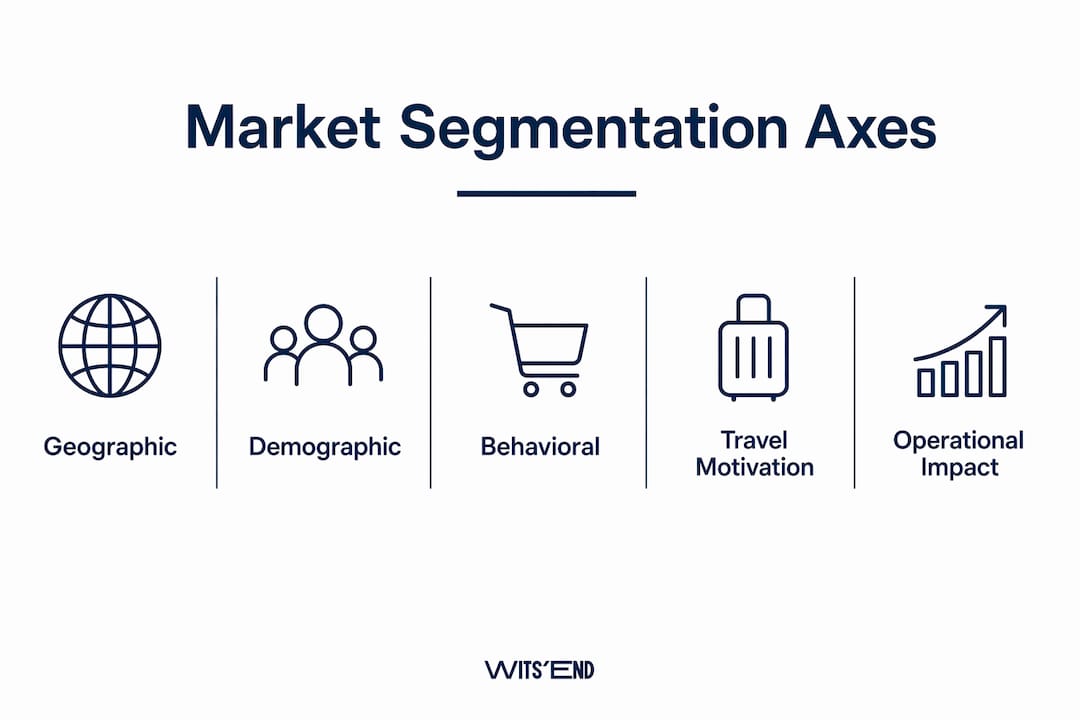
Each axis answers a different question. Geographic origin tells you where to spend your marketing budget and which OTA markets to prioritize. Travel motivation tells you what the guest actually needs from the stay. Demographics tell you how to communicate and what price point they will accept. Party size tells you how to configure your physical product and your service model.
The most useful segmentation strategies in hotels combine two or three axes rather than relying on one. A family traveling from a regional drive market for leisure has very different needs from a solo international business traveler, even if both book the same room type. Treating them identically in pricing, messaging, or service delivery leaves revenue and satisfaction on the table.
Pro Tip: Start with travel motivation as your primary axis. It is the single strongest predictor of willingness to pay, length of stay, and ancillary spend. Layer demographics and geography on top once you have clean data on motivation.
How does segmentation improve pricing, marketing, and operations?
Segment-specific dynamic pricing is the most direct financial benefit of structured segmentation. Top-performing independent hotels use segment-specific forecasting for dynamic pricing, outperforming properties without structured segmentation. The mechanism is straightforward: when you know that your corporate transient segment books within a 7-day window and your leisure segment books 30 days out, you can set rate floors and ceilings that reflect actual demand patterns rather than guessing.
Marketing efficiency follows the same logic. Segment-specific messaging improves marketing ROI by resonating with guest needs and preferences, boosting conversion and loyalty. A campaign targeting drive-market families with weekend packages performs better when the creative, the offer, and the channel are all calibrated to that segment. Generic campaigns spread across all segments produce diluted results and wasted spend.
Operationally, segmentation informs staffing models, inventory allocation, and F&B programming. A property with a high share of extended-stay corporate guests needs different housekeeping schedules, breakfast programming, and front desk protocols than one running primarily on leisure weekend business. Knowing your segment mix in advance lets you build the right staffing model rather than reacting to it.
Hotels that understand their segment mix can protect rates during peak demand and fill low season with profitable segments, managing both ADR and occupancy deliberately. That is the operational payoff of treating segmentation as a year-round discipline rather than an annual planning exercise.
Pro Tip: Before accepting a group booking, run a displacement analysis. Compare the group's contracted rate and room block against your transient demand forecast for those dates. Displacement analysis protects revenue by ensuring group blocks do not displace higher-rate transient bookings during peak periods.
What are the common challenges in hospitality market segmentation?
The most common mistake in segmentation is trying to serve too many segments at once. Focusing on 2–3 core segments enables targeted product and marketing adjustments, while trying to please every segment dilutes focus and profitability. This is a discipline problem as much as a data problem. The temptation to chase every booking type is real, especially during low-demand periods.
Operational complexity is the second major challenge. Catering to guests with fundamentally different expectations in the same property at the same time creates service delivery conflicts. A property running a corporate conference group alongside a leisure family weekend faces competing demands on F&B, noise levels, pool access, and front desk attention. Segmentation strategy needs to account for compatibility, not just revenue contribution.
Data quality is the third challenge. Segmentation is only as good as the data feeding it. PMS data that is inconsistently coded, loyalty profiles that are incomplete, or booking source data that is not mapped to segments produces misleading reports. Before you can act on segment performance, you need to trust the data.
- Audit your PMS segment codes quarterly. Inconsistent coding is the most common source of bad segment data.
- Limit your active segments to 2–3 core categories plus a catch-all "other" bucket. Complexity beyond that is rarely actionable.
- Review segment-level ADR and room-night contribution monthly, not just at budget time.
- Assign segment ownership to a specific role on your revenue or operations team. Segmentation without accountability drifts.
- Test segment assumptions against actual guest feedback. Data and experience should reinforce each other.
Pro Tip: Segmentation requires continual audit using PMS segment reports to identify overexposure or gaps. Set a monthly calendar reminder to review your segment mix against your forecast. Catching a shift early gives you time to adjust pricing and marketing before it affects your P&L.
How can hospitality businesses implement segmentation effectively?
Implementation starts with your existing data. Your PMS, loyalty program, and booking channel reports already contain the raw material for segmentation. The work is organizing it into a usable structure.
- Pull a 12-month segment report from your PMS. Look at room nights, ADR, and revenue contribution by segment code. This tells you what your current mix actually is, not what you think it is.
- Identify your top 2–3 revenue-contributing segments. These are your core segments. Every pricing, marketing, and operational decision should be tested against their needs first.
- Map each core segment to a guest profile. Define their booking window, rate sensitivity, length of stay, channel preference, and key service expectations. Use guest data and segmentation to build profiles that reflect real behavior, not assumptions.
- Integrate segment logic into your pricing workflow. Set rate strategies by segment, not just by date. Corporate transient, leisure, and group segments should each have their own rate floors, ceilings, and booking window rules.
- Align your marketing calendar to segment demand cycles. Leisure segments respond to campaigns 3–6 weeks before travel. Corporate segments book closer in. Your promotional timing should reflect those patterns.
- Build cross-departmental alignment. Revenue management, sales, marketing, and operations all need to work from the same segment definitions. A segment strategy that lives only in the revenue manager's spreadsheet will not change how the front desk or F&B team delivers the stay.
- Track KPIs weekly. Market segmentation is a weekly operational rhythm involving segment-level reporting of room-night and ADR contribution. Weekly reviews catch problems before they compound.
Deep analytics for hospitality makes this rhythm sustainable. When your reporting infrastructure is built around segment performance, the weekly review becomes a 20-minute check rather than a manual data pull.
Key takeaways
Market segmentation in hospitality is a revenue management discipline that requires clean data, focused segment choices, and a weekly operational rhythm to deliver consistent results.
| Point | Details |
|---|---|
| Start with travel motivation | It is the strongest predictor of willingness to pay, length of stay, and ancillary spend. |
| Limit to 2–3 core segments | Focusing narrows operational complexity and sharpens marketing and pricing decisions. |
| Run displacement analysis | Always compare group block rates against transient demand before accepting group bookings. |
| Audit PMS segment codes quarterly | Bad segment data produces misleading reports and poor pricing decisions. |
| Make segmentation a weekly rhythm | Segment-level ADR and room-night reporting weekly catches demand shifts before they erode revenue. |
Segmentation is a discipline, not a one-time plan
I have worked with properties that had sophisticated segmentation frameworks on paper and chaotic segment mixes in practice. The gap is almost always the same: segmentation was treated as a planning tool rather than an operating one. The strategy got built at budget time, filed away, and then ignored until the next budget cycle.
The properties that actually benefit from segmentation review their segment mix the way a good operator reviews labor costs: regularly, with accountability, and with a clear sense of what the numbers should look like. When a segment starts over-indexing or under-delivering, they adjust. They do not wait for the annual review to notice that their corporate transient share has eroded or that their leisure ADR has drifted below target.
The other thing I see consistently is that segmentation only works when it crosses departmental lines. Revenue management can set the strategy, but if the sales team is booking groups that displace your best transient weeks, or if the front desk is not delivering the experience your core segment expects, the numbers will not hold. Segmentation must inform product and service design to capture segment value fully. That means operations, marketing, and revenue management working from the same definitions and the same goals.
The operators who get this right do not have fancier tools. They have clearer priorities and better internal alignment.
— Chris
How Wits' End Solutions supports segment-driven hospitality growth
Wits' End Solutions works with hotels and restaurants across the United States to build the operational and analytical foundations that make segmentation work in practice. Our brand design and development work is built around segment clarity, ensuring your positioning, product, and marketing all speak to the guests who drive your best revenue. Our deep analytics and advising services give you the segment-level reporting infrastructure to track ADR, room-night contribution, and demand patterns on a weekly basis. If you are ready to move from broad booking acceptance to a focused, data-driven segment strategy, we can help you build it and run it.
FAQ
What is market segmentation in hospitality?
Market segmentation in hospitality is the practice of dividing guests into distinct groups based on shared characteristics such as travel motivation, geography, demographics, or party size. Hotels use these groups to tailor pricing, marketing, and service delivery to each segment's specific needs.
Why is segmentation critical for hospitality revenue management?
Segmentation allows hotels to set rates aligned with each segment's willingness to pay rather than applying a single rate across all bookings. Properties using segment-specific forecasting consistently outperform those without structured segmentation on both ADR and occupancy.
How many segments should a hotel focus on?
Industry best practice points to 2–3 core segments as the right focus for most properties. Serving more than that simultaneously dilutes marketing effectiveness and creates operational complexity that reduces profitability.
How does displacement analysis relate to segmentation?
Displacement analysis uses segment data to compare a group booking's contracted rate against the transient demand forecast for the same dates. It protects ADR by preventing group blocks from displacing higher-rate individual bookings during peak periods.
How often should hotels review their segment performance?
Segment performance should be reviewed weekly using PMS segment reports that show room-night and ADR contribution by segment. Weekly reviews allow revenue and operations teams to catch demand shifts and adjust pricing or marketing before they affect the P&L.