
TL;DR:
- A structured hotel staff training program focuses on onboarding, skills development, and continuous improvement to enhance guest experiences. Proper implementation reduces turnover, increases guest satisfaction, and delivers significant operational ROI through phased development and technology support. Maintaining ongoing reinforcement and integrating training into operational culture are essential for long-term service consistency.
A hotel staff training program is a structured, phased process that builds the technical skills, service standards, and behavioral consistency your team needs to deliver repeatable guest experiences. Done right, systematic training programs reduce staff turnover by 20–30% and increase guest satisfaction by 15–25%. That return compounds: every dollar invested in training yields $2–$4 back in operational performance. This guide walks hotel management professionals through the full training lifecycle, from pre-hire setup and workflow design to modern learning technology and ROI measurement, using frameworks that work in real hospitality operations.
What does a hotel staff training guide actually cover?
The term "hotel staff training guide" is widely used, but the industry standard for this process is called a structured staff development program. It covers four distinct layers: onboarding, skills training, performance management, and continuous development. Most managers focus only on the first layer and wonder why service quality drifts after 90 days.

A complete program addresses all four. Onboarding sets role clarity and cultural expectations. Skills training covers both technical procedures and soft skills like guest communication. Performance management tracks progress through check-ins and observation. Continuous development keeps standards from eroding over time. Each layer depends on the one before it.
The tools that support this process include learning management systems (LMS), onboarding checklists, mobile training platforms, and performance review templates. Platforms like SkillsCaravan, Yourco, and Axonify are built specifically for deskless, shift-based hospitality workforces. Knowing which tools serve which layer is the first decision you need to make before building your program.
What prerequisites must you have before training begins?
The most common failure point in any hotel staff training process is launching before the foundation is ready. Completing paperwork and establishing role clarity before Day One is the single highest-leverage preparation step. New hires who arrive to unclear job descriptions, missing system access, or incomplete HR paperwork disengage immediately.
Before your first training session runs, confirm these are in place:
- Role documentation: Written job descriptions, standard operating procedures (SOPs), and department-specific service standards for every position
- Technology access: LMS accounts, PMS logins, scheduling software credentials, and communication platform setup completed before the employee's first shift
- Stakeholder alignment: HR, department heads, and designated trainers must agree on the training timeline and their individual responsibilities
- Training schedule: A phased calendar that maps which content is delivered in week one, weeks two through four, and the 30/60/90-day check-in points
Pro Tip: If you are opening a new property, the pre-opening onboarding workflow should begin 90 days before your first guest arrives. The final 30–14 days before opening are reserved for stress-testing departments through mock service simulations.
For multilingual teams, which represent the majority of front-line hospitality workforces in major U.S. markets, your LMS must support multiple languages on day one. Deskless and multilingual workforce support is not a nice-to-have feature. It determines whether your staff actually completes training or ignores it.
| Prerequisite | Owner | Completion Target |
|---|---|---|
| SOPs and job descriptions finalized | Department Managers | 2 weeks before hire date |
| LMS accounts and system access created | HR / IT | Day before start date |
| Training schedule distributed | HR | Day one |
| Trainer assignments confirmed | Department Heads | 1 week before start date |
How do you design a structured hotel staff training workflow?
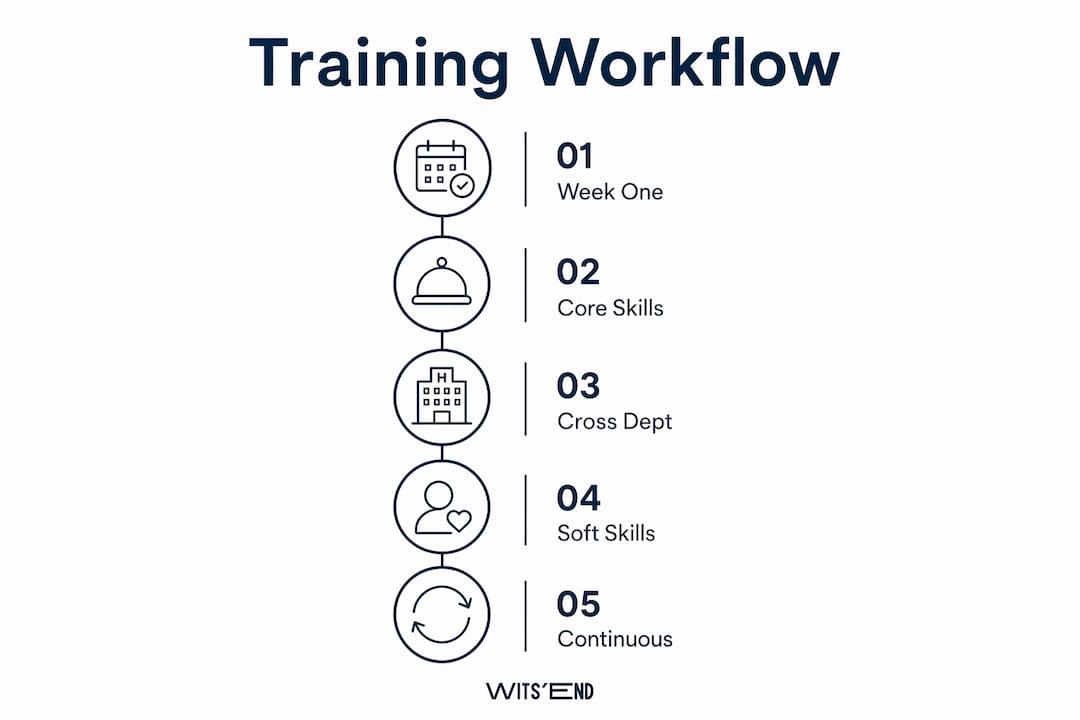
A hospitality team training workflow that produces consistent results follows a phased structure, not a single orientation event. The most effective model uses four phases: pre-hire preparation, week-one immersion, a 30/60/90-day development arc, and ongoing monthly recalibration.
Phase 1: Week One Immersion
The first week should cover property orientation, brand standards, safety and compliance, and department-specific SOPs. Pair every new hire with a buddy or mentor from their department. Buddy programs and structured 30/60/90-day check-ins measurably improve 90-day retention. The relationship gives new hires a low-stakes channel to ask questions without going to a manager every time.
Phase 2: The 30/60/90-Day Arc
- Day 30 check-in: Assess technical skill execution, identify knowledge gaps, and confirm the employee understands their performance expectations.
- Day 60 check-in: Evaluate guest interaction quality, cross-department communication, and adherence to service standards under real operating conditions.
- Day 90 check-in: Review overall performance against KPIs, discuss career development, and confirm the employee is ready for independent service delivery.
Phase 3: Cross-Department and Soft Skills Training
Cross-training front desk staff in F&B basics and housekeeping staff in guest communication creates operational flexibility. It also builds empathy across departments, which directly improves internal service delivery. Soft skills training should cover conflict resolution, upselling techniques, cultural awareness, and non-verbal communication. These are not secondary to technical training. They are what guests actually remember.
Pro Tip: Role-play simulations are the fastest way to close the gap between knowing a procedure and executing it under pressure. Run at least two simulated guest scenarios per department before staff go live on the floor.
For restaurant staff training within a hotel F&B operation, the same phased structure applies. A restaurant employee training checklist should include menu knowledge assessments, table service standards, POS system proficiency, and allergen protocols. The hospitality team training process for F&B staff benefits from daily pre-shift briefings that reinforce the previous day's service observations.
What training technologies actually improve retention?
Modern hotel staff training solutions have moved well past classroom sessions and printed manuals. Mobile-first microlearning modules lasting 3–10 minutes outperform traditional classroom training for knowledge retention in shift-based workforces. Staff complete them during downtime, between shifts, or on a break, without disrupting operations.
The most effective technology stack for a hotel training program combines three components:
- An LMS with mobile access: SkillsCaravan, Axonify, and Cornerstone OnDemand each offer hospitality-specific modules. Choose based on your workforce size, language requirements, and integration with your existing HR systems.
- An SMS or push notification platform: Tools like Yourco deliver training reminders, compliance updates, and shift-specific briefings directly to staff phones. This is particularly effective for deskless workers who rarely check email.
- Gamification and interactive content: Quizzes, scenario-based learning, and leaderboards increase completion rates. They also surface knowledge gaps faster than passive video content.
Pro Tip: Check out how mobile learning modules are being integrated into front desk check-in workflows. The same logic applies to any guest-facing role.
| Feature | Why It Matters for Hospitality |
|---|---|
| Multilingual content delivery | Serves diverse front-line workforces in U.S. markets |
| Mobile-first interface | Reaches deskless staff without requiring a desktop |
| Microlearning modules (3–10 min) | Fits shift-based schedules without disrupting operations |
| Gamification and quizzes | Increases completion rates and surfaces knowledge gaps |
| Integration with HR and scheduling tools | Reduces administrative duplication and improves compliance tracking |
How do you measure training effectiveness and ROI?
Training ROI in hospitality is measurable, and you should be tracking it. Training investment yields 200–400% ROI operationally. That means a $10,000 training program should return $20,000–$40,000 in reduced turnover costs, improved productivity, and higher guest satisfaction scores. The math only works if you are measuring the right indicators.
The core KPIs for any hotel staff training program are:
- Staff turnover rate at 30, 60, and 90 days: This is your most direct measure of onboarding effectiveness.
- Guest satisfaction scores (GSS) and Net Promoter Score (NPS): Track these by department and correlate shifts with training milestones.
- Time to full productivity: How many days does it take a new hire to operate independently? Shorter is better, and training design directly controls this.
- Training completion rates: Low completion signals a content or delivery problem, not a motivation problem.
Replacing a hospitality worker costs around $6,000. That figure makes the ROI calculation straightforward. If your onboarding program costs $500 per employee and prevents even one early departure, it has already paid for itself twelve times over.
Measurement methods should include post-training knowledge assessments, 30-day manager observation reports, and quarterly guest satisfaction reviews tied to department-level training activity. Annual refresher courses alone do not maintain service standards. Monthly performance reviews tied to specific operational bottlenecks are the standard that effective hotel operations use to stay consistent.
What are the hardest training challenges and how do you solve them?
High turnover is the defining operational challenge in hospitality. Up to 20% of hospitality staff leave within the first 45 days. The hospitality sector's quit rate runs nearly double the private sector average. That means your training program must be designed to retain, not just inform.
The most common challenges and their solutions:
- Language barriers in multilingual teams: Self-rated surveys do not work here. Visual assessment checklists and direct supervisor observation are the only reliable methods for identifying skill gaps when language is a barrier.
- Habitual drift: Monthly re-sync training is the proven countermeasure. Service standards erode gradually when staff are not regularly recalibrated against the original benchmark.
- Tight labor markets: Simplify your onboarding materials, shorten time to first independent shift, and use mobile delivery to reduce the training burden on managers.
- Low engagement: Gamification, peer recognition, and clear career progression pathways keep staff invested beyond the first 30 days.
Pro Tip: Build a 15-minute monthly "service reset" into your department meeting schedule. Cover one operational bottleneck, one guest complaint pattern, and one recognition moment. It takes almost no time and prevents the drift that kills service consistency.
The first 45 days of employment are not just an onboarding window. They are the highest-leverage retention opportunity your operation has. Treat them accordingly.
Training is a culture, not a calendar event
I have worked with hotel and restaurant operations at every stage, from pre-opening chaos to mature properties trying to recapture their original service standard. The pattern I see most often is this: management invests in a strong initial training program, sees good early results, and then quietly lets the structure collapse. Six months later, the guest scores have drifted and nobody can explain why.
The answer is almost always habitual drift. Staff do not forget their training. They adapt it to what is convenient under pressure. Without regular recalibration, the gap between trained behavior and actual behavior widens until it shows up in reviews.
The operations that hold their standards over time treat training as a continuous operating function, not a calendar event. They build team training investment into their P&L the same way they budget for labor and supplies. They assign ownership to a specific manager, not to HR alone. And they use technology to maintain consistency without adding headcount.
The other thing I would push back on is the instinct to solve training problems with more content. Most teams do not need more information. They need better reinforcement of what they already learned. Monthly service resets, peer coaching, and real-time feedback loops outperform a new training module every time.
— Chris
Build a stronger team with wits' end solutions
Wits' End Solutions works with hotel and restaurant operators across the United States to design and run training programs that hold up under real operating conditions. Our team has managed the work firsthand before recommending any approach to a client. We build training programs around your specific staffing model, service standards, and operational calendar, not a generic template.
If you are building a new property, retraining an existing team, or trying to close a persistent service gap, our hotel and restaurant training programs are built for exactly that. We also offer task force services for operators who need senior leadership on property during critical transitions. Reach out to Wits' End Solutions to discuss what your team actually needs.
Key takeaways
A structured, phased hotel staff training program is the single most effective tool for reducing turnover, improving guest satisfaction, and generating measurable operational ROI.
| Point | Details |
|---|---|
| Start before Day One | Complete paperwork, system access, and role clarity before the new hire arrives to prevent early disengagement. |
| Use a phased training arc | Structure development across 30, 60, and 90-day milestones with formal check-ins at each stage. |
| Choose mobile-first technology | Select an LMS that supports multilingual, deskless staff with microlearning modules under 10 minutes. |
| Measure turnover and guest scores | Track 30/60/90-day retention rates and guest satisfaction by department to quantify training impact. |
| Combat drift with monthly resets | Run short monthly recalibration sessions to prevent service standards from eroding between annual reviews. |
FAQ
What is a hotel staff training program?
A hotel staff training program is a structured process covering onboarding, skills development, performance management, and continuous learning. It is designed to build consistent service delivery across all guest-facing and operational roles.
How long should hotel staff training take?
Initial onboarding typically runs one to two weeks, followed by a 30/60/90-day development arc. Ongoing training should occur monthly to prevent performance drift and maintain service standards.
How do you train hotel f&b staff effectively?
Use a phased approach that combines menu knowledge assessments, POS system training, allergen protocol reviews, and daily pre-shift briefings. Role-play simulations before live service significantly accelerate readiness.
What is the ROI of hotel staff training?
Well-designed training programs return $2–$4 for every $1 invested through reduced turnover, higher guest satisfaction scores, and faster time to full staff productivity.
How do you handle training for multilingual hotel teams?
Use visual assessment checklists and direct supervisor observation to identify skill gaps. Self-rated surveys are unreliable where language barriers exist. An LMS with multilingual content delivery is required for consistent training completion.