
TL;DR:
- A structured pre-opening onboarding workflow integrates staff through phased arrivals, role-specific training, and scored readiness gates over a 90-day period, ensuring operational confidence from day one. Digital tools like ShiftTrained and online platforms streamline administration and reinforce training, reducing turnover and service errors. Building a strong culture during early weeks, rather than just logistics, is essential for a successful hotel or restaurant opening.
A pre-opening team onboarding workflow is a structured, phased process that integrates new hospitality staff fully before a hotel or restaurant opens its doors, with the explicit goal of achieving operational readiness from day one. Most operators underestimate how much coordination this requires. The standard industry term for this process is "pre-opening staff integration," and it covers everything from digital pre-boarding at offer acceptance through mock service rehearsals in the final week. Done correctly, it reduces early turnover, aligns your team around brand standards, and gives guests a polished experience on night one rather than night thirty. This guide walks you through every phase, from phased arrival schedules to readiness gates, using tools like ShiftTrained and structured training frameworks that hospitality operators across the country rely on.
What are the essential components of a pre-opening team onboarding workflow?
A pre-opening team onboarding workflow has five non-negotiable components: early administrative pre-boarding, phased departmental arrivals, role-specific training, scored readiness gates, and mock service rehearsals. Skipping any one of these creates a gap that shows up in service quality within the first two weeks of operation.

Early administrative pre-boarding means completing all paperwork, policy acknowledgments, and system access before a staff member sets foot on property. Digital pre-boarding shifts administrative tasks to the offer-acceptance period, freeing the first days on property for culture, connection, and hands-on training. This is not a minor efficiency gain. It fundamentally changes what your opening week looks like.
Phased departmental arrivals are covered in detail in the next section, but the principle is simple: not every department needs the same lead time, and staggering arrivals prevents training bottlenecks and keeps your trainer-to-staff ratio manageable.
Role-specific training goes beyond a general orientation. A front desk agent needs different knowledge than a line cook or a housekeeping supervisor. Structured training programs that break orientation, menu knowledge, and role expectations into distinct modules produce measurably better readiness than a single all-hands session.
Readiness gates are scored checkpoints at defined milestones, typically at the 30-day, 60-day, and 90-day marks, where staff must demonstrate competency before advancing to the next training phase. They create accountability and give you documented evidence of where gaps exist.
Mock service rehearsals are the final stress test before guests arrive. These are not celebrations. They are failure-testing sessions designed to surface problems while you still have time to fix them.
- Complete digital pre-boarding before the first day on property
- Schedule phased arrivals by department based on training lead time
- Build role-specific training modules with quizzes and hands-on practice
- Set scored readiness gates at 30, 60, and 90 days
- Run at least two full mock service covers before soft opening
Pro Tip: Assign a dedicated pre-opening trainer or task force lead for each department. When one person owns training accountability per department, gaps get caught and corrected before they compound.
How to structure the phased onboarding timeline before opening
The most effective pre-opening training operates within a 90-day window, with the final two to four weeks being the most intensive period for readiness drills and rehearsals. That 90-day frame is not arbitrary. It reflects how long it actually takes to move a team from hired to operationally confident.
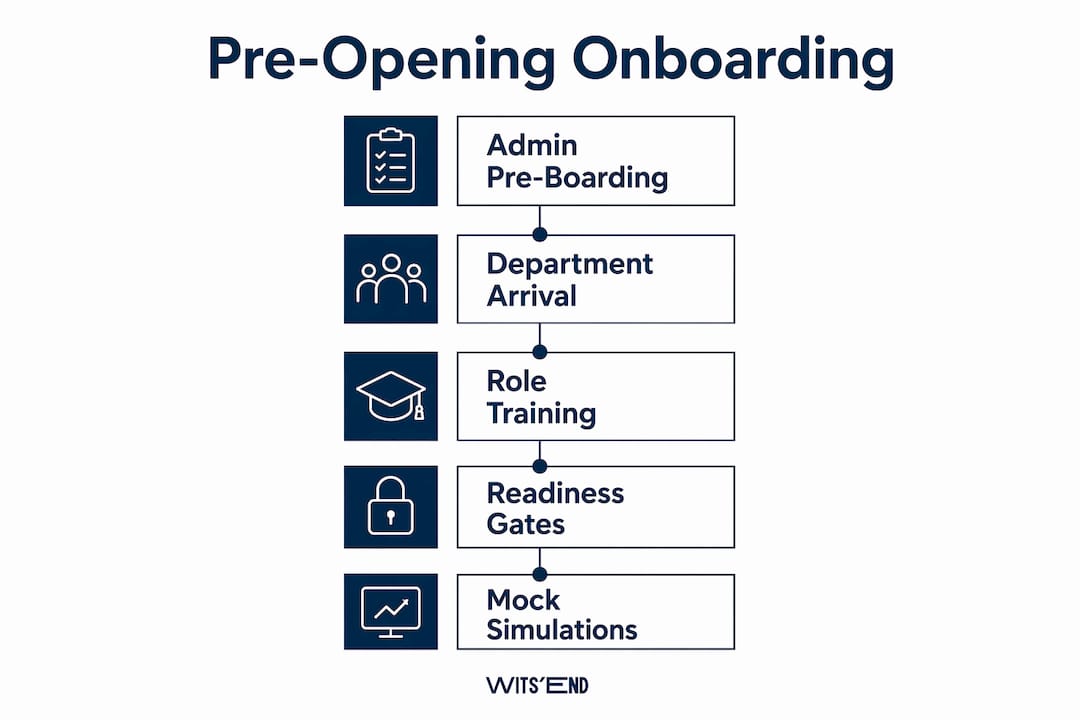
The sequencing of staff arrivals is where most operators make their first mistake. Bringing everyone on at once creates chaos. A phased arrival schedule staggers induction by department: housekeeping arrives seven days before opening, food and beverage and stewarding at five days out, and kitchen staff at four days out. Each group completes site-specific induction, safety training, and department orientation before the next wave arrives.
Here is how the final two weeks break down in practice:
- Day -14 to -10: Complete all role-specific training modules and first readiness gate assessments. Identify staff who need additional support before mock service begins.
- Day -9 to -7: Housekeeping completes room setup protocols and inspection walkthroughs. F&B teams run table service simulations with internal guests.
- Day -6 to -5: Kitchen staff complete mise en place drills and ticket-flow rehearsals. Cross-departmental briefings align front-of-house and back-of-house communication.
- Day -4 to -3: First full mock service cover with all departments operating simultaneously. Document every failure point.
- Day -2 to -1: Targeted refresher sessions based on mock service feedback. Final readiness gate sign-offs. Pre-shift briefing protocols established.
- Day 0: Soft opening begins. Treat it as a training phase, not a launch.
| Phase | Timing | Key Activities |
|---|---|---|
| Administrative pre-boarding | Offer acceptance to Day -30 | Paperwork, system access, policy acknowledgment |
| Core training modules | Day -30 to Day -14 | Role-specific training, quizzes, safety certification |
| Departmental inductions | Day -7 to Day -4 | Phased arrivals, site orientation, department drills |
| Mock service rehearsals | Day -4 to Day -2 | Full covers, failure documentation, refresher sessions |
| Soft opening | Day 0 onward | Live service with daily feedback loops |
Practical considerations matter here. Accommodation for pre-opening staff, trainer availability across overlapping departments, and equipment readiness all affect whether your timeline holds. Build a two-day buffer into every phase transition.
What are the step-by-step training and readiness activities during pre-opening?
Training delivery during the pre-opening period follows a clear sequence: knowledge first, then application, then pressure-testing under simulated conditions. Collapsing these stages or running them out of order produces staff who can recite a menu but freeze during a real cover.
Step 1: Build per-role training modules. Each role gets a dedicated curriculum covering menu knowledge, service flow, safety protocols, and brand standards. For F&B staff, this means timed menu recitation, allergen identification, and table sequencing. For kitchen staff, it means recipe execution to spec, ticket management, and station cleanliness standards.
Step 2: Administer scored readiness gates. At the end of each training module, staff complete a scored assessment. Anyone below the passing threshold gets a targeted refresher, not a full retrain. Mock service drills function best as failure-testing sessions with focused refreshers rather than full re-trains after the 14-day mark. This distinction matters because full retrains at that stage consume time you do not have.
Step 3: Run mock check-ins and service simulations. These should escalate in complexity. Start with single-department simulations, then move to cross-departmental scenarios that test communication between front desk, housekeeping, and F&B. Use internal staff as guests and assign observers to document failures in real time.
Step 4: Conduct full mock restaurant covers. At least two full covers before soft opening, with every position staffed. The goal is not a perfect service. The goal is to surface every failure mode before a paying guest experiences it.
Step 5: Collect and act on daily feedback. During soft opening, run a structured debrief after every service. Document what broke, who was involved, and what the corrective action is. Soft opening treated as a final training phase with documented daily feedback produces measurably better 30-day performance than operators who treat opening night as the finish line.
- Use a shared digital log for failure documentation during mock service
- Assign a floor manager specifically to observe and score service flow
- Run pre-shift briefings every day from mock service through the first 30 days of operation
- Rotate staff through adjacent roles during simulations to build cross-functional awareness
Pro Tip: Score every mock service cover against a defined rubric, not just gut feel. When staff see a numeric score tied to specific behaviors, they self-correct faster and take the rehearsal seriously.
What are common pitfalls in pre-opening team onboarding workflows?
Up to 20% of new hire turnover happens within the first 45 days when onboarding is treated as a single event rather than a structured integration. That number represents real cost: recruiting fees, lost productivity, and the operational disruption of replacing staff during your most vulnerable period.
The most damaging pitfalls are predictable and preventable:
- Treating onboarding as a one-day event. A single orientation session does not build operational readiness. The 90-day integration window exists because competency takes time to develop and reinforce.
- Ignoring cross-departmental coordination. Front-of-house and back-of-house teams that never train together before opening will communicate poorly under pressure. Cross-departmental briefings during pre-opening build the operational alignment that rarely gets addressed in standard onboarding programs.
- Falling behind on phased arrival schedules. When housekeeping arrives two days late or kitchen staff skip the first training day, the entire timeline compresses. There is no recovery time built in for this.
- Skipping structured feedback during soft opening. Without a documented feedback loop, the same service failures repeat across multiple covers. Daily debriefs are not optional during the first two weeks.
- Failing to document training deficiencies. If a staff member does not pass a readiness gate and there is no record of it, you cannot build a targeted remediation plan. Documentation protects the operator and the employee.
"The operators who struggle most in their first 30 days are not the ones who trained the least. They are the ones who trained without a system. Intensity without structure produces exhausted staff and inconsistent service."
How can digital tools enhance the pre-opening onboarding workflow?
Digital tools do not replace the hands-on work of pre-opening training. They remove the administrative friction that eats into the time you need for that hands-on work. Strategic onboarding starts at offer acceptance with digital pre-boarding, meaning staff arrive on property already cleared administratively and ready to train from hour one.
ShiftTrained is the most purpose-built tool for restaurant and hotel pre-opening training. Its AI-driven quizzes are tailored to your final menus and deliver leaderboard-style scoring that creates accountability and friendly competition among staff during the two-to-four-week intensive training block. Staff who score below threshold get targeted quiz sets, not a full module restart.
| Tool Type | Primary Function | Best Use in Pre-Opening |
|---|---|---|
| Digital pre-boarding platforms | Administrative task completion | Offer acceptance through Day -30 |
| ShiftTrained | AI menu quizzes and leaderboards | Day -14 through soft opening |
| Centralized knowledge base (e.g., Notion, Google Sites) | SOPs, checklists, brand standards | Accessible throughout all phases |
| Readiness gate scorecards | Competency tracking and documentation | End of each training phase |
Digital onboarding platforms also reduce the risk of compliance gaps by automating document collection and tracking completion status across your entire pre-opening roster. For a property opening with 80 to 150 staff, manual tracking of that volume is a liability.
Pro Tip: Build your centralized knowledge base before the first staff member arrives. When every SOP, training video, and checklist lives in one accessible location, trainers spend less time answering repeat questions and more time coaching.
Key takeaways
A pre-opening team onboarding workflow succeeds when it combines phased arrivals, role-specific training, scored readiness gates, and a soft opening treated as a final training phase rather than a launch event.
| Point | Details |
|---|---|
| Use a 90-day integration window | The final 2-4 weeks are the most intensive; plan the full timeline from offer acceptance. |
| Stagger departmental arrivals | Housekeeping at Day -7, F&B at Day -5, kitchen at Day -4 to prevent training bottlenecks. |
| Score every readiness gate | Documented competency assessments protect against turnover and identify gaps before opening. |
| Treat soft opening as training | Daily feedback loops and failure documentation during soft opening improve 30-day performance. |
| Use digital tools to remove friction | ShiftTrained and digital pre-boarding platforms free trainer time for hands-on coaching. |
What I've learned from running pre-openings that most guides won't tell you
The hardest part of a pre-opening is not the training content. It is the culture you build during those first few weeks together. I have seen properties with excellent training materials produce mediocre opening teams because leadership treated the pre-opening period as a logistics exercise rather than a cultural foundation. The staff who arrive for pre-opening training are forming their first impressions of how this organization operates. If they see disorganization, unclear expectations, and leaders who are too busy to show up to briefings, that becomes the culture.
The other thing I would push back on is the instinct to pack every hour of the pre-opening schedule with formal training. Staff burnout in the final week before opening is real, and it shows up in service. The operators who get this right build recovery time into the schedule, run shorter and sharper training sessions rather than marathon days, and use pre-shift briefings as the primary daily touchpoint rather than additional classroom hours.
Framing the soft opening correctly matters more than most operators realize. When you tell your team "this is our launch," they feel the pressure of performance. When you tell them "this is our final training phase and we expect to find problems," they engage differently. They communicate failures instead of hiding them. They ask for help instead of improvising. That shift in framing is free, and it produces better outcomes than almost any tool or checklist you can buy.
The step-by-step hotel opening process and the onboarding workflow that supports it are inseparable. You cannot build one without the other.
— Chris
How Wits' End Solutions supports your pre-opening team
Wits' End Solutions works with hotel and restaurant operators at every stage of the pre-opening process, from staffing model design and training program development through on-property task force deployment. If you need a team to build and run your pre-opening onboarding workflow from scratch, our task force services put experienced operators on your property during the critical weeks before launch. If you need structured training programs your internal team can execute, our hospitality training programs are built specifically for pre-opening readiness. We have run these openings ourselves, which means the guidance we give you is grounded in what actually works under pressure, not what looks good in a slide deck.
FAQ
What is a pre-opening team onboarding workflow?
A pre-opening team onboarding workflow is a structured, phased process for integrating new hospitality staff before a hotel or restaurant opens, covering administrative pre-boarding, role-specific training, readiness assessments, and mock service rehearsals within a 90-day window.
How long before opening should onboarding begin?
Onboarding should begin at offer acceptance, with the full 90-day integration window in place and the most intensive training occurring in the final two to four weeks before opening day.
What is a readiness gate in hospitality onboarding?
A readiness gate is a scored competency checkpoint at a defined milestone in the training timeline. Staff must meet a minimum score before advancing to the next training phase, creating documented accountability and identifying gaps early.
How does phased staff arrival improve pre-opening training?
Staggering arrivals by department, housekeeping at Day -7, F&B at Day -5, and kitchen at Day -4, prevents training bottlenecks, keeps trainer-to-staff ratios manageable, and allows each department to complete site-specific induction before the next group arrives.
What digital tools work best for pre-opening staff training?
ShiftTrained delivers AI-generated menu quizzes and leaderboards purpose-built for the pre-opening intensive period. Digital pre-boarding platforms handle administrative tasks before Day 1, and centralized knowledge bases like Notion or Google Sites keep SOPs and checklists accessible to all staff throughout the process.