

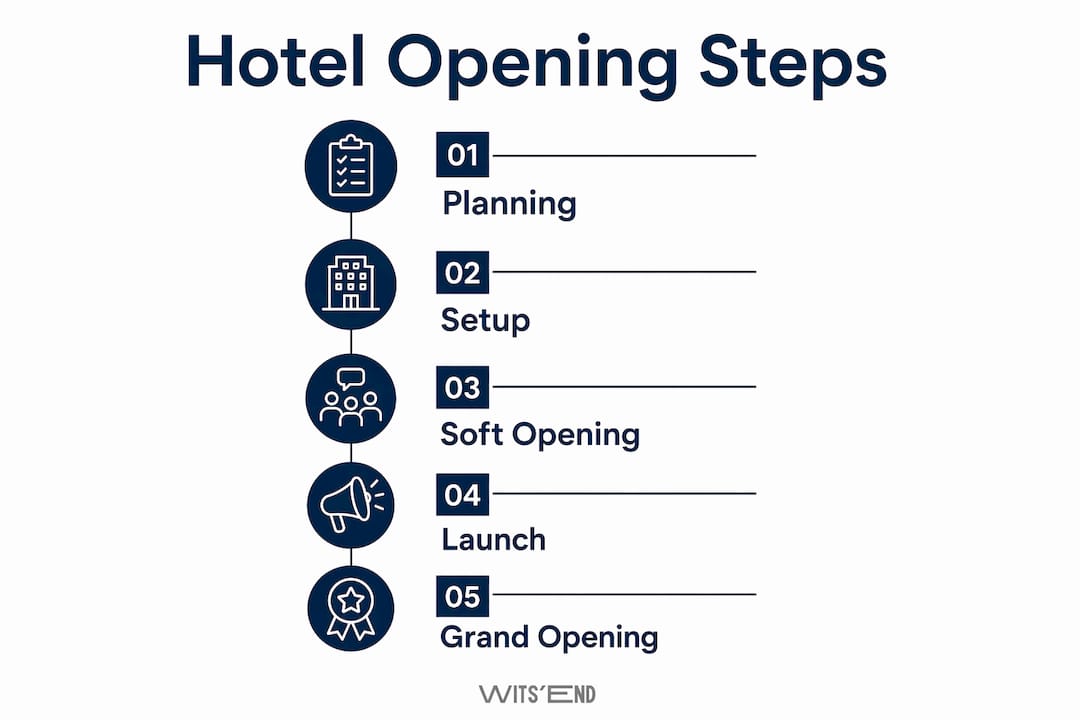
A step by step hotel opening is the systematic process of preparing, planning, and executing every activity required to launch a fully operational hotel, from concept and licensing through staffed, guest-ready rooms. Most first-time hotel owners underestimate how many moving parts converge in the final 90 days before opening. The hotel opening process is formally organized into three phases: Planning, Setup, and Launch, each with its own dependencies, deadlines, and department owners. Follow this hotel opening guide and you will know exactly what to do, in what order, and why each step matters.
What are the essential phases and timelines in opening a hotel?
A well-structured hotel opening plan is organized into three phases: Planning, Setup, and Launch. Each phase builds on the last, and skipping steps in one phase creates compounding problems in the next. Understanding this structure is the single most important thing you can do before spending a dollar.
Here is how the phases break down in practice:
-
Planning Phase (18 to 12 months out): Define your concept, secure financing, choose a location, and begin the permitting process. This is also when you decide between an independent build, a conversion, or a franchise. New hotel builds can take 18 to 24 months or longer due to permits and construction, while franchise conversions move faster by leveraging existing infrastructure.
-
Setup Phase (12 to 3 months out): Execute construction or renovation, install technology systems, recruit leadership, and build your standard operating procedures (SOPs). This phase is where most budget overruns and timeline slippage occur.
-
Launch Phase (3 months out through opening): Conduct staff training, run mock operations, execute a soft opening, and then move to your grand opening. The soft opening alone typically spans 30 to 45 days of preparation, training, limited guest trials, and operational review.
Pro Tip: Assign a department head to own each phase milestone. When accountability is shared across a team without named owners, deadlines slip and tasks fall through the gaps.
The distinction between a soft opening and a grand opening matters more than most owners realize. A soft opening is a controlled, limited-capacity trial. A grand opening is your public, full-capacity debut. Treating them as the same event is one of the most common and costly mistakes in the hotel opening process.
How to prepare the legal, licensing, and infrastructural groundwork
Legal compliance and hotel licensing are among the most common blockers in any hotel opening timeline, and they are almost always underestimated. Permits move at the pace of local government, not your construction schedule. Starting this work early, with professionals who know your local regulatory environment, is not optional.
The core legal and infrastructure tasks to complete before any guest sets foot on property include:
- Business registration and entity formation: Establish your LLC, corporation, or partnership structure before signing any vendor contracts.
- Hotel operating license: Requirements vary by state and municipality. In New York, for example, hotels must comply with the Multiple Dwelling Law in addition to standard business licensing.
- Health and safety permits: Fire safety inspections, food service permits (if you operate F&B), and ADA compliance certifications all require lead time.
- Liquor license: If your hotel includes a bar or restaurant, apply for your liquor license at least six months before your target opening date. Approval timelines are notoriously unpredictable.
- Insurance: General liability, property, workers' compensation, and umbrella policies must be in place before staff begin working on property.
- Utilities and connectivity: Confirm that electrical, HVAC, water, and high-speed internet infrastructure meet the load requirements of your PMS, point-of-sale systems, and guest Wi-Fi.
Pro Tip: Hire a local hospitality attorney or permitting consultant, not a general business attorney. The difference in turnaround time and accuracy is significant, and a single missed permit can delay your opening by weeks.
Physical infrastructure readiness goes beyond construction completion. Safety systems, including sprinklers, emergency lighting, and key card access, must be tested and certified. Your loading dock, laundry facilities, and back-of-house storage need to be operational before your housekeeping team can run a single mock room turn.
How to set up technology, staffing, and operational systems
Technology and staffing are the two areas where hotels most often open underprepared. Both require more lead time than owners expect, and both directly determine whether your first week of operations feels controlled or chaotic.
Choosing and integrating your core technology stack
PMS integration with booking and channel management must be fully operational well before opening day to allow for system testing and employee training. The three systems every hotel needs from day one are a Property Management System (PMS), a channel manager, and a direct booking engine. Popular PMS platforms include Mews, Opera Cloud, and Cloudbeds. Your channel manager connects your inventory to OTAs like Booking.com and Expedia. Your booking engine captures direct reservations through your own website.
| System | Primary Function | When to Go Live |
|---|---|---|
| Property Management System (PMS) | Manages reservations, check-in, billing, and reporting | 60 days before soft opening |
| Channel Manager | Syncs inventory across OTAs in real time | 45 days before soft opening |
| Booking Engine | Captures direct bookings on your website | 45 days before soft opening |
| Point of Sale (POS) | Processes F&B and retail transactions | 30 days before soft opening |
Large-scale PMS migrations require phased go-live waves and explicit integration certifications because of complex data and operational dependencies. Even for a single property, plan for at least two weeks of system testing before any real guest data enters the platform.
Building your team from the top down
Hiring key management first, particularly your General Manager, allows for proper team building and operational control before opening. Your GM should be on property at least six months before the grand opening. They own the hiring plan, the SOP development, and the training calendar.
The staffing sequence that works in practice looks like this:
- Hire General Manager and Director of Operations (6 months out)
- Hire department heads: Front Office Manager, Executive Housekeeper, F&B Director (4 to 5 months out)
- Recruit line staff: front desk agents, housekeepers, servers, maintenance (2 to 3 months out)
- Complete payroll setup, contracts, and uniform procurement (2 months out)
- Run department-level training and cross-training (6 to 4 weeks out)
- Conduct mock operations and full property walkthroughs (3 to 2 weeks before soft opening)
A pre-opening checklist covers at least ten critical areas including legal, infrastructure, technology, housekeeping, F&B, HR, sales, guest experience, finance, and soft opening. Assign each area to a department head and track completion weekly.
What is the role of soft opening and how is it effectively executed?
A soft opening is a controlled, limited-capacity trial period that runs before your public grand opening. It is not a marketing event. It is an operational stress test conducted under real guest conditions with lower stakes. Soft openings reduce the risk of costly operational failures on opening day by identifying service gaps before the full public launch.
The standard soft opening timeline breaks into four phases:
- T-45 to T-30 (Pre-soft preparation): Finalize SOPs for every department, complete staff training, and confirm all technology systems are live and tested. Run tabletop exercises for front desk, housekeeping, and F&B scenarios.
- T-30 to T-15 (Limited guest trials): Open a portion of your rooms, typically 20 to 40 percent of capacity, to invited guests such as friends, family, local media, and loyalty members. Collect structured feedback after every stay.
- T-15 to T-7 (Review and adjustment): Analyze feedback, identify recurring service failures, and retrain staff on specific gaps. Adjust SOPs where the real-world experience diverged from the written procedure.
- T-7 to T-1 (Final readiness): Conduct a full property walkthrough, confirm all rooms are guest-ready, and brief every department on grand opening expectations.
The feedback collected during soft opening is the most valuable data you will gather in your first year of operations. Guests who participate in a soft opening are generally forgiving of minor issues. The guests who arrive on grand opening day are not. Use that window deliberately.
Pro Tip: Build a simple feedback form for soft opening guests that covers arrival experience, room condition, F&B quality, and staff interaction. Four categories, five questions each. The patterns that emerge will tell you exactly where to focus your final training push.
How to plan and execute a successful grand opening
The grand opening is the official public launch after soft opening, with full-capacity operations, live pricing, and active marketing. Every decision made in the prior 12 to 18 months is tested on this day. The goal is not a flawless event. The goal is a controlled, guest-centered experience that sets the tone for your brand.
The grand opening countdown works best when structured as follows:
- 45 days out: Confirm your grand opening date publicly. Activate pre-opening marketing across your website, OTAs, and social channels. Begin accepting reservations at full rate.
- 30 days out: Finalize your event plan, including any ribbon-cutting ceremony, media invitations, and VIP guest list. Confirm catering, AV, and signage vendors.
- 14 days out: Conduct a full operational dress rehearsal. Every department runs its opening-day SOP from start to finish, including check-in, housekeeping turns, F&B service, and night audit.
- 7 days out: Complete all punch-list items from the dress rehearsal. Brief all staff on grand opening day roles, escalation protocols, and guest communication standards.
- Opening day: Station a manager in every department for the first four hours. Log every guest complaint and operational issue in real time.
- Post-opening (Days 2 to 30): Review daily logs, hold brief team huddles each morning, and track KPIs including occupancy rate, average daily rate (ADR), RevPAR, and guest satisfaction scores.
Common mistakes at this stage include launching marketing too late, failing to confirm OTA listings are live and accurate, and not having a clear escalation path when something goes wrong on opening day. Your hospitality marketing strategy should be active at least 45 days before the grand opening, not the week before.
Key takeaways
A successful hotel opening requires structured phases, named accountability, and operational testing before the public launch.
| Point | Details |
|---|---|
| Start planning 12 to 18 months out | Permits, construction, and hiring take longer than anticipated; early starts prevent costly delays. |
| Hire leadership before line staff | Your General Manager should be on property six months before opening to own hiring and training. |
| Go live on technology early | PMS, channel manager, and booking engine must be tested 45 to 60 days before the soft opening. |
| Use soft opening as a stress test | Run SOPs under real guest conditions for 30 to 45 days to identify and fix service gaps before the grand opening. |
| Track KPIs from day one | Monitor occupancy, ADR, RevPAR, and guest satisfaction scores starting on opening day to establish performance baselines. |
What I have learned from hotel openings that no checklist will tell you
The checklists matter. The timelines matter. But the thing that actually determines whether a hotel opening goes smoothly is whether the people running it have done the work before. Not read about it. Done it.
The most consistent pattern I have seen in troubled openings is that the technology integration gets treated as an IT task rather than an operations task. Your PMS is not a software problem. It is the central nervous system of your hotel. When it is not set up correctly, your front desk cannot check guests in, your housekeeping team does not know which rooms are ready, and your revenue manager is flying blind. I have watched teams spend weeks training on a PMS that was not yet properly integrated with their channel manager, which means every reservation had to be manually reconciled. That is a preventable disaster.
The second pattern is underinvesting in the soft opening. Owners feel pressure to open at full capacity as quickly as possible because every day of soft opening is a day of reduced revenue. That math is real. But the cost of a bad grand opening, in refunds, negative reviews, and staff turnover, far exceeds the revenue lost during a proper 30-day soft opening. Treat the soft opening as an investment, not a delay.
My practical advice: get your pre-opening support structure in place before you hire your first line employee. Know who owns what. Build the accountability structure before you build the team.
— Chris
How Wits' End supports your hotel opening from concept to launch
Opening a hotel is one of the most operationally complex projects a business owner can take on. Witsendsolutions works with hotel owners across the United States at every stage of that process, from brand development and concept creation through staff training, SOP development, and daily operations.

Our task force teams can step into your pre-opening process as operating partners, filling leadership gaps, running training programs, and managing the details that fall through the cracks when your core team is stretched thin. Our staff training programs are built specifically for hotel environments, covering front desk fluency, housekeeping standards, F&B service, and guest experience from the ground up. If you are planning a hotel opening and want a partner who has done this work before, reach out to Witsendsolutions to talk through where you are in the process.
FAQ
What does a step by step hotel opening process include?
A step by step hotel opening covers three main phases: Planning, Setup, and Launch. Each phase includes specific tasks across legal, technology, staffing, operations, and marketing that must be completed in sequence to avoid delays.
How far in advance should I start planning a hotel opening?
Pre-opening planning should start 12 to 18 months before your target opening date. Permits, construction, and hiring consistently take longer than owners anticipate, and starting early is the primary way to protect your timeline.
What is the difference between a soft opening and a grand opening?
A soft opening is a limited-capacity operational trial lasting 30 to 45 days, used to test SOPs and train staff under real conditions. A grand opening is the full public launch with live pricing, active marketing, and full-capacity operations.
How many staff do I need before a hotel opens?
All department heads should be hired four to six months before opening, with line staff recruited two to three months out. Your General Manager should be the first hire, as they own the staffing plan and training calendar for every other department.
What technology does a hotel need before opening day?
Every hotel needs a Property Management System, a channel manager, and a direct booking engine live and tested before the soft opening. Point-of-sale systems for F&B should be operational at least 30 days before the soft opening to allow for staff training.