

Building a hotel brand from scratch, or rebranding an existing property, is one of the most consequential decisions you will make as an owner or developer. The hotel brand creation workflow touches everything from your positioning in a crowded market to the franchise fees eating into your P&L for the next 20 years. Get the process right and you build a property guests return to. Get it wrong and you spend years correcting brand promises your operation was never built to keep. This guide walks you through every phase of that process, the contract clauses that will cost you if you miss them, and the operational discipline that turns a good brand into a durable business.
Table of Contents
- Understanding prerequisites for your hotel brand creation workflow
- Step-by-step hotel brand creation workflow explained
- How to navigate and negotiate your hotel franchise agreement
- Executing your hotel brand rollout and launch marketing effectively
- Measuring brand success and optimizing for long-term growth
- Why operational discipline matters more than just a brand logo
- Empower your hotel brand with Wits' End Solutions
- Frequently asked questions
Understanding prerequisites for your hotel brand creation workflow
Before you sketch a logo or call a franchise development rep, you need a clear financial and strategic picture. Most owners underestimate how much of their revenue will flow to a franchisor before they ever see it. Initial franchise fees range from $25,000 to $50,000 with ongoing royalty rates between 4% and 8% of gross revenue. Add advertising fund contributions, technology platform fees, and reservation system charges on top of that and the total gets uncomfortable fast.
The benchmark you need to know: a total fee burden exceeding 12-15% of gross revenue is considered very aggressive. Calculate your full fee stack before you sign anything. Many owners negotiate royalty rates and completely miss the technology fees and mandatory property improvement plan (PIP) costs that show up at renewal.
Here is what to clarify before beginning your hotel brand creation workflow overview:
- Total cost of ownership: Map every fee category including royalties, marketing contributions, technology fees, training fees, and capital improvement requirements.
- Market opportunity: Confirm your trade area supports your target segment. A luxury lifestyle concept in a secondary market with no corporate demand base is a bet, not a plan.
- Stakeholder alignment: All partners and investors need to agree on the brand tier, investment level, and timeline before creative work begins.
- Legal review: Franchise disclosure documents (FDDs) require a qualified franchise attorney, not a general real estate lawyer.
- Brand versus franchise distinction: Your brand identity and your franchise agreement are two different things. One defines who you are to guests; the other defines what you owe a flag.
| Fee category | Typical range | What to watch |
|---|---|---|
| Initial franchise fee | $25,000 to $50,000 | One-time but negotiable |
| Royalty fee | 4% to 8% of gross revenue | Most owners focus here |
| Marketing/advertising fund | 1% to 3% of gross revenue | Pooled spend, limited control |
| Technology/reservation fees | 1% to 3% of gross revenue | Often uncapped and rising |
| PIP at renewal | Varies widely | Frequently underestimated |
Pro Tip: Ask the franchisor for an audited breakdown of what the marketing fund spent in the last three years and where your property's reservation volume actually came from. If the answer is vague, you are funding their brand, not yours.
Having outlined why careful preparation is critical, let's break down the detailed step-by-step workflow to build your hotel brand.
Step-by-step hotel brand creation workflow explained
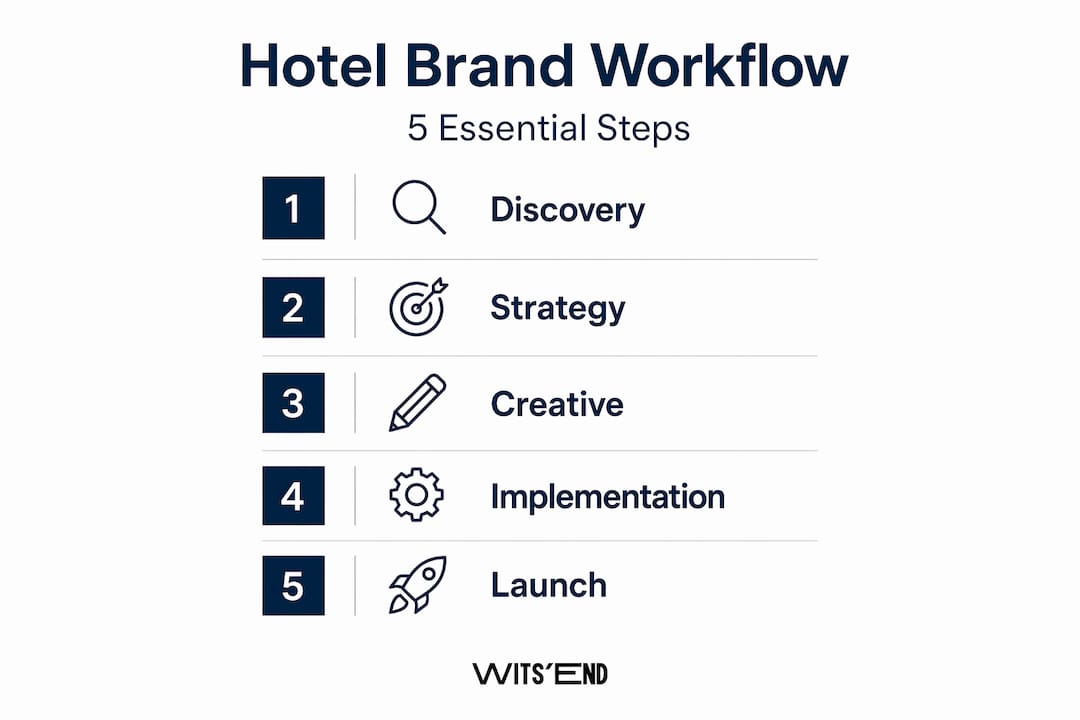
The hotel brand development workflow follows five phases: discovery and research, strategy development, creative development, implementation and rollout, and measurement and optimization. Each phase has a clear purpose and specific deliverables. Skipping or rushing one phase does not save time. It creates rework in the next.
-
Discovery and research. Stakeholder interviews, competitive analysis, guest persona development, and trade area review. You are answering one question: what does this market need that it is not getting? This phase should produce a written brief, not just a mood board.
-
Strategy development. Define your hotel brand positioning and audience definition including your unique value proposition (UVP), target segments, and two or three brand messaging pillars. Your UVP is the one thing you do better or differently than anyone else within five miles. If you cannot state it in one sentence, it needs more work.
-
Creative development. Logo, color palette, typography, photography style, verbal tone of voice, and brand guidelines. The brand guidelines document is not optional. It is the operating manual for every future vendor, designer, and marketing hire who touches your property.
-
Implementation and rollout. Signage, digital presence, room design details, uniforms, collateral, and staff training. Every physical and digital touchpoint that a guest interacts with needs to reflect the same brand. A beautiful website that does not match the experience at check-in is a broken promise.
-
Measurement and optimization. Define your KPIs (key performance indicators) before launch. Direct booking rate, brand search volume, guest satisfaction scores, and repeat visit rate are the starting four. Review them monthly for the first year.
| Phase | Primary output | Common mistake |
|---|---|---|
| Discovery | Positioning brief | Skipping competitive analysis |
| Strategy | UVP and messaging pillars | Too many target audiences |
| Creative | Brand guidelines document | Treating guidelines as optional |
| Implementation | Touchpoint activation plan | Inconsistent rollout sequence |
| Measurement | KPI dashboard | Setting metrics after launch |
Pro Tip: The brand guidelines document should be specific enough that a contractor who has never met you can produce on-brand collateral. If it is vague, it is not a guide; it is a mood board with a cover page.

With the workflow phases defined, let's examine how to approach franchise agreement negotiations critical to protecting your brand investment.
How to navigate and negotiate your hotel franchise agreement
Franchise agreements are long, dense, and written to favor the franchisor. That does not mean they are non-negotiable. It means you need to know exactly where to push and what to accept. Most first-time hotel franchise signers focus on the royalty rate and sign everything else. That is where the expensive surprises hide.
Key franchise negotiation points include capping personal guarantees, securing larger or exclusive territories, and negotiating caps on mandatory technology upgrades and capital improvement requirements. Personal guarantees without a cap can expose your personal assets well beyond the value of the property. Get a dollar cap and a sunset clause on that guarantee.
The renewal section is where many owners get caught. Renewals often force acceptance of higher fees and stricter terms, so negotiating renewal rights under original agreement terms or with caps on required property improvements is worth significant effort during the initial negotiation. Franchisors know most operators will not walk away at renewal after 10 years of investment. Negotiate as if you might.
Here are the contract clauses that need your attention:
- Section on operations manual modifications: Franchisors often retain the right to update their operations manual unilaterally. These changes can require costly new systems or procedures. Push for advance notice and a materiality threshold before you must comply.
- Termination and cure provisions: Understand exactly what triggers a default and how much time you have to cure it. Short cure windows on minor breaches are a liability.
- Transfer and assignment rights: If you plan to sell the property, the franchisor often has approval rights over the buyer. Know how restrictive those rights are before you sign.
- Territory protection: Get the protected area in writing with specific boundaries. A verbal assurance from a development rep is worth nothing.
Investing in the right staff execution and brand delivery from the beginning also reduces your exposure. Properties that deliver consistent guest satisfaction are less vulnerable to franchisor pressure at renewal because their performance metrics are strong.
Pro Tip: Hire a franchise attorney who has worked specifically on hotel franchise agreements, not general franchise law. The nuances in hotel FDDs, particularly around PIP obligations and system contribution fees, are different enough from retail or food service franchises that general experience is not sufficient.
Having secured a firm contract foundation, let's explore effective brand launch execution including marketing and operational discipline.
Executing your hotel brand rollout and launch marketing effectively
A well-designed brand that no one knows about is just a design project. Launch execution determines whether your brand enters the market with momentum or has to fight for awareness from day one. Rebranding projects often take 2-4 years with construction starting 12 to 18 months after announcement and require a 90-day intensive PPC (pay-per-click) marketing window to stabilize demand.
Plan your rollout in three layers that move in sequence.
- Internal activation first. Staff training before the brand is public. Your team needs to understand the brand story, values, and service standards before a single guest arrives. If your staff cannot articulate what makes the property different, your guests will not feel it.
- Digital presence launch. Website, Google Business Profile, and OTA (online travel agency) listings updated and consistent. Your brand name, imagery, and messaging need to match across every channel before paid media begins.
- Paid media launch. A 90-day PPC campaign covering three layers: brand name defense, non-brand category searches, and competitor conquest terms. Budget the most heavily in the first 30 days when new brand signals are weakest.
Running a phased rebrand? Do not kill the old brand's digital presence immediately. Run ads on old brand terms with "formerly [Old Name]" messaging for 60 to 90 days to capture guests searching for your previous identity.
For properties undergoing a full marketing strategies during hotel rebranding, this transition window protects demand that would otherwise go to competitors while awareness of the new brand builds organically.
Your staff brand training programs should be completed before the public launch date, not after. Every delay in training is a gap between what your marketing promises and what guests actually experience.
Pro Tip: Set up conversion tracking on your PPC campaigns before launch day. You need to know which keyword groups and ad formats are driving actual bookings, not just clicks. Adjust your budget allocation at the 30-day mark based on data, not assumptions.
Once your brand is launched, continuous measurement and optimization secure long-term success.
Measuring brand success and optimizing for long-term growth
Launching a brand is a beginning, not a finish line. The properties that build lasting market position are the ones that treat measurement as an ongoing discipline rather than a post-launch checkbox. Successful hotel brands double down on a unique differentiator embedded in every touchpoint to build emotional resonance and long-term guest loyalty.
Start with these four core metrics:
- Direct booking rate. The percentage of reservations coming through your own website versus OTAs. As your brand awareness grows, this number should rise. A stagnant direct booking rate after 12 months means your brand is not building recognition.
- Guest satisfaction scores. Track post-stay survey scores and review platform ratings weekly. Identify specific service moments that generate negative feedback and trace them back to training gaps or operational breakdowns.
- Brand search volume. Use Google Search Console to monitor how often people search your property name directly. This is one of the clearest signals of growing brand awareness.
- Repeat guest rate. If guests who had a strong first experience do not come back, your brand promise may be inconsistent across stays.
Operational discipline, consistent service delivery, and staff execution are often a stronger competitive advantage than brand narrative alone. A beautifully written brand story means very little if the room was not clean or the front desk interaction felt indifferent. Systems and training sustain brand delivery far more reliably than brand guidelines documents alone.
Build feedback loops into your operations: post-stay surveys, quarterly staff brand alignment sessions, and monthly review of OTA comment themes. When you see a pattern in guest feedback, treat it as a signal about brand delivery, not just service recovery. Embed your service delivery and experience consistency into every standard operating procedure so that brand quality becomes a habit, not a campaign.
Pro Tip: Compare your brand search volume growth against your direct booking rate growth every quarter. If search volume is rising but direct bookings are flat, you have a conversion problem on your website, not an awareness problem in the market.
Why operational discipline matters more than just a brand logo
Here is the thing most brand consultants will not tell you: your logo is one of the least important parts of your brand. Owners spend months agonizing over color palettes and font choices while underinvesting in the systems and training that actually deliver the brand to a guest.
Branding in 2026 is a living ecosystem where operational discipline is often the most defensible competitive advantage. Disconnects between what your marketing promises and what guests actually experience erode trust faster than any competitor can. A guest who reads your brand story online and then encounters a disengaged front desk agent does not just leave disappointed. They leave with a broken expectation, which is worse than no expectation at all.
We have seen properties with exceptional visual branding and mediocre review scores sitting alongside unflagged independents with no formal brand identity but operational discipline and staff execution that drives a 4.8-star rating and a 40% repeat guest rate. The second property has the stronger brand. It just does not look like it on paper.
The real investment in hotel brand creation is your people. Training them, aligning them to your brand values, and reinforcing that alignment over time is what turns a brand into a competitive position that cannot be copied by the hotel that just opened across the street. Visual identity can be replicated. Consistent guest experience, built through disciplined operations, cannot.
Empower your hotel brand with Wits' End Solutions
If you have made it through this guide, you know that a strong hotel brand is built in layers: financial clarity, strategic positioning, creative development, contract protection, staff alignment, and ongoing measurement. That is a lot to manage alongside the demands of running a property.
At Wits' End, we work alongside hotel owners and developers at every stage of this process. From brand design and development services that produce positioning strategies, visual identity, and brand guidelines built for your specific market, to training programs for hotel staff that align your team with brand values and service standards before the first guest walks in. Our analytics and hotel business optimization expertise means you have the data to make confident decisions at every phase of growth. We have done the work ourselves before we ever recommend it to you.
Frequently asked questions
What are the main phases in a hotel brand creation workflow?
The 5-phase hotel brand development process covers discovery and research, strategy development, creative development, implementation and rollout, and measurement and optimization. Each phase builds on the last and has specific deliverables that feed into your launch readiness.
How can I protect myself from high fees in a franchise agreement?
Negotiate personal guarantee caps and fee limits on technology and capital improvement requirements, and secure renewal terms that allow you to operate under original agreement conditions rather than accepting escalated fee structures automatically.
Why is staff training important in hotel brand creation?
Operational discipline and consistent service delivery are what translate your brand promise into the actual guest experience. Without trained staff who understand and deliver your brand values, even the strongest visual identity will fail to build guest trust.
How long does a hotel rebranding and rollout typically take?
Major rebranding projects take 2-4 years, with construction typically beginning 12 to 18 months after announcement. Plan for a focused 90-day marketing launch window to stabilize demand and establish the new brand in the market.