
TL;DR:
- Hospitality industry terminology is essential for clear communication across departments to prevent service failures and improve efficiency. Understanding key concepts like ADR, RevPAR, and room status classifications (OOO vs. OOS) enhances operational accuracy and financial analysis. Mastery of standardized vocabulary, supported by ISO 18513, drives professional growth and facilitates cross-departmental collaboration.
Industry terminology in hospitality is the specialized vocabulary professionals use across hotels and restaurants to communicate precisely, execute operations, and deliver consistent guest experiences. Without shared language, departments misalign, service fails, and revenue reporting becomes unreliable. This guide covers the core terms across front office, housekeeping, revenue management, and food and beverage, grounded in international standards like ISO 18513 and practical frameworks from HSMAI. Whether you are a student entering the field or a seasoned operator, fluency in this vocabulary is a direct driver of career growth and organizational performance.
What are the key hospitality terms every professional should know?
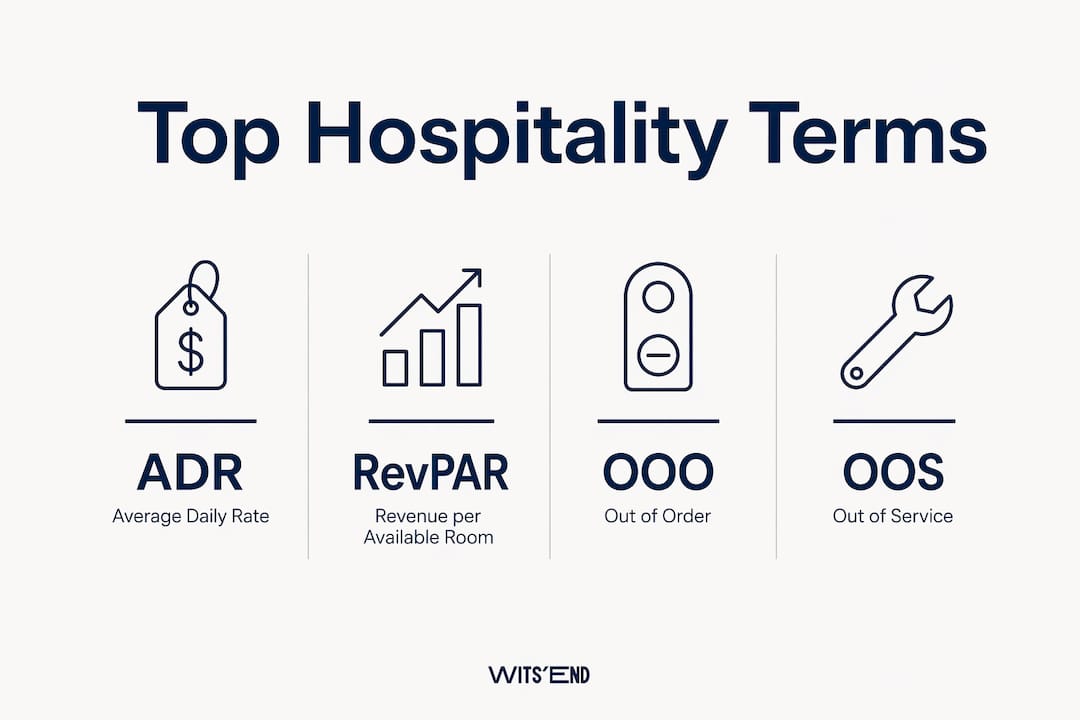
Hospitality industry terms fall into four functional clusters: front office, housekeeping, revenue management, and food and beverage. Knowing which cluster a term belongs to tells you who owns it and where miscommunication is most likely to occur.
Front office vocabulary covers the guest lifecycle from arrival to departure:
- Check-in / Check-out: The formal arrival and departure processes that trigger room status updates across the property management system (PMS).
- No-Show: A guest who holds a confirmed reservation but does not arrive. No-shows affect both revenue forecasting and room inventory decisions.
- Walk-in: A guest who arrives without a prior reservation. Misinterpreting walk-in vs. no-show can produce negative guest outcomes within minutes, particularly when front desk agents act on incorrect room availability data.
- Overbooking: Deliberately selling more rooms than are physically available, based on historical no-show rates, to protect occupancy revenue.
Housekeeping vocabulary drives labor scheduling and room readiness:
- Turnover: A full room clean and reset for an arriving guest. This is distinct from a stayover service, where a guest remains in residence and receives a lighter refresh. Confusing turnover and stay-through guests compromises housekeeping efficiency and labor scheduling directly.
- Out of Order (OOO): A room removed from inventory for an extended period due to significant maintenance or renovation. OOO rooms are excluded from occupancy calculations.
- Out of Service (OOS): A room temporarily unavailable due to a minor repair. OOS rooms are short-term and are typically not excluded from occupancy reporting.
Revenue management vocabulary connects pricing to performance:
- ADR (Average Daily Rate): Total room revenue divided by the number of rooms sold. ADR measures pricing strength but ignores unsold inventory.
- RevPAR (Revenue per Available Room): Total room revenue divided by total available rooms. RevPAR accounts for both price and occupancy, making it a far more accurate measure of asset performance than ADR alone.
| Term | Formula | What it measures |
|---|---|---|
| ADR | Room Revenue / Rooms Sold | Pricing strength |
| RevPAR | Room Revenue / Rooms Available | Overall revenue efficiency |
| Occupancy Rate | Rooms Sold / Rooms Available | Demand capture |
Pro Tip: When presenting performance to ownership, always lead with RevPAR. ADR in isolation can look strong even when occupancy is collapsing, which creates a misleading picture of property health.
Technology tools like property management systems and channel managers automate bookings and simplify daily operations, but only when the team using them understands the terminology behind the data those systems produce.

How does standardized terminology improve hotel operations and guest experience?
ISO 18513 is the international standard that defines hotel and tourism terminology to reduce miscommunication between properties, guests, and distribution partners. ISO 18513:2021 establishes vocabulary standards specifically to reduce operational failures caused by inconsistent term usage across room types, meal plans, and service descriptions. The practical implication is significant: when a hotel's internal definition of "half board" does not match a guest's expectation formed through an OTA listing, the result is a service failure that no amount of recovery can fully repair.
Terminology alignment also accelerates interdepartmental collaboration. When a front office agent, a revenue manager, and a housekeeping supervisor all use the same definition of OOO versus OOS, maintenance scheduling and revenue forecasting stay synchronized. Without that alignment, a room flagged incorrectly as OOO rather than OOS gets excluded from sellable inventory, and the property loses revenue it could have captured.
"Terminology standards serve as essential service design tools connecting hotel internal definitions to guest expectations." — ISO 18513 research insight
Training programs that embed ISO 18513 definitions from day one produce faster onboarding and fewer service errors. New hires who learn the standard vocabulary alongside their operational tasks build a mental model that transfers across departments and properties. This is particularly valuable for multi-property groups where staff rotate between locations.
Pro Tip: Build a one-page hospitality vocabulary list into your new hire orientation packet. Include the ISO 18513 definitions for room types and meal plans alongside your property-specific terms. It takes 20 minutes to create and eliminates weeks of correctable confusion.
What hospitality financial and operational metrics are essential to understand?
Financial fluency is not optional for hospitality professionals who want to influence decisions above the department level. The terms below appear in every budget meeting, ownership report, and strategy review.
ADR and RevPAR are the two metrics ownership and asset managers reference most. ADR tells you what you charged; RevPAR tells you how well you filled the house at that price. A property with a high ADR and low occupancy will show a weak RevPAR, signaling a pricing strategy that is not aligned with demand. Understanding both metrics and the relationship between them is the foundation of revenue management literacy.
OOO vs. OOS carries direct financial consequences. OOO rooms are long-term unavailable and excluded from occupancy; OOS rooms are short-term and typically remain in the denominator for occupancy calculations. Misclassifying a room as OOO when it should be OOS inflates your occupancy percentage artificially, which distorts RevPAR and misleads ownership on true asset performance.
Gross Revenue vs. Net Revenue is where many operators make P&L reporting errors. OTA agreements often operate on a net basis, deducting commissions before income is recognized. A booking that appears as $200 in gross revenue may only contribute $160 in net revenue after a 20% OTA commission. Reporting gross without accounting for this creates a false picture of profitability.
| Metric | Definition | Common mistake |
|---|---|---|
| ADR | Room revenue divided by rooms sold | Using it as the sole performance indicator |
| RevPAR | Room revenue divided by rooms available | Ignoring the occupancy component |
| OOO | Long-term room removal from inventory | Confusing with OOS, distorting occupancy data |
| OOS | Short-term room unavailability | Treating it as OOO and losing sellable inventory |
| Net Revenue | Gross revenue minus OTA commissions | Reporting gross only and overstating profit |
Pro Tip: Always confirm with your finance team whether your PMS is reporting gross or net revenue before presenting numbers to ownership. The difference can be significant enough to change a profitability conversation entirely.
How does mastering hospitality terminology support professional growth?
HSMAI identified over 108 essential hospitality terms required for sales and operational professionals to advance and improve organizational efficiency. Terms like displacement analysis, EBITDA, and FFO appear in budget discussions and ownership presentations. Professionals who do not know them are excluded from those conversations by default, regardless of their operational competence.
The career benefit of terminology fluency extends beyond your own department. A sales manager who understands RevPAR and ADR can advocate more effectively for rate strategy decisions. A food and beverage director who understands F&B profitability metrics can defend menu pricing in a P&L review. Mastering terms across revenue management and accounting allows sales leaders to navigate budget and strategy discussions with authority.
Breaking down departmental silos requires a shared language. When operations, sales, and finance teams use different definitions for the same concept, strategy execution breaks down at the handoff points. Successful hospitality leaders build cross-functional fluency deliberately, not by accident.
Here are practical ways to build your hospitality vocabulary list continuously:
- Read department reports outside your own. If you work in F&B, read the weekly rooms report. If you work in sales, read the housekeeping labor summary.
- Ask for definitions in meetings. When an acronym appears that you do not recognize, ask. No one in a professional setting will penalize curiosity.
- Use HSMAI resources. Their published glossaries and training materials cover the financial and operational terms that appear most frequently in senior-level discussions.
- Embed terminology into training. If you manage a team, build a structured training program that introduces new vocabulary in the context of real operational scenarios, not abstract definitions.
- Review your service standards regularly. Terminology and service standards are inseparable. When one evolves, the other must follow.
Terminology fluency is also a signal of professional credibility. In budget meetings and ownership reviews, the professionals who use precise language are the ones who get heard. Vague language signals vague thinking. Precise language signals command of the operation.
Key takeaways
Mastering industry terminology in hospitality requires consistent application across front office, housekeeping, revenue management, and F&B, grounded in standards like ISO 18513 and reinforced through structured training.
| Point | Details |
|---|---|
| Standardized vocabulary reduces failures | ISO 18513 aligns internal definitions with guest expectations, preventing service breakdowns. |
| RevPAR outperforms ADR as a metric | RevPAR captures both price and occupancy, giving a complete picture of revenue performance. |
| OOO vs. OOS distinction matters financially | Misclassifying room status distorts occupancy data and misleads ownership on asset performance. |
| Net revenue accuracy prevents P&L errors | OTA commissions must be deducted before reporting revenue to avoid overstating profitability. |
| Terminology fluency drives career advancement | HSMAI links mastery of 108+ terms to career growth and stronger cross-departmental strategy execution. |
Why terminology is the first thing I fix on any property
When Wits' End Solutions walks into a new engagement, one of the first things I look for is how the team talks to each other. Not what systems they use or what their RevPAR is. How they talk. If a front desk agent says "the room is out of order" when they mean it needs a light bulb replaced, that is an OOS situation being treated as OOO. That one misclassification can pull a room from sellable inventory for days and nobody flags it because everyone is using the same wrong term.
The properties that run well share a common language. Every department uses the same definitions for the same concepts. That consistency does not happen by accident. It comes from deliberate onboarding, written standards, and managers who correct terminology errors the same way they correct service errors. I have seen teams with outdated PMS systems outperform properties with modern technology simply because their communication was precise.
My advice to students entering the field: learn the financial terms before you think you need them. Understanding ADR, RevPAR, and net versus gross revenue before your first management role puts you in a different category from your peers. And to operators: if your team cannot define the difference between OOO and OOS without hesitation, that is a training gap with a direct cost attached to it.
— Chris
How Wits' End Solutions builds operational clarity into your team
At Wits' End Solutions, we work with hotels and restaurants at every stage of the business lifecycle, from concept through daily operations. Our training programs are built around the real vocabulary your team uses on property, not generic hospitality theory. We embed terminology standards into onboarding, service design, and cross-departmental communication frameworks so your team speaks the same language from day one. If your operation is experiencing service inconsistencies, P&L reporting confusion, or interdepartmental friction, a terminology audit is often the fastest fix. Reach out to Wits' End Solutions for a consultation and let us show you what clearer communication does for your bottom line.
FAQ
What is industry terminology in hospitality?
Industry terminology in hospitality refers to the specialized vocabulary used by hotel and restaurant professionals to communicate operational, financial, and service-related concepts precisely. Terms like ADR, RevPAR, OOO, and turnover are examples of this shared language.
Why does ISO 18513 matter for hotel operations?
ISO 18513 establishes international definitions for hotel and tourism terms, reducing miscommunication between properties, guests, and distribution partners. Inconsistent term usage in room types and meal plans directly causes service failures in guest experience.
What is the difference between ADR and RevPAR?
ADR measures revenue per room sold, while RevPAR measures revenue per room available. RevPAR is the more accurate performance indicator because it accounts for both pricing and occupancy simultaneously.
What is the difference between OOO and OOS rooms?
OOO (Out of Order) rooms are removed from inventory for extended periods and excluded from occupancy calculations. OOS (Out of Service) rooms are temporarily unavailable due to minor repairs and typically remain in the occupancy denominator.
How does terminology fluency support career advancement in hospitality?
HSMAI identifies over 108 terms tied to career advancement in hospitality sales and operations. Professionals who understand financial and cross-departmental vocabulary participate more effectively in budget discussions and strategy decisions.