
A well-run restaurant secret shopper program gives you an objective view of what guests actually experience, not what your shift reports claim happened. It works through structured in-person, phone, online, and video visits scored against your own brand standards. Most operators can identify coaching gaps and begin to see measurable service improvements within a few weeks to several months.
TL;DR:
- Regularly tracking key performance indicators such as average check size, service recovery rate, and speed of service helps detect issues before they impact guest satisfaction.
- Diverse visit types, including in-person, phone, online, and video shops, evaluate all guest touchpoints and channel-specific processes for comprehensive insights.
- Ongoing scheduling should be aligned with specific goals, covering all revenue channels and varying evaluators to prevent staff recognition and bias.
- Rapid, actionable reporting within days enables quick coaching on issues like upselling gaps or slow service, while long-term trends reveal persistent problems and training effectiveness.
- A successful program hinges on strong follow-up, consistent scoring, and integrating findings into operational routines, rather than just collecting data for its own sake.
Table of Contents
- What Does a Restaurant Secret Shopper Program Actually Deliver?
- What Do Secret Shoppers Check, and Which Visit Type Fits?
- How Often Should You Schedule Shops, and Who Should Do Them?
- From Report to Action: Closing the Coaching Loop
- How Do You Keep Shopper Data Reliable?
- Wits' End's Take: Start Small, Verify Everything
- What Legal and Ethical Rules Apply to Secret Shopper Visits?
- What Should You Budget for a Secret Shopper Program?
- Why Most Programs Fail Before They Start
- Ready to Put a Verified Program in Place?
- Resources Worth Bookmarking
- Sources
- FAQ
What Does a Restaurant Secret Shopper Program Actually Deliver?
The return shows up in specific numbers, not vague "better service" claims. Operators running consistent evaluations typically see shifts such as higher average check size from suggestive selling, fewer service recovery complaints, and stronger guest satisfaction scores tied to speed and accuracy.
The operational payoff is speed of detection. A shift manager might not notice that three servers skip the wine pairing mention, but a structured shop catches it in one visit instead of three months of declining dessert sales. That compounding effect is why the practice functions as a restaurant secret shopper program rather than a one-off inspection: consistency of measurement is what makes the data usable.
Track these KPIs from day one:
- Average check per cover, to catch upselling gaps
- Service recovery rate, meaning how often a mistake gets corrected before the guest complains
- Speed of service by meal period, since lunch and dinner breakdowns rarely match
Programs that report data into a standing operations review, rather than a one time PDF, tend to convert findings into action faster, according to Altametrics. Expect your first meaningful trend line after multiple shops per location.
What Do Secret Shoppers Check, and Which Visit Type Fits?
A useful restaurant secret shopper checklist follows the entire guest journey, not just the food. Cover these touch points on every visit:
- Reservation or waitlist experience and greeting time
- Host stand accuracy and table assignment
- Server knowledge, upsell attempts, and order accuracy
- Food quality, temperature, and plating consistency
- Ticket timing from order to delivery
- Bill accuracy and payment process
- Departure experience and thank you
Channel matters as much as checklist content. Dine-in visits test the full sequence above. Phone orders test hold times, order accuracy, and upsell scripting. Delivery app and pickup shops test packaging integrity and temperature retention, which dine-in checklists never touch.
In-person mystery shopping remains the standard for full-journey evaluation. Phone-based shops isolate call handling and order accuracy without the variable of table service. Online and app-based shops test digital ordering flow and fulfillment accuracy. Video mystery shopping adds unfiltered visual proof of interactions that a written report cannot fully capture, per Altametrics.
Pro Tip: Build your checklist directly from your existing brand standards manual rather than a generic template. If your steps of service document specifies a wine offer at the table, that becomes a checklist line item, not a vague "upselling attempted" box.
How Often Should You Schedule Shops, and Who Should Do Them?
Scope and frequency depend entirely on what you're trying to fix. Start here:
- Define the purpose before writing the checklist. A speed of service problem needs timing data every visit; a training rollout needs pre and post comparison shops.
- Set sampling rules by footprint. A single unit typically needs a few shops monthly across different dayparts. Multi-unit groups should sample every location periodically, rotating shift and meal period so managers can't predict the visit.
- Cover every channel that generates revenue. If delivery apps drive 30% of sales, they need proportional shop coverage, not an afterthought.
- Rotate evaluators and vary their profiles. A shopper who visits the same location repeatedly gets recognized by staff, which defeats the purpose. Age, party size, and visit time should vary too.
- Set a steady state cadence and pilot faster at launch. Run shops weekly for the first month to establish a baseline, then settle into monthly or quarterly rhythm once trends stabilize.
Increase frequency temporarily after a menu launch, a leadership change, or a spike in negative reviews. These triggers usually signal that staff behavior is drifting from standard faster than your normal cadence would catch.
From Report to Action: Closing the Coaching Loop
A report that sits in an inbox accomplishes nothing. The report itself needs specific components: numeric scores against each checklist item, timing data down to the minute, a narrative section explaining context, photo or video evidence, and a flagged priority list separating urgent fixes from minor notes.
Turnaround speed determines whether findings stay actionable. Delivering results within a few days means a manager can address a coaching issue with the actual shift still fresh in staff memory, instead of investigating a vague complaint from three weeks ago. Make shopper findings a fixed line item on your monthly operations agenda rather than a special event, a practice Altametrics recommends for keeping the data useful over time.
Translate specific findings into specific fixes:
- A missed wine offer becomes a one line addition to the server coaching script, rehearsed at the next preshift.
- A slow ticket time on Friday dinner becomes an A/B test on expo staffing during that window.
- A pattern of departure experience gaps across three locations becomes an SOP revision, not three separate conversations.
Trend data earns its value here. One shop tells you what happened on one night. Six months of shops tell you whether your new hire training actually works, and which manager's shift consistently underperforms. Use that longer view to build recognition programs for locations or shifts that consistently score above target. Reviewing findings alongside broader restaurant customer experience practices helps connect individual shop results to loyalty outcomes rather than treating each report as an isolated event.
How Do You Keep Shopper Data Reliable?
Data quality determines whether anyone trusts the results enough to act on them. A single sloppy report can poison a manager's confidence in the entire program, so quality control isn't optional overhead. It's the difference between a program people use and one they ignore.
Build these checks into every cycle:
- Editor review of every report before it reaches operations, catching inconsistent scoring or vague narrative before it causes confusion.
- Score calibration across evaluators, so a "3 out of 5" means the same thing whether shopper A or shopper B wrote it.
- Duplicate and pattern detection, flagging when the same evaluator or same time slot keeps appearing.
Video mystery shopping earns its keep here, but selectively. Used as a training artifact, a short clip of an actual service breakdown accelerates behavior change faster than a written description ever could. Used as constant surveillance, it damages trust with staff and yields diminishing returns. Keep privacy and disclosure practices aligned with your state's recording laws before rolling out video shops broadly.
Push scored data directly into whatever dashboard your managers already check daily, rather than a separate report they have to remember to open. Wits' End Solutions structures this kind of reporting and dashboard integration so shopper findings sit alongside the other numbers operators already track.
Pro Tip: Save video evidence for your highest-priority findings only. If you record every visit, staff eventually treat every shift like it's being filmed, which defeats the purpose of an unannounced evaluation.
Wits' End's Take: Start Small, Verify Everything
Operators who see the fastest results usually start with a pilot rather than a full rollout. Four to six shops across a handful of locations, tied to three specific KPIs, gives you a clean baseline before you commit budget to a full annual cycle.
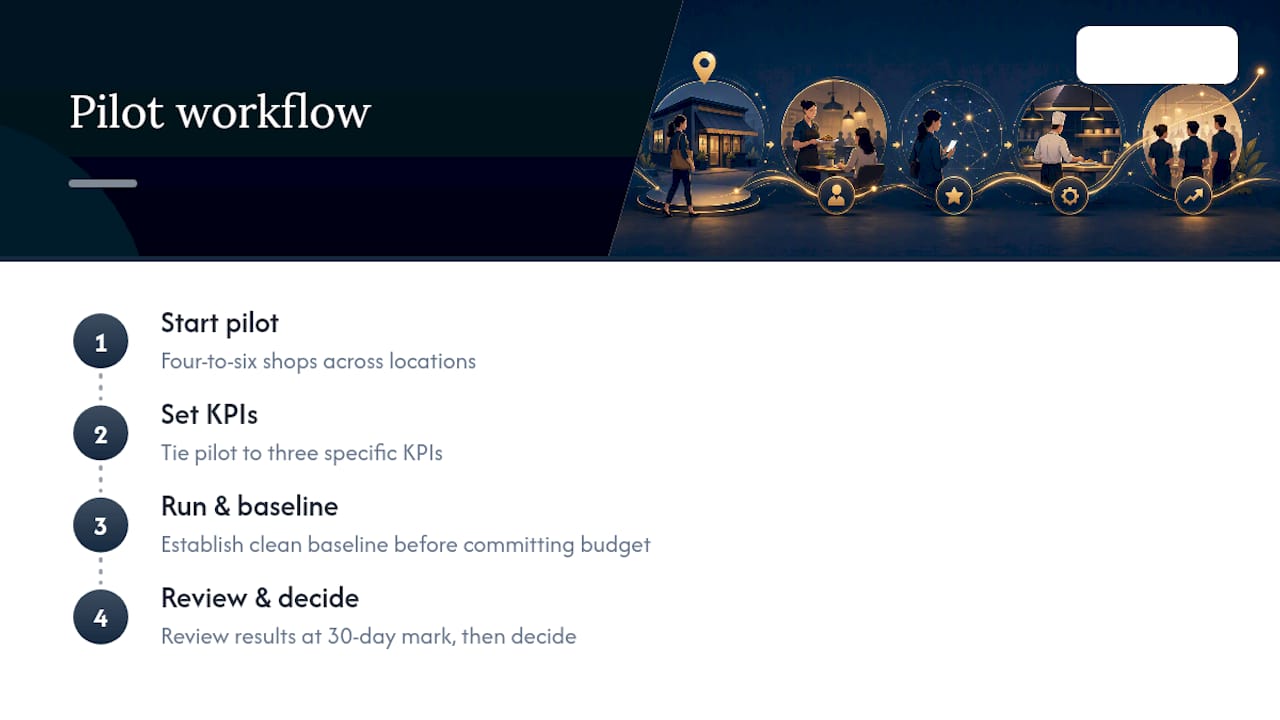
Wits' End Solutions has applied this exact discipline in hospitality settings where verified secret shopper audits contributed to measurable revenue gains within a 30 to 90 day window. The lesson translates directly to restaurants: pick your three KPIs, run your pilot, review results at the 30-day mark, and only then decide whether to scale.
What separates a useful audit from a wasted one is the same principle every human editor review depends on: consistent scoring across every shopper, every visit, every location. Skip that step and the data becomes noise dressed up as insight.
What Legal and Ethical Rules Apply to Secret Shopper Visits?
Secret shopping sits in well-established legal territory, but a few boundaries matter. Evaluators posing as ordinary guests to assess public-facing service is standard commercial practice and not deceptive in a legally actionable sense, since they're engaging in the exact transaction any guest would make.
Recording is where operators need to pay closer attention. Video and audio recording laws vary by state. Some states require only one party to consent to a recording, while others require every party's consent, which affects whether a video mystery shop can capture staff conversations without prior notice. Confirm your state's requirement before deploying video shops, and keep any recorded footage limited to training and coaching purposes rather than public use or punitive action against a specific employee without review.
Compensation transparency protects the integrity of your data. Reputable programs pay shoppers a flat fee plus reimbursement for the visit, and never charge evaluators to participate. Shared Insight notes that legitimate mystery shopping platforms will never ask a shopper to pay to join, a warning sign worth passing along if you're recruiting your own evaluator pool rather than working through an established portal.
Finally, treat findings as coaching tools, not disciplinary weapons. Using a single shopper visit to justify termination undermines trust in the entire program and discourages honest engagement from staff once word gets around that shops function as gotcha exercises rather than improvement tools.
What Should You Budget for a Secret Shopper Program?
Cost scales with visit volume, evaluator sophistication, and how much reporting infrastructure you need. A single-unit operator running a handful of monthly shops spends far less than a multi-unit group covering twenty locations across three channels every quarter.
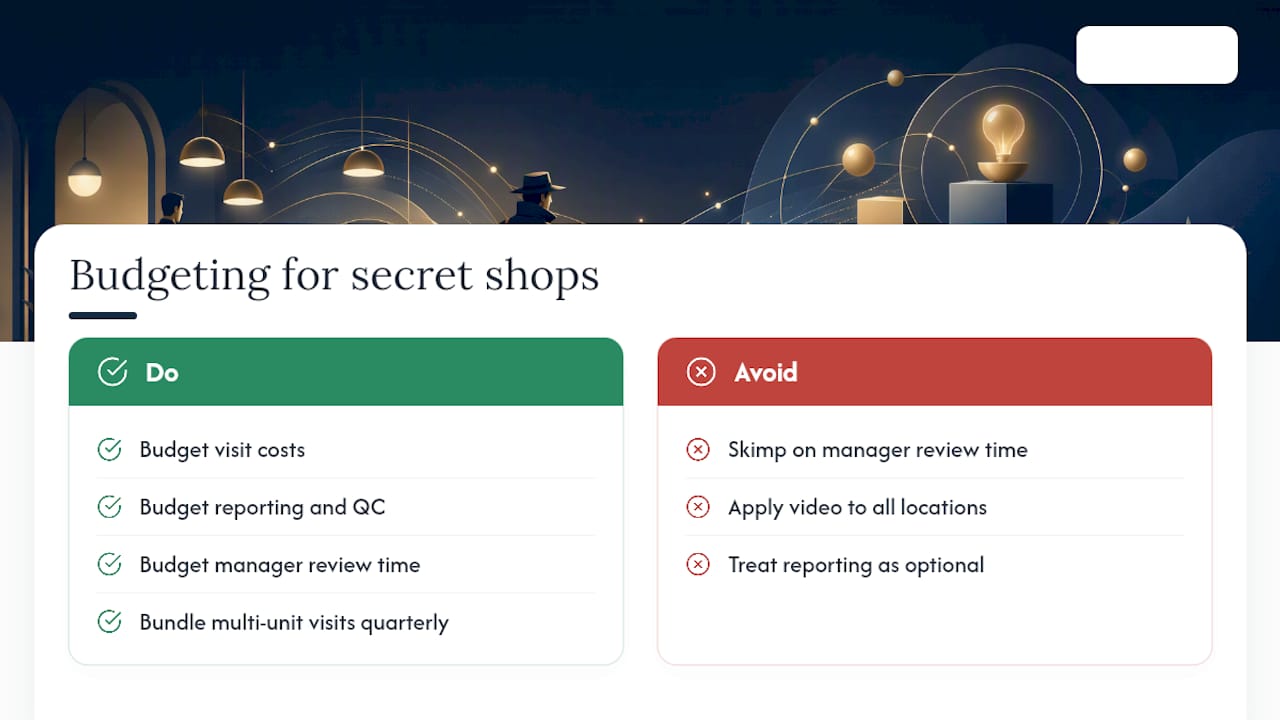
The real budget conversation isn't just per-shop cost. Factor in three components: the visit itself, including reimbursement and evaluator compensation; the reporting and quality control layer that turns raw notes into a usable score; and the internal time your managers spend reviewing findings and running coaching sessions. Skimping on the third component is the most common mistake operators make. A stack of detailed reports nobody reviews delivers zero return regardless of how much the shops themselves cost.
Video shops typically carry a premium over standard written reports, given the added evaluator training and file handling involved. Reserve video for your highest-stakes locations or your most persistent problem areas rather than applying it across your entire footprint.
Multi-unit groups get better per-shop economics by bundling visits across locations into a single quarterly cycle rather than running each location on a separate ad hoc schedule. That bundling also makes benchmarking across locations far more useful, since every shop uses the same checklist, timeframe, and evaluator pool. Whatever your footprint, treat the reporting and coaching follow-through as a fixed cost, not an optional add-on. A Wits' End Solutions engagement typically scopes visit volume against your specific budget and location count before a single shop is scheduled, which avoids the common trap of overpaying for coverage you don't need.
Why Most Programs Fail Before They Start
The conventional advice treats secret shopper programs like a purchase decision: pick a vendor, set a frequency, wait for reports. That framing misses the actual point of failure, which happens after the report arrives, not before.
Most programs that fizzle out do so because nobody owns the coaching loop. A general manager gets a report showing a recurring problem, mentions it once at a preshift meeting, and moves on. Three months later the same issue shows up again because nothing structural changed. The checklist wasn't the weak link. The follow through was.
What the research and practitioner guidance actually support is treating shopper data as a standing operations input, reviewed on a fixed schedule, tied to specific coaching scripts and SOP revisions rather than general reminders. Programs that skip video entirely but nail that follow through loop tend to outperform programs with expensive video setups and no accountability structure behind them.
Prioritize the review cadence and the coaching conversion process before you worry about evaluator sophistication or shop frequency. Get that part right, and even a modest four shop pilot will outperform a bloated annual program nobody actually reads.
— Chris
Ready to Put a Verified Program in Place?
Some firms run secret shopper audits built around your specific brand standards rather than a generic template, with every report passing through human quality review before it reaches your team. Broad restaurant consulting engagements often take months to show measurable change, but a focused audit pilot can surface actionable coaching priorities inside a single review cycle.
A typical engagement includes a custom checklist matched to your concept, scheduled visits across the channels that matter most to your revenue, prioritized reporting with clear coaching priorities, and a follow-up coaching session to walk your management team through the findings. Many pilot clients see their first actionable report within weeks of kickoff, not months.
If you're ready to see what an objective view of your guest experience actually looks like, visit the Wits' End Solutions services page to scope a pilot audit for your locations.
Resources Worth Bookmarking
If you're building or recruiting for a shopper program, a few resources are worth a look. Shared Insight's mystery shopper application shows how legitimate evaluator recruitment works, useful context if you're vetting your own pool. ShopperHub's shopper portal illustrates how larger programs centralize scheduling and assignment management. For broader context on why service consistency drives loyalty, Wild Foodz's guide to customer service in hospitality connects shopper findings to the bigger guest experience picture.
Sources
- Become a mystery shopper | Shared Insight
- Secret Shoppers — Altametrics
- Apply to be a mystery shopper — ShopperHub (CX Group)
FAQ
How Do I Become a Mystery Shopper for Restaurants?
Sign up through a legitimate portal such as Shared Insight or a similar shopper platform, complete a profile, and accept assignments that include clear instructions and payment details before your visit.
How Much Does a Secret Shopper Get Paid?
Pay varies by assignment complexity and reimbursement structure, typically a flat fee plus reimbursement for the meal purchased, though exact rates depend on the program and the scope of the report required.
What Are the Requirements to Be a Secret Shopper?
Most programs require reliable attention to detail, discretion, and the ability to complete a detailed report shortly after the visit. Legitimate programs never charge a fee to join, which is a key sign to watch for when evaluating an opportunity.
What Is the Best Secret Shopper Company to Work For?
The right fit depends on whether you want a general consumer platform or a restaurant-specific program that pairs evaluators with human-reviewed reporting, like the model Wits' End Solutions uses for its hospitality clients.
How Much Does a Wits' End Secret Shopper Audit Cost?
Pricing depends on the number of locations, shop frequency, and reporting scope, so current rates are available directly through the Wits' End Solutions services page.