
TL;DR:
- Food and beverage management oversees all hospitality operations, from menu planning to cost control, ensuring consistency and profitability. It relies on integrated systems and management functions like planning, organizing, coordinating, directing, and controlling to prevent operational drift. Successful operators focus on disciplined routines, real-time data, and systematic procedures to sustain growth and competitive advantage.
Food and beverage management is the integrated oversight system governing every aspect of food and drink operations in hospitality businesses, from menu planning and procurement through staffing, cost control, and service coordination. Known formally as F&B management, it sits at the intersection of culinary operations and business administration, making it one of the most demanding disciplines in hospitality. The goal is not simply to serve good food. It is to deliver consistent guest experiences while protecting margins across every shift, every outlet, and every season. Modern F&B management increasingly relies on point-of-sale systems, inventory platforms, and sales analytics to support that balance.
What is F&B management and what does it actually cover?
F&B management is defined as the integrated system of strategic oversight that includes menu planning, procurement, inventory control, cost management, staff scheduling, and service coordination. These six pillars are not independent functions. They operate as a single system, and a breakdown in any one of them creates pressure across all the others. A procurement error, for example, cascades into inventory shortfalls, menu gaps, and guest complaints within 24 hours.

Menu planning sets the creative and financial foundation. Every dish on a menu carries a food cost percentage, a production time, and a sales expectation. Procurement translates that menu into supplier relationships, purchase orders, and delivery schedules. Inventory control tracks what arrives, what gets used, and what gets wasted, giving managers the data to tighten ordering cycles and reduce spoilage.
Cost management sits above all of these. Labor, food cost, and overhead must be tracked against revenue daily, not monthly. Staffing and training determine whether the service experience matches the menu's promise. Service coordination ties the kitchen and the floor together, making sure production speed and table pacing stay aligned.
Pro Tip: When developing a new menu, run a cost analysis on every item before it goes live. Creativity without cost discipline is the fastest way to erode margins.
| F&B management | Restaurant management |
|---|---|
| Covers multiple outlets and departments | Focuses on a single venue |
| Includes catering, banquets, and hotel dining | Primarily daily restaurant operations |
| Requires cross-department coordination | Manages one team and one kitchen |
| Strategic and operational scope | Primarily operational scope |
How does the F&B management operational lifecycle work?
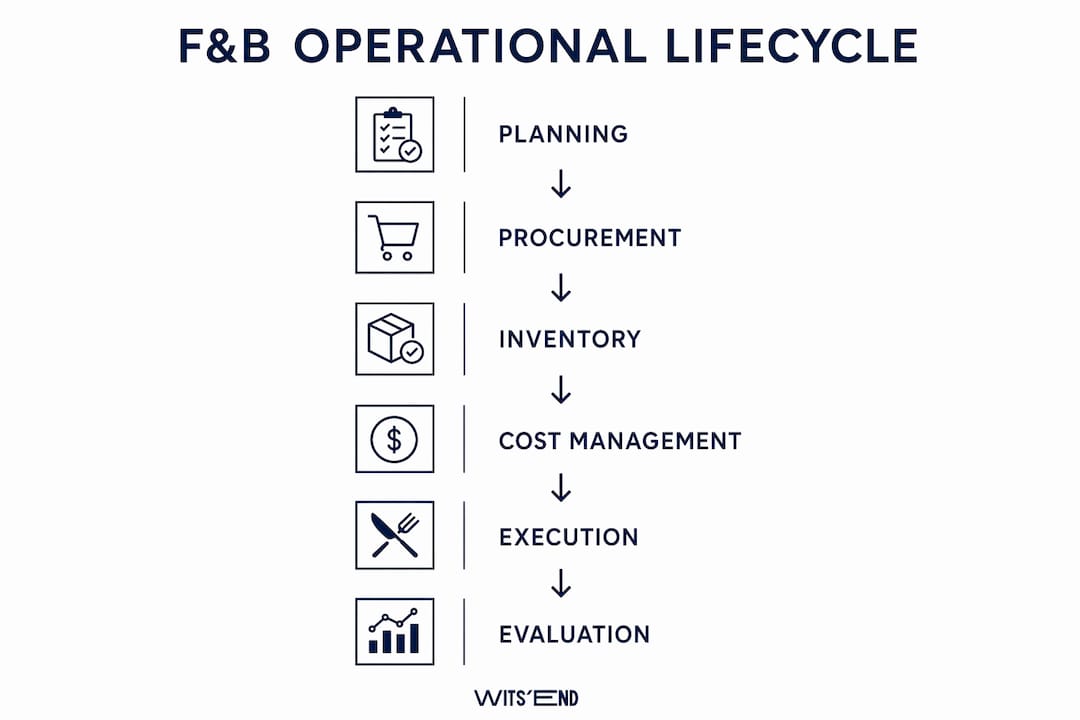
The operational lifecycle of F&B management relies on five management functions: planning, organizing, coordinating, directing, and controlling. Together, they transform raw ingredients and human effort into consistent, repeatable results.
- Planning operates at three levels. Strategic planning sets annual revenue targets, concept direction, and capital investment priorities. Operational planning translates those targets into weekly schedules, purchasing budgets, and menu cycles. Supervisory planning covers daily prep lists, staffing assignments, and service briefings.
- Organizing defines the role structure. Who owns purchasing decisions? Who approves menu changes? Who manages the floor during peak service? Clear accountability prevents the ambiguity that causes operational drift.
- Coordinating is where most F&B operations lose ground. The most common failure point is the gap between front-of-house service speed and back-of-house production capacity. Structured pre-shift meetings, shared ticket systems, and clear communication protocols are the practical tools that close this gap.
- Directing goes beyond onboarding. Continuous staff training and supervision aligned to brand service standards are what create the guest experience that feels polished rather than improvised. This is especially critical during peak periods when operational stress is highest.
- Controlling acts as the quality assurance mechanism. It catches deviations from standards and budgets before they compound into financial losses. Daily P&L reviews, waste logs, and guest feedback loops are the instruments of control.
Pro Tip: Schedule a 10-minute pre-shift meeting between your kitchen lead and floor manager every day. This single habit resolves the majority of coordination gaps before service starts.
| Function | Objective | Typical activities |
|---|---|---|
| Planning | Set direction and targets | Budgeting, menu cycles, scheduling |
| Organizing | Define accountability | Role assignments, reporting structure |
| Coordinating | Align production and service | Pre-shift meetings, ticket systems |
| Directing | Drive performance | Training, coaching, service standards |
| Controlling | Maintain standards and margins | P&L review, waste tracking, audits |
How does F&B management differ from restaurant management?
Restaurant management typically focuses on the daily operations of a single venue, while F&B management covers multiple outlets, departments like catering and banquets, and entire hospitality groups or regions. This is not a subtle distinction. It changes the required skill set, the decision-making scope, and the organizational complexity entirely.
A restaurant manager at a standalone bistro in Chicago manages one kitchen, one floor team, and one P&L. An F&B director at a full-service hotel in New York may oversee a lobby bar, a signature restaurant, room service, a rooftop venue, and a catering operation simultaneously. Each outlet has its own cost structure, staffing model, and guest profile.
The broader scope of F&B management demands skills that go well beyond running a great dinner service:
- Multi-unit financial oversight: Reading and reconciling P&Ls across outlets with different revenue mixes and cost structures.
- Cross-department coordination: Aligning the kitchen, service teams, purchasing, and event sales around shared operational goals.
- Vendor and contract management: Negotiating supplier agreements that serve multiple menus and volume requirements.
- Brand consistency: Maintaining a coherent guest experience across venues that may have distinct concepts and price points.
- Strategic planning: Contributing to capital expenditure decisions, concept development, and long-term revenue strategy.
Large-scale event catering adds another layer. A single corporate event for 500 guests requires production planning, logistics coordination, and staffing models that have nothing in common with nightly restaurant service. F&B managers who work in hotel or resort environments regularly operate across all of these contexts at once.
What are the modern challenges in food and beverage management?
F&B management combines culinary arts with business administration, finance, and data-driven marketing. Businesses that fail to achieve this balance face operational instability, and the current environment makes that balance harder to maintain than ever.
The most significant modern challenges, and the best practices addressing them, include:
- Sustainability as a competitive requirement. Sustainability and sales data analysis are now cornerstones of modern F&B management, not optional initiatives. Operators who build sourcing relationships with local and regional producers reduce supply chain risk while meeting guest expectations around responsible practices.
- Data analytics for menu optimization. Menu engineering is a dynamic necessity requiring ongoing analysis of sales velocity versus food cost percentages. This process should run weekly or monthly, not as a one-time creative exercise. Items that sell well but carry high food costs need reformulation or repricing. Items that carry strong margins but low sales need repositioning or removal.
- Technology adoption. Point-of-sale systems, inventory management software, and customer feedback platforms enable real-time data gathering that supports proactive decision-making. Operators still running inventory on spreadsheets are working with a 48-hour lag on information that should be available in real time.
- Staff training and culture. Consistent quality is a people problem as much as a systems problem. Building a culture where standards are understood, practiced, and reinforced daily is what separates operations that scale from those that plateau.
Pro Tip: Pull your menu sales mix report every two weeks. If your top five sellers by volume are not also among your top five by margin, you have a menu engineering problem worth solving immediately.
Practical steps for implementing F&B management principles
Knowing the framework is one thing. Putting it into practice across a live operation requires deliberate sequencing. These are the steps that produce durable results:
- Build documented operational systems first. Documented frameworks prevent quality fluctuations as operations grow. Standard operating procedures for opening, closing, prep, and service should exist in writing before you scale a single outlet.
- Apply menu engineering on a fixed schedule. Use your POS data to run a four-quadrant analysis of your menu monthly. Stars (high sales, high margin) stay. Puzzles (high margin, low sales) get repositioned. Plowhorses (high sales, low margin) get reformulated. Dogs get cut.
- Schedule labor against revenue forecasts, not habits. Build your staffing model from projected covers and revenue, not from last week's schedule. Labor cost as a percentage of revenue is a controllable number when scheduling is treated as a financial decision.
- Tighten procurement with par levels and vendor scorecards. Set par levels for every high-cost ingredient and review them monthly. Score your vendors on delivery accuracy, quality consistency, and price stability. Replace vendors who underperform before the cost shows up in your P&L.
- Create feedback loops that close within 24 hours. Guest feedback, waste logs, and daily sales reports should be reviewed the morning after service, not at the end of the month. Fast feedback cycles allow you to correct problems before they become patterns.
For operators building these systems from the ground up, a menu creation process grounded in cost analysis and guest data is the right place to start.
Key takeaways
Effective F&B management requires integrating six operational pillars, five management functions, and real-time data systems to deliver consistent guest experiences and protect profitability across every outlet.
| Point | Details |
|---|---|
| Six operational pillars | Menu planning, procurement, inventory, cost management, staffing, and service coordination work as one system. |
| Five management functions | Planning, organizing, coordinating, directing, and controlling prevent operational drift and financial loss. |
| F&B vs. restaurant management | F&B management covers multiple outlets and departments; restaurant management focuses on a single venue. |
| Menu engineering is ongoing | Sales velocity and food cost analysis should run weekly or monthly, not as a one-time task. |
| Technology closes information gaps | POS systems and inventory platforms replace lagging spreadsheet data with real-time operational visibility. |
What I've learned from watching F&B operations succeed and fail
The operators who struggle most with F&B management are usually not struggling with the culinary side. They are struggling with the systems side. A talented chef running a kitchen without documented procedures, real-time cost data, or a structured communication protocol with the floor team will eventually hit a ceiling. The food may be excellent. The operation will still leak money and consistency.
What I have seen work, consistently, is treating F&B management as a discipline that requires the same rigor as financial management. That means weekly menu reviews, daily P&L check-ins, and pre-shift communication as non-negotiable habits rather than aspirational practices. The F&B strategy that drives profitability is almost never a creative breakthrough. It is the accumulation of small, disciplined decisions made every day.
The sustainability and analytics trends reshaping hospitality right now are real, and they reward operators who already have strong operational foundations. If your systems are solid, layering in data analytics and sustainable sourcing creates genuine competitive advantage. If your systems are not solid, those same tools just add complexity to an already unstable operation. Get the fundamentals right first.
— Chris
How Wits' End Solutions supports your F&B operation
Wits' End Solutions works with hotels, restaurants, and food and beverage groups across the United States at every stage of the business lifecycle. Whether you need help building operational systems from scratch, tightening cost controls on an existing operation, or deploying deep analytics to drive better decisions, the team brings direct operating experience to every engagement. From concept development and menu engineering to staff training and task force support, Wits' End Solutions can step in at the level your business actually needs. Explore the full range of hospitality services and find out where the right support can make the biggest difference for your operation.
FAQ
What is the F&B management definition?
F&B management is the integrated system of strategic oversight covering menu planning, procurement, inventory control, cost management, staffing, and service coordination in hospitality operations. Its goal is to deliver consistent guest experiences while protecting profitability.
What does F&B management involve on a daily basis?
Daily F&B management involves reviewing P&L data, managing staff schedules, coordinating kitchen and floor operations, monitoring inventory levels, and addressing guest feedback. Pre-shift meetings and waste tracking are standard daily practices in well-run operations.
How is F&B management different from restaurant management?
Restaurant management focuses on the daily operations of a single venue, while F&B management covers multiple outlets, departments like catering and banquets, and broader hospitality groups. The scope, required skills, and strategic complexity are significantly greater in F&B management roles.
What skills does an F&B manager need?
An F&B manager needs financial literacy for P&L management, operational knowledge across kitchen and service functions, vendor negotiation skills, staff leadership capabilities, and proficiency with POS and inventory systems. Data analysis is increasingly central to the role.
Why is menu engineering important in F&B management?
Menu engineering is a dynamic process requiring weekly or monthly analysis of sales velocity against food cost percentages to protect margins. Items that underperform on margin or sales volume should be reformulated, repositioned, or removed on a regular cycle.