

Most hospitality leaders know the phrase "guest experience," but fewer have a working definition that's specific enough to act on. It's not the friendliness of your front desk staff. It's not your TripAdvisor score. What is guest experience, exactly? It's the cumulative sum of every interaction a guest has with your brand, from the moment they discover you online to the review they post after checkout. Understanding that scope changes how you lead, how you build teams, and where you invest. This article breaks it down in a way that's directly useful for the people running hotels and restaurants at the operator level.
Table of Contents
- Key takeaways
- What guest experience actually means
- The real economic argument for guest experience
- How technology is reshaping guest experience management
- Cross-department alignment is where experience breaks down
- Practical steps to enhance guest experience now
- My take on why guest experience is the future of hospitality leadership
- How Wits' End helps you build a better guest experience
- FAQ
Key takeaways
| Point | Details |
|---|---|
| Guest experience spans the full journey | Every touchpoint from pre-arrival to post-stay shapes how guests feel about your brand. |
| Service and experience are not the same thing | Guest service is reactive; guest experience is proactive, holistic, and cross-departmental. |
| Retention improvements drive serious profit | A 5-point gain in retention can yield between 25% and 95% profit growth. |
| Technology should free up your staff | AI and automation work best when they give your team more time for human connection, not less. |
| Service failures are recoverable assets | Guests who receive a well-handled recovery are 12 times more likely to leave a positive review. |
What guest experience actually means
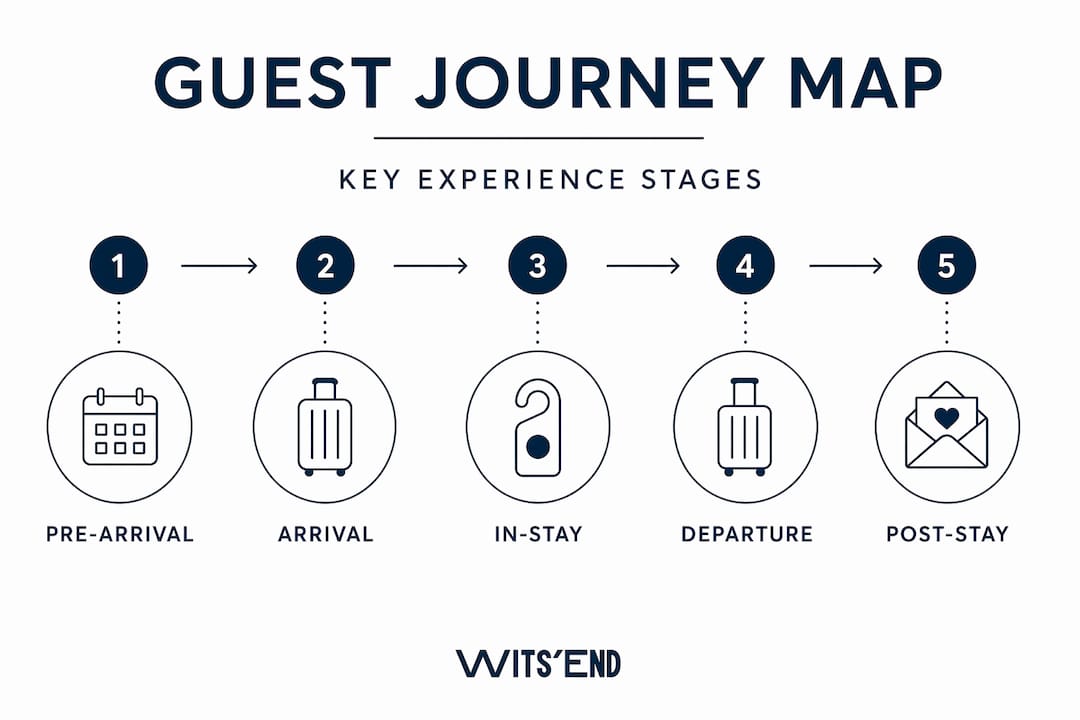
Guest experience is the cumulative effect of every interaction a guest has with your brand across the entire journey. Not just the check-in. Not just the meal. Every phase: inspiration and discovery, booking, arrival, the time spent on property, and the follow-up communication after they leave.
That scope is wider than most operators treat it in practice. Many teams focus their energy on the in-stay phase because that's where the team is visible. But a guest who can't find clear pricing during the booking process, or who receives a generic "thank you for staying" email two days after checkout, has a different cumulative impression than one whose entire journey felt considered and intentional.
This is where the distinction between guest service and guest experience becomes critical. Guest service is reactive. It shows up when a guest has a problem or makes a request. Guest experience is proactive and always on. Guest experience is not a department but a lived reality requiring coordination across housekeeping, food and beverage, marketing, revenue management, and the front of house. Every one of those teams shapes how a guest feels, whether they realize it or not.
The emotional dimension is what most operators underestimate. Guests don't remember the thread count of the sheets. They remember how the hotel made them feel when something went wrong, or how a server anticipated what they needed before they asked. Consistency in that emotional tone, across every department, across every shift, is what separates a strong guest experience from a forgettable one.

Pro Tip: Map your guest journey in writing, phase by phase, and ask yourself honestly: which of these phases do we own, and which do we leave to chance? Most hotels and restaurants own the in-stay phase and nearly abandon everything else.
The real economic argument for guest experience
The business case for investing in guest experience is not abstract. A 5-point retention improvement yields 25% to 95% profit growth, and repeat guests spend 23% more per stay on average. These numbers explain why the importance of guest experience has moved from a hospitality philosophy to a financial priority for serious operators.
Loyalty programs are a direct lever. Loyalty members spend more than double annually compared to non-members, and 62% of customers are willing to pay for premium loyalty benefits. Paid loyalty programs, when designed well, can generate 4.3 times ROI. The key word there is "designed well." A loyalty program built around transactional discounts is not the same as one built around experiential rewards that make guests feel genuinely valued.
The metrics that matter most in tracking guest experience performance have also shifted. Net Promoter Score (NPS) has been a default measure for years, but NPS is only actionable when integrated with CRM and transaction data to identify which guest segments are actually driving revenue. A property that scores a 47 NPS without knowing whether the promoters are one-time visitors or high-value repeat guests cannot prioritize its investment intelligently.
| Metric | What it measures | Why it matters in 2026 |
|---|---|---|
| Net Promoter Score (NPS) | Guest likelihood to recommend | Useful only when tied to revenue and retention data per segment |
| Customer Lifetime Value (CLV) | Total revenue from a guest over time | Reveals true ROI of experience investments |
| Retention rate | Percentage of returning guests | A 5-point improvement drives 25% to 95% profit growth |
| Review sentiment score | Emotional tone across public reviews | AI tools now track this in real time across platforms |
| Loyalty program engagement | Member spend vs. non-member spend | Benchmarks the return on your loyalty investment |
What separates leading hospitality organizations from the rest is that they close the loop. They connect feedback to transaction data, they segment by guest value, and they use that combined picture to decide where experience improvements will actually move the P&L.
How technology is reshaping guest experience management
Understanding guest experience management today means understanding the role technology now plays at every phase of the journey. Predictive AI flags concerns before they escalate and recommends optimal recovery actions. Sentiment monitoring tools scan review platforms in real time and surface patterns your management team would otherwise miss. CRM platforms can trigger personalized outreach based on a guest's history, preferences, or even their in-stay behavior.
The best use of these tools is not to replace the human element but to protect it. Automating low-value repetitive tasks gives your staff more time to spend on the high-value interactions that actually build loyalty. When your front desk team isn't manually entering reservation details into three different systems, they can make eye contact with the guest who just walked in after a delayed flight and actually address what that person needs.
That said, the risk of overreliance on technology is real. Guests notice when they're being processed rather than hosted. A welcome email that's algorithmically generated from data fields feels different from one that reflects genuine familiarity. Technology should facilitate deeper connections, not create distance between your brand and the people you serve.
Here is where a guest experience strategy built on technology delivers the most:
- AI-driven sentiment monitoring that surfaces negative trend patterns before they appear in public reviews
- CRM-linked pre-arrival communication that gives guests useful, relevant information without overwhelming them
- Post-stay feedback triggers that invite response at the right moment, maximizing both completion rates and honest input
- Predictive recovery tools that give managers guidance on how to respond to specific guest complaints effectively
Pro Tip: Before adding any new technology to your guest experience stack, ask one question: does this tool give my team more time with guests, or does it give my team a reason to spend less time with them? The answer tells you whether it belongs in your operation.
Cross-department alignment is where experience breaks down
The most common reason a guest experience strategy fails is not a lack of investment. It's misalignment between what a brand promises and what a guest actually encounters on property. Marketing and operations must collaborate closely so that the promises in digital outreach match the on-site reality, because critical guest expectations are set in the inspiration and research phases long before a guest books.
A hotel that markets itself on quiet, design-forward atmosphere and then has a lobby that's loud, dated, and understaffed has a brand alignment problem. That friction doesn't just disappoint guests. It generates negative reviews with specific, credible detail that future guests read and believe. No amount of operations improvement repairs the damage if the promise was never anchored in reality to begin with.
| What guests experience | What creates it | Common misalignment |
|---|---|---|
| Arrival impression | Physical space, staff presence, speed of check-in | Marketing imagery doesn't match actual property condition |
| Consistency across shifts | Training, standards, and accountability systems | Day shift and evening shift deliver different levels of service |
| Feeling recognized | CRM data use, staff briefings before service | Guest data collected but never shared across departments |
| Post-stay communication | Marketing automation connected to operations data | Generic outreach sent with no reference to the actual stay |
Solving this requires the kind of standout brand development work that starts with an honest audit of what the brand promises versus what operations actually delivers, and then closes the gap in both directions.
Practical steps to enhance guest experience now
Knowing what guest experience is and actually improving it are two different things. Here are the steps that generate the most impact for hotels and restaurants that are serious about building a better guest experience strategy.
-
Design loyalty programs around experiences, not discounts. A guest who receives a complimentary in-room amenity tied to a previous preference remembers that moment. A guest who gets 10% off their third stay is slightly less likely to pay full price next time. Think about what makes a guest feel seen, not what makes the math work on a spreadsheet.
-
Build a service recovery protocol before you need it. Guests who receive good recovery responses are 12 times more likely to leave a positive review and 4 times more likely to return. That means a well-handled failure can outperform a flawless stay in terms of loyalty outcomes. Your team needs to know exactly what they're empowered to do, and they need to feel confident doing it, before a problem arrives. You can explore restaurant loyalty strategies to see how this applies in a food and beverage context.
-
Personalize proactively using the data you already have. Most properties collect far more guest information than they actually use. Birthdays, dietary preferences, previous room types, past complaints. That data, deployed thoughtfully before and during a stay, creates moments that feel personal without being intrusive.
-
Close the feedback loop visibly. Guests who leave feedback want to know it was heard. When you make a change based on guest input, tell people. In your pre-arrival emails, on your social channels, or in your responses to reviews. That visibility builds the kind of trust that turns a satisfied guest into a loyal one.
Pro Tip: The feedback process itself is part of the guest experience. A survey that takes seven minutes and asks questions that feel internal and operational sends a message about how much you value the guest's time. Keep post-stay feedback to three questions or fewer and make every question one that actually changes a decision.
My take on why guest experience is the future of hospitality leadership
I've watched properties pour money into renovation projects, technology platforms, and marketing campaigns while their guest scores stayed flat. The reason, almost every time, is that they were treating guest experience as a metric to improve rather than an operating philosophy to embed. A score is the output. The experience is everything that happens before that score is written.
What I've learned from working with hotels and restaurants across every stage of the business lifecycle is that the properties with genuinely strong guest experience share one trait. They treat every guest interaction as something worth designing. Not scripted, not rigid. Designed with intention, then trusted to their teams through real training and real empowerment.
The misconception that guest experience is a single department's responsibility limits growth more than any operational constraint I've seen. When your housekeeping team understands how their work connects to a guest's emotional state, and when your marketing team is calibrated against what your ops team can actually deliver, the experience improves without adding a single new tool or staff member.
Technology has a genuine role. But the properties that lead on guest experience use it to create more space for human connection, not to replace it. The future of this industry belongs to operators who understand that the unreasonable hospitality that builds loyalty cannot be automated. It has to be felt, consistently, by people who are trained, trusted, and proud of where they work.
— Chris
How Wits' End helps you build a better guest experience
At Witsendsolutions, we work with hotels and restaurants that are serious about turning guest experience from a talking point into a measurable business advantage. Our brand design and development work closes the gap between what your brand promises and what guests actually experience on property. Our analytics and advising platform connects NPS, CRM, and transaction data so your team knows exactly where to invest for the highest return. And when you need senior operational leadership on the ground, our task force services put experienced operators alongside your team to build the systems, training, and standards that hold. If you're ready to move past the basics, we're ready to work beside you.
FAQ
What is guest experience in a hotel or restaurant?
Guest experience is the total impression a guest forms from every interaction with your brand across the full journey, covering pre-arrival, the on-property stay, and post-stay engagement. It goes well beyond customer service to include physical environment, communication, staff behavior, and brand consistency.
How does guest experience differ from guest service?
Guest service is reactive and occurs when a guest makes a request or has a problem. Guest experience is proactive and continuous, encompassing every designed and undesigned touchpoint across all departments throughout the guest's journey.
Why does guest experience matter for revenue?
A 5-point improvement in guest retention can yield 25% to 95% profit growth, and repeat guests spend 23% more per stay on average. Strong guest experience drives retention, positive reviews, and word-of-mouth that directly reduce acquisition costs.
What is guest experience management?
Guest experience management is the strategic practice of designing, monitoring, and continuously improving every touchpoint across the guest journey using tools like CRM platforms, NPS tracking, sentiment analysis, and cross-departmental service standards.
How do you start improving guest experience?
Start by mapping every phase of your guest journey and auditing which touchpoints are intentional versus accidental. Then prioritize closing the biggest gaps between your brand promise and operational reality, beginning with the phases where guest expectations are set before they even arrive.