
What is an operational partnership in hospitality?
An operational partnership is a structured collaboration where one partner manages daily business operations and another provides capital and financial oversight. In hospitality, this typically means an operating partner handles staffing, marketing, service delivery, and P&L management, while a financial partner funds acquisitions, structures the capital, and governs through board-level oversight.
The arrangement works because the two sides bring genuinely different skills. Neither partner is redundant. Compensation for the operating partner usually ties directly to Net Operating Income, which keeps both parties focused on the same bottom line.
- Operating partner: daily operations, sales, marketing, customer service, hiring, and training
- Financial partner: capital provision, acquisition facilitation, financial structuring, board governance
- Joint entity: typically a newly formed LLC, often with equal 50/50 ownership
- Compensation: operating partner salary plus an NOI-based incentive bonus
- Mutual dependency: each side fills a gap the other cannot cover alone
How roles and responsibilities divide between partners
Clear role definitions prevent the most common partnership failures. The operating partner runs the business full time, covering general operations, all sales and business development, marketing, customer service, and associate hiring and training. The financial partner handles LLC formation, capital structure, acquisition coordination, and quarterly board meetings.

Governance typically runs through a three-person board: the operating partner, the financial partner, and one independent member chosen by the operating partner without financial or family ties to either side. That independent seat matters. It breaks deadlocks before they become crises.
One detail many operators overlook: operating partners often must sign personal guarantees on business debt even when they contribute limited capital. That financial exposure goes beyond what most people expect when they enter the arrangement.
Why operational partnerships strengthen hospitality businesses
Hospitality is volatile by nature. Demand swings with the economy, geopolitics, and consumer sentiment. Operational partnerships reduce that exposure by distributing risk across two parties with complementary strengths rather than concentrating it in one owner.
BCG's 2025 analysis found that joint ventures and strategic alliances have grown more resilient than traditional M&A over the past eight years, particularly as companies prioritize supply chain stability and operational continuity. The same logic applies directly to hotels and restaurants. A well-structured partnership gives you agility that organic growth rarely delivers at the same speed or capital efficiency.
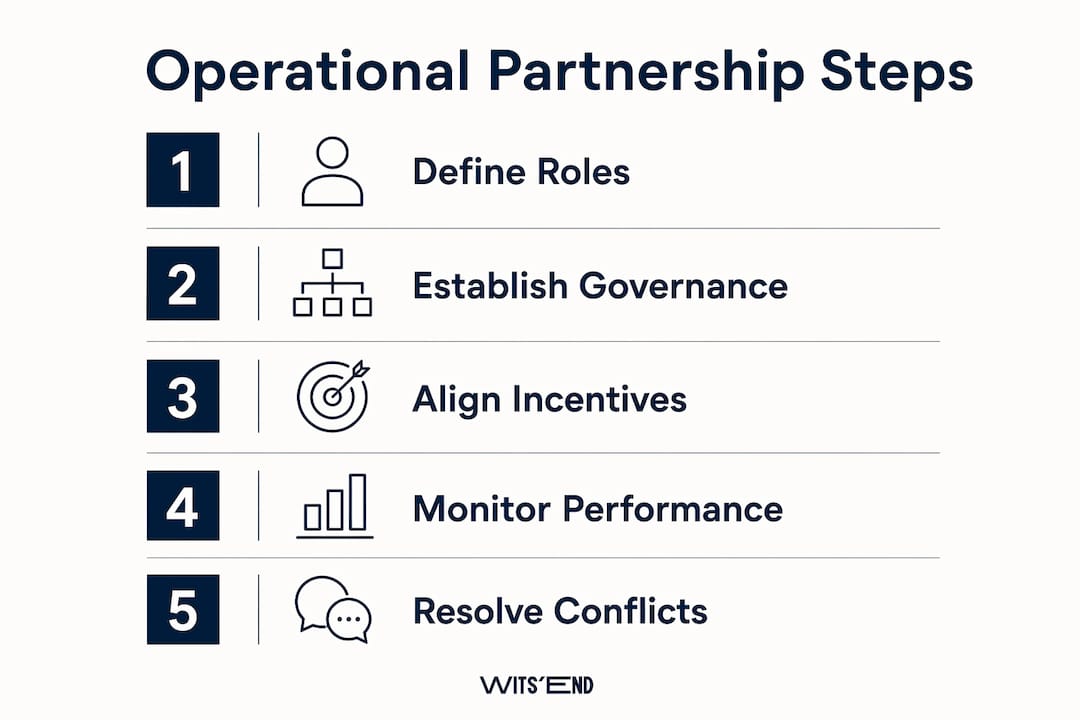
Performance-based compensation tied to NOI also aligns incentives in a way that flat management fees never do. When the operator earns more as the business earns more, short-term convenience stops competing with long-term asset value.
What a solid partnership agreement must include
The agreement is where most partnerships either hold together or fall apart. Legal experts consistently point to four non-negotiable components.
- Governance provisions: management roles, voting procedures, and decision-making authority must be explicit, not implied
- Profit-sharing model: distributions should reflect ownership percentages and performance incentives, documented clearly
- Dispute resolution: mediation and arbitration clauses, plus buy-sell triggers to prevent deadlock on critical decisions like key hires or capital investments
- Exit strategies: buyout provisions, ownership transfer terms, and dissolution procedures give both sides clarity if the relationship changes
Without buy-sell triggers, a disagreement between partners can freeze the business entirely, blocking hires, investments, and operational decisions until the dispute resolves. That kind of paralysis costs real money in hospitality, where staffing gaps and deferred maintenance compound quickly.
How Wits' End Solutions approaches operational partnerships
Wits' End Solutions works with hotel and restaurant owners at every stage, from concept through ongoing operations. The model is built around the same LLC structure described above, with ownership splits negotiated to fit each situation and NOI-based incentives written into the agreement from day one.
What separates the Wits' End approach is that the team has run these operations themselves. Every recommendation comes from direct experience managing staffing models, menus and sourcing, P&L reporting, and guest experience at the property level. Governance frameworks, role definitions, and dispute resolution clauses are not boilerplate. They reflect what actually works in hotels and restaurants under real operating pressure.
Wits' End Solutions also integrates deep analytics through its Ingest partner platform, giving both operating and financial partners clear visibility into performance data. That transparency keeps the board aligned and reduces the friction that leads to disputes.
Examples of operational partnership models in hospitality
The most common model is a hotel owner partnering with an experienced operator to run a property the owner financed but cannot manage full time. The owner holds the financial partner role; the operator takes the LLC's operating seat and manages everything from front desk staffing to food and beverage. Food delivery integration is one area where hospitality partnerships have expanded significantly, with operators coordinating third-party delivery alongside in-house service.
Restaurant groups use a similar structure when expanding to new markets. A capital partner funds the buildout; an operating partner with regional knowledge handles hiring, vendor relationships, and daily service. The arrangement moves faster than a corporate rollout and carries less risk than a franchise.
Common challenges and how to address them
Misaligned expectations on decision-making authority cause more partnership breakdowns than financial disagreements. Address this before signing by mapping every operational decision to a specific decision-maker in the LLC agreement.
Cash flow timing is another friction point. Operating partners need working capital to run the business; financial partners want distributions. A clear cash reserve policy in the agreement, reviewed quarterly at board meetings, keeps both sides from pulling in opposite directions.
Legal and compliance considerations for hospitality partnerships
Hospitality partnerships carry licensing, labor, and liability obligations that generic LLC agreements do not cover. Liquor licenses, health department permits, and employment law compliance all attach to the operating entity, which means the operating partner carries significant regulatory exposure. The LLC agreement should specify which partner is responsible for maintaining each license and what happens if a license is suspended or revoked.
Best practices for communication and conflict resolution
Monthly board meetings by teleconference or in person are the structural minimum. Between meetings, operating partners should share financial reports and key operational metrics on a fixed schedule, not on request. Transparency prevents the information asymmetry that turns small disagreements into formal disputes.
When conflict does arise, go to the agreement first. If the agreement includes a clear escalation path, from direct negotiation to mediation to arbitration, most disputes resolve before they require legal intervention.
Wits' End Solutions: operational partnership support for hotels and restaurants
Running a hotel or restaurant is hard enough without a partnership structure that works against you. Wits' End Solutions brings senior operational leadership directly to your property, whether you need an outside advisor, a co-operator, or a full operating partner on site. We structure the LLC, define the roles, build the governance framework, and then actually run the operation alongside you.
If you are a hotel or restaurant owner looking for an experienced operator to share the load and grow the asset, reach out to Wits' End Solutions for a consultation.
Key Takeaways
An operational partnership works when roles, incentives, and governance are documented clearly before the business opens its doors.
| Point | Details |
|---|---|
| Role clarity is foundational | Operating and financial partner duties must be explicitly defined in the LLC agreement, not assumed. |
| NOI-based compensation aligns incentives | Tying operator pay to Net Operating Income keeps both partners focused on long-term profitability. |
| Buy-sell triggers prevent deadlock | Without them, a single disagreement can freeze critical decisions and stall operations. |
| BCG research validates the model | Joint ventures and strategic alliances have proven more resilient than traditional M&A over eight years. |
| Wits' End Solutions delivers the full model | From LLC structuring to on-property leadership, Wits' End Solutions builds and runs operational partnerships in hospitality. |