
TL;DR:
- Partnerships in hotel management are strategic arrangements that combine resources and expertise to enhance operations and guest satisfaction. Properly structured, they improve decision-making, distribute risk, and increase financial returns. Building active oversight, shared data, and local alliances is essential for long-term success.
Partnership in hotel management is defined as a formal or informal arrangement where two or more parties combine resources, expertise, or market access to improve operations, guest satisfaction, and financial returns. The role of partnership in hotel management goes far beyond sharing costs. Done well, it aligns decision-making authority, distributes risk, and creates guest experiences that no single operator can deliver alone. Hotel owners who treat partnerships as a core operating strategy, rather than a convenience, consistently outperform those who manage in isolation. This article breaks down the partnership types that matter most, how to structure agreements that protect your interests, and how technology and local alliances are changing what collaboration looks like in 2026.
What types of partnerships exist in hotel management?
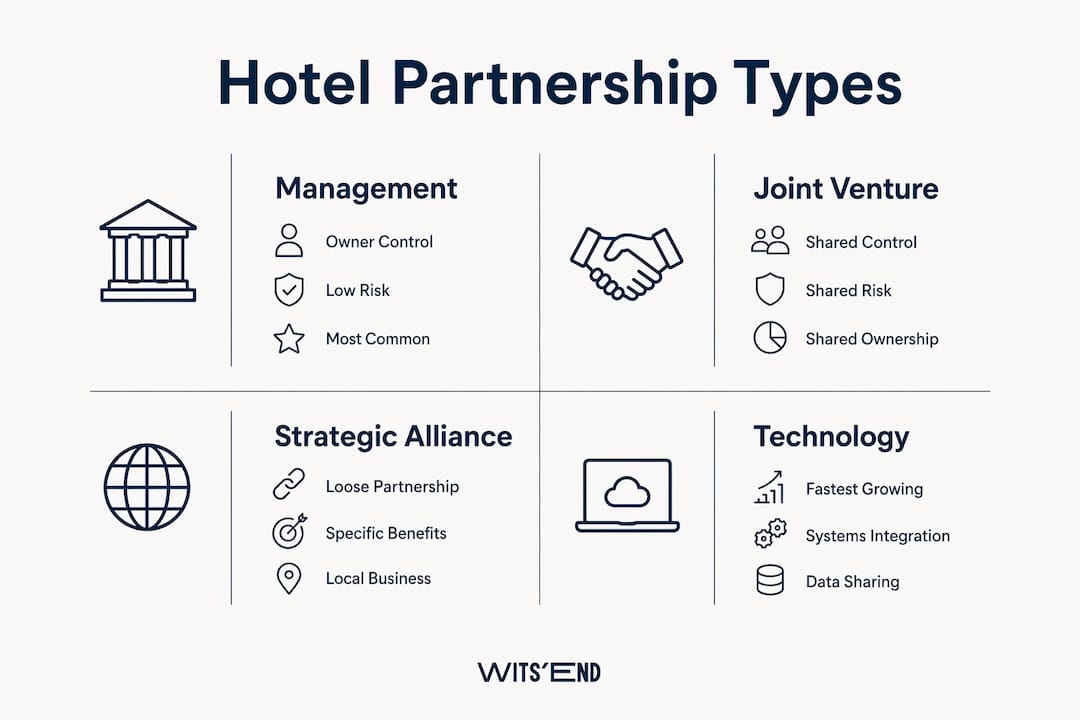
Hotel partnerships fall into four main categories, and each one distributes control and risk differently. Understanding the distinctions before you sign anything is the most important step you can take.

Hotel management agreements are the most common structure. The owner retains the asset and bears most financial risk, while a management company runs daily operations. Management agreements delegate broad day-to-day authority to operators, which means owners must negotiate hard for approval rights on material decisions like capital expenditures, key hires, and brand changes. Without those rights written into the contract, you are funding a business you cannot steer.
Joint ventures bring an operating partner and a capital partner together under a shared ownership structure. The operating partner contributes expertise and execution. The capital partner contributes cash. Joint ventures use a three-tier decision-making framework that separates routine daily decisions from major financial decisions requiring unanimous or supermajority consent. That tiered structure is what keeps joint ventures from collapsing when partners disagree.
Strategic alliances are looser arrangements with local businesses, experience providers, or technology platforms. A hotel partnering with a local tour operator, a regional food and beverage group, or a wellness brand falls into this category. These alliances rarely involve shared ownership, but they directly affect guest experience and revenue diversification. Evolving vendor relationships into strategic partnerships is a recognized approach in hospitality event support, and the same logic applies to hotel operations.
Technology collaborations are the fastest-growing partnership type. Hotels now partner with property management systems, revenue management platforms, and data aggregators to build integrated operating environments. These are not vendor relationships in the traditional sense. They are operational dependencies that shape how your team makes decisions every day.
Here is a quick comparison of the four types:
| Partnership type | Control level | Risk exposure | Best suited for |
|---|---|---|---|
| Management agreement | Low (owner) | High (owner) | Owners without operating capacity |
| Joint venture | Shared | Shared | Capital-plus-operator deals |
| Strategic alliance | High (owner) | Low | Guest experience and revenue add-ons |
| Technology collaboration | Moderate | Low to moderate | Multi-property efficiency gains |
How to structure hotel partnership agreements that protect you
The structure of your partnership agreement determines whether the relationship creates value or creates conflict. Most disputes between owners and operators trace back to contracts that were vague on three things: who decides what, who gets paid first, and who absorbs losses.
On decision-making, the clearest agreements define a dollar threshold below which the operator acts independently and above which the owner must approve. Without that threshold, operators have broad discretion, and owners must proactively negotiate approval rights to maintain any real oversight. A $25,000 threshold for unilateral operator spending is common in mid-scale properties. Luxury assets often set it lower.
On profit distribution, joint ventures typically structure returns in two layers. Capital partners receive a preferred annual return, often in the 8–10% range, before any profits are split. After that threshold, operating partners receive 60–70% of remaining profits as compensation for their sweat equity. That split rewards execution, not just capital. It also means the operating partner has a strong incentive to perform, which is exactly the alignment you want.
On risk and tax, debt allocation is the detail most owners overlook. Debt allocation under Section 752 tax rules significantly affects how partners deduct losses and what they net at exit. Structuring debt allocation incorrectly can reduce a partner's loss deductions during the operating years and shrink returns when the asset sells. Get a tax attorney involved before the deal closes, not after.
Here is a structured approach to evaluating any hotel partnership agreement:
- Define the decision-making threshold in writing, with specific dollar amounts and categories.
- Confirm the preferred return rate for capital partners and the profit split above that threshold.
- Identify which partner absorbs operating losses and under what conditions.
- Review debt allocation and its tax implications with qualified counsel.
- Negotiate performance benchmarks that trigger renegotiation or termination rights.
Pro Tip: Hire a hotel asset manager to sit between you and your operating partner. Asset managers monitor operational performance and act as your defense against incentive misalignment, catching problems before they become P&L damage.
How does technology improve partnership value in hotel management?
Technology does not just support hotel partnerships. It changes what partnerships are capable of delivering. The shift happening right now is from transactional vendor relationships to data-sharing ecosystems that let hotels evaluate partnership ROI in real time. That shift gives owners visibility they have never had before.
Integrated operations platforms are the clearest example. Unified platforms covering multiple properties improve revenue management and operational efficiency across an entire portfolio. When your property management system, revenue management tool, and food and beverage reporting all feed into one dashboard, you stop making decisions based on gut feel and start making them based on actual data. That is a structural advantage in any partnership, because both parties can see the same numbers.
Data transparency also changes accountability. When an operating partner knows the owner can pull real-time occupancy, labor cost, and guest satisfaction data at any time, performance standards become concrete rather than aspirational. The deep analytics and advising capabilities that Wits' End Solutions brings to hotel clients are built around exactly this principle: shared data creates shared accountability.
The next wave involves AI and personalization. Hotels that build data-sharing agreements into their technology partnerships now will be positioned to deliver personalized guest experiences at scale within the next two to three years. The infrastructure decisions you make today determine what you can offer guests in 2028.
How do local and strategic alliances improve guest experience?
Local alliances are one of the most underused tools in hotel management collaboration. A well-chosen local partner does three things at once: it differentiates your property, it adds revenue streams you do not have to build from scratch, and it connects guests to authentic experiences that no national brand can replicate.
The selection criteria matter more than the concept. Any local partner you bring into your guest experience carries your brand's reputation. Alignment on service standards, reliability, and commitment to quality is non-negotiable. A partnership with a local chef for an in-hotel dining series only works if that chef shows up consistently and delivers at the level your guests expect.
Exclusive collaborations are particularly effective for loyalty program growth. When a guest can access a private wine tasting, a behind-the-scenes kitchen tour, or a curated city itinerary only through your hotel, that experience becomes a reason to return. Joining preferred partner programs on major booking platforms increases search views by 65% and bookings by 20%. That data point illustrates how even platform-level alliances translate directly into revenue, not just brand awareness.
The risk management side of local alliances is straightforward but often skipped. Before formalizing any alliance, define what happens when the partner underperforms. Include service level expectations, response time commitments, and a clear exit clause. A handshake deal with a local spa or tour operator feels fine until a guest complains, and then you need a contract to fall back on.
For hospitality business optimization in 2026, the most effective owners are building a portfolio of local alliances rather than relying on a single anchor partner. Diversification at the alliance level protects guest experience when one partner has a bad season.
Key Takeaways
Effective hotel partnerships combine clear contractual structure, aligned financial incentives, and real-time data transparency to drive operational performance and guest satisfaction.
| Point | Details |
|---|---|
| Define decision-making thresholds | Write specific dollar amounts into every management agreement to protect owner oversight. |
| Structure profit splits intentionally | Capital partners take preferred returns first; operating partners earn the majority of remaining profits. |
| Use asset managers as oversight | Asset managers prevent incentive misalignment and monitor operator performance on the owner's behalf. |
| Build data-sharing into tech partnerships | Integrated platforms give both parties real-time visibility, which raises accountability across the board. |
| Diversify local alliances | A portfolio of local partners protects guest experience and adds revenue streams that branded operators cannot provide. |
What I've learned about hotel partnerships after years in the field
The most common mistake I see owners make is treating the partnership agreement as a one-time event rather than an ongoing management tool. They negotiate hard at signing, then step back and assume the contract will run itself. It does not. Operators have every incentive to expand their discretion over time, and without active asset management, that expansion happens quietly.
The second mistake is underestimating how much technology changes the power dynamic. Owners who invest in unified hotel operations platforms gain something most operators do not want them to have: real-time visibility into performance. That visibility is not just a reporting tool. It is leverage. When you can see labor cost variance by shift, you have a conversation with your operator that is grounded in facts, not impressions.
The future of hotel management collaboration is not about finding the perfect partner. It is about building the systems and structures that make any partnership perform. Clear contracts, active oversight, shared data, and a curated set of local alliances are the four pillars. Get those right, and the specific partner matters less than you think.
— Chris
How Wits' End Solutions supports hotel partnership strategy
Wits' End Solutions works with hotel and restaurant owners at every stage of the partnership lifecycle, from structuring the initial concept and brand to running the numbers on a joint venture and training the team that executes daily. Our brand design and development work ensures your property enters any partnership with a clear identity that partners and guests can rally around. Our deep analytics and advising services give you the real-time data visibility that turns a good partnership agreement into a high-performing operation. And when you need senior operators on property fast, our task force services put experienced hospitality professionals in the building, not on a conference call.
FAQ
What is the role of partnership in hotel management?
Partnership in hotel management combines complementary resources, expertise, and market access to improve operations, guest satisfaction, and financial returns. It is a core operating strategy, not a supplemental arrangement.
What is a hotel management agreement?
A hotel management agreement delegates day-to-day operational authority to a management company while the owner retains the asset and bears financial risk. Owners must negotiate approval rights on major decisions to maintain oversight.
How are profits split in a hotel joint venture?
Capital partners typically receive an 8–10% preferred annual return before profits are divided. Operating partners then receive 60–70% of remaining profits as compensation for their operational contribution.
Why do hotel owners need an asset manager?
Asset managers act as the owner's representative, monitoring operator performance and preventing incentive misalignment between the owner and the management company. They are the most direct protection against a management agreement working against your interests.
How do local alliances improve hotel performance?
Local alliances add differentiated guest experiences, new revenue streams, and loyalty program value that national brands cannot replicate. Joining preferred partner programs on major booking platforms has been shown to increase search views by 65% and bookings by 20%.