
TL;DR:
- Hotel construction is a complex, six-phase process lasting about 36 months from start to opening. Early decisions on brand, permitting, and procurement are crucial to ensure timely project completion and operational readiness. Managing permitting, MEP installation, and pre-opening activities proactively reduces delays and cost overruns.
Hotel construction is defined as a multi-phase development process spanning approximately 36 months from initiation to opening, covering pre-construction planning, permitting, civil works, MEP installation, interior fit-out, and commissioning. For developers and investors, understanding this hotel construction process overview is the difference between a project that opens on time and one that bleeds capital in delays. Hotel builds are categorically more complex than standard commercial construction. Hospitality-specific requirements, including brand standards, life safety codes, and guest experience design, create dependencies that ripple across every phase of the hospitality lifecycle.
What are the main phases of hotel construction?
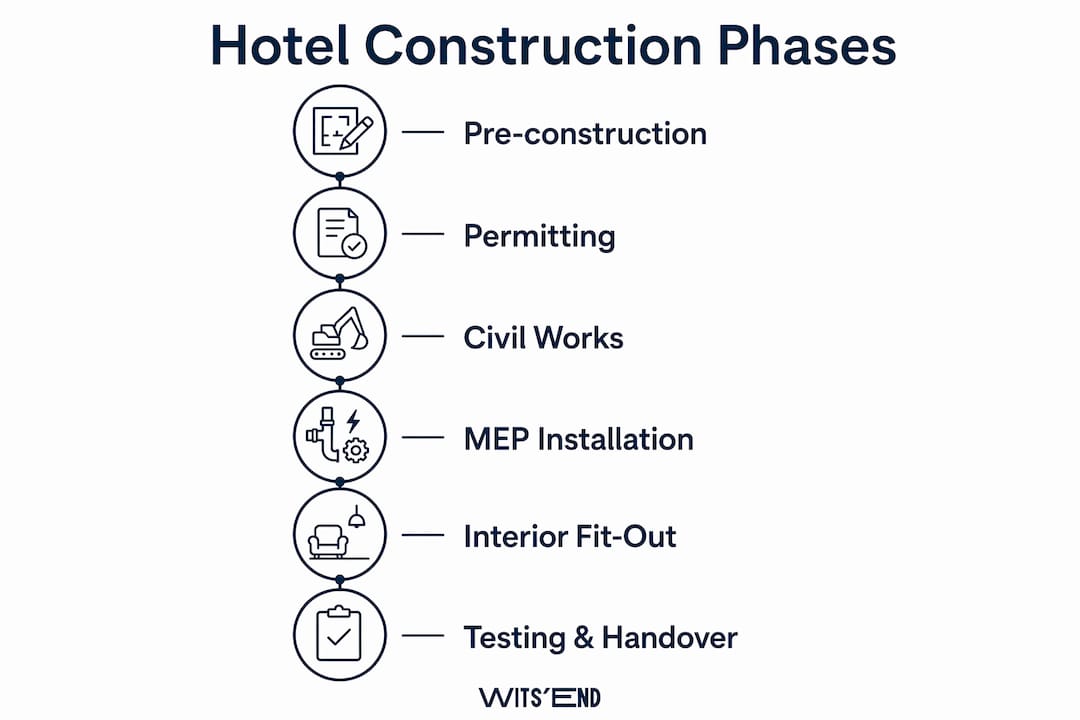
The hotel development process follows a defined sequence. Each phase depends on the one before it. Skipping steps or compressing timelines creates compounding problems downstream.
Phase 1: Pre-construction (months 1–9)
Pre-construction covers site selection, feasibility analysis, brand selection, concept design, and budget development. Pre-construction takes about 9 months on a standard new-build project. This phase sets every financial and operational parameter for what follows. Decisions made here, including brand affiliation and management structure, directly shape the technical specifications, FF&E budgets, and construction sequencing that come later.

Phase 2: Permitting and entitlements (months 6–18)
Permitting runs partially concurrent with late pre-construction. Government approvals take 6–12 months depending on jurisdiction, project scale, and local regulatory complexity. That range is wide because zoning variances, environmental reviews, and building department backlogs vary dramatically by market. Developers who treat permitting as a formality routinely find themselves 6 months behind before a shovel hits the ground.
Phase 3: Civil works and structure (months 10–22)
Foundation, structural frame, and exterior envelope work begins once permits clear. This phase runs concurrently with early MEP rough-in on completed floors. The sequencing here requires tight coordination between the general contractor, structural engineer, and MEP subcontractors.
Phase 4: MEP installation (months 12–29)
Mechanical, electrical, and plumbing systems in hotels demand over 17 months of installation with floor-by-floor sequencing. That timeline is not a planning error. It reflects the genuine complexity of running HVAC, fire suppression, electrical distribution, plumbing, and data infrastructure through a building with dozens of guest rooms, a commercial kitchen, and multiple public spaces.
Phase 5: Interior fit-out and FF&E installation (months 22–34)
Interior finishes, furniture, fixtures, and equipment arrive and are installed after MEP rough-in is complete on each floor. FF&E budgets include casegoods, lighting, kitchen equipment, audiovisual systems, and decorative elements. Lead times on custom FF&E frequently run 16–20 weeks, which means procurement must begin well before the building is ready to receive it.
Phase 6: Testing, commissioning, and handover (months 34–36)
Final testing and handover occupy 2–4 months at the close of the project. This phase includes life safety system testing, brand-mandated inspections, staff training, and operational dry runs. It is the phase most developers underestimate.
| Phase | Typical Duration | Key Milestone |
|---|---|---|
| Pre-construction | ~9 months | Brand selection, budget approval |
| Permitting and entitlements | 6–12 months | All government approvals secured |
| Civil works and structure | ~12 months | Structural frame complete |
| MEP installation | 17+ months | All systems rough-in complete |
| Interior fit-out and FF&E | ~12 months | Rooms and public spaces complete |
| Testing and commissioning | 2–4 months | Brand inspection passed, opening ready |
How do hospitality requirements change the construction process?
Hotel construction differs from office or retail builds in ways that catch developers off guard. Developers consistently underestimate the complexity of life safety compliance, brand standards, and operational integration when they approach a hotel project with a commercial construction mindset.
The MEP complexity alone separates hotels from most other building types. A 200-room hotel requires individual HVAC control in every guest room, commercial-grade plumbing on every floor, fire suppression throughout, and data infrastructure supporting both guest Wi-Fi and back-of-house operations. Running all of that concurrently with civil construction requires detailed floor-by-floor coordination that standard commercial project management does not account for.
Brand standards add another layer. Franchised hotels must meet brand-mandated specifications for everything from corridor width to bathroom fixture specifications to lobby lighting levels. These requirements are not negotiable, and they are enforced through formal brand inspections before opening. A design that drifts from brand standards during construction creates expensive rework at the worst possible time.
- Life safety compliance: Hotels must meet commercial fire, egress, and accessibility codes that exceed residential standards. Sprinkler systems, fire-rated corridors, and ADA-compliant guest rooms require early coordination with the architect and local authority.
- FF&E procurement lead times: Custom furniture and casegoods take 16–20 weeks from order to delivery. Procurement must begin during construction, not after.
- Brand approval process: Franchised properties require brand representatives to review and approve design documents, mock-up rooms, and final inspections. Each approval gate adds time if submissions are not prepared correctly.
- Operational integration: Back-of-house areas, including the kitchen, laundry, and housekeeping zones, must be designed to support actual hotel operations, not just pass a building inspection.
Pro Tip: Commission a mock-up guest room before full fit-out begins. Brand representatives, ownership, and the operations team can review finishes, furniture layout, and fixture performance in a real space before you commit to 200 rooms.
What project management strategies keep hotel builds on track?
The hotel building stages require multi-disciplinary coordination that goes beyond standard construction management. Architects, structural engineers, MEP engineers, interior designers, brand representatives, and the general contractor must all work from aligned documents and a shared schedule.
Early brand selection is the single highest-leverage decision in the entire process. The brand determines prototype design requirements, FF&E specifications, technology standards, and the inspection process. Developers who delay brand selection push every downstream decision into a compressed timeline. Locking in brand and management agreements during pre-construction gives the design team the parameters they need to work efficiently.
Phased procurement is the second critical strategy. Because FF&E lead times are long, procurement must run parallel to construction rather than sequentially. A procurement schedule tied to the construction schedule, with clear floor-by-floor installation windows, prevents the common scenario where the building is ready but the furniture has not arrived.
Permitting progress requires active management, not passive monitoring. Assign a dedicated entitlements coordinator or retain a local land use attorney in complex jurisdictions. Regulatory delays are the most common source of schedule overruns in the early phases, and they are largely preventable with proactive communication with the relevant agencies.
Pro Tip: Build a 10–15% contingency into your construction budget from day one. Hotel projects carry more budget risk than standard commercial builds because of MEP complexity, brand-mandated changes, and FF&E cost volatility.
The gap between substantial completion and operational readiness is where many projects lose weeks or months. Misalignment between these two milestones can delay opening by 3–4 months if commissioning, brand inspections, and staff training are not planned as part of the construction schedule rather than as afterthoughts.
What risks commonly derail hotel construction projects?
Hotel construction carries a distinct risk profile. Understanding where projects fail is the most direct path to preventing those failures on your own development.
-
Permitting delays: Regulatory timelines are the most unpredictable variable in the entire process. A zoning variance that takes 3 months in one market can take 9 months in another. Developers who build permitting contingencies into their schedule and budget absorb these delays without cascading impact.
-
Brand standard misalignment: Design documents that do not fully reflect brand requirements create rework during construction or, worse, during brand inspections. The fix is early and frequent coordination between the design team and the brand's technical services team.
-
MEP schedule overruns: Underestimating the complexity of mechanical, electrical, and plumbing work is the most common cause of mid-project delays. The 17-plus month MEP installation window is not compressible without significant additional cost.
-
FF&E procurement failures: Late procurement decisions, vendor defaults, or shipping delays can push the fit-out phase back by weeks. A detailed procurement schedule with buffer time for each product category is non-negotiable.
-
Operational readiness gaps: Physical completion does not mean the hotel is ready to open. Staff must be hired and trained, systems must be tested, and brand inspections must be passed. Planning the pre-opening phase as a formal project phase prevents last-minute scrambles.
Hotel financial returns depend not just on opening day but on a 24–36 month stabilization period to reach consistent operating performance. First-time developers who plan only to opening day routinely underestimate the capital required to carry the asset through revenue stabilization.
Mitigation across all of these risks comes down to three practices: detailed upfront planning, realistic scheduling with built-in contingencies, and retaining advisors who have managed hotel-specific construction before.
Key Takeaways
Hotel construction is a defined, sequential process where early decisions on brand, permitting, and procurement determine whether the project opens on time and within budget.
| Point | Details |
|---|---|
| Plan for 36 months | A standard new-build hotel runs approximately 36 months from initiation to opening. |
| Permitting takes longer than expected | Government approvals require 6–12 months and must be managed proactively. |
| MEP complexity is the critical path | Mechanical, electrical, and plumbing installation takes 17+ months and cannot be rushed. |
| Operational readiness is a separate phase | Substantial completion and opening readiness are not the same milestone. |
| Revenue stabilization takes 24–36 months | Budget and investor expectations must account for the post-opening ramp period. |
What I've learned from watching hotel projects go sideways
The most expensive mistakes in hotel construction do not happen during construction. They happen in the first 90 days of pre-construction, when developers are still treating the project like a standard commercial build.
I have watched projects lose 6 months because brand selection was deferred until after design was 60% complete. The design team had to rebuild documents from scratch to meet brand prototype requirements. That cost was entirely avoidable. Early brand decisions are not a formality. They are the foundation every other decision is built on.
The second pattern I see consistently is developers who treat the commissioning and pre-opening phase as a wind-down rather than a sprint. Getting a hotel from substantial completion to actual opening requires coordinating brand inspections, life safety sign-offs, staff hiring, system testing, and soft-opening operations simultaneously. Projects that plan for this phase explicitly open on time. Projects that assume it will sort itself out do not.
My honest advice: bring your operations and brand advisors into the conversation during pre-construction, not after the building is up. The decisions that shape your opening experience are made on paper, not on-site.
— Chris
How Wits' End Solutions supports hotel developers
Wits' End Solutions works with developers and investors at every stage of the hotel development process, from initial concept through to operational launch. Our brand design and development work aligns your property with the right market position before construction documents are drawn, preventing the costly rework that comes from late brand decisions. We also support construction sequencing, FF&E procurement planning, and operational readiness so your team is not figuring out the pre-opening phase under pressure. If you need senior hospitality expertise on the ground during the critical commissioning window, our task force services place experienced operators directly on your project. Reach out to discuss where your development stands.
FAQ
How long does hotel construction take from start to finish?
A standard new-build hotel takes approximately 36 months from project initiation to opening, with pre-construction alone accounting for about 9 months.
What is the most complex phase of hotel construction?
MEP installation is the most complex phase, requiring over 17 months of floor-by-floor mechanical, electrical, and plumbing work that runs concurrently with civil construction.
Why does permitting take so long for hotel projects?
Government approvals for hotel developments typically require 6–12 months because they involve zoning, environmental review, and building department processes that vary significantly by jurisdiction.
What is the difference between substantial completion and operational readiness?
Substantial completion means the building is physically finished. Operational readiness means all systems are tested, brand inspections are passed, and staff are trained. The gap between the two can delay opening by 3–4 months if not planned in advance.
How long does it take for a new hotel to stabilize revenue?
Hotel revenue typically takes 24–36 months after opening to reach consistent operating performance. Investors and developers should build this stabilization period into their financial projections from the start.