

TL;DR:
- The hospitality lifecycle includes property development and guest management stages that must be managed together. Proper planning during construction influences long-term guest experience and revenue growth. Integrated lifecycle management improves profitability and reduces reliance on costly OTA channels.
The hospitality lifecycle is the full sequence of stages a hotel or restaurant moves through, from the first concept sketch to years of active guest relationships. It covers two parallel tracks: the property development lifecycle and the guest lifecycle. Both tracks run simultaneously in a mature operation, and both require deliberate management. Operators who understand how these tracks connect make better decisions at every phase, from pre-construction planning to post-stay loyalty programs. Wits' End Solutions works with owners across all of these stages, and the patterns we see repeat across property types and markets.
What are the main stages of the hospitality lifecycle?
The hospitality property lifecycle runs from site acquisition through grand opening and into long-term facility management. New-build hotel projects typically span 18–36+ months from site acquisition to opening, with boutique projects requiring $10M–$50M+ in capital. Adaptive reuse projects can open in 15–24 months, while larger boutique developments can stretch to 30–48+ months. These timelines are not conservative estimates. They reflect real critical-path constraints that catch underprepared developers off guard.
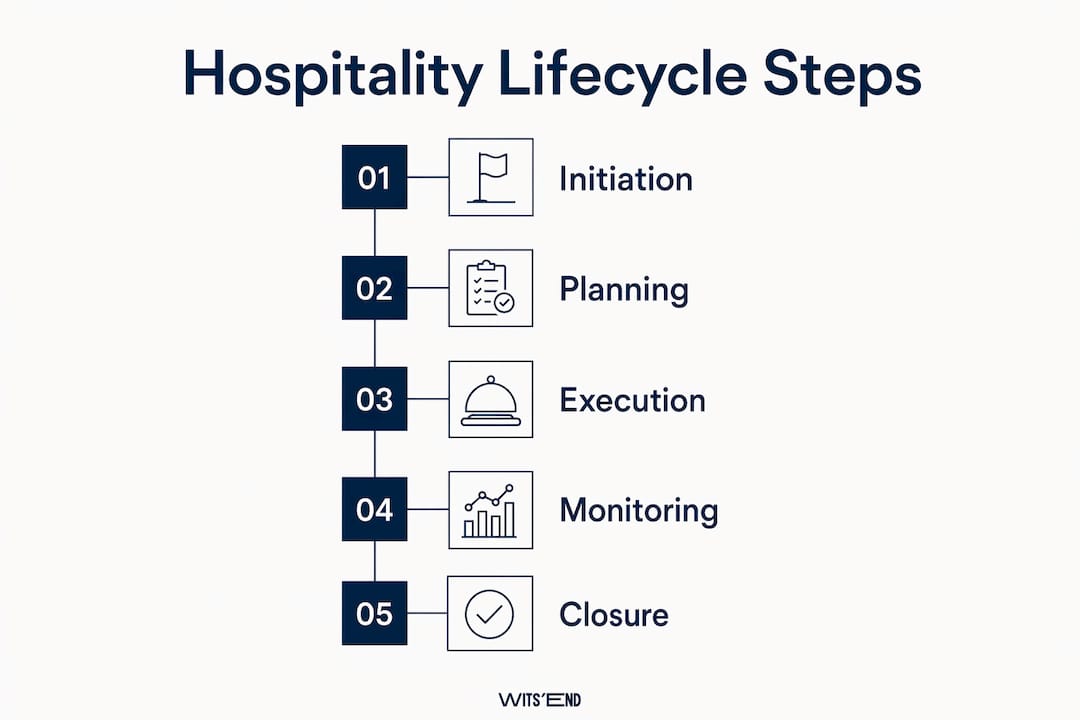
The project lifecycle follows five recognized phases: initiation, planning, execution, monitoring, and closure. Hospitality renovations and new builds apply this same five-stage framework to balance construction progress against active operations. Each phase has distinct deliverables and decision points that feed directly into the next.
| Stage | Key Activities | Typical Duration |
|---|---|---|
| Initiation | Feasibility study, site selection, capital stack | 1–3 months |
| Planning | Design, permitting, zoning approvals | 6–18+ months |
| Execution | Civil works, MEP, facade, interior fit-out | 12–24 months |
| Monitoring | Testing, commissioning, punch lists | 2–4 months |
| Closure | Grand opening, staff onboarding, soft launch | 1–3 months |
Two items consistently delay projects more than any other: entitlement and FF&E. Zoning and entitlement approvals alone take 6–18+ months and sit on the critical path before a single shovel breaks ground. FF&E procurement lead times run 16–32+ weeks for premium items. Missing either window pushes your opening date and burns capital.
Pre-construction phases like feasibility, design, and permitting dictate budget and schedule more than construction duration does. Most first-time developers learn this the hard way. The decisions made in planning lock in 70–80% of your total project cost before construction begins.
Pro Tip: Order FF&E no later than the moment your building permit is approved. Waiting until construction is underway is the single most common cause of delayed hotel openings.
A step-by-step hotel opening plan that accounts for these lead times will protect your schedule and your budget.
What are the key stages in the hotel guest lifecycle?
The guest lifecycle describes every interaction a guest has with your property, from the moment they first encounter your brand to the point where they become a repeat advocate. The hotel guest journey consists of 7–8 distinct stages, and properties routinely neglect 70% of guest touchpoints, particularly in the pre-arrival and loyalty phases. That neglect has a direct cost.
The stages and their revenue opportunities are:
- Discovery: The guest finds your property through search, social media, or word of mouth. Your brand positioning and SEO determine whether you appear at all.
- Consideration: The guest compares options. Rate parity, reviews, and photography drive decisions at this stage.
- Booking: The guest commits. Direct booking channels reduce OTA commission costs immediately.
- Pre-arrival: Confirmation emails, upsell offers, and personalized communication set expectations and generate incremental revenue. Most properties skip this entirely.
- Arrival: First impressions are formed in the first 90 seconds. Check-in experience, room condition, and staff interaction define the stay's emotional baseline.
- On-property: Every service interaction is a revenue and satisfaction moment. F&B, spa, concierge, and housekeeping all contribute.
- Departure: A clean, fast checkout with a genuine farewell creates a positive final memory.
- Post-stay and loyalty: Follow-up communication, review requests, and direct rebooking offers determine whether the guest returns through you or through an OTA.
Guest journey mapping is not documentation for its own sake. It identifies specific leakage points where automation can recover revenue and reduce OTA dependency. The pre-arrival and loyalty stages are where most properties leave the most money on the table.
Pro Tip: Automate your pre-arrival sequence with a three-touch email flow: a confirmation, a 72-hour pre-arrival message with upsell offers, and a same-day arrival welcome. This alone can lift ancillary revenue measurably.
Improving guest experience at every stage requires mapping the full journey before you can fix any single part of it.
How do the property lifecycle and guest lifecycle connect?
The two lifecycles are not separate programs. Every decision made during property development shapes the guest experience for years after opening. Room layout choices made in the design phase determine how easily housekeeping can turn rooms efficiently. Lobby flow decisions affect check-in speed. Kitchen placement affects F&B service times. Development decisions are guest experience decisions made years in advance.
The connection also runs in the other direction. Pre-opening marketing should begin during the execution phase of construction, not after the ribbon is cut. Building a direct booking audience before opening reduces your dependence on OTA channels from day one. Properties that launch with an existing email list and social following start their guest lifecycle with a significant commercial advantage.
| Property Stage | Guest Lifecycle Opportunity |
|---|---|
| Planning and design | Brand identity, concept development, direct booking infrastructure |
| Construction | Pre-opening marketing, email list building, social audience growth |
| Soft launch | Loyalty program seeding, review generation, staff training |
| Full operations | Guest journey automation, upsell programs, repeat booking campaigns |
| Renovation | Proactive guest communication, loyalty retention, phased disruption management |
Viewing the guest journey as a compounding commercial loop rather than a linear funnel yields better ROI at every touchpoint. Search data, pricing behavior, and stay history all feed future targeting. Properties that connect their development data to their guest data make smarter capital decisions over time.
What are best practices for managing the hospitality lifecycle effectively?
Lifecycle management in hospitality requires discipline across both tracks. The following practices apply whether you are opening a new property or optimizing an existing one.
-
Build realistic project timelines. Account for entitlement periods of 6–18+ months and FF&E lead times of 16–32+ weeks before setting an opening date. Setting aggressive timelines is the most common and most costly mistake first-time developers make.
-
Map the full guest journey before opening. Identify every touchpoint from discovery through loyalty. Assign ownership for each stage to a specific team member or automated system. Gaps in ownership become gaps in revenue.
-
Invest in pre-arrival and post-stay automation. These two stages generate the highest return per dollar spent on guest communication. Most properties automate booking confirmation and nothing else.
-
Build direct booking infrastructure from day one. Without a guest lifecycle marketing program, hotels leak revenue by reacquiring the same guests through OTA channels at full commission cost. A direct rebooking email sequence is foundational, not optional.
-
Coordinate renovations across departments. Maintenance and renovation phases affect every guest-facing team. Housekeeping, F&B, and front desk all need advance notice and adjusted protocols. Uncoordinated renovations create guest complaints that undermine the investment.
-
Use lifecycle data to inform capital decisions. Guest satisfaction scores, repeat booking rates, and revenue per available room all signal where the property lifecycle needs attention. Hospitality business optimization requires connecting operational data to capital planning.
-
Treat the loyalty stage as a revenue channel, not a reward program. Loyalty is the stage where the commercial loop closes. A guest who books directly, returns twice, and refers one colleague is worth multiples of a one-time OTA booking.
Key Takeaways
The hospitality lifecycle connects property development decisions directly to guest revenue outcomes, and operators who manage both tracks together outperform those who treat them separately.
| Point | Details |
|---|---|
| Property lifecycle spans 18–36+ months | Plan for entitlement delays and FF&E lead times before setting an opening date. |
| Guest lifecycle has 7–8 stages | Pre-arrival and post-stay are the most neglected and highest-return touchpoints. |
| Development decisions shape guest experience | Room design, lobby flow, and kitchen placement affect service quality for years. |
| Direct booking infrastructure is foundational | Without it, hotels pay OTA commissions to reacquire guests they already earned. |
| Lifecycle data drives better capital decisions | Connect guest satisfaction and revenue metrics to renovation and investment planning. |
Why most operators treat the lifecycle as two separate problems
The most persistent mistake I see from operators is treating the property lifecycle and the guest lifecycle as separate departments. Construction is a real estate problem. Guest experience is a marketing problem. The two teams rarely talk, and the property opens with design decisions that actively work against the guest journey the marketing team is trying to create.
I have seen hotels spend $30M on a build and then launch with a three-email CRM sequence and no pre-arrival program. The development was meticulous. The guest lifecycle was an afterthought. Within 18 months, OTA dependency was above 60% and the owner was asking why direct bookings were not growing.
The answer is always the same. The commercial infrastructure for the guest lifecycle needs to be built during the property lifecycle, not after opening. Brand identity, direct booking channels, and loyalty program architecture belong in the planning phase alongside MEP drawings and FF&E schedules. Operators who understand this connection do not just open better. They compound revenue faster from the first night of service.
Lifecycle marketing for hospitality is not a post-opening fix. It is a pre-opening investment that pays returns for the life of the property.
— Chris
How Wits' End Solutions supports every phase of your lifecycle
Wits' End Solutions works with hotel and restaurant owners across the full lifecycle, from the first concept to years of active operations. Our work covers brand design and development, construction guidance, team training, and deep analytics and advising powered by our Ingest partner platform. When a property needs hands-on support during a critical phase, our task force services place experienced operators on property to manage the work directly. Every recommendation we make comes from people who have done the job themselves. If you are building, opening, or optimizing a hospitality business, we are ready to work alongside you.
FAQ
What does "explain hospitality lifecycle" mean for operators?
The hospitality lifecycle describes the full sequence of stages a property moves through, from development and opening to ongoing guest relationship management. Operators use it as a framework for planning, staffing, and revenue decisions at each phase.
How long does the hotel property lifecycle take?
New-build hotel projects typically take 18–36+ months from site acquisition to grand opening, with larger boutique projects extending to 30–48+ months. Adaptive reuse projects can open in 15–24 months.
What are the stages of the hotel guest lifecycle?
The guest lifecycle runs through discovery, consideration, booking, pre-arrival, arrival, on-property stay, departure, and post-stay loyalty. Properties that neglect pre-arrival and loyalty stages miss the highest-return touchpoints in the entire cycle.
Why does direct booking matter in lifecycle management?
Without direct rebooking infrastructure, hotels pay OTA commissions to reacquire guests they already served. Building direct booking channels during the development phase reduces this cost from the first night of operation.
What is lifecycle management in hospitality?
Lifecycle management in hospitality is the practice of actively planning and coordinating both property development phases and guest journey stages to maximize operational performance and revenue. It connects capital decisions to guest experience outcomes across the full life of the business.