
TL;DR:
- Managing the full guest journey, from booking to post-stay, enhances satisfaction and loyalty through targeted improvements. Implementing technology tools, staff empowerment, and regular mapping counters operational friction and fosters consistent, memorable experiences. Continuous measurement and prompt follow-up are essential for building trust, driving repeat visits, and maintaining high satisfaction scores over time.
Guest experience is defined as every interaction a guest has with your property, from the moment they land on your booking page to the follow-up message they receive after checkout. Operators who manage this full arc, rather than just the in-person visit, consistently outperform those who focus only on service during the stay. The strategies covered here, including guest journey mapping, technology integration, frontline empowerment, and post-visit engagement, give you a practical framework to improve guest experience at every stage. These are the same methods Wits' End Solutions applies with hotel and restaurant clients across the United States.
How can guest journey mapping improve guest experience?
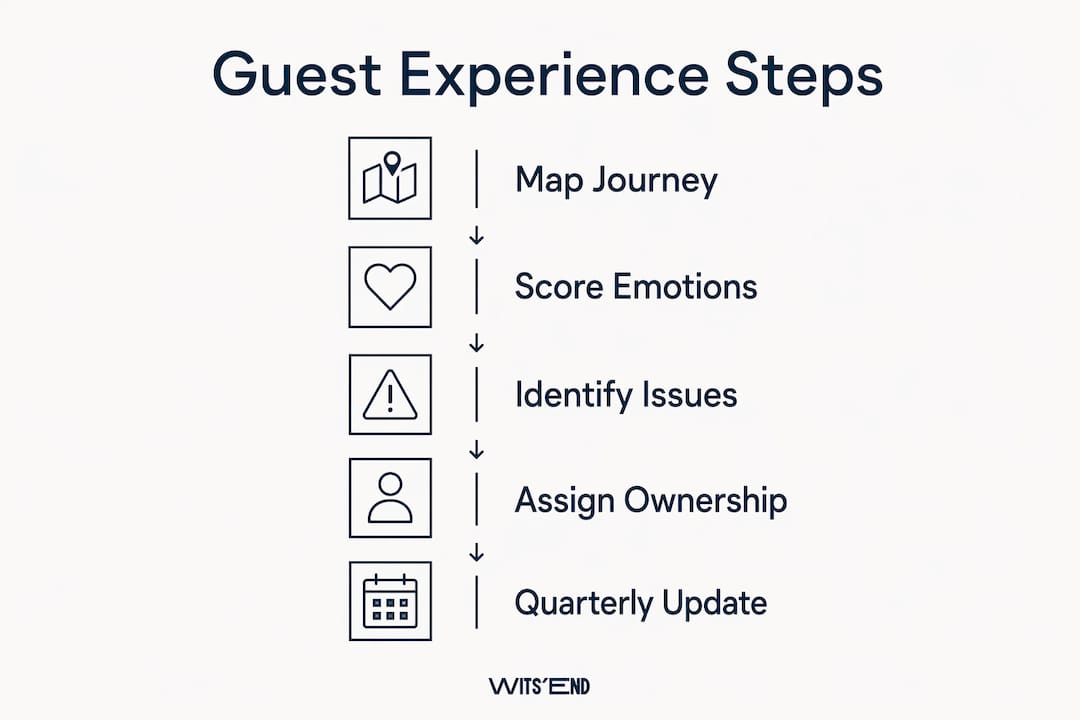
A guest journey map is a structured document that charts every touchpoint a guest encounters, from search and booking through departure and review. It is the most foundational tool for identifying where satisfaction breaks down and where small fixes deliver the biggest returns.

Effective maps cover 40 or more touchpoints, each scored on a 1–5 emotional scale that reflects how a guest feels at that moment. That scoring is what separates a useful map from a decorative one. When you see a cluster of low scores around check-in or the reservation confirmation email, you know exactly where to direct your team's attention.
Two data points from journey mapping research are worth internalizing. Website load time over 3 seconds causes 53% of guests to abandon the booking process before they ever contact you. Check-in waits longer than 5 minutes drop satisfaction scores by 30%. Both of these are fixable operational problems, not hospitality philosophy problems.
The map also creates accountability across departments. Your front desk, F&B team, and housekeeping each own specific touchpoints. When you assign action plans by department and review the map quarterly, you prevent the common pattern where guest experience initiatives launch with energy and then quietly stall.
| Journey Stage | Key Touchpoints | Emotional Impact |
|---|---|---|
| Pre-arrival | Website load speed, booking confirmation email | High abandonment risk if slow or impersonal |
| Arrival | Check-in wait time, greeting quality | 30% satisfaction drop after 5-minute wait |
| In-stay | Room readiness, service request response time | Directly tied to review scores |
| Departure | Checkout speed, farewell interaction | Sets the tone for post-stay sentiment |
| Post-stay | Thank-you message, review request | Highest-impact window for generating positive reviews |
Pro Tip: Update your journey map every quarter, not just after a major complaint. Guest expectations shift, and a map built in January may already be outdated by April.
What technology actually reduces friction for guests?
Technology improves guest satisfaction when it removes friction. It creates problems when it adds complexity. That distinction should drive every tech decision you make.
The highest-impact tools in hospitality right now fall into three categories:
- Digital compendiums and in-room guides. Replacing printed binders with mobile-accessible property guides cuts the volume of routine front desk calls and gives guests answers at the moment they need them.
- Chatbots and automated messaging. Handling requests like extra towels, late checkout inquiries, and restaurant reservations through automated SMS or app-based messaging speeds response and personalizes stays using past guest data.
- Unified ordering platforms. Poolside ordering, in-room dining requests, and spa bookings handled through a single interface reduce the coordination failures that generate complaints.
- Loyalty and CRM integration. When your point-of-sale or property management system connects to a guest profile, your team can recognize returning guests by name, note dietary preferences, and surface relevant offers without asking the guest to repeat themselves.
The personalization piece is where operators often underinvest. Using loyalty member history to update deals and QR code menus supports both speed and accuracy. That combination reduces the frustration that comes from generic, impersonal service.
Pro Tip: Before adding any new guest-facing technology, test it yourself as a guest would. If it takes more than two taps or two steps to complete a request, simplify it before rollout.
What frontline strategies improve guest interactions and complaints?
Staff behavior is the variable guests remember most. A clean room and a fast check-in matter, but a team member who handles a problem with genuine warmth is what generates a five-star review.
The LEARN model is the most widely applied complaint resolution framework in hospitality. It stands for Listen, Empathize, Apologize, Resolve, and Notify. Recording incidents and reviewing trends monthly helps identify systemic issues rather than treating every complaint as a one-off event. That monthly review is where real operational improvement happens.
Complaint handling is the highest-leverage improvement available to restaurant operators in particular. Most guests do not complain openly. They simply leave and post a review later. Collecting immediate post-dining feedback through a short digital survey or a direct table conversation catches dissatisfaction before it becomes public.
Empowering your frontline staff is the operational move that makes all of this work. Pre-approved goodwill options like a complimentary dessert, a room upgrade, or a waived fee give staff the tools to resolve issues on the spot without waiting for a manager. That speed matters. A quick, sincere resolution prevents escalation and keeps a recoverable situation from becoming a negative review.
- Listen without interrupting. Let the guest finish before responding.
- Empathize by acknowledging the guest's emotion, not just the facts of the complaint.
- Apologize sincerely. Quick, sincere apologies focused on guest emotions reduce anger and rebuild trust faster than explanations.
- Resolve the issue immediately using pre-approved goodwill options when possible.
- Notify the relevant department and log the incident for trend review.
Pro Tip: Train your team to apologize for the guest's experience, not just the specific incident. "I'm sorry your evening didn't go as planned" lands better than "I'm sorry the steak was overcooked."
How do personalization and post-visit engagement drive repeat business?
Personalization is the practice of using what you already know about a guest to make their next interaction feel considered rather than generic. At scale, it requires three things working together: your people, your data, and your technology.
For restaurants, personalized dining experiences built on loyalty data, such as a guest's preferred table, dietary restrictions, or favorite dish, create the kind of recognition that drives repeat visits. Operators using restaurant analytics platforms can surface this data at the point of service without requiring staff to memorize guest profiles. For a deeper look at how data supports this work, the guide on restaurant analytics for operators covers the practical mechanics.
For hotels, the post-stay window is where most operators leave loyalty on the table. Sending a personal thank-you within 24 hours of checkout, with a direct link to your preferred review platform, is the single highest-impact post-stay action for independent properties. The timing and the directness of the link both matter. Friction in the review process is the most common reason satisfied guests never leave a review.
| Personalization Tactic | Where It Applies | Primary Impact |
|---|---|---|
| Loyalty profile at point of sale | Restaurants | Faster recognition, relevant offers |
| Pre-arrival preference survey | Hotels | Room setup, amenity selection |
| Post-checkout thank-you with review link | Hotels and restaurants | Higher review volume and rating |
| Targeted deal updates via email or SMS | Restaurants | Repeat visit frequency |
| In-stay service history for returning guests | Hotels | Reduced friction, stronger loyalty |
Pro Tip: The guest experience starts at booking confirmation, not check-in. A well-crafted confirmation email that anticipates questions and sets expectations is one of the cheapest improvements you can make.
Key takeaways
Improving guest experience requires consistent management of every touchpoint, from booking to post-stay follow-up, supported by staff empowerment, smart technology, and structured feedback systems.
| Point | Details |
|---|---|
| Map the full guest journey | Score 40-plus touchpoints emotionally to find where satisfaction breaks down. |
| Fix friction before adding amenities | Website speed and check-in wait time affect satisfaction more than new features. |
| Empower staff to resolve complaints fast | Pre-approved goodwill options prevent escalation and protect your review scores. |
| Personalize with data you already have | Loyalty profiles and order history let your team deliver recognition without guesswork. |
| Act within 24 hours post-stay | A timely thank-you with a direct review link is the highest-return post-visit action. |
The part most operators get wrong
I have worked with a lot of hotel and restaurant operators who believe the path to better guest satisfaction runs through new amenities, redesigned menus, or the latest tech platform. Sometimes those things help. More often, the real problem is inconsistency in what the team already does.
Memorable experiences come from predictable, fast, and reliable service, not from surprises. Guests build trust with a property when they know what to expect and that expectation is met every single time. One exceptional stay followed by a mediocre one does more damage than two mediocre stays in a row, because it breaks the pattern the guest thought they understood.
The operators I have seen sustain high satisfaction scores over time share one habit: they measure consistently. They run their journey map reviews on a schedule, they track their NPS or satisfaction scores monthly, and they treat a dip in scores as an operational signal rather than a bad week. That discipline is harder to maintain than any single initiative, and it is the thing that separates properties that improve from those that plateau.
The other thing I would push back on is the instinct to add technology to solve a people problem. A chatbot does not fix a front desk team that does not greet guests warmly. A digital menu does not compensate for a server who cannot describe the food. Technology works when it supports a well-trained team. It does not replace one.
— Chris
How wits' end solutions helps operators build better guest experiences
Wits' End Solutions works with hotel and restaurant operators across the United States to build the systems, teams, and analytics infrastructure that make consistent guest satisfaction possible. From brand design and development that shapes how guests perceive your property from the first touchpoint, to deep analytics and advising that turns guest data into operational decisions, the work is grounded in what actually drives satisfaction scores and repeat visits. For properties that need hands-on support, our task force services place experienced operators on property to implement improvements directly alongside your team. If you are ready to move from identifying problems to fixing them, reach out for a consultation.
FAQ
What is the most important step to improve guest experience?
Mapping the full guest journey and scoring each touchpoint emotionally is the most important first step. It identifies where satisfaction breaks down before you invest in fixes.
How does complaint handling affect guest loyalty?
Complaint handling is the highest-leverage improvement available to restaurant and hotel operators. Guests whose complaints are resolved quickly and sincerely are more likely to return than guests who experienced no problem at all.
When should hotels send post-stay review requests?
Send a personalized thank-you with a direct review link within 24 hours of checkout. Timing and ease of submission are the two factors that most influence whether a satisfied guest leaves a review.
How many touchpoints should a guest journey map include?
An effective guest journey map covers 40 or more touchpoints, each scored on a 1–5 emotional scale. That level of detail surfaces specific moments where small operational changes produce measurable satisfaction gains.
What is the LEARN model in hospitality?
LEARN stands for Listen, Empathize, Apologize, Resolve, and Notify. It is a structured complaint resolution framework that guides frontline staff through service recovery in a consistent, guest-centered way.