

TL;DR:
- Effective hotel operations rely on seamless communication among departments like front office, housekeeping, and maintenance to prevent service failures. Managers must focus on fixing processes before implementing technology and ensure leadership presence for better oversight. Tracking combined KPIs and promoting cross-training enhances operational resilience and guest satisfaction.
Hotel operations is the industry term for the coordinated daily activities, department workflows, and management processes that keep a hotel functional and guest-focused. Understanding hotel management at this level means knowing how front office, housekeeping, food and beverage, maintenance, and administration work together as a single system. Performance benchmarks like Average Daily Rate (ADR), Revenue per Available Room (RevPAR), and occupancy rates give operators a measurable view of how well that system is running. When these elements align, the result is a property that delivers consistent guest experiences while hitting its financial targets.
What are the key departments in hotel operations?
Hotel operations run on five core departments, and each one has a defined role in the daily service workflow. The front office is the guest's first and last point of contact. It manages reservations, check-in and check-out, billing, and guest relations. Housekeeping controls room cleanliness, linen management, and public area upkeep. Food and beverage covers restaurants, bars, banquet events, and catering. Maintenance and engineering keep property assets safe and functional. Administrative functions handle HR, finance, procurement, and regulatory compliance.

The real test of hotel management processes is not how well each department performs in isolation. It is how well they hand off to each other. Room status communication between housekeeping, engineering, and the front desk is the single most common source of daily friction. A delayed room-ready signal causes lobby congestion, guest frustration, and front desk pressure all at once. Real-time messaging between these three departments, rather than relying solely on Property Management System updates, resolves this faster than any technology upgrade alone.
Here is how each department connects to the others:
- Front office depends on housekeeping for accurate room status and on maintenance for flagged room issues before guest assignment.
- Housekeeping relies on front office for departure lists and on engineering for repair requests that block room turnover.
- Food and beverage coordinates with front office on group arrivals, VIP amenities, and banquet scheduling.
- Maintenance supports all departments by keeping equipment, HVAC, plumbing, and guest room systems operational.
- Administration ties the whole structure together through payroll, vendor contracts, compliance tracking, and financial reporting.
Strong interdepartmental communication is not a soft skill. It is an operational requirement that directly affects revenue.
Which KPIs best measure hotel operations health?
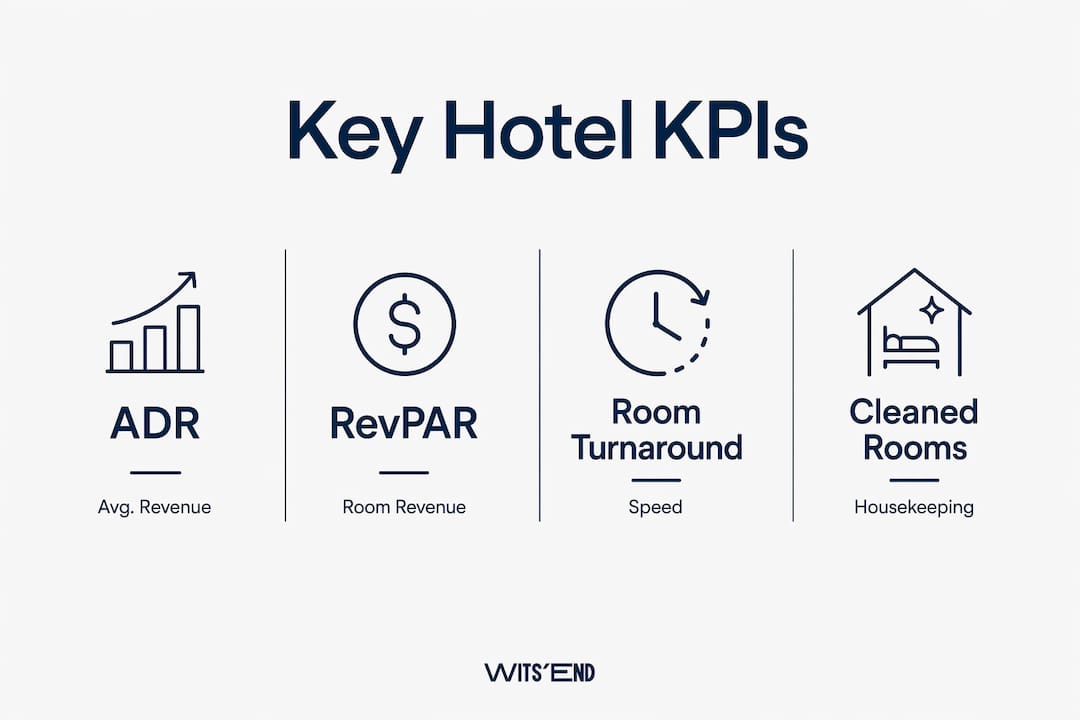
The most useful KPIs for hotel operations combine financial metrics with service quality indicators. No single number tells the full story. ADR measures the average revenue earned per occupied room. RevPAR multiplies ADR by occupancy rate, giving a fuller picture of how well the property is monetizing its available inventory. Occupancy rate alone can be misleading because a hotel running at 95% occupancy with deeply discounted rates may underperform a property at 80% with strong ADR.
Operations-specific KPIs like rooms cleaned per attendant and room turnaround time are critical benchmarks for arrival readiness. These metrics tell you whether housekeeping is staffed correctly for the day's demand. Labor cost percentage measures payroll as a share of total revenue, and it is one of the fastest indicators of whether staffing models are aligned with business volume. Guest complaint rates and response times round out the picture by showing where service delivery breaks down.
| KPI | What it measures | Why it matters |
|---|---|---|
| ADR | Average revenue per occupied room | Tracks pricing effectiveness |
| RevPAR | Revenue per available room | Combines rate and occupancy into one metric |
| Labor cost % | Payroll as a share of revenue | Flags overstaffing or understaffing quickly |
| Rooms per attendant | Housekeeping productivity | Measures arrival readiness capacity |
| Guest complaint rate | Service failure frequency | Early warning for systemic service issues |
Pro Tip: Track KPIs in pairs. A rising complaint rate alongside a falling labor cost percentage usually means the property is understaffed, not underperforming on service training.
What are the most common operational challenges and how do you fix them?
Labor shortages, poor interdepartmental handoffs, manual process inefficiencies, and deferred maintenance are the four most common friction points in hotel operations. Each one compounds the others. A short-staffed housekeeping team falls behind on turnovers. Delayed room readiness backs up the front desk. Guests wait in the lobby. Complaint rates climb. The problem looks like a guest service failure, but it started in a staffing model.
Cross-training staff does more than cover gaps during peak periods. It reveals employee strengths that would otherwise stay hidden in a single-role structure. A front desk agent who understands housekeeping priorities communicates more effectively during high-demand arrivals. A food and beverage team member who has worked banquet setup handles unexpected event changes with less supervision. Cross-training builds a more agile workforce and reduces the operational brittleness that comes from rigid role definitions.
Common operational challenges and their fixes:
- Labor shortages: Invest in career development pathways and cross-training to retain existing staff and build internal depth.
- Manual process inefficiencies: Audit workflows before digitizing them. Automating a broken process makes it faster and more broken.
- Poor interdepartmental handoffs: Implement real-time redundant communication loops, not just PMS updates, between housekeeping, engineering, and front desk.
- Preventive maintenance gaps: Build a maintenance backlog tracker and schedule recurring inspections rather than reacting to failures.
Pro Tip: Before buying any new software, map the manual process it is meant to replace. If the process has unnecessary steps, remove them first. Technology should replace a clean workflow, not a messy one.
Automation bloat is a real risk. Digitizing broken processes accelerates existing inefficiencies rather than removing them. Fix the process first, then apply the technology.
How does technology transform hotel operations and management?
A Property Management System is the operational backbone of any hotel. PMS platforms integrate reservations, housekeeping status, billing, and guest profiles into one system, reducing manual errors and giving managers a real-time view of the property. Room assignment automation and inventory tracking enable consistent service standards across high-volume periods. Without a PMS, coordination between departments depends entirely on verbal communication and paper logs, both of which fail under pressure.
Revenue management software adds a pricing layer on top of the PMS. It uses demand forecasting and competitive rate data to adjust room pricing dynamically. Customer Relationship Management tools track guest preferences, stay history, and service requests, enabling personalized service at scale. A guest who requested a high-floor room on their last visit should not have to ask again. CRM data makes that possible without relying on individual staff memory.
Digitized guest services like mobile check-in, digital room keys, and in-room tablets reduce front desk queues and improve satisfaction, particularly in high-demand or short-staffed properties. These tools also free front desk agents to focus on complex guest needs rather than routine transactions. The hotel check-in workflow is one of the highest-leverage points for technology adoption because it directly shapes the guest's first impression of the property.
Technology works best when it is aligned with a clear operational goal. The question is never "what technology should we add?" It is "what specific problem does this solve, and have we already fixed the underlying process?"
What are best practices for managing hotel operations effectively?
Effective hotel operations management requires balancing guest experience with cost controls, and that balance does not happen by accident. Skilled leadership integrates human resources, compliance, staff coordination, and guest service focus into a single management approach. Managers who stay only in the back office lose visibility into service delivery. Managers who stay only on the floor lose control of financial performance. The best operators move between both.
Six practices that consistently improve hotel operational efficiency:
- Set KPI baselines before making changes. You cannot measure improvement without knowing where you started. Pull ADR, RevPAR, labor cost percentage, and complaint rates for the past 90 days before adjusting any process.
- Build clear escalation paths. Every team member should know exactly who to contact when a room issue, guest complaint, or maintenance problem exceeds their authority to resolve.
- Schedule leadership floor time. General managers and department heads who spend structured time on the floor catch problems before they reach guests.
- Review procurement and vendor contracts quarterly. Supply costs drift upward without regular renegotiation. A quarterly review catches price creep before it shows up in the P&L.
- Invest in training before technology. A well-trained team using basic tools outperforms an undertrained team using advanced software. Training is the higher-leverage investment.
- Use guest experience data to drive operational decisions. Satisfaction scores and complaint patterns reveal which processes are failing guests, not just which staff members need coaching.
The food and beverage operation deserves specific attention because it is often the most complex revenue center in the building. F&B optimization requires its own KPI set, staffing model, and procurement discipline, separate from rooms operations but tightly integrated with the overall guest experience.
Key Takeaways
Effective hotel operations require integrating department workflows, tracking the right KPIs, fixing processes before automating them, and maintaining leadership presence on property.
| Point | Details |
|---|---|
| Department coordination is the core challenge | Real-time communication between housekeeping, engineering, and front desk prevents the most common service failures. |
| KPIs must combine financial and service metrics | ADR and RevPAR alone miss labor and service quality signals that predict future revenue problems. |
| Fix processes before automating them | Digitizing a broken workflow accelerates the problem rather than solving it. |
| Cross-training builds operational resilience | Staff who understand multiple roles cover gaps faster and communicate more effectively across departments. |
| Technology serves operations, not the other way around | Every tool adoption should map to a specific operational problem with a clean underlying process. |
What I've learned about hotel operations that most guides get wrong
Most articles on hotel operations focus on the technology stack or the org chart. After years of working inside hotel and restaurant businesses, I have found that neither is where operations actually breaks down.
The real failure point is almost always communication between three departments: housekeeping, engineering, and the front desk. Those three teams share the most time-sensitive information in the building, and they are often the least connected. A PMS update is not enough. You need a redundant, real-time communication loop, whether that is a group messaging channel, a radio protocol, or a physical whiteboard in a shared space. The tool matters less than the discipline around using it.
The second thing most guides get wrong is the relationship between technology and process. I have seen properties spend significant money on new software while the underlying workflow it was meant to support was still broken. The software made the problem faster, not better. Audit the manual process first. Remove the unnecessary steps. Then, and only then, apply the technology.
The third thing is leadership presence. Hotel operations do not run on systems alone. They run on people who feel accountable and supported. A general manager who spends structured time on the floor every day catches problems before guests do. That is not a management philosophy. It is an operational control.
— Chris
How Wits' End Solutions supports hotel operators
Wits' End Solutions works with hotel owners and operators at every stage of the business, from initial concept through daily operations. The team brings hands-on experience in staffing models, P&L management, and deep analytics that translate raw operational data into decisions you can act on. For properties that need immediate operational support, the hotel task force services place experienced senior operators on property to stabilize performance and build internal capacity. Whether you need an outside perspective or a full operating partner, Wits' End Solutions builds the engagement around what your property actually needs, not a fixed consulting model.
FAQ
What does hotel operations management cover?
Hotel operations management covers all coordinated activities that keep a property functional and guest-focused, including front office, housekeeping, food and beverage, maintenance, and administration. It also includes financial oversight, staffing, compliance, and performance tracking through KPIs like ADR and RevPAR.
What is the difference between ADR and RevPAR?
ADR measures average revenue per occupied room, while RevPAR measures revenue per available room by combining ADR with occupancy rate. RevPAR gives a more complete picture of how well a property is monetizing its total inventory.
Why do hotel operations fail at the department handoff level?
Delayed room status communication between housekeeping, engineering, and the front desk is the most common source of daily operational friction. Real-time redundant communication loops resolve this more reliably than PMS updates alone.
How should hotels approach technology adoption?
Hotels should audit and simplify manual workflows before implementing any new technology. Digitizing broken processes accelerates existing inefficiencies rather than removing them, so process optimization must come first.
What is the most effective way to address hotel labor shortages?
Cross-training staff and investing in career development pathways are the most effective responses to labor shortages. Cross-training covers staffing gaps and reveals employee strengths that build a more resilient team during peak demand periods.