

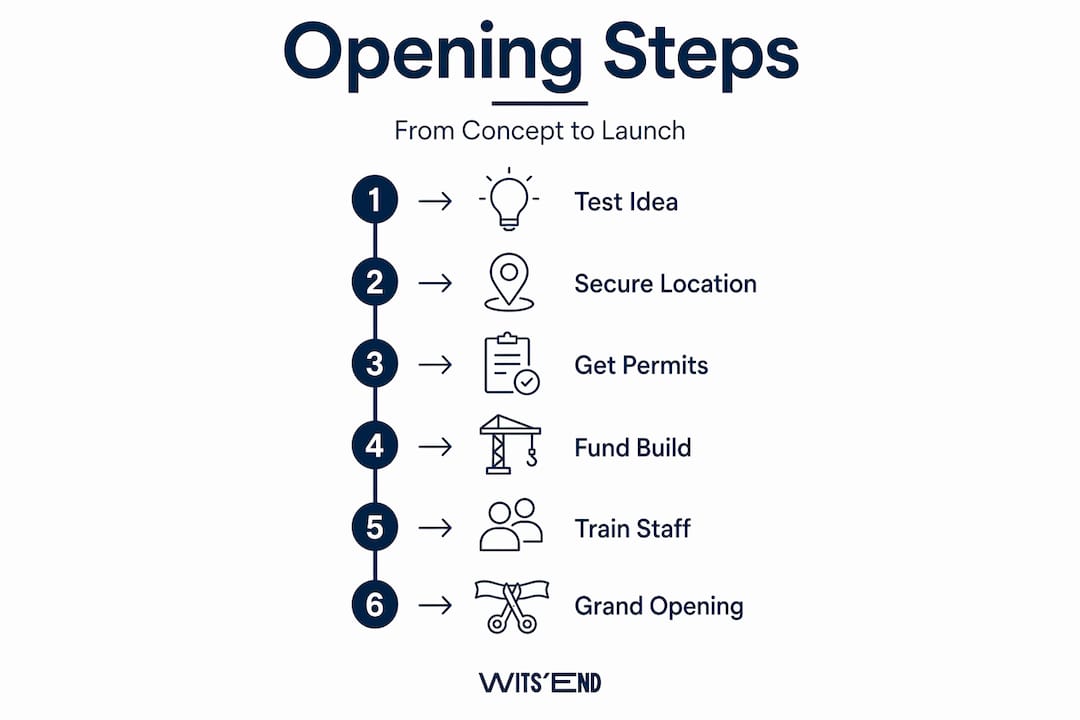
Opening a restaurant is one of the most rewarding things you can do as an entrepreneur, and one of the most demanding. Knowing how to open a restaurant the right way means understanding that 60% of independent restaurants close within their first year, almost always from undercapitalization and poor planning rather than bad food. The path from concept to opening night spans anywhere from 6 to 18 months and involves permits, financing, hiring, design, and regulatory approvals happening at once. This guide walks you through every phase, with the specificity you need to actually get there.
Table of Contents
- Key takeaways
- How to open a restaurant: concept and business model
- Securing and designing your location
- Licenses, permits, and regulatory compliance
- Financing your restaurant
- Hiring, training, and planning your launch
- What I have learned after years in this business
- How Wits' End helps you open stronger
- FAQ
Key takeaways
| Point | Details |
|---|---|
| Plan with discipline | Validate your concept, target market, and unit economics before signing any lease or committing capital. |
| Budget beyond buildout | Startup costs and ongoing liquidity both demand attention; cash reserves of 90 days minimum are non-negotiable. |
| Permits take longer than expected | Some approvals exceed 12 months, so negotiate lease clauses that protect you from paying rent before you can legally open. |
| Hire and train early | Build your leadership team before opening day so training, culture, and systems are already in motion. |
| Design for durability | Spaces that prioritize function over trend age better and perform better through years of heavy service. |
How to open a restaurant: concept and business model
The most common mistake aspiring restaurateurs make is falling in love with a concept before testing whether it can make money. Concept validation means asking hard questions before anything else. What cuisine are you serving? At what price point? Who is your customer, and do enough of them live or work near your intended location? Is your service model (fast casual, full service, counter service) aligned with your labor cost targets?
Your concept should be specific enough to stand out but practical enough to execute consistently at scale. A chef-driven neighborhood bistro and a high-volume diner have entirely different financial and operational assumptions, and mixing the two up in your planning is where things go wrong. The same applies to a hotel restaurant, where covers, average check, and captive audience dynamics require their own modeling.
Once your concept is clear, build a detailed restaurant business plan. This is not a formality. It is the document that forces you to reconcile your vision with reality. A strong plan covers your concept summary, market analysis, competitive positioning, menu strategy, organizational structure, financial projections, and funding requirements. Lenders and investors will scrutinize every assumption, so every number needs a source and a logic.
Your choice of business entity matters here too. Most restaurant operators form an LLC for liability protection and tax flexibility, though some multi-unit operators prefer a corporation structure. Talk to an attorney early. The entity you form affects everything from how you take on investors to how you handle payroll.
- Confirm your cuisine, service model, and price point match the local market demand
- Research competitors within a one-mile radius of your target location
- Define your ideal customer profile with demographic and behavioral specifics
- Build a 3-year financial model before approaching any lender or landlord
- Choose your business entity with legal counsel before signing anything
Pro Tip: Use your business plan as a living document. Update it every quarter once you open, because the assumptions you make pre-launch will shift quickly once real data arrives.
Securing and designing your location
Location is not just about foot traffic, though foot traffic matters enormously. When you evaluate a space, you are really evaluating a combination of visibility, accessibility, zoning compliance, lease terms, and physical suitability for a food service operation. A corner space on a busy block is worth very little if the HVAC cannot support your kitchen load or the landlord will not allow exterior signage.
Here is the order in which most experienced operators approach location evaluation:
- Confirm zoning for food service use before getting attached to a space
- Assess foot traffic patterns at different times of day and week, not just peak hours
- Review the condition of existing kitchen infrastructure, plumbing, and electrical capacity
- Understand the full lease cost including base rent, common area maintenance, and build-out allowances
- Negotiate lease contingencies that allow you to exit or delay rent if key permits are denied
That last point is critical. As many operators learn the hard way, you should negotiate rent deferral clauses contingent on permit approvals. Paying full rent on a space you cannot legally open is a fast way to drain your reserves before you serve a single guest.
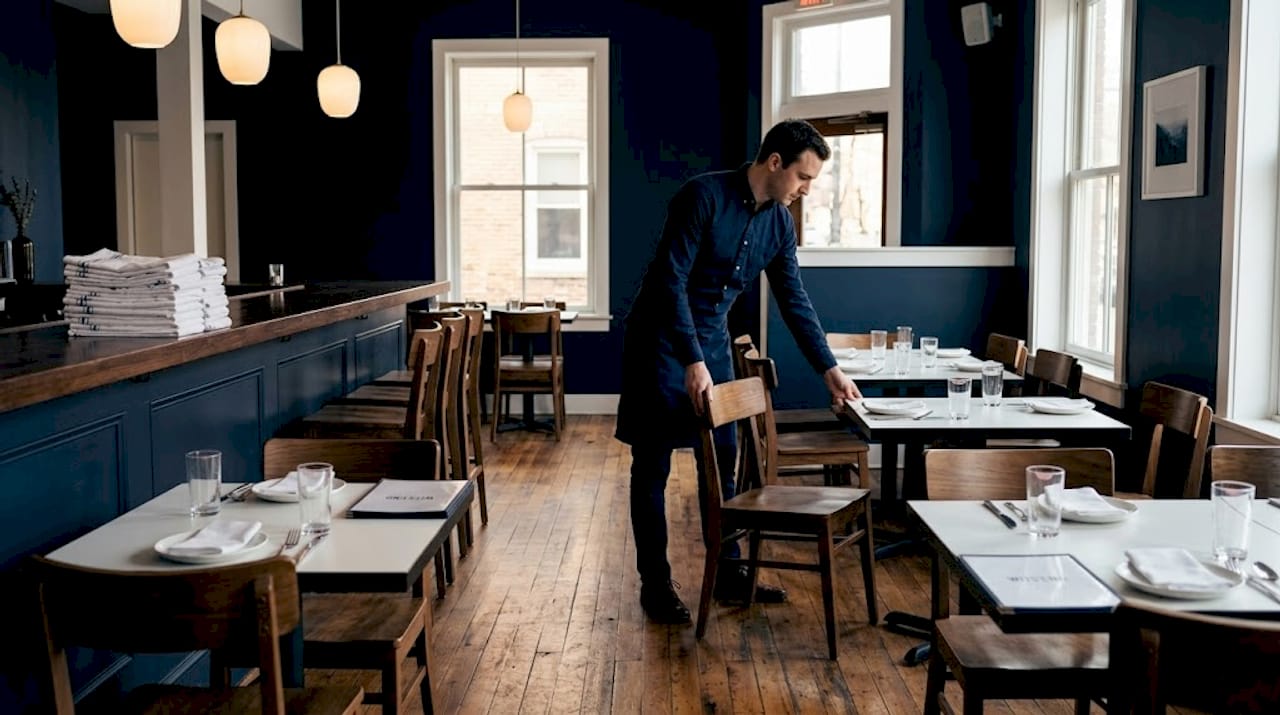
On design: the best restaurant spaces are built to last, not to impress on Instagram for six months. Durable materials, practical layouts, and proper equipment placement will serve you far better than a trending aesthetic that dates quickly. As one principle from operators with decades of experience holds, great design should be understated and built to endure. Focus your design dollars on your kitchen flow, your guest circulation, and your acoustics. Those three things directly affect your service quality and your team's ability to perform.
| Design priority | Why it matters |
|---|---|
| Kitchen flow | Reduces ticket times and labor waste during high-volume service |
| Guest circulation | Affects table turns, accessibility compliance, and perceived comfort |
| Acoustics | High noise levels drive guests out early and reduce average check |
| Durable materials | Lower long-term maintenance costs and a cleaner aesthetic over time |
Pro Tip: If you are opening a cafe or a diner with counter seating, prioritize sightlines from every seat to your service area. Guests who feel ignored because of poor layout do not come back.
Licenses, permits, and regulatory compliance
This is where many restaurant projects stall, sometimes terminally. The permits required to open a restaurant vary by city and state, but the core list typically includes a business license, a food service establishment permit, a certificate of occupancy, and a liquor license if you plan to serve alcohol.
The challenge is not just the list. It is the sequence and the timeline. Permit approvals in competitive urban markets can take far longer than first-time operators expect. Some permits take over 12 months for approval, with fees required upfront and no guarantee of timing. If you are figuring out how to open a restaurant in New York, this reality is especially pronounced. Zoning variances, landmark reviews, and city agency coordination can stack inspection timelines in ways that make even well-funded projects feel impossible.
Common pitfalls to avoid in the permitting process:
- Starting construction before confirming zoning approval and building permit status
- Failing to schedule health department pre-inspections early in the build-out process
- Missing fire safety or ADA compliance requirements that trigger costly redesigns
- Applying for your liquor license too late. In many states, this process alone takes 90 to 180 days
- Not keeping organized documentation of every approval, inspection, and variance
The single most expensive mistake in restaurant development is assuming your construction completion date and your legal opening date are the same thing. They almost never are. Build your timeline around permit approvals, not around your contractor's schedule.
Work with a permit expediter in dense urban markets. The cost is modest relative to the rent you will pay waiting for approvals that could have been accelerated.
Financing your restaurant
Restaurant margins are thin. Profit margins typically run between 3% and 9%, with food costs at 28% to 35% of revenue and labor costs at 30% to 35%. That math leaves very little room for error, which is why your financing strategy needs to be built around realistic assumptions from the start.
In New York, for example, startup costs range from $227,500 to over $1,290,000 depending on concept, location, and build-out scope. But total startup cost is only part of the picture. Most operators who fail focus their capital planning on buildout and equipment while ignoring the ongoing liquidity needed for payroll, inventory, marketing, and seasonal dips in the first year.
| Financing source | Best use case | Key consideration |
|---|---|---|
| SBA loan | Full startup funding for first-time operators | Requires strong business plan and relevant experience |
| Equipment financing | Kitchen and technology purchases | Preserves working capital for operations |
| Working capital line | Covers payroll and inventory between revenue cycles | Critical for seasonal or ramp-up periods |
| Personal investment | Demonstrates commitment to lenders and investors | Should not eliminate your personal emergency reserves |
SBA financing remains the most accessible option for independent operators. It offers longer repayment terms and flexible structures, but lenders expect a polished business plan and evidence of operational experience. Equipment financing is worth considering separately because it preserves your working capital for the period when you need it most: the first 90 days of operation.
Pro Tip: Budget at least 20% to 30% above your initial estimates for every major cost category. Contractors miss deadlines. Equipment gets back-ordered. Health inspections require modifications. Your buffer is not pessimism. It is professionalism.
Hiring, training, and planning your launch
The team you hire before opening day shapes everything that happens after it. You need core leadership in place well ahead of your target opening. That means an executive chef or head of kitchen operations, a general manager, and ideally a front-of-house lead who can build and train your service team alongside you.
Here is a practical sequence for your pre-opening staffing plan:
- Hire your executive chef and general manager at least 60 days before target opening
- Develop your training program and service standards before your first hourly hire walks through the door
- Run at least two weeks of internal training covering menu knowledge, service flow, POS systems, and guest interaction protocols
- Conduct a soft opening with a limited guest list two to three weeks before your public launch
- Use soft opening feedback to adjust staffing levels, timing, and menu execution before full service begins
Training is where a lot of operators cut corners because they are racing toward opening. That is the wrong call. A team that does not know the menu deeply, does not understand your service expectations, and has not practiced under pressure will cost you more in poor reviews and turnover than the training investment ever would. As a general rule, staffing and operations integration that happens early in the development phase consistently produces more stable launches.
Your marketing plan should also be active before you open. Build your social presence, claim your Google Business profile, and create a pre-opening email list. Local press and food media coverage in the week before opening costs very little and can generate meaningful awareness for your first weeks of service.
What I have learned after years in this business
I have worked with a lot of operators across the full range of concepts: fine dining, fast casual, hotel restaurants, and everything in between. What separates the ones who make it from the ones who do not is almost never the food. It is discipline.
The operators who succeed treat their financial model as a contract with reality. They do not open a restaurant hoping the numbers will work out. They prove the numbers can work before they spend a dollar on construction. They also take the regulatory process seriously from day one, not as an obstacle but as a sequenced set of milestones that their entire timeline should be built around.
What I have seen trip people up most consistently is the gap between creative confidence and operational rigor. You can have a brilliant concept, a beautiful space, and a talented chef. But if your P&L assumptions are off by 10 points on labor, or you are six months behind on your liquor license, none of that matters.
My honest take: if you have never worked inside a restaurant at a management level, partner with someone who has before you open. That experience is not optional. It is the thing that tells you the difference between a concept that works on paper and one that works on a Saturday night in the weeds.
— Chris
How Wits' End helps you open stronger
At Witsendsolutions, we have helped operators move from initial concept to opening night across a wide range of restaurant and hotel food and beverage projects. We know where the delays happen, where the money goes, and where most first-time operators need the most support.

Whether you need help developing a hospitality brand identity that stands out in a crowded market, building out your pre-opening training programs, or stress-testing your financial model before you sign a lease, our team brings direct operational experience to every engagement. We also offer business optimization services for operators who are already open and working to build healthier margins and more consistent operations. If you are ready to move from planning to execution with confidence, we are ready to work alongside you.
FAQ
How long does it take to open a restaurant?
Opening a restaurant typically takes 6 to 18 months from concept to launch, with permitting and construction timelines being the most variable factors.
What are the biggest reasons restaurants fail in their first year?
Undercapitalization and poor planning are the leading causes, with 60% of independent restaurants closing within the first year according to industry data.
How much does it cost to open a restaurant in New York?
Startup costs in New York range from approximately $227,500 to over $1,290,000, depending on concept, location, and the scope of the build-out.
What permits do I need to open a restaurant?
At minimum, you will need a business license, food service establishment permit, and certificate of occupancy. If you plan to serve alcohol, a liquor license is also required, and that process alone can take 90 to 180 days.
Do I need a business plan to open a restaurant?
Yes. A detailed business plan is required by most lenders and investors, and more importantly, it forces you to validate your financial assumptions before committing capital to a concept.