
TL;DR:
- Hospitality professionals use specialized terminology to ensure precise communication across operations, finance, and guest services. Understanding key terms like RevPAR, ADR, and GOPPAR helps improve revenue management and profitability. Standardized language standards support consistent service and reduce misunderstandings in daily operations and event management.
Key hospitality industry terms are the specialized vocabulary professionals use to navigate operations, finance, guest services, and event management with precision. Without this shared language, a front desk manager and a revenue director can sit in the same meeting and walk away with completely different action plans. This hospitality terminology guide covers the terms that matter most, from RevPAR and ADR to MICE and attrition clauses, with definitions grounded in current U.S. industry standards including ISO 18513:2021 and the Events Industry Council glossary.
What are the core financial and performance terms in hospitality?
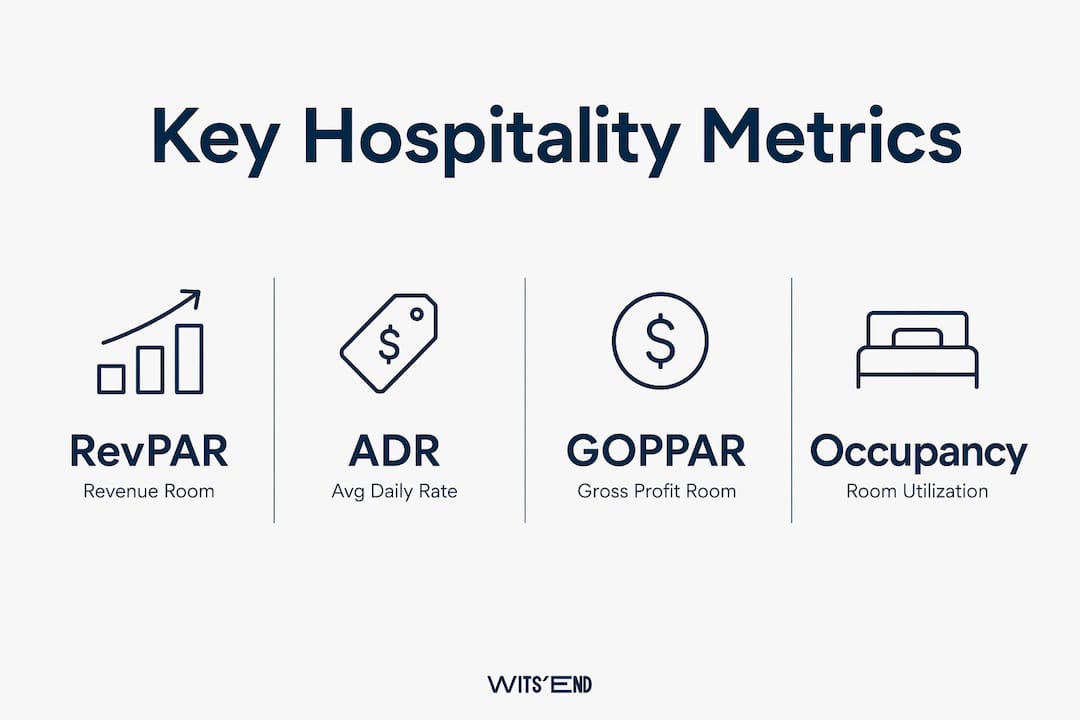
RevPAR, or Revenue Per Available Room, is the single most cited hotel performance metric in U.S. hotel operations. The formula is straightforward: ADR multiplied by occupancy percentage. A property with an ADR of $200 and 75% occupancy posts a RevPAR of $150. That number tells ownership whether the hotel is filling rooms at the right price or simply discounting its way to a full house.

ADR, or Average Daily Rate, measures the average revenue earned per occupied room per day. It reflects pricing power and market positioning, not just volume. A hotel can have strong occupancy and weak ADR, which signals a discounting problem rather than a demand problem.
GOPPAR, or Gross Operating Profit Per Available Room, goes one layer deeper than RevPAR. It accounts for operating expenses, giving a clearer picture of actual profitability. Financial health metrics like GOPPAR and GOP reveal whether a property is generating real profit or just top-line revenue.
Here is a quick reference for the four metrics every hospitality professional should know:
| Metric | What it measures | Formula |
|---|---|---|
| ADR | Average price per occupied room | Total room revenue ÷ rooms sold |
| Occupancy Rate | Percentage of rooms sold | Rooms sold ÷ rooms available |
| RevPAR | Revenue efficiency per available room | ADR × occupancy % |
| GOPPAR | Profit efficiency per available room | Gross operating profit ÷ rooms available |
Revenue Management is the practice of adjusting pricing and inventory in real time to maximize revenue based on demand forecasts. Yield Management is an older, related term that focuses specifically on selling the right room to the right guest at the right price. The two terms are often used interchangeably, though Revenue Management is the broader, more current standard.
Pro Tip: Track both RevPAR and GOPPAR together. RevPAR tells you how well you are selling rooms. GOPPAR tells you whether those sales are actually profitable after labor and operating costs.
Which operational and front-of-house terms are crucial for daily management?
Overbooking is a deliberate strategy, not an accident. Controlled overbooking compensates for predictable no-shows and last-minute cancellations by accepting more reservations than available rooms. Done with accurate historical data, it protects occupancy without creating a guest service crisis. Done carelessly, it results in "walking" a guest, which means relocating them to another property at the hotel's expense.
The key operational terms every front-of-house team should know:
- No-Show: A guest who holds a reservation but does not arrive and does not cancel. No-shows directly affect RevPAR and trigger overbooking calculations.
- Comp Room: A complimentary room provided at no charge, typically for VIP guests, group organizers, or service recovery situations.
- Bumping: The act of relocating a guest with a confirmed reservation to another property when the hotel cannot accommodate them. This carries legal and reputational risk.
- Room Block: A set of rooms reserved for a specific group at a negotiated rate, held until a cut-off date.
- Cut-Off Date: The deadline by which a group must claim rooms in their block. Unreleased rooms return to general inventory after this date.
- Walk-In: A guest who arrives without a prior reservation and requests a room at the front desk.
Upselling and cross-selling are two distinct revenue tactics that front-of-house teams use daily. Upselling means encouraging a guest to upgrade to a higher room category or add a premium service. Cross-selling means offering a different but complementary product, such as a restaurant reservation or spa package. Both require staff training to feel like genuine hospitality rather than a sales pitch. The pre-shift briefing is the most effective time to align your team on which rooms to upsell and what cross-sell offers are active that day.
Pro Tip: Set a clear overbooking threshold based on your trailing 90-day no-show rate. Never overbook by more than your historical no-show average, and always have a walk agreement with a comparable property nearby.
What terminology relates to meetings, events, and conference management?
MICE is the standard acronym for the business travel segment covering Meetings, Incentives, Conferences, and Exhibitions. This segment drives significant group revenue for full-service hotels and convention properties. Understanding MICE terminology is non-negotiable for any sales or catering manager working with corporate clients.
The Events Industry Council glossary contains approximately 1,400 specialized terms. That number reflects how technically complex event management has become. Knowing the right terms prevents contract disputes, budget errors, and operational breakdowns.
Core MICE terms every hospitality professional should recognize:
- BEO (Banquet Event Order): The master document for any catered event. It details room setup, menu, timing, staffing, and billing. Every department touches the BEO.
- RFP (Request for Proposal): A formal document sent by a meeting planner to hotels requesting pricing, availability, and service details for a group event.
- Master Account: A centralized billing account that consolidates all group charges, so the organizing company pays one invoice rather than individual guest folios.
- Site Inspection: A pre-event visit by a meeting planner to evaluate the property. A strong site inspection is often the deciding factor in winning a group contract.
- Convention Services Manager (CSM): The hotel staff member who manages all operational details of a group event after the sales contract is signed.
Two financial terms in event contracts carry the most risk for planners who do not read the fine print. Plus Plus (++) means a quoted price has both service charges and taxes added on top. Missing this detail can create a 20–30% budget variance between the quoted price and the final invoice. Attrition Rate is the negotiated tolerance for unused rooms in a contracted room block, commonly 10–20%. If a group books 100 rooms but only uses 75, and the attrition clause allows 20% variance, the group owes penalties on only 5 rooms, not 25.
How do hospitality terminology standards support consistent service quality?
ISO 18513:2021 is the international standard that defines tourism accommodation vocabulary across cultures and markets. It standardizes terms like meal plans, room types, and property classifications so that a "half-board" room in one country means the same thing as it does in another. For U.S. properties serving international guests, this standard reduces miscommunication at the front desk and in online booking descriptions.
The practical benefits of standardized hospitality language include:
- Consistent guest expectations: When room type names and meal plan definitions are standardized, guests arrive knowing exactly what they booked.
- Cleaner internal communication: Departments use the same terms, which reduces errors in housekeeping assignments, F&B orders, and billing.
- Stronger contract clarity: Standardized language in group contracts and event orders leaves less room for dispute.
- Faster staff onboarding: New team members learn one set of definitions rather than a property-specific dialect.
The Events Industry Council's 1,400-term glossary serves a similar function for the meetings and events segment. It gives planners, hotels, and vendors a shared reference point that reduces the back-and-forth that slows down event execution.
"A unified vocabulary is not a bureaucratic exercise. It is the foundation of operational efficiency and guest satisfaction. When every team member uses the same language, service becomes predictable, and predictable service is the baseline for excellence."
The role of food terminology in hospitality is a strong example of where standardization matters most. Terms like "table d'hôte," "prix fixe," "à la carte," and "family-style service" carry specific meanings that affect menu design, staffing ratios, and guest experience. A server who misunderstands the difference between a prix fixe and an à la carte service will create confusion at the table. Understanding guest experience language at this level of detail separates average operators from excellent ones.
Key Takeaways
Mastering hospitality terminology is the foundation of effective operations, accurate financial reporting, and professional communication across every department.
| Point | Details |
|---|---|
| RevPAR and GOPPAR together | Track both metrics to understand revenue performance and actual profitability, not just occupancy. |
| Controlled overbooking is intentional | Use historical no-show data to set overbooking thresholds and protect occupancy without walking guests. |
| Plus Plus (++) creates budget risk | Always clarify whether a quoted event price includes service charges and taxes to avoid a 20–30% variance. |
| ISO 18513:2021 standardizes key terms | Use this standard as a reference for room types, meal plans, and classifications to align guest expectations. |
| MICE glossaries reduce contract disputes | The Events Industry Council's 1,400-term glossary gives planners and hotels a shared language for group events. |
Why terminology fluency is the most underrated skill in hospitality
I have sat across the table from hotel GMs who could not define GOPPAR and revenue managers who had never heard of an attrition clause. That gap is not a knowledge problem. It is a communication problem that compounds over time. When your front desk team does not understand the difference between a no-show and a cancellation, your RevPAR calculations are wrong. When your catering manager does not flag a Plus Plus quote, your client's event goes over budget and they blame the hotel.
The operators who move fastest in this industry are the ones who speak the same language as their ownership groups, their lenders, and their event clients. Terminology fluency is not about sounding sophisticated in meetings. It is about making faster, cleaner decisions because everyone in the room is working from the same definitions.
The most costly misunderstandings I have seen in hospitality operations come from terms that seem obvious but are not. "Comp" means different things to a front desk agent and a food and beverage director. "Attrition" means something completely different in HR and in a group contract. Building a shared internal glossary, even a simple one, is one of the highest-return investments a property can make in its team.
Continuous learning matters here. Standards like ISO 18513:2021 and resources like the Events Industry Council glossary exist precisely because the industry recognized that informal, property-specific language creates friction. Use them. Build them into your onboarding. Make terminology review a standing item in your pre-shift briefings.
— Chris
How Wits' End Solutions helps hospitality teams build operational clarity
Wits' End Solutions works with hotels, restaurants, and food and beverage groups across the United States at every stage of the business lifecycle. Our team covers brand design and development, daily operations, team training, and deep analytics and advising powered by our Ingest partner platform. We have done the work ourselves before we ever recommend it to a client, which means the guidance we give is grounded in real operations, not theory. If your team needs sharper communication, stronger financial reporting, or a clearer operational framework, we can help you build it. Reach out to Wits' End Solutions at witsendsolutions.com to start the conversation.
FAQ
What does RevPAR mean in hospitality?
RevPAR stands for Revenue Per Available Room and is calculated by multiplying ADR by occupancy percentage. It is the primary metric used to measure a hotel's revenue performance relative to its total room inventory.
What is the MICE segment in the hospitality industry?
MICE stands for Meetings, Incentives, Conferences, and Exhibitions. It refers to the business travel and group events segment, which is a major revenue driver for full-service hotels and convention properties.
What does Plus Plus (++) mean on an event quote?
Plus Plus means the quoted price does not include service charges or taxes, which are added on top. Misreading a Plus Plus quote can create a 20–30% variance between the estimated and final event cost.
What is an attrition clause in a hotel group contract?
An attrition clause sets the maximum percentage of unused rooms in a contracted block before penalties apply, typically 10–20%. It protects meeting planners from owing full penalties when attendance falls slightly short of projections.
Why does ISO 18513:2021 matter for U.S. hospitality operations?
ISO 18513:2021 standardizes vocabulary for tourism accommodation, including room types and meal plans, to reduce miscommunication across cultures. U.S. properties serving international guests benefit directly from aligning their descriptions with this standard.