

For multi-property hotel groups, the right technology stack starts with one decision: adopt a cloud-native, centralized property management system as your operational foundation, then layer in integrated revenue management, POS/payments, housekeeping automation, CRM/guest communications, and a centralized business intelligence layer. That sequence matters because each downstream tool depends on clean, real-time data from the PMS to function at group scale.
Here is what each category delivers:
- Centralized PMS / hospitality operating system: Portfolio-level controls, unified guest profiles, automated workflows, and embedded payments across all properties.
- Revenue management system (RMS): Dynamic pricing across your portfolio, fed by live occupancy and demand signals from the PMS.
- CRM and guest communications: Segmented marketing, pre-arrival messaging, and in-stay engagement tied to a single guest record.
- Housekeeping and maintenance automation: Digital room boards, auto-allocation, mobile tasking, and real-time room status across properties.
- POS and payments integration: F&B connectivity, room-charge workflows, and PCI DSS-scoped payment handling.
- Business intelligence and centralized reporting: Cross-property benchmarking on KPIs like RevPAR, GOPPAR, and staff-hours per occupied room.
- Sales and events / group bookings: RFP automation, group-block management, and contract and billing workflows.
Groups with five or more properties should treat PCI DSS and SOC 2 compliance as non-negotiable vendor requirements, not optional checkboxes. Published case studies and a working sandbox environment are the two trust signals that separate credible vendors from marketing-heavy ones. Wits' End Solutions can help you map these categories to your specific portfolio before you ever open a vendor conversation.
Table of Contents
- How do operations tools compare across multi-property hotel groups?
- What does each core tool category actually do for your group?
- How should you evaluate and choose operations tools for your group?
- What does a realistic rollout look like across multiple properties?
- What integration and data governance decisions should you make early?
- How should you build a business case for operations tools?
- Key Takeaways
- What experienced operators know that vendor demos won't tell you
- How Wits' End Solutions supports your tool selection and rollout
- Useful sources and further reading
How do operations tools compare across multi-property hotel groups?
The table below compares tool categories at the group level. Vendor names are intentionally absent here; the goal is to help you filter by category fit before you enter any demo cycle.
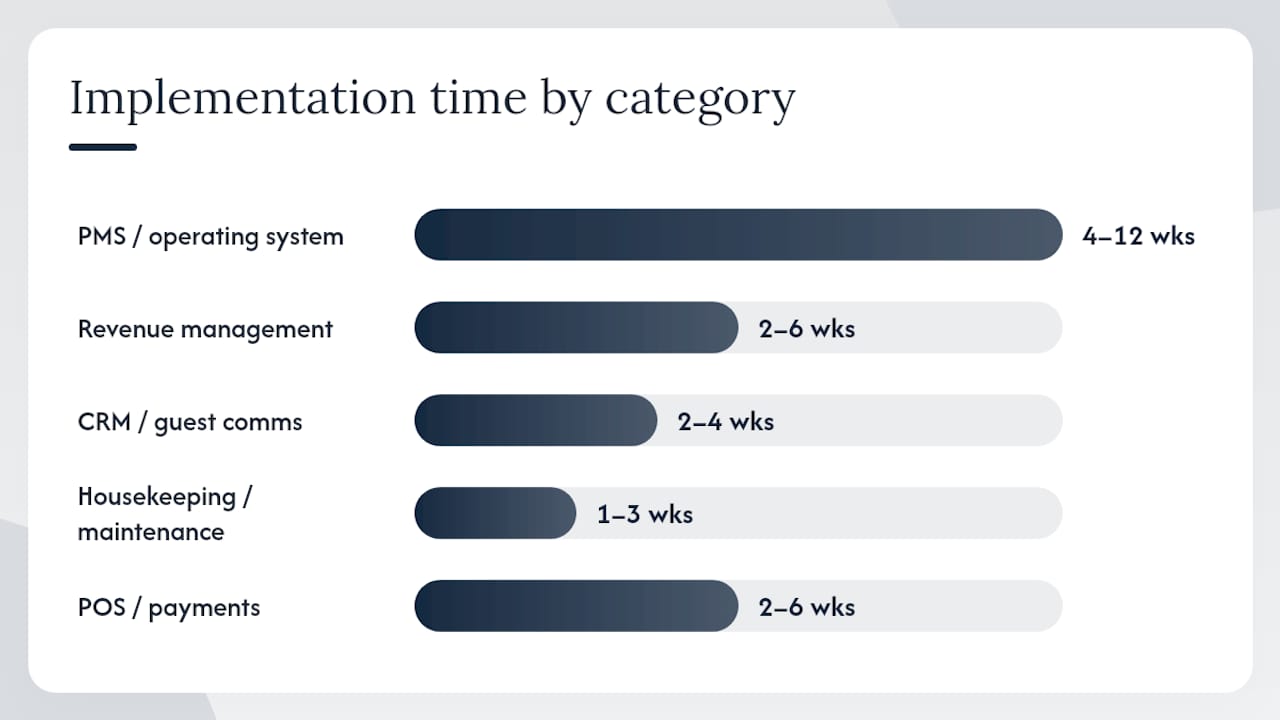
| Category | Best for | Deployment | Key integrations | Pricing shape | Implementation time | US support | Reporting strength | API maturity |
|---|---|---|---|---|---|---|---|---|
| PMS / operating system | All group sizes | Cloud-native | RMS, POS, CRM, payments, channel manager | Per-room/month | 4–12 weeks per property | Widely available | High: portfolio dashboards | High: open APIs, marketplaces |
| Revenue management | 10+ properties | Cloud | PMS, channel manager, OTAs | Per-property or % of revenue | 2–6 weeks | Moderate to high | High: rate and demand analytics | Moderate to high |
| CRM / guest comms | All group sizes | Cloud | PMS, email/SMS, loyalty | Per-property or per-contact | 2–4 weeks | Widely available | Moderate: segment and campaign | Moderate |
| Housekeeping / maintenance | All group sizes | Cloud or hybrid | PMS, mobile apps | Per-property flat fee | 1–3 weeks | Moderate | Moderate: task and SLA tracking | Moderate |
| POS / payments | F&B-heavy groups | Cloud or on-prem | PMS, accounting, payments gateway | Per-terminal or per-transaction | 2–6 weeks | Widely available | Moderate: F&B and revenue | Moderate |
| Business intelligence | 5+ properties | Cloud | PMS, RMS, POS, HR/payroll | Module or subscription | 2–4 weeks | Moderate | Very high: cross-property KPIs | Moderate to high |
| Sales and events | Groups with meeting space | Cloud | PMS, CRM, billing | Per-property or per-user | 3–8 weeks | Moderate to high | Moderate: group revenue tracking | Moderate |
Fast rollout scenario: Groups that need to go live quickly across multiple properties should prioritize vendors with pre-built integration marketplaces and a documented onboarding playbook. A cloud-native PMS with open APIs and a library of certified connectors can compress a typical 12-week rollout to 6–8 weeks on a well-prepared property.
Deep customization scenario: Enterprise portfolios with complex F&B operations, loyalty programs, and multi-brand structures need vendors with mature API documentation, dedicated implementation engineers, and a phased migration path. Expect longer timelines and higher upfront costs, but the long-term operational leverage is proportionally greater.
Pro Tip: Choose a single-platform "operating system" approach when your group needs consistent data across all properties and wants to minimize integration overhead. Choose a best-of-breed ecosystem when you have specific, high-value needs in one category (such as a sophisticated RMS or a loyalty platform) that no single vendor covers well. Most groups with 10 or fewer properties benefit from the operating system approach; larger portfolios with specialized needs often end up with a hybrid.
Look for these trust signals in every vendor conversation: published case studies with named hotel group customers, sandbox or demo access before you sign, a documented implementation timeline and onboarding plan, a public integration partner list or marketplace, SOC 2 and PCI DSS compliance statements, and transparent pricing examples or ranges.
What does each core tool category actually do for your group?
PMS and hospitality operating system
A modern PMS at the group level is less a reservation ledger and more a shared data layer. The best platforms today position themselves as hospitality operating systems with embedded payments, portfolio-level controls, and automation that reduces manual admin while increasing revenue per guest. Oracle OPERA Cloud, for example, offers centralized guest profiles, multi-property reporting, and integrated POS and sales management built specifically for chain-level operations. Platforms like Daylight PMS from Shiji take an API-first approach with over 1,200 documented endpoints, which matters when you need to connect a large ecosystem of third-party tools quickly.
Selection checks: Does the platform support portfolio-level rate and availability controls from a single dashboard? Can it deduplicate guest profiles across properties automatically?
Revenue management systems
An RMS earns its cost by automating pricing decisions that a revenue manager cannot make fast enough manually across a large portfolio. The key inputs are live occupancy data, forward-looking demand signals, competitor rate feeds, and historical patterns. At the group level, you want portfolio-level pricing rules with property-level overrides, not a tool that treats each property as an isolated unit.
Selection checks: Can the RMS push rate changes to the PMS and channel manager simultaneously? Does it support group-block pricing separately from transient inventory?
CRM and guest communications
CRM at the group level means one guest record that follows a traveler across every property in your portfolio. That single record enables personalized pre-arrival messaging, in-stay upsells, and post-stay marketing that feel relevant rather than generic. U.S. marketing law (CAN-SPAM, TCPA) requires explicit consent management, so your CRM must support opt-in tracking and suppression lists by channel.
Selection checks: Does the CRM sync guest profiles with the PMS in real time? Can you segment by stay history across all properties, not just one?
Housekeeping and maintenance automation
Digital room boards and mobile tasking tools eliminate the walkie-talkie-and-whiteboard model that still runs housekeeping in too many hotels. Platforms in this category offer auto-allocation of rooms to attendants, live room status updates, and remote monitoring across properties, which means a director of housekeeping can see the status of every room in the portfolio from one screen. SLA tracking for maintenance requests closes the loop between guest-reported issues and resolution time.
Selection checks: Does the platform integrate with your PMS for real-time check-out triggers? Can supervisors reassign tasks from a mobile device without logging into a desktop?
POS and payments integration
Room-charge workflows between POS and PMS are where data breaks most often in group operations. A guest charges dinner to their room, the POS posts to the wrong folio, and the front desk spends 20 minutes at checkout reconciling. The fix is a certified, real-time integration between your POS and PMS, with virtual card handling for OTA reservations built into the payment flow. PCI scope reduction is a meaningful cost benefit: a cloud-based payments gateway that handles card data outside your network shrinks your audit surface considerably.

Selection checks: Is the POS-to-PMS integration certified and real-time, or batch-synced? Does the payments gateway support virtual card processing for OTA bookings?
Business intelligence and centralized reporting
A BI layer that sits above your PMS, RMS, and POS is what turns raw data into decisions. Cross-property benchmarking on RevPAR, GOPPAR, and staff-hours per occupied room tells you which properties are underperforming and why. Most PMS platforms offer some reporting, but a dedicated BI tool with a normalized data model across your full stack gives you the analytical depth that group-level decisions require.
Selection checks: Can the BI tool ingest data from all your systems, or only from the PMS? Does it support custom KPI definitions for your specific portfolio structure?
Sales and events / group bookings
Automating RFP responses and group-sales workflows is one of the highest-ROI moves a group with meeting space can make. Cvent is the dominant platform in this category for U.S. hotel groups, covering RFP management, group-block tracking, and contract and billing workflows. The Access Group offers enterprise-level event management and financial integration for larger portfolios. Faster RFP turnaround directly affects win rate on group business, and the data from these platforms feeds your BI layer for group revenue forecasting.
Selection checks: Does the platform connect to your PMS for real-time room block availability? Can it generate group contracts and invoices without manual re-entry?
How should you evaluate and choose operations tools for your group?
Start with business outcomes, not feature lists. Score every vendor against three questions: Will this reduce labor costs or recover staff hours? Will it increase RevPAR or ancillary revenue? Will it deliver consistent guest experience across all properties?
- Define your integration requirements first. Map every system you currently run and identify which connections are manual today. Any vendor that cannot connect to your existing PMS via an open API is a red flag.
- Confirm multi-property controls. The platform must support portfolio-level configuration with property-level overrides. A tool that requires separate logins and separate reporting for each property creates more work, not less.
- Verify deployment model and data ownership. Cloud-native is the default for new deployments. Confirm you own your data and can export it in a standard format if you switch vendors.
- Assess implementation timeline and migration effort. A realistic timeline for a 10-property group running a PMS replacement is 6–18 months, depending on data complexity and integration count. Any vendor quoting 4 weeks for a full portfolio migration deserves scrutiny.
- Confirm US support and SLAs. 24/7 US-based support and a published uptime SLA (99.9% is the common benchmark) are baseline requirements for a group operation.
- Require SOC 2 and PCI DSS documentation. Ask for the actual compliance reports, not just a checkbox on a sales deck.
- Evaluate analytics maturity. Request a live demo of cross-property reporting. If the vendor cannot show you a portfolio dashboard with real data in the demo, assume it does not exist.
- Get transparent pricing. Per-room/per-month pricing is the most common model for PMS and CRM tools. Per-property flat fees are common for housekeeping and maintenance platforms. Understand what is included in the base price and what triggers additional module or user fees.
- Assess training and onboarding services. Ask for a sample onboarding plan and references from groups of similar size. Staff adoption is where most rollouts stall, and the vendor's training program is a direct indicator of how seriously they take it.
Questions to ask vendors during demos:
- What is your average implementation time for a group of our size?
- Can you show us a live cross-property dashboard from a current customer?
- What does your data migration process look like, and who owns the migration work?
- How do you handle a system outage during peak check-in hours?
- What integrations are certified versus custom-built?
As a rough cost-sizing rule, budget $500–$1,500 per room for a full PMS replacement including implementation, data migration, and first-year support. Smaller point solutions (housekeeping, CRM) typically run $100–$400 per room annually.
Pro Tip: Require a sandbox environment and run a 60-day pilot on one low-risk property before committing to a full portfolio rollout. Set three measurable KPIs for the pilot (for example: check-in time, housekeeping turnaround, and front-desk transactions per hour) and use the pilot results to build your executive business case.
What does a realistic rollout look like across multiple properties?
A phased rollout is the only approach that works at group scale. Trying to cut over an entire portfolio simultaneously is how you create guest-facing failures and staff burnout simultaneously.
- Pilot phase (weeks 1–12, one property). Select a mid-volume property with a cooperative GM and a stable team. Complete data migration, configure integrations, train all staff, and run the new system in parallel with the old one for at least two weeks. Measure your pilot KPIs weekly. Shiji's multi-property implementations show that digital check-in features alone, when deployed correctly, can reallocate meaningful front-desk hours to guest-facing service. Use your pilot data to prove the same for your portfolio.
- Regional rollout (weeks 13–36, 3–10 properties). Apply lessons from the pilot. Update SOPs before each property goes live, not after. Assign a dedicated implementation lead per region and hold weekly go/no-go checkpoints against your KPI targets.
- Full portfolio scale (weeks 37 onward, all remaining properties). By this phase, your team has a repeatable playbook. The main risks shift from technical to organizational: maintaining change management momentum and keeping executive sponsorship active.
Key KPIs to track throughout rollout: check-in time (minutes), housekeeping room turnaround (minutes), ancillary revenue per occupied room, front-desk transactions per hour, and staff-hours per occupied room.
Common migration risks and practical mitigations:
- Data mismatch: Run a data audit on the source system before migration begins. Deduplicate guest profiles and validate rate codes against your current configuration.
- Staff resistance: Involve department heads in vendor selection. Staff who helped choose the tool are more likely to champion it.
- Guest friction during cutover: Schedule cutovers on low-occupancy nights. Communicate proactively with guests who have reservations spanning the cutover date.
Pro Tip: The pilot's job is not just to test the software. It is to build the internal case for executive sponsorship. Document every hour saved, every error eliminated, and every piece of guest feedback that changed. That evidence is what gets the budget approved for the full rollout.
What integration and data governance decisions should you make early?
The integrations that matter most at group scale are PMS to POS, PMS to RMS, PMS to CRM, and PMS to your payments gateway. Every other connection is secondary until those four are stable and real-time.
- API maturity checklist: Confirm real-time event feeds (not batch), webhook support for key events (check-in, check-out, payment), a documented integration marketplace with certified partners, and publicly available API documentation. Vendor help centers and knowledge bases are a direct signal of integration maturity. A vendor with thorough, searchable documentation is a vendor that takes integrations seriously.
- Data governance: Establish a single source of truth for guest profiles, typically the PMS. Define a master guest profile standard and enforce deduplication rules before migration. For U.S. operations, your CRM must support CAN-SPAM and TCPA consent tracking with documented suppression lists.
- Security and compliance: PCI scope reduction is achievable when your payments gateway handles card data outside your network perimeter. Require SOC 2 Type II reports (not just Type I) and ask vendors for their uptime SLA in writing. A 99.9% SLA translates to roughly 8.7 hours of allowable downtime per year.
- Operational handoffs: Assign a named internal owner for integration monitoring at each property. Define vendor escalation paths before go-live, not during an incident.
How should you build a business case for operations tools?
Vendor pricing for hotel operations software typically falls into four shapes: per-room/per-month (most common for PMS and CRM), per-property flat fee (common for housekeeping and maintenance tools), user or module pricing (common for BI and sales platforms), and transaction-based fees (common for payments and RMS signals).
| Cost driver | Entry-level groups (2–9 properties) | Enterprise portfolios (10+ properties) |
|---|---|---|
| PMS licensing | Per-room/month, lower volume rates | Volume discounts, custom enterprise pricing |
| Implementation and migration | Moderate; often self-guided with vendor support | High; typically requires dedicated implementation team |
| Integration engineering | Low to moderate; pre-built connectors | Moderate to high; custom API work likely |
| Training and change management | Often included in onboarding | Separate line item; budget 10% of software cost |
| Data cleansing and migration | 1–2 weeks of internal effort | 4–12 weeks; may require third-party data specialists |
| Ongoing support and SLA | Standard support tiers | Premium SLA often required; priced separately |
A simple ROI framework: divide annual benefit by total first-year cost. If recovering 2 staff-hours per occupied room per day across a 200-room property at a fully loaded labor rate of $25/hour generates $1.8M in annual labor savings, and your total first-year technology cost (licensing, implementation, training) is $400,000, your first-year ROI is 4.5x. That math holds up in executive conversations because it uses your own numbers, not vendor projections.
Hidden costs that routinely blow budgets: integration engineering for non-marketplace connections, data cleansing before migration, temporary productivity loss during cutover (budget 2–4 weeks of reduced throughput per property), and the change management effort that most groups underestimate by half.
Key Takeaways
The single most important selection criterion for a hotel group is integration depth combined with portfolio-level controls. A PMS that cannot connect cleanly to your RMS, POS, and CRM in real time will cost you more in manual labor and data errors than it saves in licensing fees.
| Point | Details |
|---|---|
| Start with the PMS as your foundation | Every other tool depends on clean, real-time data from a centralized cloud-native PMS. |
| Require SOC 2 and PCI DSS documentation | Ask for actual compliance reports before signing; a checkbox on a sales deck is not evidence. |
| Run a pilot before full portfolio rollout | A 60-day pilot on one property with defined KPIs is the fastest path to executive buy-in. |
| Budget for hidden costs | Integration engineering, data cleansing, and change management typically add 25–40% to the base software cost. |
| Wits' End Solutions for advisory support | Wits' End provides vendor shortlisting, pilot design, data migration guidance, and on-site task force support for U.S. hotel groups. |
What experienced operators know that vendor demos won't tell you
Most hotel groups buy operations software based on what the platform can do. The ones that get the most out of it focus first on what their own organization can absorb.
The most common failure pattern is not a bad vendor choice. It is a group that selected a capable platform, skipped the SOP work, and then blamed the software when staff reverted to spreadsheets and phone calls. Technology does not fix a process that was never documented. Before you go live on any new system, your SOPs need to be written, tested, and owned by a named person at each property.
Three blind spots appear in nearly every multi-property rollout. First, integrations are almost always under-scoped. Groups assume that because two platforms have an API, the connection will be straightforward. In practice, mapping data fields, handling edge cases, and testing under real load takes two to three times longer than the vendor's estimate. Second, training is treated as a one-time event rather than an ongoing program. Staff turnover in hospitality is high, and a training session at go-live does nothing for the team member hired six months later. Build a training library, not a training day. Third, executive KPIs are missing from the rollout plan. When the C-suite does not have a clear metric to watch, the project loses sponsorship the moment something goes wrong, and something always goes wrong during a migration.
The groups that succeed treat the pilot phase as a proof-of-concept for the organization, not just for the software. They measure human-hours recovered, not just system uptime. They track guest friction during cutover and use it to refine the process before the next property goes live. And they keep a cross-functional team (operations, IT, finance, and HR) actively involved through the full rollout, not just for the kickoff meeting.
How Wits' End Solutions supports your tool selection and rollout
Selecting and deploying the right hotel operations management stack is a multi-month organizational project, not a software procurement exercise. Wits' End Solutions works with U.S. hotel groups at every stage of that process: building the vendor shortlist against your specific portfolio requirements, designing the pilot structure and KPI framework, managing data migration planning, and deploying on-site task forces to support go-live at individual properties.
Our deep analytics and reporting services give groups an independent view of operational performance before, during, and after a technology rollout, so you are measuring real outcomes rather than relying on vendor-reported metrics. We also run staff training programs designed specifically for hospitality teams, which means your people are ready to use the new system on day one, not day thirty.
If you are at the vendor evaluation stage, the shortlisting, or the pilot design phase, reach out to Wits' End Solutions for a consulting engagement scoped to where you are right now.
Useful sources and further reading
- hospitality management software | Mews
- How Hotel Groups Can Streamline Operations with Smart ...
- Maitre – Hotel Management Software
- Hotel Cloud Property Management System (PMS) | Oracle
- Daylight PMS (formerly Shiji Enterprise Platform): Next-Gen Cloud Hotel Management
- Shiji for COOs: Streamlined Multi-Property Management
- help.shrgroup.com