
TL;DR:
- Operations in boutique hotels coordinate staffing, systems, and daily processes to deliver consistent guest experiences. Small teams benefit from cross-training and technology that automate tasks, improve efficiency, and protect brand standards. Implementing clear procedures and proactive maintenance helps overcome common challenges and enhances guest satisfaction.
Operations in boutique hotels is defined as the coordinated management of people, systems, and daily processes that deliver a consistent, personalized guest experience while keeping the business financially sound. Unlike large chain hotels, boutique properties carry the additional burden of maintaining a distinct identity across every guest touchpoint, from check-in to checkout. The role of operations in boutique hotels is not simply to keep things running. It is to design a back-end that makes exceptional front-end service repeatable. Get this right, and your property earns loyalty. Get it wrong, and even the most beautiful room cannot save your reviews.
What are the core operational functions in boutique hotels?
Boutique hotel management involves a demanding blend of staffing, scheduling, housekeeping, maintenance, and an integrated property management system (PMS) that ties all daily tasks together. The industry term for this coordination is "operations management," and in boutique properties, it carries more weight per employee than in large hotels. Every department is leaner, which means every role matters more.
The core operational functions break down as follows:
- Front desk and guest services: Handles reservations, check-in and checkout, and real-time guest requests. In boutique hotels, this team also carries the brand voice in every interaction.
- Housekeeping: Manages room readiness, turnover speed, and cleanliness standards. Room readiness directly affects check-in satisfaction scores.
- Maintenance: Responds to equipment issues, manages preventive schedules, and protects the physical asset.
- Food and beverage (F&B): Even a small breakfast program or bar requires its own scheduling, inventory, and service standards.
- General management: Oversees P&L management, vendor relationships, staffing models, and compliance.
Typical boutique hotels with 40–50 rooms require fewer than 20 full-time employees. That staffing reality makes cross-training non-negotiable. A front desk associate who can support housekeeping during peak turnover is not a luxury. It is a structural requirement.
Pro Tip: Build your weekly schedule around your highest-demand hours, not your lowest. Staff for the rush, then cross-train to cover the gaps.
How can boutique hotels optimize operations with technology in 2026?
Technology is the most reliable way to extend the capacity of a small team without adding headcount. The right tools reduce manual work, speed up communication, and give owners real data to make decisions.
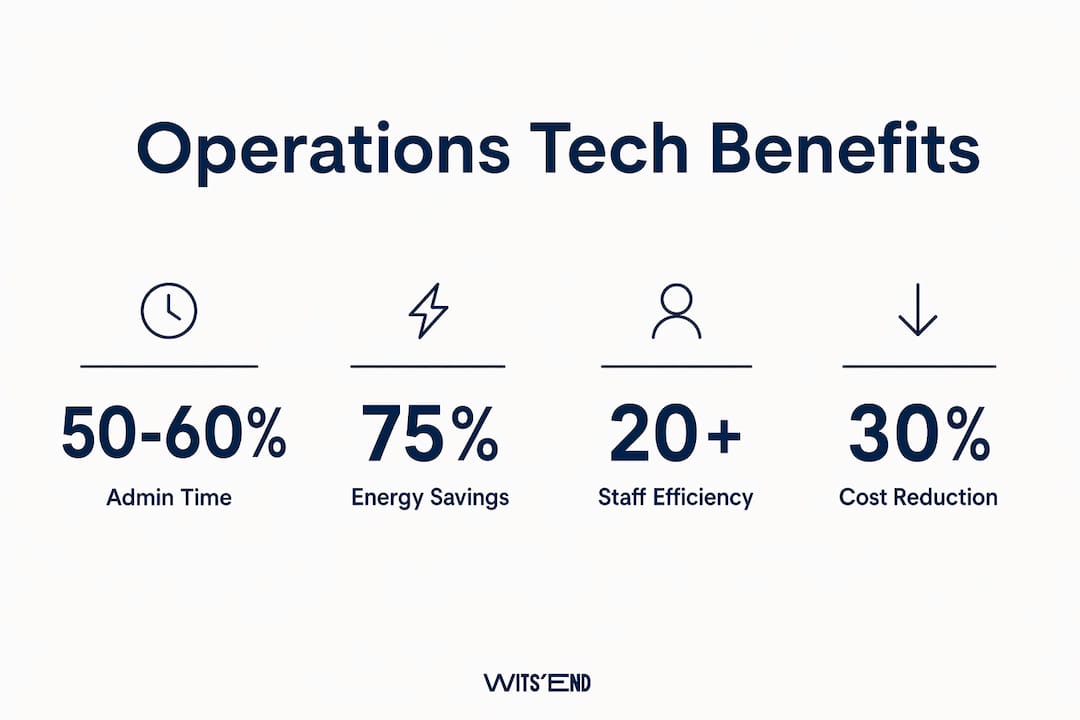
Cloud-based PMS platforms reduce administrative time by 40–50%, while mobile check-in and contactless payment solutions decrease front desk workload by 30–40%. That is not a marginal gain. It frees your front desk team to focus on guest interaction rather than data entry.
The highest-impact technology investments for boutique hotel operations in 2026 include:
- Cloud-based PMS with channel manager integration: Centralizes reservations, rates, and availability across all booking platforms in real time.
- Automated guest messaging: Sends pre-arrival instructions, upsell offers, and post-stay surveys without manual effort.
- Housekeeping management apps: Assign rooms, track real-time status, and flag maintenance issues from a mobile device.
- Smart energy management systems: Reduce lighting expenses by up to 75% and HVAC costs by up to 25% through occupancy-based automation.
- Contactless payment and digital folios: Cut checkout time and reduce front desk congestion.
| Operational area | Technology solution | Key benefit |
|---|---|---|
| Reservations | Cloud PMS with channel manager | Eliminates double bookings, saves admin time |
| Guest communication | Automated messaging platform | Faster response, higher satisfaction scores |
| Housekeeping | Real-time room status app | 15–20% productivity improvement |
| Energy management | Smart HVAC and lighting controls | Up to 75% reduction in lighting costs |
| Payments | Contactless and digital folios | Faster checkout, reduced front desk load |
Capital-light operational improvements focused on guest-visible sustainability and modular experiences deliver stronger ROI than disruptive remodels. Visible sustainability investments, such as energy monitoring dashboards or refillable amenity stations, also meet rising guest expectations around environmental responsibility.
What operational challenges do boutique hotels face and how to overcome them?
The most common operational challenges in boutique hotels are not unique to any one property. They follow a predictable pattern: the hotel grows, the owner adds people instead of systems, and the operation becomes fragile.
Scaling boutique hotel operations requires shifting from people-dependent reactive work to system-driven proactive design. Without that shift, operational complexity causes breakdowns in housekeeping, maintenance, and guest communication. The problems do not stay contained. They compound.
The four most common challenges and their solutions:
- Staff burnout from role overload. Cross-train staff across two or three functions and build clear shift handoff protocols. Burnout in small teams spreads fast.
- Brand dilution when adding properties. Document your core brand elements in a written service playbook before you open a second location. If it is not written down, it will not transfer.
- Reactive maintenance cycles. Build a preventive maintenance calendar tied to your PMS. Reactive repairs cost more and disrupt guests.
- Inconsistent guest communication. Standardize response templates and set response time targets. Guest satisfaction scores improve by 15–20% when hotels respond to inquiries in under 60 seconds.
Pro Tip: Treat your standard operating procedures (SOPs) as a living document. Review them quarterly and update them when a process breaks down, not when it is convenient.
Independent boutique owners often lack the time and tools to run complex operations well. Professional management partnerships provide shared expertise and reduce costs, particularly for owners managing their first property or preparing to scale.
How does operations management impact guest experience in boutique hotels?
Every guest touchpoint is an operational output. The quality of your check-in, the cleanliness of your room, the speed of your response to a special request: all of these are determined by the systems your team runs, not by individual effort alone.
The guest journey in a boutique hotel passes through several operationally managed moments:
- Pre-arrival: Confirmation emails, pre-check-in forms, and upsell communications set expectations before the guest walks in.
- Arrival and check-in: Speed, warmth, and accuracy at the front desk create the first physical impression.
- Room readiness: Housekeeping standards determine whether the room matches the promise made at booking.
- In-stay requests: Response time and resolution quality on maintenance or service requests define the middle of the stay.
- Checkout and follow-up: A smooth checkout and a well-timed post-stay survey close the loop and invite return visits.
Boutique hospitality operations must protect the human emotional touch by optimizing predictable tasks with scalable systems, not by removing personalization. Automated pre-arrival messaging, for example, frees your front desk team to spend more time on genuine conversation at check-in. The system handles the routine. The person handles the relationship.
Personalized systems that record guest preferences, dietary needs, or room configurations create the conditions for repeat loyalty. A guest who feels remembered returns. A guest who feels processed does not.
What are best practices for staffing and culture in boutique hotel operations?
Staffing in boutique hotels is a precision exercise. You cannot afford redundancy, and you cannot afford gaps. The goal is a team that is flexible enough to cover multiple functions and stable enough to deliver consistent service.
Ownership involvement early on and clear documented SOPs prevent brand dilution and keep operations consistent when working with third-party management. Culture does not survive on intention alone. It requires written standards, regular training, and leadership that models the behavior it expects.
Core staffing and culture best practices:
- Define role boundaries clearly, then train across them. Every team member should have a primary role and at least one secondary function they can cover.
- Write a service playbook. Document your greeting standards, escalation protocols, and recovery procedures for service failures. This is your culture in written form.
- Hold brief daily standups. A 10-minute pre-shift meeting aligns the team on arrivals, departures, VIPs, and any known issues.
- Build an escalation protocol. Every team member should know exactly what to do when a guest complaint exceeds their authority to resolve.
| Staffing approach | Best for | Trade-off |
|---|---|---|
| Fully in-house team | Properties with consistent demand | Higher fixed labor cost |
| Cross-trained core team | Boutique hotels with 40–50 rooms | Requires ongoing training investment |
| Third-party management partner | Owners scaling or lacking operational depth | Requires strong SOP documentation upfront |
Third-party operators bring operational depth and shared infrastructure that most independent owners cannot build alone. For boutique hotels preparing to scale or recover from operational drift, a management partner can reset systems without requiring the owner to step away from the brand.
Key Takeaways
Effective operations management in boutique hotels is the foundation that makes personalized, consistent guest service repeatable and financially sustainable.
| Point | Details |
|---|---|
| Operations defines guest experience | Every guest touchpoint is an operational output, not a matter of individual effort. |
| Small teams require cross-training | Properties with fewer than 20 staff must train across roles to prevent gaps and burnout. |
| Technology multiplies team capacity | A cloud PMS and automated messaging cut admin time by up to 50% without adding headcount. |
| Systems protect brand at scale | Documented SOPs and service playbooks prevent brand dilution when adding properties or partners. |
| Responsiveness drives satisfaction | Responding to guest inquiries in under 60 seconds improves satisfaction scores by 15–20%. |
Operations is not the back office. It is the whole hotel.
I have worked with boutique hotel owners who treat operations as the unglamorous side of the business. They invest in design, in brand, in social media, and then wonder why their reviews mention slow check-in or inconsistent room quality. The answer is almost always the same: the operation was never designed. It just grew.
The most common mistake I see is confusing "we have good people" with "we have good systems." Good people in a broken system will eventually burn out or leave. Good systems give good people the structure to do their best work consistently. That is the shift that separates a boutique hotel that earns loyalty from one that earns one-time visits.
What I find most underrated in boutique hotel operations is the recovery protocol. Every hotel has service failures. The properties that turn a failure into a loyalty moment are the ones with a clear, practiced response. That does not happen by instinct. It happens because someone wrote it down, trained the team on it, and reviewed it when it did not work.
The human touch in boutique hospitality is real and it is valuable. But it needs a reliable back-end to stand on. Build the system first. The warmth follows naturally.
— Chris
How Wits' End Solutions supports boutique hotel operations
Wits' End Solutions works with boutique hotel owners across the United States at every stage of the business lifecycle, from initial concept through daily operations. For properties looking to align their brand identity with operational standards, the brand design and development service builds the framework that keeps guest experience consistent as the business grows. For owners who need a clearer picture of where their operation is losing efficiency, deep analytics and reporting surfaces the data that drives real decisions. And for properties that need hands-on support, the task force services put experienced operators on property to implement change directly.
FAQ
What is the role of operations in a boutique hotel?
Operations in a boutique hotel is the coordinated management of staffing, systems, and daily processes that deliver consistent, personalized guest service. It connects every department, from housekeeping to front desk, into a single functioning whole.
How many staff does a boutique hotel typically need?
Boutique hotels with 40–50 rooms typically require fewer than 20 full-time employees. Cross-training across roles is standard practice to maintain coverage without overstaffing.
How does technology improve boutique hotel operations?
A cloud-based PMS reduces administrative time by 40–50%, and smart energy systems can cut lighting costs by up to 75%. These tools extend the capacity of small teams without adding headcount.
What are the biggest operational challenges in boutique hotels?
Staff burnout, brand inconsistency across properties, and reactive maintenance cycles are the most common challenges. Documented SOPs and cross-training are the most effective countermeasures.
When should a boutique hotel consider third-party management?
A boutique hotel benefits from a third-party management partner when the owner lacks operational depth, is preparing to scale, or when service consistency has declined. Clear SOP documentation makes the transition effective.